Spanish National Anthem: Why It Has No Lyrics
Spain's Marcha Real has no official lyrics, as the 1997 decree sets only the music. Here's why, plus Mexico's anthem in Spanish and English.
 Learn SpanishFree app with audio, quizzes and real books
If you search for the lyrics of the Spanish national anthem, you won't find any official ones, because there are none. Spain's anthem is the Marcha Real ("Royal March"), also known as the Marcha Granadera ("Grenadiers' March"). It is an eighteenth-century military march whose composer is unknown; its first surviving manuscript dates from 1761 and is linked to the musician Manuel de Espinosa. Today it is regulated by Royal Decree 1560/1997, which sets out the score and nothing else. It's one of the very few national anthems in the world that are played but never sung.
So what do Spanish speakers sing? Each Spanish-speaking country in the Americas has its own anthem with words, and the one learners meet most often is Mexico's. Below you'll find out why Spain's anthem is wordless, then read the chorus and first stanza of the Mexican anthem with their meaning in English, and the words worth learning from them.
Why the Spanish national anthem has no lyrics
The Marcha Granadera began as a military signal, not a song. The first written mention of it dates from 1749, and in 1761 it appears in a book of infantry bugle and drum calls, the Libro de Ordenanza de los toques militares de la Infantería Española, prepared by Manuel de Espinosa. Whether Espinosa composed the tune or only wrote down and arranged an older melody is still debated.
On 3 September 1770 King Charles III declared it a march of honour, to be played on solemn occasions in the presence of the king. Over the following decades it simply came to be treated as the national anthem. No law made it one; custom did. In 1870 General Prim held a national competition for a new anthem, and the jury declared it void, judging that none of the entries improved on the old march.
The music you hear today goes back to an arrangement by the composer Bartolomé Pérez Casas, made official for military bands in 1908. A decree of 1942 formally named the Marcha Granadera the national anthem. In 1997 the Spanish state bought the rights to the music, and Royal Decree 1560/1997 of 10 October fixed the official score: sixteen bars in B flat major, 52 seconds in the full version and 27 in the short one. The decree describes the bars, the tempo and when each version is played. It contains no text, because there is none to include.
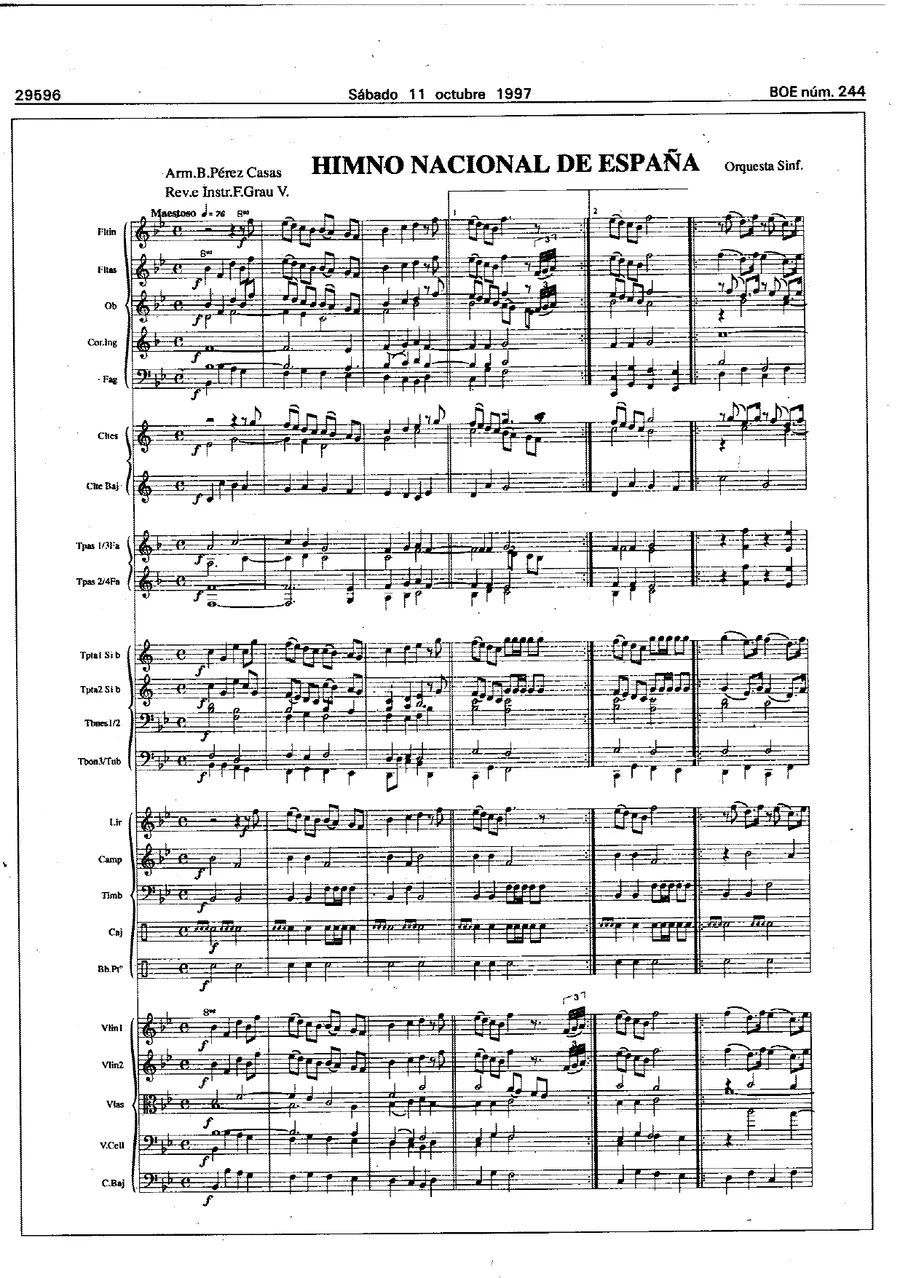
Words have been written for the march several times over the past century, and some versions were sung for a while, but none ever became official. The most recent attempt came in 2008, when the Spanish Olympic Committee held a competition for lyrics. The winning text was withdrawn within days, before it reached parliament, because it lacked broad support.
That's why, before a match, Spain's footballers stand in silence as the anthem plays, while their opponents sing. In the stands, many fans sing along to the melody with "lo, lo, lo".
The lyrics: the Mexican national anthem
The Himno Nacional Mexicano is the most widely sung anthem in the Spanish language. The words are by Francisco González Bocanegra, the music by Jaime Nunó, and it was first performed in 1854. Its official text is set out in Mexico's Law on the National Coat of Arms, Flag and Anthem. The official version has a chorus and four stanzas. When the anthem is played in honour of the flag or the president, the law sets out what is sung: the chorus, the first stanza and the chorus again. That is the text below.
Chorus
| Spanish | Meaning |
|---|---|
| Mexicanos, al grito de guerra | Mexicans, at the cry of war, |
| El acero aprestad y el bridón, | make ready the steel and the steed, |
| y retiemble en sus centros la tierra | and let the earth tremble to its core |
| Al sonoro rugir del cañón. | at the thundering roar of the cannon. |
First stanza
| Spanish | Meaning |
|---|---|
| Ciña ¡oh patria! tus sienes de oliva | May your brow, oh homeland, be wreathed in olive |
| De la paz el arcángel divino, | by the divine archangel of peace, |
| Que en el cielo tu eterno destino | for in heaven your eternal destiny |
| Por el dedo de Dios se escribió. | was written by the finger of God. |
| Más si osare un extraño enemigo | But should a foreign enemy dare |
| Profanar con su planta tu suelo, | to defile your soil with his foot, |
| Piensa ¡oh patria querida! que el cielo | remember, oh beloved homeland, that heaven |
| Un soldado en cada hijo te dio. | gave you a soldier in every son. |
The chorus is a call to arms; the stanza answers it with a wish for peace. The olive branch comes first, and only if an invader arrives does every son become a soldier. After the stanza the chorus is sung once more.
The story behind the Mexican anthem
In November 1853 the Mexican government announced a competition for the words of a national anthem. Mexico had been independent for just over thirty years and still had no song that the whole country shared. Francisco González Bocanegra, a young poet from San Luis Potosí, didn't want to enter. According to a well-known story, his fiancée locked him in a room until he had written his poem. Whatever the truth of it, his ten stanzas won.
A second competition chose the music. The winner was Jaime Nunó, a Spanish-born composer and bandmaster living in Mexico. So the most widely sung anthem in the Spanish language has a Mexican poet and a Spanish composer. It was first performed on the night of 15 September 1854, the eve of Independence Day, at the Gran Teatro de Santa Anna in Mexico City.
Some of the original stanzas praised the political leaders of the day, including Antonio López de Santa Anna and Agustín de Iturbide. As Mexican politics moved on, these stanzas were dropped. In 1943 President Manuel Ávila Camacho issued the decree that fixed the official version, and the law of 1984 sets it out to this day: the chorus and four stanzas.
Words worth learning
el grito: shout, cry. From gritar, to shout. In Mexico el Grito is also the name of the ceremony on the night of 15 September, when the president rings a bell and calls out ¡Viva México! Note al grito: a + el always merges into al.
el acero: steel. Here it stands for the sword or bayonet, a figure of speech poets love. In a kitchen you'll see acero inoxidable, stainless steel.
aprestad: get ready, make ready. This is the vosotros command of aprestar: drop the -r of the infinitive and add -d (hablad, comed, venid). Mexicans never use vosotros in conversation; they say ustedes and preparen. The anthem uses the older, solemn form.
el bridón: a bridled horse, a war horse. A word you'll only meet in poetry. The everyday word is el caballo, and la brida is the bridle.
retiemble: let it tremble. Present subjunctive of retemblar, with the same stem change as temblar: tiemblo, tiemble. A subjunctive at the start of a sentence often expresses a wish, as in ¡Viva México! (long live Mexico).
el rugir: the roar. Any infinitive can become a noun with el in front: el sonoro rugir del cañón is "the loud roaring of the cannon". Compare el amanecer, dawn, literally "the dawning".
ciña: may it wreathe, may it crown. Present subjunctive of ceñir, to gird or encircle, again expressing a wish. In daily life ceñido means tight-fitting, said of clothes.
¡oh patria!: oh homeland. La patria is the homeland, the fatherland. Spanish opens every exclamation with an upside-down ¡ and every question with ¿, even in the middle of a sentence, as here.
las sienes: the temples, the sides of the forehead. Singular la sien. To wreathe someone's temples with olive or laurel is to crown them.
se escribió: was written. Spanish often makes a passive with se: aquí se habla español, Spanish is spoken here.
Más si osare: but if ... should dare. Two old forms in three words. Here Más means "but": in modern spelling this conjunction is mas, without an accent, and in speech it has been replaced by pero. Osare is the future subjunctive of osar (to dare), a tense that has almost vanished. You'll still find it in laws and in a proverb: Adonde fueres, haz lo que vieres, "wherever you go, do as you see done".
extraño: here "foreign". Today the word usually means strange or odd (¡Qué extraño!, how strange!), and a foreigner is un extranjero.
la planta: here the sole of the foot, la planta del pie. Its usual meaning today is "plant", and also a floor of a building: la planta baja is the ground floor.
el suelo: ground, soil, and also the floor of a room. Se me cayó al suelo: I dropped it on the floor.
Keep going with Spanish
The twelve lines of the Mexican anthem already give you a vosotros command, two present subjunctives, a passive with se and the future subjunctive, a tense most speakers never use. To build on them, try our free Spanish word lists with audio, no account needed. If you're wondering how much work the language takes, read Is Spanish hard to learn?
Our Learn Spanish app takes you from your first words through grammar and graded reading to Spanish classics, with a translation under every line. It's free to download, though some books and extra content need diamonds you earn while learning, or Premium.