Anna Karenina Characters: Who's Who, with Russian Names
A guide to the main characters of Anna Karenina: who they are, how they change, and what their Russian names, patronymics and nicknames mean.
 Learn RussianFree app with audio, quizzes and real books
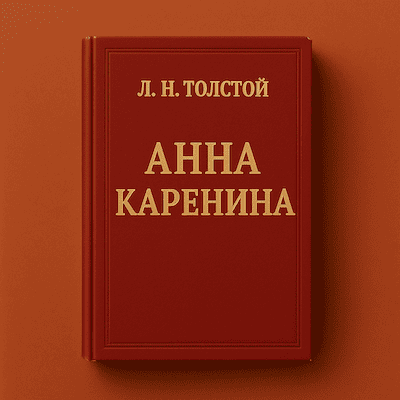
Anna Karenina has dozens of named characters, and most of them have three or four names each. Ten people carry the novel. Learn who they are and how Russians address them, and the book becomes much easier to follow, in English or in Russian.
The guide below covers each character's personality and early story without spoilers. The endings come in a separate section, with a warning first.
Two plots, one novel
The book tells two stories that run side by side and touch only now and then.
Anna's story is set mostly in St Petersburg society. A married woman falls in love with a young officer, and the affair costs her everything the world around her values.
Levin's story is set mostly in the country. A landowner wants to marry, run his estate well and understand what life is for.
The two plots are tied together by one family. Anna's brother, Stiva Oblonsky, is married to Dolly, and Dolly's younger sister is Kitty, the woman Levin loves. Stiva is also Levin's old friend. So almost everyone in the book is a relative or a friend of the Oblonskys, and the novel fittingly opens in their house.
Anna and Levin meet only once, late in the book. Readers have argued for well over a century about how the two halves fit. One fair answer: they ask the same question, how to live, and give very different replies.
How the names work
Every educated Russian in the novel has a first name, a patronymic and a surname. The patronymic comes from the father's first name.
| Father's name | Son's patronymic | Daughter's patronymic |
|---|---|---|
| Аркадий (Arkady) | Аркадьевич | Аркадьевна |
| Александр (Alexander) | Александрович | Александровна |
| Дмитрий (Dmitry) | Дмитриевич | Дмитриевна |
So Anna and her brother Stepan share a patronymic: Анна Аркадьевна and Степан Аркадьевич. In speech, and often in the novel itself, the long forms are shortened: Аркадьич, Дмитрич, Иваныч. Calling someone by first name plus patronymic is polite and respectful, roughly like "Mr" or "Mrs" in English.
Surnames change with gender. Anna is Каренина because she's married to Каренин. Most Russian surnames ending in a consonant like -ин or -ов add -а for a woman. That's why the title is Anna Karenina and her husband is Karenin. In the novel, Vronsky's mother is графиня Вронская, the feminine of Вронский.
Nicknames. Стива is a family form of Степан, Сережа comes from Сергей and Костя from Константин. Russian aristocrats of the time spoke French and admired English manners, and some of their nicknames show it: Долли for Darya and Кити for Katerina are English-style forms, not Russian ones.
Two Alexeis. Anna's husband and her lover share a first name: Alexei Alexandrovich Karenin and Alexei Kirillovich Vronsky. In Russian the patronymic keeps them apart, so watch it closely.
The main characters
Anna Arkadyevna Karenina (Анна Аркадьевна Каренина)
Anna is married to a senior official in St Petersburg and has a son she adores. She comes to Moscow to save her brother's marriage and leaves with her own in danger. She's warm, intelligent and admired by everyone, and she can't live a life she doesn't feel.
When Vronsky first sees her at the railway station, he notices something she can't hide:
Как будто избыток чего-то так переполнял ее существо, что мимо ее воли выражался то в блеске взгляда, то в улыбке.
It was as if an excess of something filled her so completely that it showed against her will, now in the brightness of her eyes, now in her smile.
That excess of life is the key to her. Tolstoy never makes her simply guilty or simply a victim. The world that condemns her is full of people doing the same thing more discreetly.
Alexei Alexandrovich Karenin (Алексей Александрович Каренин)
Anna's husband is older than her, powerful, correct and cold. He lives by rules and appearances, and he cares a great deal about what people will say. Coming home from Moscow, Anna suddenly sees him differently, down to his ears:
отчего у него стали такие уши?
why have his ears become like that?
In anger she calls him something worse: не человек, а машина ("not a man but a machine"). Yet Karenin is one of the most surprising characters in the book. At one moment of crisis he rises far above himself, and Tolstoy makes you feel for him even when he's at his stiffest.
Count Alexei Kirillovich Vronsky (граф Алексей Кириллович Вронский)
Vronsky is a rich, handsome guards officer with a promising career. Levin, his rival for Kitty, has to admit there's a lot to like:
Вронский был невысокий, плотно сложенный брюнет, с добродушно-красивым, чрезвычайно спокойным и твердым лицом.
Vronsky was not tall: a stocky, dark-haired man with a kind, handsome, extremely calm and steady face.
At first he's a man of his set: he courts Kitty with no intention of marrying her. His love for Anna is real, though, and it changes him. He gives up his career for her. The question the novel keeps asking is whether love alone can fill a life once everything else has gone.
Konstantin Dmitrich Levin (Константин Дмитрич Левин)
Levin is a landowner in his early thirties who prefers his estate to Moscow drawing rooms. He's honest, awkward, quick to take offence and always thinking: about farming, about the peasants, about death and God. Stiva introduces him to his colleagues as a jack of all trades:
Земский деятель, новый земский человек, гимнаст, поднимающий одною рукой пять пудов, скотовод и охотник и мой друг, Константин Дмитрич Левин, брат Сергея Иваныча Кознышева.
A local council man, one of the new ones, a gymnast who can lift five poods with one hand, a cattle breeder, a hunter and my friend, Konstantin Dmitrich Levin, brother of Sergei Ivanovich Koznyshev.
A пуд is an old Russian weight of about 16 kilos, so five poods is a lot. Many readers see Tolstoy himself in Levin, and the name supports it: Tolstoy's first name was Лев. For the same reason, some readers say the name as Lyovin.
Kitty: Ekaterina Alexandrovna Shcherbatskaya (Екатерина Александровна Щербацкая)
Kitty is the youngest Shcherbatsky daughter, a princess, pretty and sincere, in her first season in society. At the start she has to choose between Levin and Vronsky, and she gets it wrong. Her story is about growing up: humiliation, illness, and slowly finding what she's good at. In the app text Levin calls her by the everyday form of her name, Катерина Александровна, when he's being formal and hurt.
Stepan Arkadyevich Oblonsky, "Stiva" (Степан Аркадьевич Облонский)
Anna's brother is charming, lazy, generous and always in debt. Everyone is pleased to see him. His affair with the governess opens the book, and Tolstoy sums up his conscience in one sentence:
Он раскаивался только в том, что не умел лучше скрыть от жены.
The only thing he regretted was not hiding it better from his wife.
Stiva never really changes. That's the point of him. He's the happy, careless man around whom other people's tragedies happen.
Darya Alexandrovna, "Dolly" (Дарья Александровна Облонская)
Stiva's wife and Kitty's elder sister. In her early thirties she has already borne seven children, five of them living, and she's worn out by money troubles and her husband's betrayal. Dolly is the novel's quiet conscience: she forgives, she runs the house, and she sees both Anna and Levin more clearly than they see themselves.
Seryozha (Сережа)
Anna's son, Sergei Alexeyevich Karenin. He's the person Anna loves most before Vronsky, and the one she loses most painfully. When she visits him in secret, the pet name comes out first, and she corrects herself to the formal one in front of the porter:
Сережа... Сергей Алексеич
Seryozha... Sergei Alexeyich
The child's pet name and the formal one, side by side, say everything about the distance that has grown between them.
Nikolai Levin (Николай Левин)
Konstantin's elder brother: brilliant, sick, angry and poor, living with a woman he took out of a brothel. He drinks and quarrels with everyone, but Konstantin loves him. Nikolai is how death enters Levin's half of the book.
Sergei Ivanovich Koznyshev (Сергей Иванович Кознышев)
Levin's half-brother on his mother's side, which is why the surname differs. He's a well-known thinker and writer, calm, reasonable and admired. Levin respects him but hates being introduced as "the brother of the famous Koznyshev". Koznyshev is the intellectual who talks about the people; Levin is the man who mows hay with them.
Spoiler warning
The next section reveals how each main character's story ends. Skip it if you haven't finished the book.
How their stories end
Anna leaves her husband for Vronsky, but Karenin won't let her have Seryozha, and society shuts its doors to her. Isolated, jealous and dependent on morphine, she throws herself under a train. Tolstoy ends her chapter with an image of a candle:
И свеча, при которой она читала исполненную тревог, обманов, горя и зла книгу, вспыхнула более ярким, чем когда-нибудь, светом, осветила ей все то, что прежде было во мраке, затрещала, стала меркнуть и навсегда потухла.
And the candle by whose light she had been reading the book of troubles, lies, grief and evil flared up brighter than ever before, lit up for her everything that had been in darkness, flickered, began to fade, and went out for ever.
Vronsky survives an attempt on his own life earlier in the book. After Anna's death he volunteers to fight for the Serbs against the Turks, hoping, in effect, to die.
Karenin forgives Anna when she nearly dies in childbirth, then falls back under the influence of Countess Lidia Ivanovna and her mystics. After Anna's death he takes in her daughter by Vronsky.
Levin and Kitty marry. Levin nurses his brother Nikolai through his death, and Kitty, not he, turns out to know how to help a dying man. Their son is born. Levin still can't find a reason to live, until a peasant mentions a man who lives для души, "for his soul". In the last pages Levin decides that his life, though he'll keep arguing and losing his temper, now has meaning:
...но жизнь моя теперь, вся моя жизнь, независимо от всего, что может случиться со мной, каждая минута ее — не только не бессмысленна, какою была прежде, но имеет несомненный смысл добра, который я властен вложить в нее!
...but my life now, my whole life, whatever happens to me, every minute of it, is not only not meaningless, as it was before, but has the unquestionable meaning of goodness, which I have the power to put into it!
Stiva and Dolly stay together, as unhappy in their own way as ever.
Read it in Russian
The opening pages of Anna Karenina are free on our site, in Russian with an English translation under every line. They introduce Stiva, Dolly, Levin, Kitty and Vronsky within the first few chapters. Start with the famous first line, and see our guide on how to read Anna Karenina in Russian when you're ready for the rest.
Meeting these people under their own Russian names, with every patronymic and nickname intact, brings them much closer than any translation can. Our Learn Russian app has Anna Karenina in full, with a translation under every line, along with the vocabulary and grammar to get you there. It's free to download, though some books and extra content need diamonds you earn while learning, or Premium.