"All Happy Families Are Alike": Anna Karenina's First Line in Russian
The opening line of Anna Karenina in Russian, word by word: what it means, why translators disagree, the Anna Karenina principle and the line that follows.
 Learn RussianFree app with audio, quizzes and real books
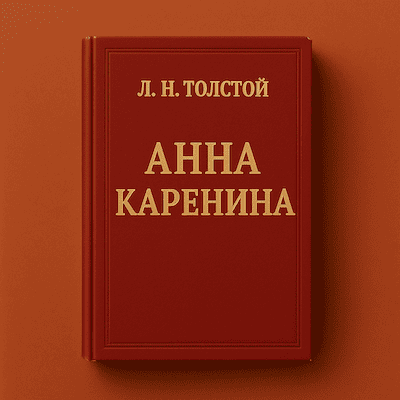
Anna Karenina opens with one of the most quoted sentences in world literature. In Russian it's just twelve words:
Все счастливые семьи похожи друг на друга, каждая несчастливая семья несчастлива по-своему.
All happy families are alike; every unhappy family is unhappy in its own way.
Tolstoy's novel was serialised from 1875 to 1877 and came out as a book in 1878. The line has been quoted ever since, often by people who never read past it. It's worth reading slowly in Russian, because almost every word teaches something.
The line, word by word
| Russian | Literally | What to notice |
|---|---|---|
| Все | all | Plural of весь. It agrees with семьи. |
| счастливые | happy | Full adjective, nominative plural. |
| семьи | families | Nominative plural of семья. |
| похожи | (are) alike | Short form of похожий, plural. No verb "are" in Russian. |
| друг на друга | on each other | The fixed phrase for "each other". |
| каждая | each, every | Feminine, to match семья. |
| несчастливая | unhappy | Full adjective, feminine singular. |
| семья | family | Nominative singular. |
| несчастлива | (is) unhappy | Short form, feminine singular. |
| по-своему | in its own way | Adverb built from свой. |
Все счастливые семьи
Семьи can be two things: the nominative plural ("families") or the genitive singular ("of a family"). Here все and счастливые settle it. Both are plural, so семьи is plural too. Learners meet this ambiguity constantly in Russian, and the words around a noun usually decide it. See the nominative case and the genitive case if the two endings still blur together.
похожи друг на друга
Похожий means "similar" or "alike". As a predicate, Russian prefers its short form: похож, похожа, похоже, похожи. The thing you resemble comes after на in the accusative case: он похож на отца, "he looks like his father".
Друг на друга is how Russian says "each other". The first друг never changes. The second one takes whatever case the preposition demands. With на that's accusative, so друга. Compare друг с другом ("with each other", instrumental) and друг о друге ("about each other", prepositional). The word друг here has nothing to do with friendship. It just means "the other one".
каждая несчастливая семья несчастлива
Here the sentence switches from plural to singular. Happy families are a group; unhappy ones are taken one at a time. The grammar carries the meaning.
Notice the two forms of the same adjective. Несчастливая is the full form, sitting in front of the noun as a description. Несчастлива is the short form, standing after the noun as the predicate. Russian uses exactly this split all the time: умная девушка ("a clever girl") but девушка умна ("the girl is clever"). Short forms often sound more literary or more absolute, which suits a sentence pronouncing a law of life.
по-своему
По-своему means "in its own way". It comes from свой, the reflexive possessive, so it always points back to the subject: here, each unhappy family. The same pattern gives по-моему ("in my opinion") and по-русски ("in Russian"). Always write it with a hyphen.
What the line really says
The claim is about difference. Happiness, Tolstoy suggests, needs many things to go right at once, so happy families end up looking alike. Unhappiness needs only one thing to go wrong, and there are endless ways for that to happen.
The novel then tests the idea. Three families sit at its centre: the Oblonskys, the Karenins and the Levins. Each is unhappy, or happy, in its own way, and the book never quite lets the first line have the last word.
How translators have handled it
Every English translator has had to decide what to do with these twelve words, and the choices show how much a short sentence can hide.
Word order. Constance Garnett, whose translation (1901) was the standard English version for decades, wrote "Happy families are all alike". She moved all after the noun, which sounds natural in English and gives the line its famous rhythm. Later translators, including Richard Pevear and Larissa Volokhonsky (2000), keep all at the front, closer to the Russian.
"Alike" or "resemble one another". Похожи друг на друга contains "each other". Some versions keep that with "resemble one another". Others shorten it to "alike", which is lighter but loses the picture of families looking at each other and seeing themselves.
"Each" or "every". Каждая can be either. "Each" stresses the families one by one; "every" sounds more like a general rule.
The punctuation. Tolstoy uses a comma. Most English versions use a semicolon, because two full clauses joined by a comma look wrong in English. Russian is happy with the comma.
The repetition. Несчастливая... несчастлива is deliberate. Good translations keep "unhappy... unhappy" rather than reaching for a synonym.
The Anna Karenina principle
The first line has given its name to an idea used well beyond literature. The geographer Jared Diamond called it the Anna Karenina principle in Guns, Germs, and Steel (1997). He used it to explain why so few wild animals were ever domesticated: a species has to pass many tests, and failing any single one rules it out. All domesticable animals are alike; every undomesticable animal is undomesticable in its own way.
Scientists and economists now use the phrase for any case where success depends on many factors at once, while failure needs only one. That's a fair reading of what Tolstoy meant about families.
The second line
The famous sentence is a prologue. The story starts with the next one, which is only five words long:
Все смешалось в доме Облонских.
Everything was in chaos in the Oblonsky house.
This is a lovely trap for learners. Все looks the same as in the first line, but here it's всё, "everything". Russian books usually print ё as е, so you tell them apart from the grammar. In the first line все is plural and goes with семьи. Here it's the subject of a neuter singular verb, смешалось, so it must be всё.
Смешалось is the past tense of смешаться, "to get mixed up". It's perfective (see verb aspects): the confusion has already happened and now it's the state of the house. В доме is the prepositional case of дом, and Облонских is the genitive plural of the family name: "of the Oblonskys".
The next sentence tells you why:
Жена узнала, что муж был в связи с бывшею в их доме француженкою-гувернанткой, и объявила мужу, что не может жить с ним в одном доме.
The wife had found out that her husband was having an affair with the French governess who had worked in their house, and she told him she could not live under the same roof as him.
So within three sentences, Tolstoy has stated a law of family life and shown a family breaking it. Forms like бывшею and француженкою are older instrumental endings; modern Russian says бывшей and француженкой. You'll see them throughout the book.
Is the opening hard?
By sentence length, yes. When we measured the openings of seven Russian classics, Anna Karenina averaged 21 words a sentence, the longest of the seven. The first two lines are short, though, and almost everything in them is core grammar: plurals, short adjectives, a reflexive possessive, a perfective past. If you can follow them, you can start the book. Our guide on how to read Anna Karenina in Russian covers what comes next, and the character guide will help you keep the names straight.
Read it in Russian
The opening pages of Anna Karenina are free on our site, in Russian with an English translation under every line. You can also browse all our Russian books.
Reading the first line in Russian is the best way to see why it has outlived almost every other sentence of its century. Our Learn Russian app has Anna Karenina in full, with a translation under every line, along with the vocabulary and grammar to get you there. It's free to download, though some books and extra content need diamonds you earn while learning, or Premium.