Turkish National Anthem: İstiklal Marşı Lyrics and Meaning
İstiklal Marşı lyrics in Turkish and English: the two stanzas sung today, line by line, and the story of Mehmet Akif Ersoy's 1921 anthem.
 Learn TurkishFree app with audio, quizzes and real books
The Turkish national anthem is the İstiklal Marşı, the "Independence March". The words are by the poet Mehmet Akif Ersoy, and the Grand National Assembly in Ankara adopted them on 12 March 1921, in the middle of the War of Independence. The music used today is by Osman Zeki Üngör and became official in 1930. The poem has ten stanzas, but only the first two are sung, at official ceremonies, at the weekly flag ceremony in schools and before matches. Here they are line by line, with what each line means and the Turkish worth learning from them.
The lyrics and what they mean
The text below follows the version printed in the official gazette in March 1921, as reproduced by the Grand National Assembly. The marks over some vowels (hilâl, istiklâl) show long vowels from older spelling; today you'll usually see hilal and istiklal.
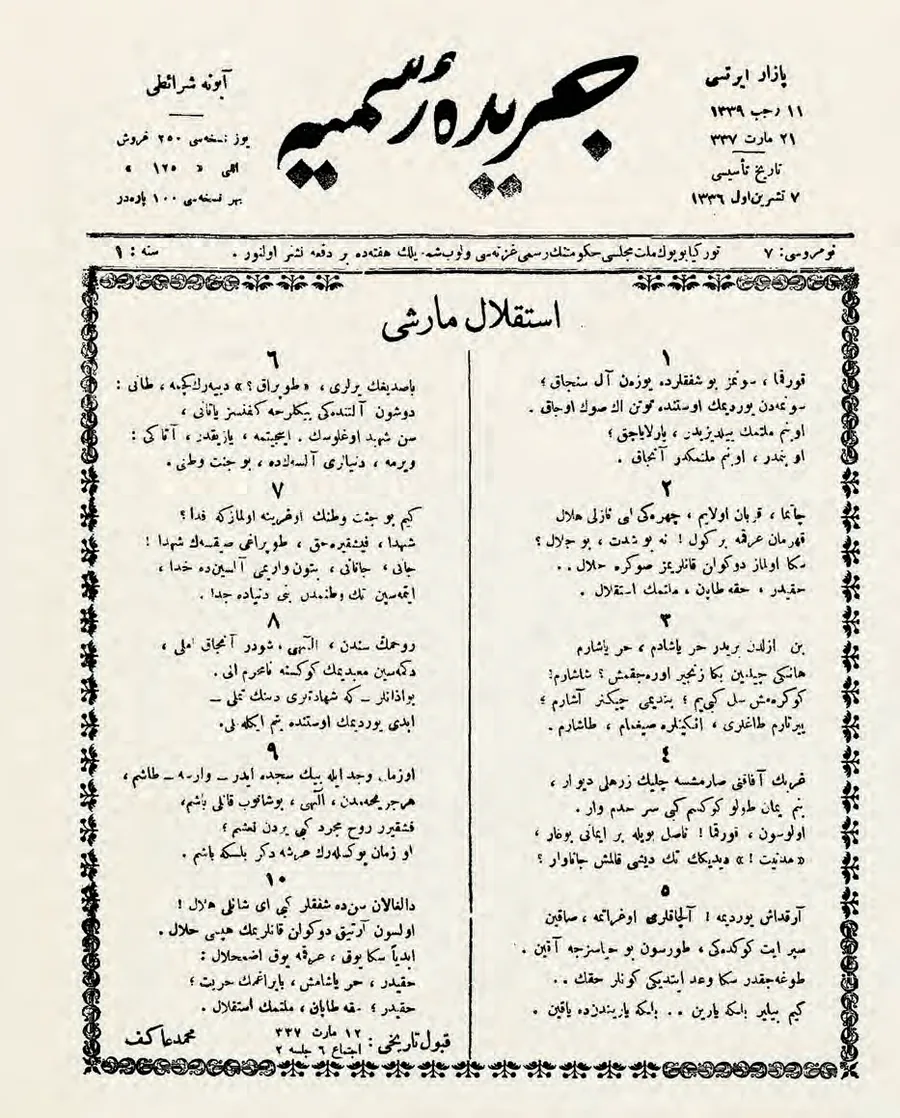
Stanza 1
| Turkish | Meaning |
|---|---|
| Korkma, sönmez bu şafaklarda yüzen al sancak; | Do not fear! The crimson flag that waves in these dawns will never fade, |
| Sönmeden yurdumun üstünde tüten en son ocak. | not until the last hearth still smoking in my homeland goes out. |
| O benim milletimin yıldızıdır, parlayacak; | It is the star of my nation, and it will shine; |
| O benimdir, o benim milletimindir ancak. | it is mine, and it belongs to my nation alone. |
Stanza 2
| Turkish | Meaning |
|---|---|
| Çatma, kurban olayım, çehreni ey nazlı hilâl | Do not frown, I beg you, O coy crescent moon, |
| Kahraman ırkıma bir gül! Ne bu şiddet, bu celâl? | smile on my heroic people! Why this fury, why this anger? |
| Sana olmaz dökülen kanlarımız sonra helâl. | or else we will never forgive you the blood we have shed. |
| Hakkıdır, Hakk’a tapan milletimin istiklâl. | Independence is the right of my nation, which worships God. |
The poet is addressing the flag. In the first stanza he reassures the nation: as long as one home in the country still has a fire burning, the flag will fly. In the second he turns to the crescent on the flag and asks it not to frown, as if it were angry at the people fighting for it. The last line plays on one word: hak means "right", and Hak, with a capital, is a name for God.
The story behind it
In 1920, Turkey was fighting the War of Independence, and the new government in Ankara wanted a march to lift the spirits of the army and the people. The Ministry of Education opened a competition with a prize of 500 lira. According to the ministry, 724 poems were submitted, and none was judged good enough.
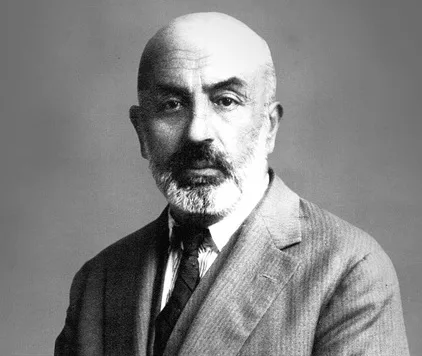
The poet everyone had in mind was Mehmet Akif, a deputy for Burdur in the new Assembly. He had stayed out of the competition because he didn't want to write a poem like this for money. On 5 February 1921, the education minister Hamdullah Suphi wrote to him, asking him to write it anyway and promising to settle the question of the prize in a way he could accept.
Akif wrote the anthem in his small room at the Tacettin Dergâhı, a lodge in Ankara where he was living. A fellow deputy who shared the lodge later told how Akif woke one night, couldn't find any paper, and wrote a stanza on the wall beside his bed: the one that begins Ben ezelden beridir hür yaşadım, hür yaşarım ("I have lived free since the beginning of time, and free I live"). The next morning he scraped it off with his penknife.
On 12 March 1921, Hamdullah Suphi read the poem to the Assembly, and it was adopted by a large majority. When deputies asked to hear it again, standing, the chair replied that since the Assembly had adopted it, it was now the official anthem, so they should all listen on their feet. Akif gave the 500 lira prize to the Darülmesai, a charity that taught poor women and children a trade, even though, as the ministry's own account notes, he didn't own an overcoat at the time.
The words came first and the music later. For several years the anthem was played with a tune by Ali Rıfat Çağatay. In 1930 the official tune became the one by Osman Zeki Üngör, a violinist and conductor, who had composed it in 1922 after hearing that the army had entered İzmir. Today the Constitution names the İstiklal Marşı as the national anthem, and 12 March is marked every year as the day of its adoption and of remembering Mehmet Akif Ersoy.
The full poem ends on almost the same note as the sung part. The last stanza closes with Hakkıdır hür yaşamış bayrağımın hürriyet; Hakkıdır Hakk’a tapan milletimin istiklâl: "Freedom is the right of my flag, which has always lived free; independence is the right of my nation, which worships God."
Words worth learning
The anthem is written in the Turkish of 1921, full of Arabic and Persian loanwords, but most of its words are still in use. Here are the ones worth taking away.
korkma means "don't be afraid". It's the verb korkmak (to fear) with the negative -ma. You'll hear Korkma! every day, from parents to children and between friends.
sönmez means "it won't go out". Sönmek is what a fire, a candle or a light does when it goes out: Işıklar söndü, "The lights went out." The ending -mez is the negative aorist, used for general truths and firm statements: it won't, it never does.
şafak is "dawn". You'll meet it in şafak sökmek, "dawn breaks", and the plural şafaklarda here is poetic: "in these dawns".
al sancak is "the crimson banner", a poetic name for the Turkish flag. Al is an old word for bright red; in daily life you say kırmızı. The everyday word for flag is bayrak, which appears in the last stanza.
hilâl is "crescent", the one on the flag. In daily speech the moon is just ay. The Turkish Red Crescent is called Kızılay, literally "Red Moon".
ocak here is the "hearth", the fire at the centre of a home, so "the last hearth" means "the last household". Today ocak is also the kitchen stove and the month of January.
yurdumun means "of my homeland". The word is yurt, and its final t turns into d before a vowel ending: yurt → yurdum. Today yurt is also a student dormitory, and yurt dışı means "abroad".
millet means "nation", as in milletimin, "of my nation". In everyday talk millet also means "people" or "everyone": Millet ne der?, "What will people say?"
parlayacak means "it will shine": parlamak (to shine) plus the future ending -acak. Its subject is yıldız, "star", one of the first words children learn.
çatma means "don't frown". The full expression is kaş çatmak, "to knit one's brows". Çehre is an old Persian word for "face"; today you'd say yüz.
kurban olayım literally means "may I be sacrificed for you". It's an old, affectionate way of saying "I beg you", and you can still hear it from older speakers.
helâl means "rightfully yours, lawful". You'll hear it constantly in Helal olsun!, "Well done!", and in Hakkını helal et, "forgive me anything I owe you".
hak means "right", and hakkıdır is "it is its right". With a capital letter, Hak is a name for God, which is why the line reads Hakk’a tapan, "who worships God". Note the doubled k before a vowel: hak → hakkı.
istiklâl is "independence", a word from Arabic. The modern Turkish word is bağımsızlık, built from bağ (tie), -ım, -sız (without) and -lık: "the state of having no ties". Istanbul's famous İstiklal Avenue carries the old word.
Keep learning
Many of these words live on in everyday Turkish, and you'll find more of them in our free Turkish word lists with audio, including the list on history and civilization. For the customs that go with the language, read Turkish traditions and the phrases that go with them.
Our Learn Turkish app takes you from your first words like korkma and yıldız to reading Turkish poetry and literature. It's free to download, though some books and extra content need diamonds you earn while learning, or Premium.