Kürk Mantolu Madonna (Madonna in a Fur Coat): Summary
A shy Turkish clerk leaves a notebook telling how, in 1920s Berlin, he loved the painter Maria Puder, lost her, and learned ten years later why.
 Learn TurkishFree app with audio, quizzes and real books
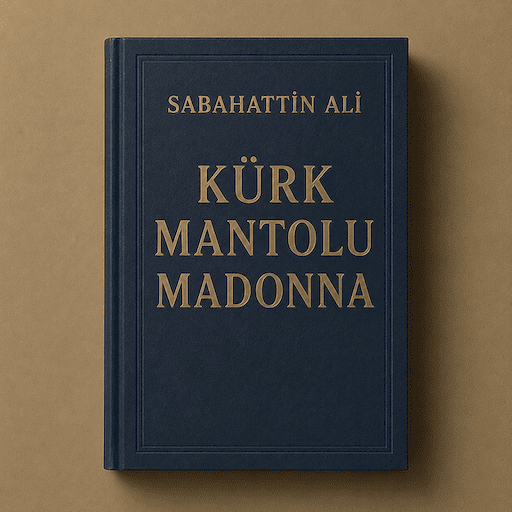
Kürk Mantolu Madonna (Madonna in a Fur Coat in English) is a novel by Sabahattin Ali, published in 1943. A young man in Ankara shares an office with Raif Efendi, a grey, sickly translator nobody takes seriously. When Raif is dying, he hands over a black notebook, and the young man reads the story Raif never told anyone: the winter he spent in Berlin in his twenties, and the woman in the fur coat.
For decades it was a quiet classic; today it's one of Turkey's best-selling novels, loved by readers born long after Sabahattin Ali died in 1948.
The characters
Raif Efendi is the German translator at a timber and machinery firm in Ankara. He eats lunch from a tin at his desk, gets shouted at over typing errors, and goes home to relatives who treat him as a wallet. In his notebook he describes himself plainly:
Şu koskocaman dünyada benim kadar yapayalnız dolaşan bir insan daha var mı acaba?
I wonder if there's anyone else in this whole huge world who walks about as utterly alone as I do.
Maria Puder is a painter who earns her living playing the violin and singing at a Berlin cabaret, the Atlantik. Her father was a Jew from Prague, her mother is German, and she is sharp, funny and fiercely independent. The first time she really talks to Raif, she says:
Boğulacak kadar yalnızım!
I'm so lonely I could drown!
The narrator is never named. He's under twenty-five, has lost his bank job, and starts out bored by Raif. He ends up the only person who knows him. His first sentence is about Raif:
Şimdiye kadar tesadüf ettiğim insanlardan bir tanesi benim üzerimde belki en büyük tesiri yapmıştır.
Of all the people I have come across so far, one has perhaps made the greatest impression on me.
Hamdi is the narrator's old school friend, now deputy director of the firm. He gives the narrator the job, puts him in Raif's room, and sums Raif up in one line:
kendisi sessiz sadasız, allahlık bir adamdır, kimseye zararı dokunmaz.
he's a quiet, harmless soul, wouldn't hurt a fly.
Raif's family fill his small house in Ankara: his exhausted wife Mihriye Hanım, his daughters Neclâ and little Nurten, his sister-in-law Ferhunde and her vain husband Nurettin Bey, and two brothers-in-law, Cihat and Vedat. Raif's salary keeps them all. Ill in bed, he tells the narrator what he is to them:
Ben onlar için hiçbir şey değilim... Hiçbir şey değildim...
I'm nothing to them... I never was anything...
Summary
Ankara: the man nobody sees
The narrator sits opposite Raif for weeks without a real conversation. Then, after Hamdi humiliates Raif over a late translation, he finds a sketch on Raif's desk: Hamdi caught in a few lines, more truthfully than the narrator has ever seen him. He starts visiting Raif at home. Raif falls ill after a night walk in the snow, and it turns into pneumonia. He sends the narrator to empty his office drawer, which holds a black notebook, and tells him to burn it. Then he gives in: Oku, göreceksin! ("Read it, you'll see!").
The notebook: Havran to Berlin
The notebook begins on 20 June 1933. Something happened yesterday, Raif writes, that brought back events of ten years earlier. He was a shy boy in Havran who drew and read novels. His father, an olive and soap merchant, sent him to Germany, where inflation made life cheap, to learn soap-making. In Berlin Raif learned German and drifted into books instead.
The portrait
At an exhibition one October day, he stops in front of a self-portrait of a woman in a fur coat, by Maria Puder. A critic compares it to Andrea del Sarto's Madonna of the Harpies, and Raif calls it the Madonna in the fur coat. He comes back every afternoon, until a young woman from the gallery teases him and he flees.
Weeks later, drunk after an evening with Frau van Tiedemann, a widow at his boarding house, he sees the woman from the painting in the street. He follows her the next night to the Atlantik, where she plays the violin. She comes to his table: she was the young woman who teased him.
Friendship on her terms
Maria offers friendship, with one rule:
Şuna dikkat edin ki, benden her hangi bir şey istediğiniz gün her şey bitmiş demektir.
Mind this: the day you ask me for anything at all, it's all over.
All autumn they walk through Berlin, the botanical garden in the rain, the museums, talking about men, art and being uprooted. Raif asks for nothing.
New Year's Eve
On New Year's Eve Maria drinks too much, and Raif finds her outside in the snow in a thin dress. He takes her home and they spend the night together. In the morning she tells him she isn't in love with him:
Demek ki insanlar birbirine ancak muayyen bir hadde kadar yaklaşabiliyorlar ve ondan sonra, daha fazla sokulmak için atılan her adım daha çok uzaklaştırıyor.
So people can only come close to each other up to a certain point, and after that, every step taken to come closer pushes them further apart.
Illness and parting
Maria falls ill with pleurisy, and Raif spends the night outside the hospital. As he nurses her at home, she tells him what was missing: she couldn't believe he loved her so much, and now she does. A few happy weeks follow. Then a telegram: Raif's father has died. Maria leaves for Prague first, and from the train step she says:
Şimdi ben gidiyorum. Fakat ne zaman çağırırsan gelirim...
I'm leaving now. But whenever you call me, I'll come...
Spoiler warning: the rest of this summary reveals the ending.
Ten years
In Havran, Raif prepares the house for Maria. In October her letters stop, and his come back uncollected. He decides she has dropped him, stops trusting anyone, marries, and becomes the Raif Efendi of the office.
Then, the day before the notebook begins, he runs into Frau van Tiedemann, now Frau Döppke, in Ankara. At the station she tells him that Maria died ten years ago, after giving birth to a daughter, without ever naming the father. The pale little girl boarding the train with her is that daughter. Raif realises he spent ten years angry at a dead woman, and thanks her anyway:
Bana hakikaten yaşamak imkânını verdiğin birkaç ay için sana teşekkür ederim. Böyle birkaç ay, birkaç ömür kıymetinde değil midir?..
Thank you for the few months in which you truly let me live. Aren't a few months like that worth several lifetimes?..
The narrator reads all night. In the morning Raif is dead. The narrator sits at Raif's empty desk and reads the notebook again.
What it means
Everyone has an inner world
The opening pages argue that the dullest-looking people have inner lives we never bother to explore, and the frame story proves it: the clerk everyone mocks lived the most intense love in the book. The narrator's last feeling is İçimde onu kaybetmiş gibi değil, asıl şimdi bulmuş gibi bir his vardı ("I felt not as if I'd lost him, but as if I'd only now found him").
Love and its limit
Maria wants love between equals, without a man's demands. Raif wants to give her everything. The night that should unite them pushes them apart, and their reconciliation comes too late. The book blames neither of them.
Mistrust that wastes a life
Raif's tragedy isn't losing Maria; it's what he believed about her. One silence makes him distrust everyone for ten years. Dying, he blames no one: İnsanlar bana hiç bir şey yapmadılar... Hiç bir şey... Hep ben... Hep ben... ("People didn't do anything to me... Nothing at all... It was always me... always me...").
Why it's a good novel for learners of Turkish
It's a manageable length. About 40,000 words in our edition, a short novel you can finish in a couple of months of daily reading.
It's in the first person. Two narrators talk to you directly about feelings and everyday things, in long but logical sentences.
You'll see the -miş past at work. Repeating office gossip, the narrator says Raif was once the bank's translator, bankanın mütercimi imiş, "apparently". Frau Döppke tells Maria's last months the same way: doktora gitmiş, gebe olduğu anlaşılmış ("she went to the doctor, and it turned out she was pregnant"). It's a perfect illustration of -di vs -miş; see also our page on the Turkish past tense.
It keeps 1940s Turkish. You'll read istiyen for today's isteyen, and tesir and tesadüf where people now say etki (effect) and rastlantı (chance). Turkish readers meet the same words.
It's on our list of the best books to learn Turkish too, as the novel to read after easier texts.
Read it in Turkish
You can read the opening of Kürk Mantolu Madonna free on our site, in Turkish with a translation under every line. The full book is in the app.
Kürk Mantolu Madonna is the novel Turks press on their friends, and reading it in the original is a real milestone. Our Learn Turkish app has Kürk Mantolu Madonna and three more Turkish classics in full, with a translation under every line, along with the vocabulary and grammar to get you there. It's free to download, though some books and extra content need diamonds you earn while learning, or Premium.