Best Books to Learn English: What to Give a Learner
Which books should a friend learning English read? Graded readers, novels that work at B1, and our data on which classics have the shortest sentences.
Sooner or later someone learning English asks you for a book. A colleague from abroad, a partner, an exchange student, a friend's teenager: "What should I read?" The natural answer is your own favourite novel, and it's usually the wrong one. The best English book for a learner is the one that matches their level, and that's rarely the book a native reader loves most.
Most learners have had years of English at school, follow films and songs quite well, and still find the jump to a real novel daunting. Here's what to hand them at each stage, and what our own measurements say about the classics.
Beginners (A1 to A2)
- Graded readers. Series like Oxford Bookworms Library, Penguin Readers and Cambridge English Readers are written for learners. Oxford Bookworms has a starter level and six levels above it, and the lowest is written with around 250 words. Penguin and Oxford often retell famous stories in simpler English, while Cambridge commissions original ones. Advise your friend to start a level below what feels comfortable: lots of easy books teach more than a few hard ones.
- A grammar book with exercises. Raymond Murphy's Essential Grammar in Use puts a short explanation on the left page and exercises on the right. It suits beginners and anyone whose school English is a distant memory.
Intermediate (B1 to B2)
This is where learners get stuck, and where reading helps most. Two tips: choose books with lots of dialogue, and choose stories they already know in their own language, so they can guess new words from context.
- J.K. Rowling, Harry Potter and the Philosopher's Stone. Written for children but read by everyone, full of dialogue, and most learners already know the plot.
- George Orwell, Animal Farm. Short, plain and famous in translation, so the fable is often familiar before they open it.
- John Steinbeck, Of Mice and Men. A slim novel told largely through speech, ideal for getting used to the contractions of spoken English.
- Louis Sachar, Holes. A boy is sent to a detention camp in the Texas desert where the boys dig holes every day. Written for young readers but gripping for adults, with short chapters and clear language.
- Mark Haddon, The Curious Incident of the Dog in the Night-Time. Narrated by a boy who thinks very precisely and very literally, which keeps the sentences simple and easy to follow.
- Raymond Murphy, English Grammar in Use. The same layout as the beginner book, for B1 to B2. Good to keep nearby when a tense in a novel puzzles them.
Towards advanced: the classics
Native readers rarely notice how long a sentence is. Learners do: long sentences tire them faster than hard words. So we measured the first 3,000 words or so of each English classic in our library.
| Book | Author | Words measured | Average words per sentence |
|---|---|---|---|
| Pride and Prejudice | Austen | 3,000 | 13 |
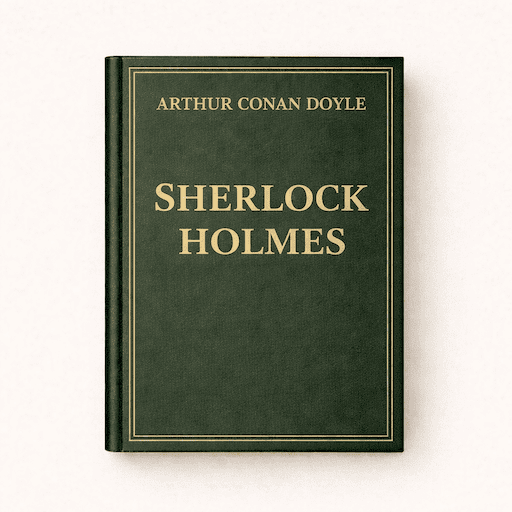
| The Adventures of Sherlock Holmes | Conan Doyle | 3,000 | 13 |
| The Picture of Dorian Gray | Wilde | 3,000 | 14 |
| Great Expectations | Dickens | 3,000 | 18 |
| Dracula | Stoker | 3,000 | 25 |
Treat the figures as rough: they cover only the openings, and the count was automatic. Sentence length isn't everything, either. Pride and Prejudice scores low because its opening runs on short exchanges between Mr and Mrs Bennet, but Austen's irony and 19th-century vocabulary are harder for a learner than the number suggests. Dorian Gray opens with a preface of short aphorisms.
What to recommend, in order:
- Start with Sherlock Holmes. The book is a collection of short stories, each complete in itself, and finishing a whole case in one evening keeps a learner going far better than half a novel.
- Then The Picture of Dorian Gray. Wilde's dialogue is sharp and short, and the novel isn't long.
- Put Pride and Prejudice third. If your friend knows the story from a film or series, the irony is much easier to catch.
- Save Great Expectations and Dracula. Dickens's descriptions and the long sentences of Stoker's diary entries can wear out anyone below B2.
What trips learners up
The difficulties depend on the learner's first language, and knowing them makes you a better helper. German speakers meet a crop of false friends: become isn't bekommen (to get), also isn't German also (so), and their Handy is your mobile. Speakers of many languages, German and Turkish among them, write I have seen him yesterday, because their own language uses one form where English insists on two. We explain how to put that across in present perfect vs past simple.
If your friend is working towards a certificate such as IELTS or Cambridge B2 First, regular reading is exactly the practice those reading papers reward.
How to choose
Let them read the first page before they commit. If they can follow what's happening, the book fits. And if you want to know why reading works so well, the research is in Does reading books help you learn a language?
And if you'd like to try being the learner for a change, you can start Spanish, French, German, Italian, Russian or Turkish with FluenTech, and read classics in those languages with a translation under every line.