God Save the King and Star-Spangled Banner: Lyrics, Meaning
The lyrics of God Save the King and The Star-Spangled Banner, what the old words mean in modern English, and the story behind the UK and US anthems.
The two best-known anthems in the English-speaking world are Britain's God Save the King and America's The Star-Spangled Banner. Millions of people know them by heart, yet both are written in an English nobody speaks any more, full of old subjunctives and words like thy, o'er, hail'd and ramparts.
God Save the King has no known author: both words and tune are anonymous. According to the Royal Family, there is no authorised version of the text either: the words are a matter of tradition. It was first sung in public in London in 1745, and on official occasions usually only the first verse is sung. Since Queen Elizabeth II died on 8 September 2022 and Charles III became King, the anthem has been sung with King again instead of Queen.
The Star-Spangled Banner was written by Francis Scott Key, a lawyer and amateur poet, in September 1814, after he watched the bombardment of Fort McHenry in Baltimore. The tune comes from a song that was popular in London, To Anacreon in Heaven. It became the national anthem by an Act of Congress of 3 March 1931. It has four verses, and today usually only the first is sung.
Below you'll find the words of each anthem, what they mean in plain modern English, the lines people most often get wrong, and the story behind them.
God Save the King: what the words mean
This is the text as it appears on the Royal Family's official website.
God save our gracious King!
Long live our noble King!
God save the King!
Send him victorious,
Happy and glorious,
Long to reign over us,
God save the King.
In today's English: "May God protect our kind King, may our noble King live long. May God make him victorious, happy and glorious, and may he reign over us for a long time."
Every line is a wish, and that's the key to the grammar. God save the King doesn't state that God saves the King; it's a prayer that He will. The same goes for Send him victorious: nobody is sending the King anywhere. Send here means "make him" or "grant that he be". And Long to reign over us has nothing to do with longing: it means "(may he) reign over us for a long time".
The second verse is rarely heard:
Thy choicest gifts in store
On him be pleased to pour,
Long may he reign.
May he defend our laws,
And ever give us cause,
To sing with heart and voice,
God save the King.
"Pour on him the best gifts You have in store; may he reign long. May he defend our laws and always give us reason to sing, with heart and voice, God save the King." Here the singers address God directly, which is why the old word thy appears. Other verses were added over the years, but they are almost never sung. When a woman is on the throne, people sing Queen for King and her for him.
How God Save the King became an anthem
The words and the tune may go back to the seventeenth century, though the version we know today dates from the eighteenth. In September 1745 Prince Charles Edward Stuart, the "Young Pretender" to the British throne, defeated the army of King George II at Prestonpans, near Edinburgh. When the news reached London, the bandleader at the Theatre Royal, Drury Lane, arranged God Save the King for performance after a play. It was such a success that it was repeated every night.
Other theatres soon followed suit, and it became the custom to greet the monarch with the song on arrival. By the early nineteenth century it was regarded as the national anthem.
The tune didn't stay at home. Eighteenth-century travellers in Europe saw the value of a national song that everyone knew, and other countries adopted the melody. Around 140 composers, Beethoven, Haydn and Brahms among them, have used it in their own works.
The Star-Spangled Banner: what the words mean
This is the text as published by the Smithsonian's National Museum of American History. Here is the first of its four verses, the one sung today.
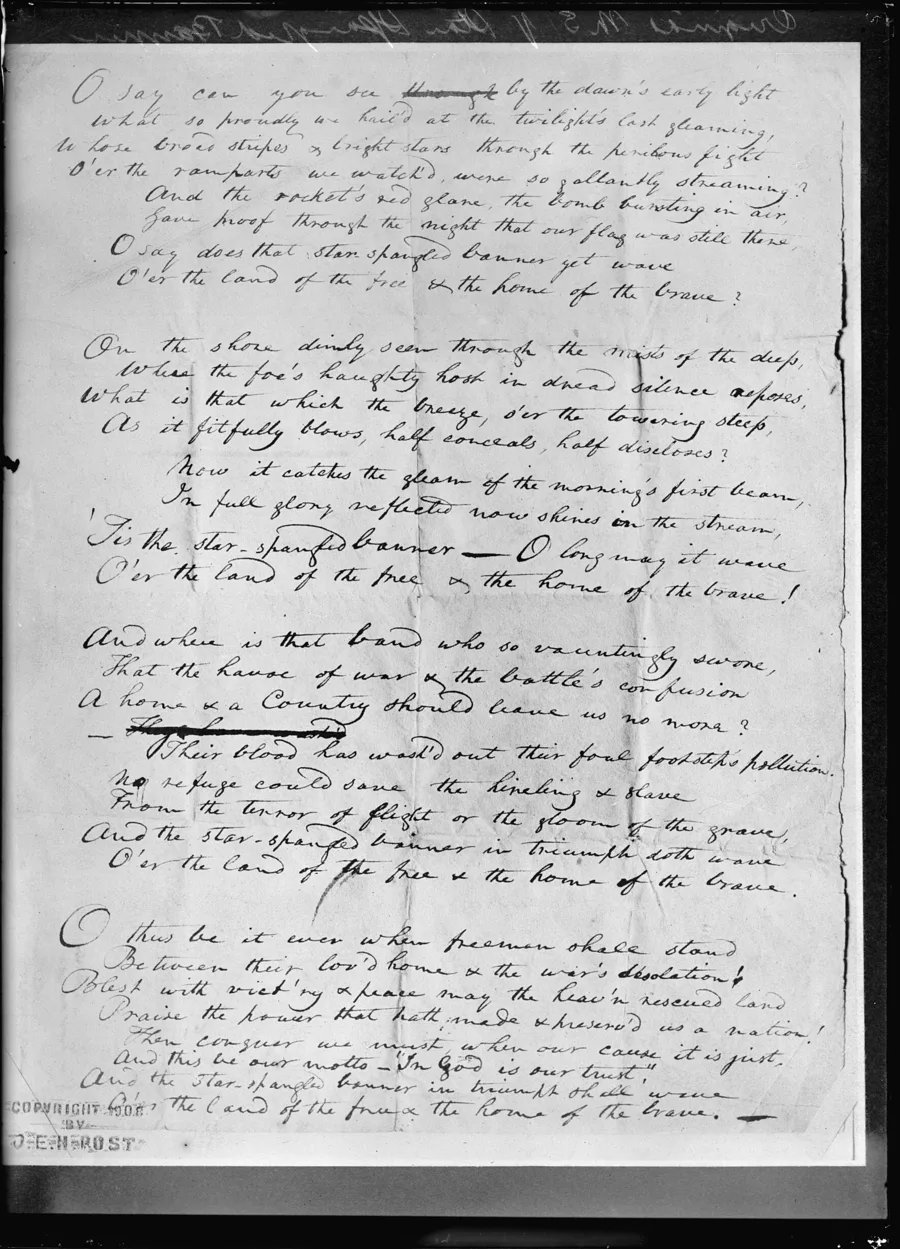
O say can you see, by the dawn’s early light,
What so proudly we hail’d at the twilight’s last gleaming,
Whose broad stripes and bright stars through the perilous fight
O’er the ramparts we watch’d were so gallantly streaming?
In plain English: "Tell me, can you see in the first light of dawn the flag we greeted so proudly as the last light faded yesterday evening, the flag whose broad stripes and bright stars were flying so bravely above the fort's walls through the dangerous battle while we watched?"
That's one long question, and it's where most people get lost. O say is a call to the listener: "tell me, can you see?" The twilight's last gleaming is the evening before, not the dawn: the poet last saw the flag at sunset, and the whole night has passed since. And in O'er the ramparts we watch'd, it's the singers who are watching the ramparts, the walls of the fort, and the flag streaming above them.
And the rocket’s red glare, the bombs bursting in air,
Gave proof through the night that our flag was still there,
O say does that star-spangled banner yet wave
O’er the land of the free and the home of the brave?
"All night, the red flash of the rockets and the bombs exploding in the air showed us that our flag was still there. Tell me, is that star-covered flag still flying over the land of the free and the home of the brave?"
The rockets and bombs were the enemy's, but every flash lit up the flag for a moment. The verse begins with a question and ends with one. Someone has watched a fort being shelled all night from a distance, and at daybreak asks: is the flag still there? Yet here means "still", so the last two lines don't celebrate a victory; they wait for the answer.
The other three verses give it. In the second, the flag catches the first beam of the morning sun and the poet sees it at last: ’Tis the star-spangled banner. The third turns on the enemy, who had boasted that they would take the country. The fourth looks ahead to peace and contains the line And this be our motto - “In God is our trust,”.
The story of the Star-Spangled Banner
In 1814 the United States and Britain were at war. Francis Scott Key had gone aboard a British ship to negotiate the release of an American civilian. When the attack began he was kept on board, and so he watched from the ship as Fort McHenry was bombarded for twenty-five hours.
At dawn on 14 September 1814 an American flag was flying over the fort, and the British ships withdrew from Baltimore. Key was so moved that he jotted down the first lines on the back of a letter, and he finished all four verses once he was back in Baltimore. A printer published the poem as a handbill, probably on 17 September, under the title Defence of Fort McHenry, and by mid-October at least seventeen newspapers along the East Coast had printed it.
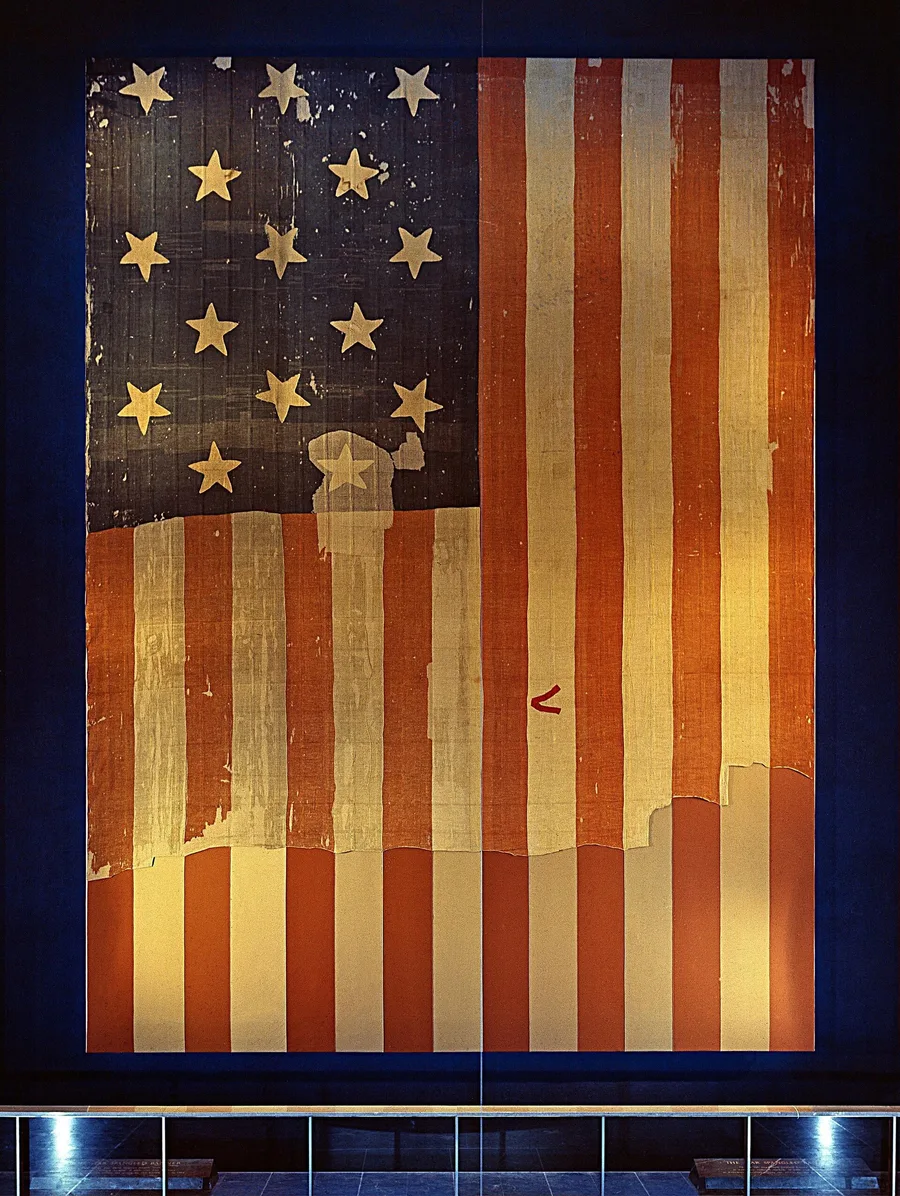
The flag Key saw still exists. Mary Pickersgill, a Baltimore flag maker, sewed it in about seven weeks in the summer of 1813, helped by her daughter, her nieces and thirteen-year-old Grace Wisher. It measures 30 by 42 feet, and it has belonged to the Smithsonian since 1912.
The tune has its own story. John Stafford Smith wrote To Anacreon in Heaven around 1775 for the Anacreontic Society, a London gentlemen's music club. So America's anthem, like Britain's, takes its melody from London. The song was already well known in America, and Key himself had written another poem to the same tune in 1805.
The song became hugely popular during the Civil War, and in 1889 the Secretary of the Navy ordered it to be played at the raising of the flag each morning. It only became the official national anthem in 1931, when President Herbert Hoover signed the law on 3 March.
Old words explained
save: in God save the King, this is the old subjunctive: "may God save". It survives in a handful of fixed phrases, such as God bless you, Heaven help us and long live the King.
gracious: kind, courteous, generous. A word from the language of the court; today a gracious host is warm and attentive, and being gracious in defeat means accepting a loss with good grace.
send him victorious: make him victorious. The same pattern survives in British English when something sends you mad.
long to reign over us: may he reign over us for a long time. Reign sounds exactly like rain.
thy: your, when speaking to one person. English once had thou and thy for "you" and "your" when talking to a single person; today they live on only in prayers, poetry and a few dialects.
in store: kept ready, waiting to be given. We still say who knows what the future has in store.
be pleased to: kindly, please. A polite old formula: On him be pleased to pour means "please pour on him".
dawn’s early light: the first light of morning. At dawn is at daybreak, and from dawn till dusk means all day long.
hail’d, watch’d: hailed and watched. Older poetry often replaced the unsounded e of -ed with an apostrophe. To hail is to greet or salute; today you hail a taxi.
twilight’s last gleaming: the last glimmer of light at dusk, in other words the evening before. A gleam of hope is a glimmer of hope.
perilous: dangerous, from peril. Rare in conversation, but common in writing: a perilous journey.
o’er: over, squeezed into one syllable to fit the line. Sung, it sounds like "or".
ramparts: the thick earth or stone walls of a fort. You'll rarely meet the word outside history books.
gallantly streaming: flying bravely in the wind. Gallant means brave and proud; sports reporters still talk about a gallant effort.
star-spangled: covered with stars. A spangle is a small piece of glittering decoration, and a banner is a flag.
yet: still. Does that star-spangled banner yet wave means "is that flag still flying?"
More anthems on our blog
We've explained other countries' anthems line by line too: La Marseillaise, the German anthem, the Italian anthem, the Spanish anthem, the Russian anthem and the Turkish anthem.
And if one of those languages has caught your ear, you can start learning it with FluenTech.