French National Anthem: La Marseillaise Lyrics and Meaning
La Marseillaise lyrics in French and English: the verse and refrain sung today, explained line by line, and how Rouget de Lisle wrote it in 1792.
 Learn FrenchFree app with audio, quizzes and real books
The French national anthem is La Marseillaise. It begins Allons enfants de la Patrie, "Forward, children of the Fatherland". Claude-Joseph Rouget de Lisle, a young army engineer, wrote both the words and the music in Strasbourg in April 1792, under the title Chant de guerre pour l'Armée du Rhin, "War Song for the Army of the Rhine". It was declared a national song on 14 July 1795, and Article 2 of the 1958 Constitution states it plainly: L'hymne national est « La Marseillaise ». On official occasions the French sing the first verse and the refrain.
The lyrics in French and English
This is the text published by the Élysée, the office of the French President. The line marked (bis) is sung twice, and the refrain follows every verse.
First verse
| French | Meaning |
|---|---|
| Allons enfants de la Patrie, | Forward, children of the Fatherland, |
| Le jour de gloire est arrivé ! | the day of glory has come! |
| Contre nous de la tyrannie, | Against us, tyranny's |
| L'étendard sanglant est levé, (bis) | bloodstained banner is raised. |
| Entendez-vous dans les campagnes | Do you hear, out in the countryside, |
| Mugir ces féroces soldats ? | those savage soldiers roaring? |
| Ils viennent jusque dans vos bras | They are coming right into your arms |
| Égorger vos fils, vos compagnes ! | to cut the throats of your sons and your wives! |
Refrain
| French | Meaning |
|---|---|
| Aux armes, citoyens, | To arms, citizens, |
| Formez vos bataillons, | form your battalions, |
| Marchons, marchons ! | let us march, let us march! |
| Qu'un sang impur | May impure blood |
| Abreuve nos sillons ! | water our furrows! |
The full song has seven verses. The first six are Rouget de Lisle's; the seventh, sung by children (Nous entrerons dans la carrière, "We shall enter the path"), was added in 1792 by an author who has never been identified. The sixth verse contains the best-known line after the refrain: Liberté, Liberté chérie, "Liberty, beloved Liberty". Official ceremonies use only the first verse and the refrain.
What does "qu'un sang impur" mean?
The last line of the refrain takes many learners by surprise. It wishes that "impure blood" may soak the furrows of French fields. To make sense of it, go back to April 1792. France had just declared war on Austria, and foreign armies were marching towards a country in the middle of its revolution. The first verse describes them: soldiers who come "right into your arms" to kill sons and wives.
In the song, the impure blood is the blood of those invading soldiers. The line is a battle cry: let us fight on our own land, and let the enemy's blood, not ours, water our fields. It's the language of a war song written in a single night for an army about to march, which is exactly what it was. Every so often there's a debate in France about how violent the words sound today, but the text has never been changed.
The story behind the anthem
Rouget de Lisle was born in 1760 in Lons-le-Saunier, in the Jura, and served as a captain in the army's engineering corps. In the spring of 1792 he was stationed in Strasbourg, close to the Rhine and the Austrian front.
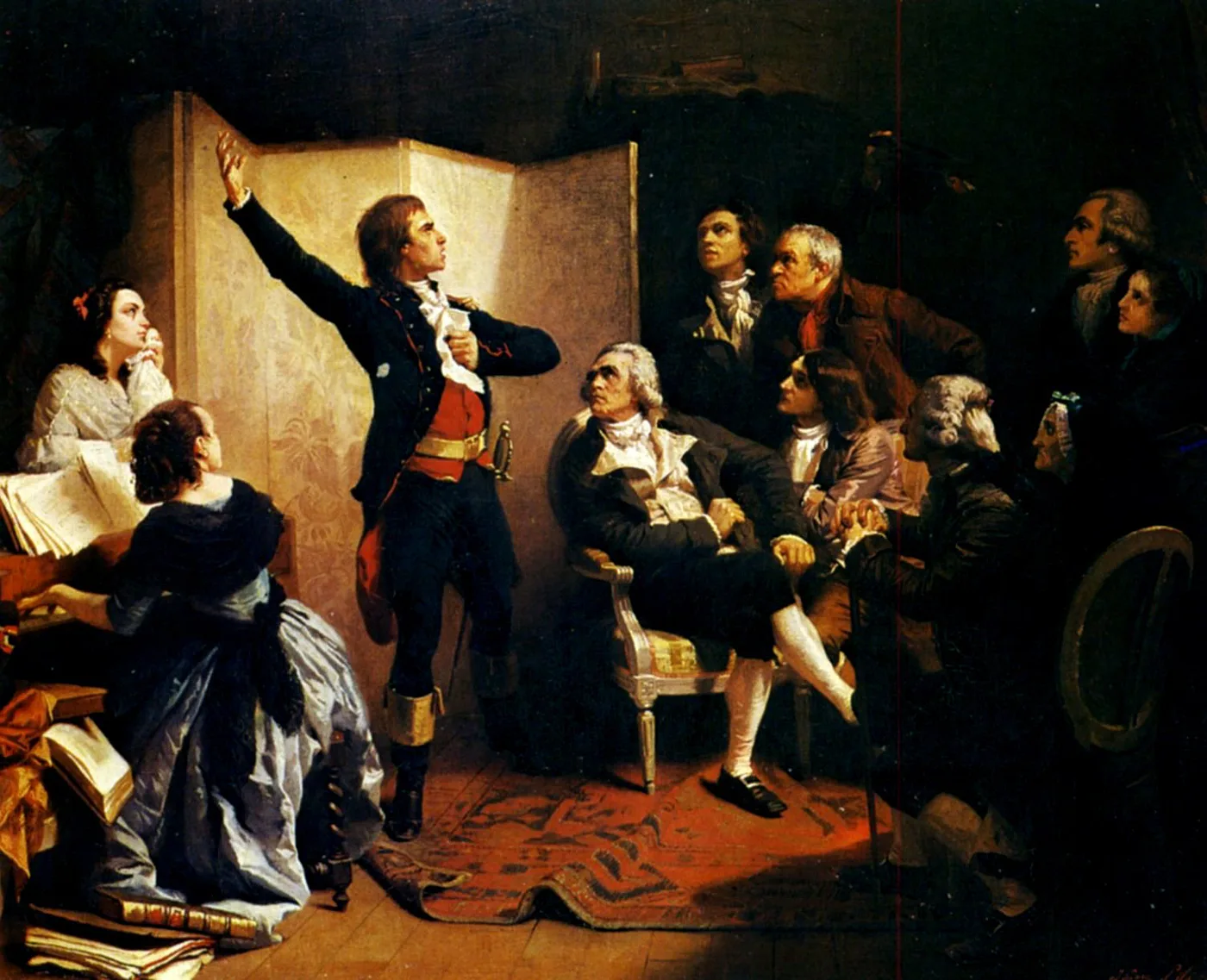
France had just declared war on the Emperor of Austria. On the night of 25 April 1792, after an evening at the home of Dietrich, the mayor of Strasbourg, Rouget de Lisle composed his Chant de guerre pour l'Armée du Rhin. It spread through Alsace in handwritten and printed copies, and Paris publishers soon took it up.
The name came that summer. Volunteers from Marseille, the fédérés, brought it to Paris and sang it during the uprising at the Tuileries Palace on 10 August 1792. Parisians called it the song of the Marseillais, and the name stuck. On 14 July 1795 it was declared a national song.
Its fortunes rose and fell after that. Napoleon's Empire and the restored monarchy banned it. It came back with the revolution of 1830, when Hector Berlioz wrote an orchestral version and dedicated it to Rouget de Lisle. The Third Republic made it the national anthem in 1879, and in 1887 the War Ministry fixed an official version, because bands were playing it in so many different ways.
Rouget de Lisle himself never had another success, and after the Revolution he faded into obscurity. On 14 July 1915, in the middle of the First World War, his remains were moved to Les Invalides in Paris. The constitutions of 1946 and 1958 both name La Marseillaise as the anthem in their second article.
Words worth learning
la patrie: homeland, fatherland. It's feminine, so la patrie, even though it comes from Latin pater (father). You'll see it in mourir pour la patrie and in the word patriote.
allons, marchons: let's go, let's march. This is the imperative for nous: take the present tense without the pronoun. Allons-y ! (Let's go!) is something you'll hear every day. In the anthem allons links to enfants, so it's sung allon-z-enfants.
le jour de gloire est arrivé: the day of glory has come. Arriver forms the past with être, not avoir, and the participle agrees with the subject: la nuit est arrivée. It's also an everyday phrase: Le colis est arrivé (The parcel has arrived).
l'étendard sanglant: the bloodstained banner. Sanglant comes from le sang (blood). Look at the word order of the whole sentence: Contre nous de la tyrannie / L'étendard sanglant est levé. In normal prose you'd say L'étendard sanglant de la tyrannie est levé contre nous. Splitting de la tyrannie from its noun is old poetic order.
entendez-vous ?: do you hear? A question formed by inversion, verb first and pronoun after, joined by a hyphen. In speech today you'd usually hear Vous entendez ? or Est-ce que vous entendez ?
les campagnes: the countryside, the fields around villages. A false friend: la campagne means "the countryside" (J'habite à la campagne), and only in some contexts a military or election campaign.
mugir: to bellow, to roar, the sound cattle make, or wind and sea. Calling soldiers' shouts mugir makes them sound like beasts. A regular -ir verb: ils mugissent.
égorger: to cut someone's throat. Built on la gorge (throat). J'ai mal à la gorge (I have a sore throat) uses the same root in a much gentler way.
vos compagnes: your wives, your companions. Une compagne is the feminine of un compagnon, and today it often means a partner in a couple: mon compagnon, ma compagne.
aux armes, citoyens: to arms, citizens. Aux is à + les, just like aux États-Unis. Citoyen (feminine citoyenne) was the title revolutionaries used instead of monsieur and madame.
former: to form, here to line up soldiers into battalions. Un bataillon is a unit of several hundred soldiers. Today former also means "to train": une formation is a training course.
qu'un sang impur abreuve: may impure blood water. Que + subjunctive expresses a wish or an order about someone else, a sort of imperative for the third person: Qu'il entre ! (Let him come in!). For most -er verbs the subjunctive looks just like the present (abreuve), so here the que is what tells you it's a wish. The same mood survives without que in Vive la France !
abreuver, les sillons: to water (animals), the furrows. Abreuver is what a farmer does for cattle; un abreuvoir is a drinking trough. Un sillon is the line a plough cuts in a field, and also the groove of a vinyl record.
Keep going with French
The anthem's two short parts already give you an imperative, a past tense with être, an inverted question and a subjunctive. To build on them, try our free French word lists with audio, no account needed. If you're wondering how much work the language takes, read Is French hard to learn?
Our Learn French app takes you from your first words through grammar and graded reading to Flaubert and Maupassant, with a translation under every line. It's free to download, though some books and extra content need diamonds you earn while learning, or Premium.