The Three Musketeers by Dumas: Summary, Characters and Meaning
In 1625 young d'Artagnan reaches Paris, befriends Athos, Porthos and Aramis, saves the queen's diamond studs and brings down the deadly Milady.
 Learn FrenchFree app with audio, quizzes and real books
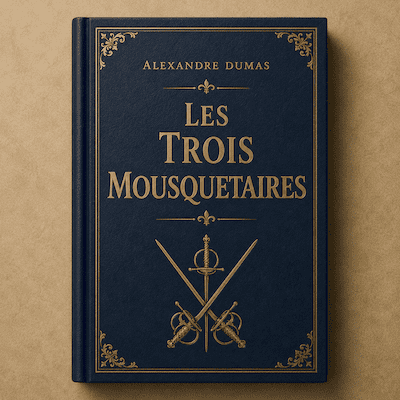
The Three Musketeers (Les Trois Mousquetaires) is Alexandre Dumas's great adventure novel, published as a serial in the Paris newspaper Le Siècle in 1844. In April 1625 an eighteen-year-old Gascon, d'Artagnan, rides to Paris to join the king's musketeers. On his first day he picks fights with three of them, Athos, Porthos and Aramis, and ends it as their friend. Together they spend three years fighting Cardinal Richelieu's guards, saving the queen's honour and chasing the most dangerous woman in French fiction.
Dumas wrote it with his collaborator Auguste Maquet and took his hero from a real Gascon officer. One thing confuses many readers: d'Artagnan is not one of the three musketeers. The title belongs to his friends.
The characters
D'Artagnan is poor, proud, hot-headed and very clever. He leaves home with fifteen écus, a ridiculous yellow horse, a letter for the captain of the musketeers, and his father's advice:
Ne craignez pas les occasions et cherchez les aventures.
Don't fear opportunities, and go looking for adventures.
Athos is the eldest, about thirty, silent, noble in every gesture, and drinks too much. His real name is the Comte de La Fère, and he hides a secret about the woman he once married. One night, drunk, he tells it as the story of "a friend", and ends:
Mon cher, l’ange était un démon.
My dear fellow, the angel was a demon.
Porthos is huge, loud and vain, with a gold baldric that is gold only at the front. Asked why he's fighting d'Artagnan, he won't admit the Gascon saw the back of it:
«Ma foi, je me bats parce que je me bats»
"Well, I'm fighting because I'm fighting."
Aramis is elegant and secretive, a musketeer who keeps announcing he'll become a priest while ladies' handkerchiefs fall out of his pockets:
«Mon cher, n’oubliez pas que je veux être Église, et que je fuis toutes les occasions mondaines.»
"My dear fellow, don't forget that I mean to enter the Church, and that I avoid all worldly occasions."
Milady de Winter is beautiful, fair-haired, a spy for the cardinal and the villain of the book. Even locked in a cell, she checks the mirror:
«Allons, rien n’est perdu. Je suis toujours belle.»
"Come now, nothing is lost. I'm still beautiful."
Cardinal Richelieu rules France in the king's name and is the musketeers' great enemy, cold and brilliant rather than evil. His most famous words are a note he signs for Milady, a licence to do anything:
C’est par mon ordre et pour le bien de l’État que le porteur du présent a fait ce qu’il a fait.
It is by my order and for the good of the State that the bearer of this note has done what he has done.
Constance Bonacieux is twenty-five, the wife of d'Artagnan's landlord and the queen's linen maid. D'Artagnan falls for her at once. When he wants to chase an enemy in the middle of their mission, she stops him:
«Votre vie est vouée en ce moment et ne vous appartient pas.»
"Your life is pledged right now; it doesn't belong to you."
Rochefort, "the man from Meung", is the cardinal's agent. He laughs at d'Artagnan's horse in chapter 1, and the feud begins:
«Je ne vous parle pas, monsieur.»
«Mais je vous parle, moi!»
"I'm not talking to you, sir."
"But I'm talking to you!"
The Duke of Buckingham, England's most powerful minister, is madly in love with Anne of Austria, queen of France. She is lonely, spied on by the cardinal and not indifferent to him, but she sends him away:
Tenez, duc, au nom du Ciel, partez, retirez-vous; je ne sais si je vous aime, ou si je ne vous aime pas; mais ce que je sais, c’est que je ne serai point parjure.
Please, Duke, in Heaven's name, go, leave me. I don't know whether I love you or not, but I do know that I will not break my vows.
The valets are a comedy of their own: Planchet, d'Artagnan's quick-witted servant; Grimaud, whom Athos has trained to obey a gesture and never speak; Mousqueton, Porthos's well-dressed Norman; and Bazin, Aramis's pious valet, who longs for the day his master swaps the uniform for a cassock. Dumas sums them up with a proverb: Tel maître, tel valet (like master, like man).
Around them are M. de Tréville, captain of the musketeers, King Louis XIII, and Lord de Winter, Milady's English brother-in-law.
Summary, part by part
Paris and the three duels (chapters 1 to 9)
At an inn in Meung, a stranger mocks d'Artagnan's horse; in the brawl the Gascon is knocked out and his letter of recommendation vanishes. In Paris, chasing that stranger down M. de Tréville's stairs, he bumps Athos's wounded shoulder, tangles with Porthos's cloak and picks up a handkerchief Aramis wanted hidden. Result: three duels, at noon, one and two o'clock.
Before the first begins, the cardinal's guards arrive to arrest the duellists. D'Artagnan picks his side, the four of them win, and the king is delighted. Soon after, d'Artagnan gives his friends the oath the book is remembered for:
«Tous pour un, un pour tous.»
"All for one, one for all."
The queen's diamond studs (chapters 10 to 22)
The queen has given Buckingham twelve diamond studs, a present from the king. The cardinal finds out and has the king ask her to wear them at a ball. Constance begs d'Artagnan to fetch them from London. The cardinal's men stop the friends one by one, Porthos at Chantilly, Aramis at Crèvecoeur, Athos at Amiens, and d'Artagnan reaches London alone. Two studs are missing: Milady cut them off at a ball in Windsor. Buckingham's jeweller copies them in two days, and at the ball the queen wears all twelve.
Milady (chapters 23 to 39)
Constance is kidnapped. D'Artagnan collects his friends, then falls for Milady and plays a nasty trick on her: through her maid Ketty, he spends a night with her in the dark, posing as the man she loves, the Comte de Wardes. When he confesses, she tries to stab him, and he sees a fleur-de-lis branded on her shoulder, the mark of a convicted thief. Athos's angel and Milady are the same woman.
The siege of La Rochelle (chapters 40 to 48)
The army besieges the Protestant port of La Rochelle. Someone sends d'Artagnan poisoned wine. Athos overhears the cardinal sending Milady to England to get rid of Buckingham, and takes the signed note from her at gunpoint. To talk unheard, the four friends bet they can breakfast for an hour in an exposed bastion under enemy fire. They win, and send Planchet to London to warn Lord de Winter.
Spoiler warning: the rest of this summary reveals the ending.
Milady's revenge (chapters 49 to 66)
De Winter arrests Milady as she lands and has her guarded by Felton, a young Puritan officer. In five days she wins him over with invented stories, and Felton, once she is free, stabs Buckingham to death in Portsmouth on 23 August 1628. Milady flees to a convent at Béthune, where the queen has hidden Constance. As the musketeers arrive, she poisons Constance, who dies in d'Artagnan's arms. The friends catch Milady and try her at night, helped by the executioner of Lille, who branded her years ago. He takes her across the river Lys and beheads her.
The ending
Rochefort arrests d'Artagnan and brings him to the cardinal. D'Artagnan hands over the signed note. Richelieu tears it up and writes him a lieutenant's commission in the musketeers, with the name left blank. Porthos is marrying a rich widow and Aramis is entering the Church, so Athos writes d'Artagnan's name on it. When d'Artagnan says he'll have nothing left but bitter memories, Athos answers:
«Vous êtes jeune, vous, et vos souvenirs amers ont le temps de se changer en doux souvenirs!»
"You're young, and your bitter memories have time to turn into sweet ones!"
What The Three Musketeers means
Friendship against the state
The motto is a promise between four men, not to the king. The musketeers serve Louis XIII, but what they really defend is each other, and the novel takes their side against the cardinal's police, spies and paperwork. It's about friends who show up, and that's why it hasn't aged.
Honour, and its cost
Dumas loves his heroes and still lets you see them clearly. They duel over nothing, live on credit and beat their servants. D'Artagnan's trick on Milady is shabby, and he asks her forgiveness before she dies. Richelieu, the great enemy, turns out to be the most reasonable man in the book, and rewards the young man who beat him.
A dark second half
Every crime in the book leads back to Milady, yet her execution is no triumph: d'Artagnan covers his ears and the friends kneel on the riverbank. The adventure ends as a tragedy, which is why the last pages feel so quiet.
Why it's a good book for learners
It's long, so read it in chapters. About 225,000 words in our edition, 67 chapters plus a preface and an epilogue. This is a book for advanced learners. But it's episodic: each chapter, about 3,300 words on average, is one scene with its own ending. Read a chapter a day and you'll finish in about ten weeks. If the preface feels heavy, skip to chapter 1: our best books to learn French found that this opening has the longest sentences of our French classics, and the adventure itself reads more easily.
It's mostly dialogue. Dumas wrote for a newspaper: people quarrel and joke in short replies, and every chapter ends on a hook.
It teaches the literary past tense. The narration runs on the passé simple, the tense of written stories: Porthos étendit la main (Porthos held out his hand). Next to it sits the imperfect for habits: Alors Athos haussait les épaules et, sans se mettre en colère, rossait Grimaud. (Then Athos would shrug and, without losing his temper, give Grimaud a beating.)
It's full of commands and old negations. D'Artagnan's father speaks in the imperative: battez-vous à tout propos (fight at every opportunity). And you'll meet the old negation ne... point for ne... pas, as in the queen's je ne serai point parjure.
Read it in French
You can read the opening of The Three Musketeers free on our site, in French with a translation under every line. No app or account is needed.
The Three Musketeers is long enough to keep you company for months and exciting enough that you'll always want the next chapter. Our Learn French app has The Three Musketeers and five more French classics in full, with a translation under every line, along with the vocabulary and grammar to get you there. It's free to download, though some books and extra content need diamonds you earn while learning, or Premium.