Kalila and Dimna: The Fables, Their Journey, and Reading Them in Arabic
Ibn al-Muqaffa's 8th-century fables came from India through Middle Persian into Arabic. What the book is, why its short stories suit learners, and a fable to read in the original.
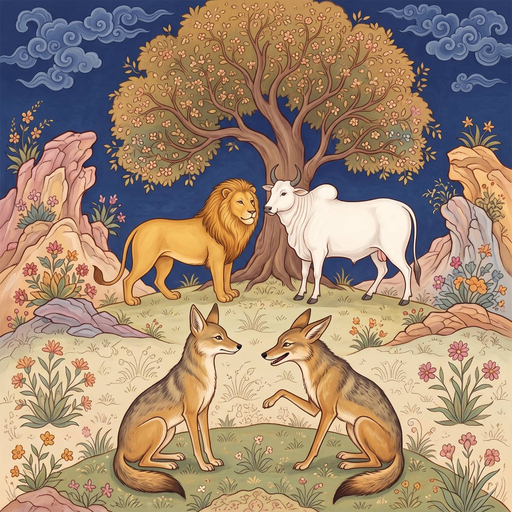
Kalila and Dimna (كليلة ودمنة, Kalīla wa-Dimna) is a book of animal fables about power, friendship and cunning, put into Arabic by Ibn al-Muqaffa in the 8th century. It's one of the founding works of Arabic prose, and also one of the friendliest classics for a learner: its stories are short, full of dialogue, and built on formulas that repeat from start to finish.
A book that travelled
The fables began in India, in the Sanskrit collection known as the Panchatantra. In the 6th century, under the Persian king Khosrow I (Anushirvan), a physician named Borzuya brought the stories to Iran and translated them into Middle Persian. Both the Sanskrit original he used and his Persian version are now lost.
Around 750, Ibn al-Muqaffa, a Persian writer living in Basra, translated the Middle Persian book into Arabic. He added an introduction and some material of his own, and his version became the one the rest of the world copied: translations into Persian, Hebrew, Latin, Spanish and many other languages go back to it. He didn't live long to see it. He was executed in Basra around 757, still a young man.
The app's text opens the way the Arabic book does, with that journey: the king sends Borzuya to India to bring back a book said to be "the root of all learning".
Who are Kalila and Dimna?
They're two jackals at the court of a lion king. Kalila is cautious and content with his place. Dimna is ambitious and wants the king's ear at any price. The first great story, which the book itself calls "the first chapter of the book", tells how Dimna sets the lion against his new friend, the ox Shatraba, by lying to both.
All of it is wrapped in a frame. An Indian king, Dabshalim, asks the philosopher Bidpai for a lesson ("give us an example of two friends whom a liar separates"), and Bidpai answers with a story. Inside it, the animals tell each other stories to make their points, so tales sit inside tales, sometimes three deep.
A fable to read: the fox and the drum
Here's one of the short fables, told by Dimna. It starts with the book's favourite formula:
قال دمنة: زعموا أن ثعلباً أتى أجمةً فيها طبل معلق على شجرةٍ،
Dimna said: They say a fox came to a thicket where a drum hung from a tree.
Whenever the wind blew, the branches knocked against the drum and it boomed. The fox followed the noise:
فتوجه الثعلب نحوه لأجل ما سمع من عظم صوته؛ فلما أتاه وجده ضخماً، فأيقن في نفسه بكثرة الشحم واللحم.
The fox headed towards it because of how loud it sounded. When he reached it, he found it huge, and felt sure it was full of fat and meat.
فعالجه حتى شقه. فلما رآه أجوف لا شيء فيه،
He worked at it until he split it open. When he saw it was hollow, with nothing inside,
قال: لا أدري لعل أفشل الأشياء أجهرها صوتاً وأعظمها جثةً.
he said: "Who knows? Perhaps the feeblest things are the loudest and the biggest."
Dimna tells it to persuade the lion not to fear the ox's great bellow. Like many morals in the book, it's true, and it's used for a scheme.
What a learner can take from that passage
| Arabic | Transliteration | Meaning | Why it's useful |
|---|---|---|---|
| زعموا أن | zaʿamū anna | they claim that, they say | Opens almost every fable |
| فلما | fa-lammā | and when | The book's way of moving the story on |
| وجده ضخماً | wajadahu ḍakhman | he found it huge | The -an ending you'll meet in case endings |
| أجوف | ajwaf | hollow | |
| أفشل، أجهر، أعظم | afshal, ajhar, aʿẓam | feeblest, loudest, biggest | One pattern, أَفْعَل, for "more" and "most" |
That last row is the kind of thing that makes Arabic satisfying: three adjectives, one mould, the roots and patterns system at work.
Why it suits learners
Short stories. Most fables run a page or two. You can finish one in a sitting, which matters a lot when every line takes effort.
Formulas that repeat. Besides زعموا أن, you'll see the same exchange again and again: a character says "your case is like that of the thief and the merchant", and the other asks وكيف كان ذلك؟ (wa-kayfa kāna dhālika?, "and how was that?"). After a few chapters you read these without thinking.
Lots of dialogue. Animals argue, plead and scheme in direct speech, which is easier than description.
The shortest sentences in our library. In our count of the six Arabic classics in the app, Kalila and Dimna averages about 20 words per sentence, the lowest of the six. See the full table in the best books to learn Arabic.
The harder side. The vocabulary is 8th-century: thickets, jackals, viziers and kings. The opening chapters are a long, serious frame about wisdom and Borzuya's journey before any animal appears, so it's fine to skip ahead to the lion and the ox. And the text is unvowelled, so read it with a translation from about an intermediate level.
Read it
You can read the opening of Kalila and Dimna free on our site, in Arabic with a translation under every line, no account needed. If you'd like something more modern next, try Gibran: our post on The Broken Wings in Arabic is a good place to start.
Our Learn Arabic app has Kalila and Dimna in the original with a translation, alongside five more classics and the grammar and vocabulary to read them. It's out on 1 December; join the waitlist and the fox and the drum will be waiting for you.
Learn Arabic arrives on 1 December
The app is almost ready: the Arabic alphabet from scratch, grammar, over 2,500 words with audio and classics such as Gibran's The Broken Wings in the original. Leave your email and we'll let you know the day it's out.
One email when the app is out. Nothing else.