The Late Mattia Pascal: Summary, Characters and Meaning
A broke librarian wins a fortune at Monte Carlo, reads that his town has buried him, and starts over as Adriano Meis, a man with no papers and no past.
 Learn ItalianFree app with audio, quizzes and real books
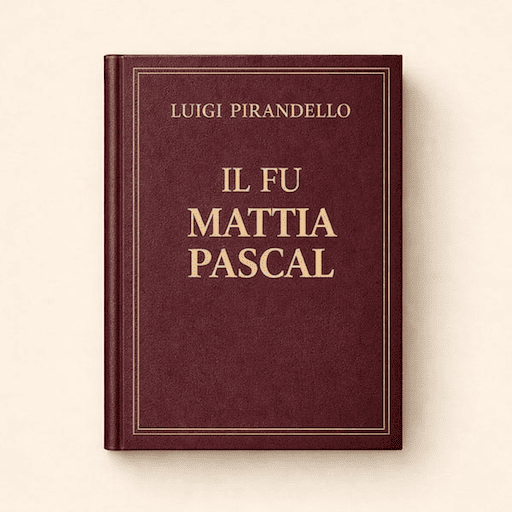
The Late Mattia Pascal (Il fu Mattia Pascal) is Luigi Pirandello's most famous novel, published in 1904, thirty years before he won the Nobel Prize. Mattia Pascal, a ruined, unhappily married librarian in the small seaside town of Miragno, runs away from home, wins a fortune at the roulette table in Monte Carlo, and on the train back reads in the paper that he has drowned himself. His wife and mother-in-law have identified a corpse as his. So he decides to stay dead.
The title is the first thing to explain. In Italian, il fu before a name means "the late", the phrase you see on gravestones and in legal papers: il fu Mattia Pascal is "the late Mattia Pascal". It's how the book's English translations are titled, and it's the answer to the book's final question.
The novel opens with one of the best first lines in Italian:
Una delle poche cose, anzi forse la sola ch’io sapessi di certo era questa: che mi chiamavo Mattia Pascal.
One of the few things, perhaps the only thing, I knew for certain was this: that my name was Mattia Pascal.
A few paragraphs later he tells you exactly what kind of story this is:
Giacchè, per il momento (e Dio sa quanto me ne duole), io sono morto, sì, già due volte, ma la prima per errore, e la seconda… sentirete.
Because, for the moment (and God knows how sorry I am about it), I have died, yes, twice already, the first time by mistake, and the second... you'll see.
The characters
Mattia Pascal tells the story, writing it down in a deconsecrated church that serves as his town's library. He's lazy, funny, impulsive, with one eye that "looks elsewhere". The book is his manuscript, not to be opened until fifty years after his "third, last and definitive death".
Adriano Meis is the name Mattia invents for himself on a train, after overhearing two passengers argue about the emperor Hadrian (Adriano) and a philosopher called Camillo De Meis:
Adriano Meis! Sì... Adriano Meis: suona bene...
Adriano Meis! Yes... Adriano Meis: it sounds good...
Mattia's mother is gentle and helpless, a widow who trusts the wrong man with the family's money. Mattia sums her up in three words: Santa donna, mia madre! (A saint, my mother!)
Aunt Scolastica (zia Scolastica), his father's sister, is a fierce old maid who sees the swindle coming and stamps on the floor to warn them:
Senti il vuoto? La talpa! la talpa!
Can you hear the hollow? The mole! The mole!
Batta Malagna is "the mole", the estate manager who digs the ground out from under the family and grows rich on it. When he wants Mattia to take responsibility for his niece, he roars: Mattia provveda! Mattia ripari! (Mattia must see to it! Mattia must make it right!)
Romilda is the daughter of Malagna's cousin, the girl Mattia was supposed to win for his friend Pomino and married himself. In one of the fights at home she clings to her mother:
No! Tu con me, mamma! Non mi lasciare, non mi lasciare qua sola!
No! You come with me, Mamma! Don't leave me, don't leave me here alone!
The widow Pescatore (Marianna Dondi, vedova Pescatore) is Romilda's mother and Mattia's terrible mother-in-law, who throws him out of the house that was once his: Tu e tua madre, via! Fuori di casa mia! (You and your mother, out! Out of my house!)
Roberto, called Berto, is Mattia's handsome brother, who married money and keeps his distance when the family is ruined. Mattia forgives him with a shrug: Dio l’aveva fatto così; gliene aveva dato pochino pochino, di cuore. (God had made him that way; He'd given him only a tiny bit of heart.)
Pomino (Gerolamo Pomino, "Mino") is Mattia's timid childhood friend: Mino era come l’ombra nostra (Mino was like our shadow).
Anselmo Paleari is Mattia's landlord in Rome, a kind old man obsessed with spiritualism and philosophy, who keeps talking at night and checking his audience: Dorme, signor Meis? (Are you asleep, Mr Meis?)
Adriana is Paleari's young daughter, shy, religious and honest, the person Mattia hurts most:
Voglio liberar la mia casa dall’ignominia di quell’uomo!
I want to free my home from that man's disgrace!
Terenzio Papiano is Adriana's brother-in-law, a widower who wants to marry her for money, and a thief. Mattia calls him il vostro indegno genero (your unworthy son-in-law).
Don Eligio Pellegrinotto is the priest who now runs the library, encourages Mattia to write, and has the last serious word of the novel.
Summary
Miragno: the first life (chapters 1 to 5)
Mattia and Berto grow up rich and spoiled in Miragno while Malagna quietly robs their mother. Mattia sets out to help Pomino court Romilda, falls for her himself, and gets her pregnant. At the same time Malagna's young wife Oliva, whom Malagna blamed for having no children, is pregnant too, and the father is Mattia. Malagna claims Oliva's baby and forces Mattia to marry Romilda.
Mattia ends up poor, living with Romilda and her furious mother. Pomino suggests, and his father arranges, a job as librarian, at sixty lire a month, among rotting books and rats. Romilda has twin girls. One dies after a few days; the other dies at almost a year old, on the same day as Mattia's mother. After a fight at home, Mattia leaves with five hundred lire his brother sent for the funeral, intending to sail to America.
Monte Carlo and the newspaper (chapters 6 and 7)
In Nice he loses his nerve, goes to Monte Carlo by chance, and wins. He goes back for twelve days and leaves with about eighty-two thousand lire. On the train home he opens a newspaper: a body has been found in the mill-race at his farm, the Stia, and identified as the librarian Mattia Pascal, a suicide. At the next station he jumps down and understands:
Ero morto, ero morto: non avevo più debiti, non avevo più moglie, non avevo più suocera: nessuno! libero! libero! libero!
I was dead, I was dead: no more debts, no more wife, no more mother-in-law: nobody! Free! Free! Free!
Adriano Meis (chapters 8 and 9)
He shaves his beard, cuts his hair, invents a past (born in Argentina, raised by a grandfather) and travels through Italy and Germany. Freedom soon turns into loneliness. In Milan he doesn't even buy a puppy, because he'd have to pay the dog tax and he no longer pays anything to anyone. He can't make a real friend without lying. One foggy winter evening he finds the phrase for what he has become: Forestiere della vita, Adriano Meis. (A stranger to life, Adriano Meis.)
Rome (chapters 10 to 15)
He rents a room from Anselmo Paleari, on via Ripetta, above the river. Paleari explains his theories of the soul, holds séances with a medium, and tells him why modern tragedy is different from ancient tragedy. Imagine a puppet theatre where, just as Orestes is about to take his revenge, the paper sky tears:
Oreste, insomma, diventerebbe Amleto. Tutta la differenza, signor Meis, fra la tragedia antica e la moderna consiste in ciò, creda pure: in un buco nel cielo di carta.
Orestes, in short, would become Hamlet. The whole difference, Mr Meis, between ancient and modern tragedy is this, believe me: a hole in the paper sky.
Mattia has his wandering eye operated on and spends forty days in the dark. He falls in love with Adriana and kisses her during a séance. Then twelve thousand lire disappear from his room. He knows Papiano took them, and he can't report it: a man with no papers can't go to the police. He realises he can't marry Adriana either, since legally he doesn't exist.
Spoiler warning: the rest of this summary reveals the ending.
The second death (chapter 16)
A Spanish painter insults him and Mattia can't even fight a duel, because nobody will stand as second for a man who doesn't exist. Walking at night, he decides it's Adriano Meis who has to die. He leaves his hat and cane on the parapet of Ponte Margherita with a note, and takes the train to Pisa.
The return (chapters 17 and 18)
He stops at Berto's villa, and his brother, after the tears, finds the perfect pun: Mattia, l’ho sempre detto io, Mattia, matto... Matto! matto! matto! (Mattia, I always said it, Mattia, mad... Mad! mad! mad!) Then he reaches Miragno to take his revenge, and finds that Romilda has married Pomino and has a baby girl. Seeing the child, he gives up. At dawn Romilda makes him coffee and remembers one small thing: Tu, al solito, senza zucchero, è vero? (No sugar for you, as usual, right?) He leaves them his wife, walks through a town that barely recognises him, and moves in with aunt Scolastica. He writes his story in the library with don Eligio and sometimes visits the grave with his name on it. When a stranger asks who he really is, he gives the last line:
Eh, caro mio... Io sono il fu Mattia Pascal.
Well, my friend... I am the late Mattia Pascal.
What The Late Mattia Pascal means
A name is not a life
Mattia believes that losing his name means losing his chains. Instead he learns that without a name you can't marry, sue, fight, own or even be robbed properly. Don Eligio puts it simply: fuori della legge e fuori di quelle particolarità, liete o tristi che sieno, per cui noi siamo noi, caro signor Pascal, non è possibile vivere (outside the law and outside those details, happy or sad, that make us who we are, dear Mr Pascal, it isn't possible to live). Pirandello came back to this idea, that identity is something others give us, all his life, most famously in Six Characters in Search of an Author and One, No One and One Hundred Thousand.
The shadow
In Rome, after the theft, Mattia looks at his shadow on the street and tries to stamp on it: Ma io no, io non potevo calpestarla, l’ombra mia (But I couldn't, I couldn't trample it, my shadow). Adriano Meis is that shadow: a man-shaped outline with no body behind it.
Laughing at disaster
Pirandello called his method umorismo, and the book shows it at work. After the scene where aunt Scolastica slaps a lump of bread dough onto the widow Pescatore's face, Mattia, scratched and covered in dough, starts laughing, and says: Posso dire che da allora ho fatto il gusto a ridere di tutte le mie sciagure (I can say that from then on I took a liking to laughing at all my misfortunes). The novel is about death, grief and failure, and it's very funny.
Why it's a great B2+ read for learners of Italian
It's a real novel, but not a huge one. About 74,000 words in our edition, in 18 chapters, many of them short. It's a step up from graded readers, best at B2 and above.
It's in the first person, and he talks to you. Mattia addresses the reader (sentirete, you'll see), argues with don Eligio and with himself. The tone is conversational, ironic and easy to follow even when the vocabulary is rich.
It runs on the passato remoto. This is a story told from the end, so the past is the passato remoto: Fui, per circa due anni... (I was, for about two years...), cedetti e sposai (I gave in and married), Scelsi allora Roma (So I chose Rome). Learners who know the passato prossimo will see the literary tense used on almost every page, which is the best way to learn to recognise it.
It uses older, Tuscan-style forms. Pirandello writes ch’io for che io, de’ miei for dei miei (de’ miei concittadini, of my fellow townsmen), sieno for siano, in istrada for in strada, and spells noja, bujo and pajo with a j. Once you know they're old spellings, they stop being a problem, and you'll meet them in all Italian writing of the period.
Our list of the best books to learn Italian has it as the novel to read when you want a real one.
Read it in Italian
You can read the opening of The Late Mattia Pascal free on our site, in Italian with a translation under every line. No app or account is needed.
The Late Mattia Pascal starts with a joke about a name and ends with a man visiting his own grave, and it keeps you reading all the way. Our Learn Italian app has The Late Mattia Pascal and four more Italian classics in full, with a translation under every line, along with the vocabulary and grammar to get you there. It's free to download, though some books and extra content need diamonds you earn while learning, or Premium.