The Metamorphosis by Kafka: Summary, Characters and Meaning
Salesman Gregor Samsa wakes up as a monstrous insect. His family feeds him, fears him, then wants him gone, and after he dies they feel free.
 Learn GermanFree app with audio, quizzes and real books
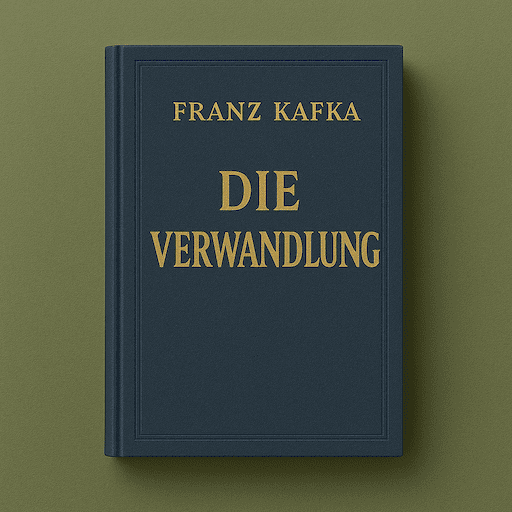
The Metamorphosis (Die Verwandlung) is a novella by Franz Kafka, written in 1912 and published in 1915. Gregor Samsa, a travelling salesman who supports his parents and his sister, wakes up one morning changed into a giant creature. He can't go to work, he can't speak, and he can barely get out of bed. The book follows what his family does with him over the next few months.
The first sentence and the word "Ungeziefer"
The book opens with one of the best-known sentences in German literature:
Als Gregor Samsa eines Morgens aus unruhigen Träumen erwachte, fand er sich in seinem Bett zu einem ungeheueren Ungeziefer verwandelt.
As Gregor Samsa awoke one morning from troubled dreams, he found himself changed in his bed into a monstrous vermin.
Ungeziefer isn't the name of an animal. It's a collective word for pests such as lice, fleas and bedbugs, anything you want out of the house, and its old root meant an unclean animal unfit for sacrifice. Kafka uses it once in the whole book, and the word Insekt never appears. Gregor has an armoured back, a segmented brown belly and many thin legs, but what he is stays vague; Kafka even asked his publisher not to draw him on the cover.
English translators have had to choose. Willa and Edwin Muir (1933) made Gregor "a gigantic insect", the version most readers met at school. Stanley Corngold kept the vagueness with "a monstrous vermin", which is closer to the German: not a beetle, but a thing nobody wants in the house.
The characters
Gregor Samsa sells cloth on the road. Since his father's business collapsed five years ago, he has paid for everything, including his parents' debt to his boss. His first thought is shock, his second is his train:
»Was ist mit mir geschehen?« dachte er. Es war kein Traum.
"What has happened to me?" he thought. It wasn't a dream.
Grete, his sister, is seventeen and plays the violin; Gregor secretly planned to send her to the conservatory. She feeds him and cleans his room, and in the end she says what the family is thinking:
Ich will vor diesem Untier nicht den Namen meines Bruders aussprechen und sage daher bloß: wir müssen versuchen es loszuwerden.
I won't say my brother's name in front of this monster, so I'll only say this: we have to try to get rid of it.
The father (der Vater), later Herr Samsa, hasn't worked for five years and has grown heavy and slow. He is the most violent person in the book, and always assumes the worst:
»Ich habe es ja erwartet,« sagte der Vater, »ich habe es euch ja immer gesagt, aber ihr Frauen wollt nicht hören.«
"I expected this," said the father, "I always told you, but you women won't listen."
The mother (die Mutter) has asthma and faints at the sight of her son, but she is the last to give up hope. On the first morning she defends him:
Der Junge hat ja nichts im Kopf als das Geschäft.
The boy thinks of nothing but the business.
The chief clerk (der Prokurist) comes to the flat in person because Gregor missed the five o'clock train. He threatens Gregor through the locked door, then hears his reply:
»Das war eine Tierstimme,« sagte der Prokurist, auffallend leise gegenüber dem Schreien der Mutter.
"That was the voice of an animal," said the chief clerk, strikingly quiet next to the mother's screaming.
The three lodgers (die drei Zimmerherren) are bearded gentlemen who rent a room when money runs short. The one in the middle speaks; the other two echo him:
»Auch wir kündigen augenblicklich.«
"We too are giving notice, effective immediately."
The charwoman (die Bedienerin), a bony old widow, is the only person in the flat who isn't afraid of Gregor. She greets him, in what she probably thinks is a friendly way:
»Komm mal herüber, alter Mistkäfer!«
"Come over here, you old dung beetle!"
It's the only time anyone calls Gregor a beetle, and it's the charwoman, not Kafka.
Summary, part by part
Part one: the morning
Gregor wakes at half past six, stuck on his back, and has already missed his train. He thinks about how much he hates his job. His family knocks; then the chief clerk arrives and, through the door, accuses him of neglecting his duties. Gregor's long, desperate answer is unintelligible.
He turns the key with his jaws and opens the door. The chief clerk flees down the stairs. The father grabs the clerk's walking stick and a newspaper and drives Gregor back, hissing like a wild man, until Gregor jams in the doorway and is shoved through, bleeding.
Part two: the room
Grete brings him milk, once his favourite drink, and he can't stand it. Next morning she lays out a choice of food on an old newspaper, and he goes for the rotten vegetables and the old cheese. Through the door he learns that his father had quietly saved money, enough for a year or two. He hides under the sofa and starts crawling over the walls and ceiling.
Grete wants to clear out his furniture. The mother hesitates: an empty room would mean giving up hope. Gregor, hearing her, clings to the picture of a lady in furs on the wall. The mother sees him and faints. The father comes home in the blue uniform of a bank messenger, and Gregor barely recognises him:
Trotzdem, trotzdem, war das noch der Vater?
And yet, and yet, was this still his father?
The father pelts him with apples from the fruit bowl. One sinks into Gregor's back and stays there.
Part three: the violin
The apple rots in Gregor's back. Now everyone works: the father at the bank, the mother sewing lingerie, Grete as a shop assistant. They take in three lodgers and turn Gregor's room into a junk room; Grete pushes in his food with her foot.
One evening Grete plays the violin for the lodgers. They get bored, but Gregor creeps into the living room:
War er ein Tier, da ihn Musik so ergriff? Ihm war, als zeige sich ihm der Weg zu der ersehnten unbekannten Nahrung.
Was he an animal, if music moved him so? He felt as if the way to the unknown nourishment he longed for were opening before him.
Spoiler warning: the rest of this summary reveals the ending.
The lodgers see him and give notice on the spot. Grete tells her parents they must get rid of "it", and the father agrees. Gregor crawls back to his room, and Grete locks him in with a cry of Endlich! (At last!). In the dark he thinks of his family:
An seine Familie dachte er mit Rührung und Liebe zurück. Seine Meinung darüber, daß er verschwinden müsse, war womöglich noch entschiedener, als die seiner Schwester.
He thought back on his family with tenderness and love. His own conviction that he had to disappear was perhaps even firmer than his sister's.
He dies as the sky begins to lighten. The charwoman finds him; Herr Samsa thanks God, throws the lodgers out, and the family takes the day off. They ride the tram into the countryside, plan a smaller flat, and notice that Grete has grown into a beautiful young woman. The last sentence is hers:
Und es war ihnen wie eine Bestätigung ihrer neuen Träume und guten Absichten, als am Ziele ihrer Fahrt die Tochter als erste sich erhob und ihren jungen Körper dehnte.
And it seemed to them a confirmation of their new dreams and good intentions when, at the end of their ride, their daughter got up first and stretched her young body.
What The Metamorphosis means
A family that lived off Gregor
Kafka never explains the transformation; he's interested in what happens next. Gregor was the breadwinner, and the family had grown used to it. Once he can't work, they find savings, jobs and energy. Gregor gets weaker as they get stronger, and the book ends not with his death but with their trip into the sunshine.
"Er" or "es"
German nouns have three genders, so a creature can be er (he) or es (it), and Kafka uses that carefully. The narration always calls Gregor er. Grete, arguing for getting rid of him, says es: Weg muß es (It has to go). Then, in panic, she slips back: er fängt schon wieder an! (he's starting again!). The charwoman reports es ist krepiert, with the verb used for animals. Names shift too: in part one the chief clerk calls Gregor "Herr Samsa"; after his death the narration calls his parents Herr and Frau Samsa, and Gregor's name vanishes.
Work before the body
Gregor's first thoughts after his transformation are about trains and his boss. Kafka spent most of his working life in an insurance office and wrote at night, and the book's dark comedy comes from that clash: a man with countless legs apologising to his chief clerk.
Why it's the best first German classic for learners
It's short. About 19,000 words in our edition, in three parts. You can read one part a week and finish in under a month.
The vocabulary is ordinary. A bedroom, a door, food, money, a job: Kafka tells a fantastic story in plain everyday words.
The grammar is real written German. The story is in the simple past (erwachte, fand, lag), like every German novel. The sentences are long but regular, with the verb at the end of each subordinate clause. And the subjunctive of wishes comes up again and again: Wäre doch die Schwester hier gewesen! (If only his sister had been there!), Wenn er uns verstünde (If he understood us).
It teaches you the pronouns. Watch how Gregor moves between er and es: it's the best lesson in German pronouns you'll find in a novel.
A note on spelling: our text keeps Kafka's spelling, so you'll see daß and muß for today's dass and muss, and a few Austrian words such as Kasten (wardrobe) and Plafond (ceiling).
Read it in German
You can read The Metamorphosis in full, free on our site, in German with a translation under every line. No app or account is needed. When you're ready for more, see our list of the best books to learn German.
The Metamorphosis is short enough to finish, strange enough to remember and simple enough to read in the original, which makes it the perfect first classic in German. Our Learn German app has The Metamorphosis and four more German-language classics in full, with a translation under every line, along with the vocabulary and grammar to get you there. It's free to download, though some books and extra content need diamonds you earn while learning, or Premium.