White Nights by Dostoevsky: Summary, Characters and Meaning
White Nights night by night: the Dreamer, Nastenka, the ending and its "minute of bliss", and why it's the best first Dostoevsky in Russian.
 Learn RussianFree app with audio, quizzes and real books
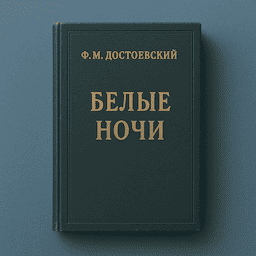
White Nights (Белые ночи) is a short novel by Fyodor Dostoevsky, published in 1848, long before Crime and Punishment. A lonely young man in St Petersburg meets a girl on the embankment one summer night. Over four nights she tells him her story and he falls in love with her, while she waits for another man. On the fifth day, in the morning, it's over.
Dostoevsky gave it a subtitle that tells you how to read it: a sentimental novel, from the memories of a dreamer. The "white nights" are the Petersburg summer nights when the sky never quite gets dark, and the whole story takes place in them.
The characters
The Dreamer (мечтатель) tells the story. He's twenty-six, poor, living on a small salary, and he has lived in Petersburg for eight years without making a single friend. He never gives his name. He knows the city's houses better than its people, and he introduces himself to Nastenka with a confession:
Я мечтатель; у меня так мало действительной жизни, что я такие минуты, как эту, как теперь, считаю так редко, что не могу не повторять этих минут в мечтаньях.
I'm a dreamer. I have so little real life that moments like this one, like now, are so rare for me that I can't help living them over again in my dreams.
Nastenka (Настенька) is seventeen. She lives with her blind grandmother, who is so afraid of losing her that she pins Nastenka's dress to her own. Nastenka is a diminutive of Anastasia (Анастасия). She tells the Dreamer only this name on the second night, and he loves it:
— Меня зовут — Настенька.
"My name is Nastenka."
The lodger (жилец) is the young man who rented the room upstairs from the grandmother. He lent Nastenka books, took her and her grandmother to The Barber of Seville, and left for Moscow for a year, promising to marry her if he could. He is barely on stage, and we never learn his name either.
Matryona (Матрёна, printed Матрена) is the Dreamer's old servant. She grows cobwebs on his ceiling, and she has the novel's last word of dialogue.
Summary, night by night
The first night
Petersburg has left for the summer and the Dreamer feels abandoned by the whole city. Walking home along a canal, he sees a girl crying by the railing. When a drunk gentleman follows her, the Dreamer rescues her. They talk, and agree to meet at the same place the next night, on condition that he doesn't fall in love with her.
The second night
Nastenka asks for his story, and he panics:
Но кто вам сказал, что у меня есть моя история? у меня нет истории...
But who told you I have a story? I have no story...
Instead he describes the "type" of the dreamer, in the third person, which is really his life. Then Nastenka tells her story: the grandmother, the pin, the lodger, the opera, and the promise. A year has passed. The lodger is back in Petersburg, and has been for three days, but he hasn't come. The Dreamer tells her to write the lodger a letter, and offers to deliver it.
The third night
No answer comes. Nastenka is happy anyway, sure the lodger will appear, and grateful to the Dreamer for one particular reason:
— Я оттого люблю вас, что вы не влюбились в меня.
"I love you because you haven't fallen in love with me."
It's the cruellest line in the book, and she says it kindly.
The fourth night
The lodger still hasn't come. Nastenka is in despair, and the Dreamer finally says it: я вас люблю, Настенька! She turns to him, and for a few pages they plan a future together. He will move into the room upstairs, and they laugh about going to the opera.
Spoiler warning: the rest of this summary reveals the ending.
As they walk, a young man passes, stops, and calls her name. It's the lodger. Nastenka runs to him, runs back to kiss the Dreamer, and leaves with the lodger.
The morning
The next morning it's raining, and Matryona brings a letter. Nastenka asks his forgiveness. She will marry the lodger next week, and she hopes the Dreamer will always be her friend and brother. As he reads, Matryona tells him she has finally taken down the cobwebs. He looks at her, and at his room, and sees himself fifteen years older, in the same room, just as alone.
Then the book's last lines. He refuses to resent her, blesses her happiness, and ends:
Боже мой! Целая минута блаженства! Да разве этого мало хоть бы и на всю жизнь человеческую?..
My God! A whole minute of bliss! Is that really so little, even for a whole human life?..
What White Nights means
The dreamer as a type
In the 1840s, the "dreamer" was a recognisable figure in Russian writing: a young man who lives in fantasies because real life frightens him. Dostoevsky's narrator knows he's one, and describes the type with a mix of tenderness and contempt:
Мечтатель — если нужно его подробное определение — не человек, а, знаете, какое-то существо среднего рода.
A dreamer, if you want a detailed definition, isn't a man at all but, you know, some sort of creature of the neuter gender.
Существо среднего рода is a joke for anyone who has learned Russian grammar. Средний род is the neuter gender, like окно or море. Dostoevsky is saying the dreamer isn't fully a man.
Loneliness in Petersburg
The city is a character. The Dreamer greets houses, almost bows to an old man he passes every day on the Fontanka, and feels betrayed when everyone leaves for their dachas. He has spent eight years in the capital and knows no one. White Nights is an early portrait of loneliness in the big city, and Dostoevsky came back to it all his life, most darkly in Notes from Underground.
Is the ending sad?
It depends on how you read the last line. The Dreamer will probably be alone forever. But he also says that one minute of real happiness is enough for a lifetime, and he means it. Nastenka isn't a villain: she was honest from the first night. The question the book leaves you with is whether the Dreamer's gratitude is noble or one more dream.
Why it's the best first Dostoevsky for learners
It's short. About 17,400 words in our edition, a tenth of Crime and Punishment and about a seventeenth of The Brothers Karamazov. You can finish it in a few weeks of steady reading.
It's in the first person and full of conversation. Two people talk, mostly about feelings, and the dialogue is far easier than the narration.
It repeats itself. The Dreamer says everything twice: никогда, никогда, завтра же, завтра же. For a learner, that's free revision.
Its grammar is useful. You'll meet the conditional если б (if only) again and again, as in Nastenka's letter: О, если б вы были он! (Oh, if only you were him!). The Dreamer answers in his head with the same words reversed. You'll also hear him say Настенька in nearly every line, and you'll get plenty of past tense storytelling.
Our analysis of which Russian classic to read first put it among the first novels to try, and our tips on how to read Dostoevsky in Russian start with it too.
Read it in Russian
You can read White Nights in full, free on our site, in Russian with a translation under every line. No app or account is needed. When you're ready for something bigger, see our guide to the Karamazov characters.
White Nights is short enough to finish and good enough to reread, which makes it the perfect first Dostoevsky in Russian. Our Learn Russian app has White Nights and six more Russian classics in full, with a translation under every line, along with the vocabulary and grammar to get you there. It's free to download, though some books and extra content need diamonds you earn while learning, or Premium.