Crime and Punishment Quotes in Russian (with Translation)
14 famous Crime and Punishment quotes in the original Russian, with an English translation, what each line means in the story and a word to learn.
 Learn RussianFree app with audio, quizzes and real books
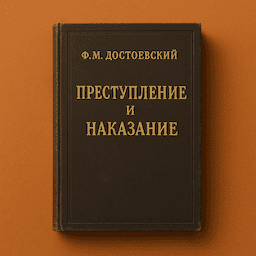
These are 14 of the most famous and most striking lines from Dostoevsky's Crime and Punishment (1866), in the original Russian with our own English translation. Each one comes with a note on where it falls in the story and one word or grammar point worth learning.
Every quote is copied from the full Russian text in our Learn Russian app. Some are shortened with "...", but nothing is reworded. They're grouped by theme, and the part and chapter are given so you can find them.
Spoiler warning: the quotes run through the whole novel, including the confession and the epilogue.
Poverty and the Marmeladovs
1. Poverty is no vice (Part 1, Chapter 2)
Милостивый государь, — начал он почти с торжественностию, — бедность не порок, это истина.
"My dear sir," he began, almost solemnly, "poverty is no vice, that's the truth."
The drunk clerk Marmeladov starts his confession to Raskolnikov in a tavern with a Russian proverb. Then he twists it: poverty is no vice, but beggary is.
Learn: порок means "vice". Notice there's no verb "is": Russian drops it in the present tense, so бедность не порок is a full sentence.
2. Nowhere else to go (Part 1, Chapter 2)
Ведь надобно же, чтобы всякому человеку хоть куда-нибудь можно было пойти.
Every man needs to have somewhere he can go, at least somewhere.
Marmeladov again, on going to ask for a loan you know you won't get, simply because there's no one else to ask. Raskolnikov will soon have nowhere to go either.
Learn: всякому человеку is dative, because in Russian "it is possible for someone" puts the person in the dative case: мне можно, ему можно.
3. Man gets used to everything (Part 1, Chapter 2)
Поплакали, и привыкли. Ко всему-то подлец-человек привыкает!
They cried, and they got used to it. Man, the scoundrel, gets used to everything!
Raskolnikov, walking home, thinks about the Marmeladov family living on the money Sonya earns on the street. This is one of the most quoted lines in the book.
Learn: привыкать к + dative, "to get used to": привыкнуть к городу, to get used to the city. The -то after всему adds bitter emphasis.
The theory
4. "I killed a principle" (Part 3, Chapter 6)
Старуха была только болезнь... я переступить поскорее хотел... я не человека убил, я принцип убил!
The old woman was just an illness... I wanted to step over as fast as I could... it wasn't a human being I killed, it was a principle!
Alone in his room, feverish, Raskolnikov tries to convince himself the murder was about an idea and not about a person.
Learn: переступить, "to step over", shares its root with the title word преступление (crime). Look at the two objects: человек is animate, so its accusative is человека, while the inanimate принцип stays the same. See the accusative case.
5. Suffering and pain (Part 3, Chapter 5)
Страдание и боль всегда обязательны для широкого сознания и глубокого сердца.
Suffering and pain are always unavoidable for a broad mind and a deep heart.
Raskolnikov to Porfiry, while defending his article on the "extraordinary man". The extraordinary man, he says, will suffer if he pities his victim.
Learn: обязательны is a short-form adjective (from обязательный, "compulsory"). Short forms are common after a subject, where English uses "are".
6. "I only killed a louse" (Part 5, Chapter 4)
— Я ведь только вошь убил, Соня, бесполезную, гадкую, зловредную.
— Это человек-то вошь!
"I only killed a louse, Sonya, a useless, nasty, harmful louse."
"A human being, a louse!"
Raskolnikov tries out his justification on Sonya, and she rejects it in a single line. Moments later he admits he doesn't believe it himself.
Learn: вошь (louse) is a feminine noun ending in a soft sign, so the adjectives take feminine accusative endings: бесполезную, гадкую.
7. Trembling creature (Part 5, Chapter 4)
Тварь ли я дрожащая или право имею...
Am I a trembling creature, or do I have the right...
The most famous line in the novel. He finally tells Sonya the real reason: he killed to find out which kind of person he was. Our Raskolnikov character analysis looks at this line in depth.
Learn: ли makes a yes/no question and comes right after the word it asks about. Дрожащая is a present active participle of дрожать, to tremble.
Guilt and confession
8. "I killed myself" (Part 5, Chapter 4)
Разве я старушонку убил? Я себя убил, а не старушонку!
Was it the old woman I killed? I killed myself, not the old woman!
The same scene, a few pages later. He has given up every excuse, and this is what is left: the murder destroyed the murderer.
Learn: старушонка is старуха (old woman) with the scornful suffix -онк-. Russian suffixes can make a word tender, small or contemptuous.
9. Bowing to all human suffering (Part 4, Chapter 4)
Я не тебе поклонился, я всему страданию человеческому поклонился.
It wasn't you I bowed down to, I bowed down to all human suffering.
On his first visit to Sonya's room, Raskolnikov suddenly drops to the floor and kisses her foot. She thinks he's mad. This is his explanation.
Learn: поклониться takes the dative: поклониться тебе, to bow to you. Putting не before тебе tells you which word is being denied.
10. "Go to the crossroads" (Part 5, Chapter 4)
Поди сейчас, сию же минуту, стань на перекрестке, поклонись, поцелуй сначала землю, которую ты осквернил, а потом поклонись всему свету, на все четыре стороны, и скажи всем, вслух: «Я убил!»
Go now, this very minute, and stand at the crossroads, bow down, first kiss the earth you have defiled, then bow to the whole world, to all four sides, and say out loud to everyone: "I have killed!"
Sonya's answer to his confession. In Part 6 he goes to the Haymarket and does kneel and kiss the ground, though he can't bring himself to say the words there.
Learn: a whole chain of perfective imperatives: поди, стань, поклонись, поцелуй, скажи. Поди is a colloquial imperative of пойти. See verb aspects.
11. "You did it" (Part 6, Chapter 2)
— да вы убили, Родион Романыч! Вы и убили-с...
"Why, you killed them, Rodion Romanych! It was you, sir..."
At their last meeting, Raskolnikov asks Porfiry who the murderer is, if not the painter who confessed. Porfiry answers almost in a whisper.
Learn: the -с on убили-с is a polite particle, a worn-down form of сударь (sir). Porfiry uses it constantly, to be polite and to mock at the same time. Романыч is the spoken form of Романович.
Svidrigailov and Razumikhin
12. Lie in your own way (Part 3, Chapter 1)
Ты мне ври, да ври по-своему, и я тебя тогда поцелую. Соврать по-своему — ведь это почти лучше, чем правда по одному по-чужому...
Lie to me, but lie in your own way, and I'll kiss you for it. Lying in your own way is almost better than telling the truth in someone else's...
Razumikhin, slightly drunk, at his most lovable. What he can't stand is people who only repeat other people's ideas. Getting things wrong in your own way, he says, is how people reach the truth.
Learn: по-своему (in one's own way) and по-чужому (in someone else's way) follow the pattern по- + adjective, like по-русски.
13. Eternity with spiders (Part 4, Chapter 1)
И вдруг, вместо всего этого, представьте себе, будет там одна комнатка, эдак вроде деревенской бани, закоптелая, а по всем углам пауки, и вот и вся вечность.
And suddenly, instead of all that, imagine there's just one little room there, something like a village bathhouse, black with soot, with spiders in every corner, and that's all eternity is.
Svidrigailov describes his idea of the afterlife on his first visit to Raskolnikov. It's one of the most chilling lines in Dostoevsky.
Learn: по всем углам, "in all the corners": по + dative plural for spreading across many places. Комнатка is a diminutive of комната.
14. "Gone to America" (Part 6, Chapter 6)
...коли тебя станут спрашивать, так и отвечай, что поехал, дескать, в Америку.
...if they ask you, just tell them he went off to America.
Svidrigailov's last words, to a watchman at dawn, just before he shoots himself. Earlier that night he had told Sonya he might be going to America. Here it means death.
Learn: поехать в + accusative for a destination, part of the verbs of motion. Дескать means "so to say", marking reported words.
And the last word
Их воскресила любовь, сердце одного заключало бесконечные источники жизни для сердца другого.
Love had raised them from the dead: each heart held endless sources of life for the other.
From the epilogue, in Siberia, when Raskolnikov and Sonya finally understand each other. It echoes the story of Lazarus that Sonya read to him in Part 4.
Learn: the word order. Их (them) is the object and comes first, любовь (love) is the subject and comes last. Russian puts the new, important information at the end, and cases make it clear who did what.
Read it in Russian
All of these lines come from the full text of Crime and Punishment in our app. You can read the opening pages free on our site, with a translation under every line. For the names and a reading plan, see our guide to Crime and Punishment for Russian learners.
Quotes like these hit harder when you reach them in the middle of the story, in Russian. Our Learn Russian app has Crime and Punishment in full, with a translation under every line, along with the vocabulary and grammar to get you there. It's free to download, though some books and extra content need diamonds you earn while learning, or Premium.