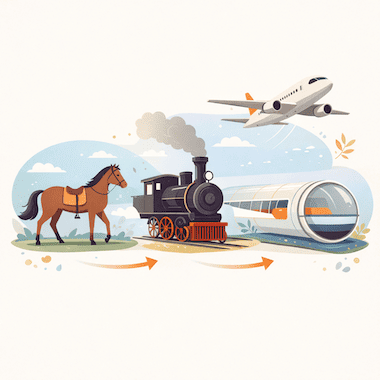
Evolution of Transportation
交通的演变
 Learn English免费应用:发音、测验和原版书
重点词汇
- transportation交通运输
- civilization文明
- domestication驯化
- invention发明
- navigation导航
- locomotive火车头
- empire帝国
- vessel船只
- infrastructure基础设施
- combustion燃烧
- autonomous自动驾驶的
- colonization殖民化
全部词汇(30)
- industrialization工业化
- emission排放
- levitation磁悬浮
- geopolitics地缘政治
- suburb郊区
- trade route贸易路线
- assembly line流水线
- propulsion推进
- transcontinental横贯大陆的
- perishable易腐烂的
- spacecraft航天器
- sustainable可持续的
- canal运河
- nomadic游牧的
- electrification电气化
- commute通勤
- supply chain供应链
- fatality死亡事故
Around 1750, a stagecoach from London to Edinburgh took ten days. Today the train does it in about four and a half hours. Changes like this run through the whole history of transportation: every faster way of moving people, goods and ideas has changed how people earn a living, what they eat and how their cities look.
1750年前后,从伦敦坐驿站马车到爱丁堡要走十天。如今,火车跑完这段路只需大约四个半小时。这样的飞跃贯穿了整部交通史:每一种更快地运送人员、货物和思想的方式,都改变了人们谋生的方式、餐桌上的食物,以及城市的面貌。
The story begins thousands of years ago with the first tamed horses and the first wooden wheels. It continues through sailing ships, steam trains, cars and jet planes, and today engineers are working on electric and self-driving vehicles. Again and again, new ways of traveling have not simply followed changes in society. They have helped cause them.
故事始于几千年前,从最早被驯服的马和最早的木轮开始。随后出现了帆船、蒸汽火车、汽车和喷气式飞机,如今工程师们正在研发电动汽车和自动驾驶车辆。一次又一次,新的出行方式并不只是跟随社会的变化,它们本身也推动了这些变化。
The Wheel: An Old Idea with a Slow Start
车轮:起步缓慢的古老发明
The wheel is often called humanity's greatest invention, but it is younger than many people think. The oldest evidence of wheeled vehicles dates from around 3500 BCE, at about the same time as the first writing. Pictures and remains of early carts and wagons have been found in Mesopotamia, Central Europe and the steppes north of the Black Sea, and archaeologists still debate where the idea appeared first.
车轮常被称为人类最伟大的发明,但它的历史比许多人想象的要短。带轮车辆最早的证据可以追溯到大约公元前3500年,与最早的文字出现的时间差不多。人们在美索不达米亚、中欧以及黑海以北的草原上都发现了早期车辆的图像和残骸,考古学家至今仍在争论这一想法最早出现在哪里。
The first wheels may not have been used for travel at all. Potters in Mesopotamia were already turning clay on slow wheels at about the same time, possibly even earlier. And many great civilizations did without wheeled transport. The Inca built a road network of about 40,000 kilometers across the Andes, but goods traveled on the backs of people and llamas. In ancient Mexico, wheels appear only on small clay animal figures. The builders of Egypt's pyramids moved huge stones on wooden sleds. The wheel was a good solution, but not the only one.
最早的轮子也许根本不是用来出行的。大约在同一时期,甚至可能更早,美索不达米亚的陶工就已经在缓慢转动的陶轮上制作陶器了。而且,许多伟大的文明并不依靠轮式运输。印加人在安第斯山脉修建了约4万公里的道路网,但货物靠人和羊驼背运。在古代墨西哥,轮子只出现在小小的陶土动物雕像上。建造埃及金字塔的人用木橇搬运巨石。车轮是一个好办法,但并不是唯一的办法。
Horses: Speed for the Ancient World
马:古代世界的速度
The taming of the horse was probably the most important change in transportation before the age of steam. It happened on the grasslands of Eurasia, and by about 2000 BCE horses were pulling light war chariots with spoked wheels. Horses gave people something new: speed. A rider could cover in one day a distance that took several days on foot, and that changed warfare, trade and the way rulers controlled large territories.
在蒸汽时代到来之前,马的驯化大概是交通史上最重要的变化。它发生在欧亚大陆的草原上,到公元前2000年左右,马已经在拉着装有辐条车轮的轻型战车了。马给人类带来了一样新东西:速度。骑手一天就能走完步行需要好几天的路程,这改变了战争、贸易,以及统治者控制广大领土的方式。
The horse changed some parts of the world more than others. The Mongol Empire of the 13th century, the largest connected land empire in history, was built on horseback. Its relay system, the Yam, had stations where messengers could change horses, so urgent news could travel a few hundred kilometers in a single day. Horses had died out in the Americas thousands of years earlier, and the Spanish brought them back from 1493. On the Great Plains of North America, peoples such as the Lakota and the Comanche built their whole way of life around the horse and became some of the strongest military powers on the continent.
马对世界各地的影响并不相同。13世纪的蒙古帝国是历史上面积最大的连成一片的陆上帝国,它是在马背上建立起来的。帝国的驿站系统“站赤”设有供信使换马的驿站,因此紧急消息一天之内就能传送几百公里。美洲的马早在数千年前就已灭绝,从1493年起,西班牙人又把马带回了美洲。在北美大平原上,拉科塔人、科曼奇人等民族围绕马建立起整个生活方式,并成为这片大陆上最强大的军事力量之一。
Sailing Ships: Roads Across the Ocean
帆船:横跨大洋的道路
For most of history, water was the easiest road. Before railways, the cheapest and fastest way to move heavy goods over long distances was by boat. Phoenician traders sailed across the Mediterranean, Arab dhows linked India, East Africa and the Persian Gulf for more than a thousand years, and Chinese junks carried silk and porcelain across Asian seas. The sea did not separate people. It connected them.
在人类历史的大部分时间里,水路是最便利的道路。在铁路出现之前,长途运送重货最便宜、最快的方式就是用船。腓尼基商人横渡地中海,阿拉伯三角帆船一千多年来连接着印度、东非和波斯湾,中国帆船则载着丝绸和瓷器往来于亚洲各海。大海并没有把人们隔开,而是把他们连在了一起。
In the 15th century, Portuguese and Spanish sailors began to cross the open ocean. Their caravels and carracks combined square sails with triangular lateen sails, and navigators found their position with the compass, the quadrant and the astrolabe. Vasco da Gama reached India by sea in 1498, and from the 1560s Spanish galleons sailed regularly between Mexico and Manila. For the first time, Europe, Africa, the Americas and Asia were linked in one trading system. It brought great wealth to some and terrible suffering to others, above all through the Atlantic slave trade and colonial rule.
15世纪,葡萄牙和西班牙的水手开始横渡开阔的大洋。他们的轻快帆船和卡拉克帆船把方形横帆和三角形的拉丁帆结合在一起,领航员用罗盘、象限仪和星盘确定船的位置。1498年,达·伽马经海路抵达印度;从16世纪60年代起,西班牙大帆船定期往返于墨西哥和马尼拉之间。欧洲、非洲、美洲和亚洲第一次被连入同一个贸易体系。它给一些人带来了巨额财富,也给另一些人带来了深重苦难,尤其是通过大西洋奴隶贸易和殖民统治。
The Age of Steam
蒸汽时代
In the early 19th century, the steam engine moved onto wheels and changed the meaning of distance. In 1829, George Stephenson's locomotive Rocket won a competition called the Rainhill Trials, reaching about 48 kilometers per hour. A year later the Liverpool and Manchester Railway opened, the first line to link two cities with steam trains only. Within a few decades, railways had spread across Britain, then Europe, and then the rest of the world.
19世纪初,蒸汽机装上了车轮,距离的意义从此改变。1829年,乔治·斯蒂芬森的“火箭号”机车在名为“雷恩希尔试验”的比赛中胜出,时速达到约48公里。一年后,利物浦至曼彻斯特铁路通车,这是第一条只用蒸汽火车连接两座城市的线路。几十年之内,铁路先遍布英国,接着扩展到欧洲,然后传遍世界其他地方。
The railway changed far more than travel times. Fresh milk, fish and vegetables could reach city markets, letters and newspapers arrived the next day, and workers could live outside the city and come in each morning. Trains also needed fixed timetables, so Britain adopted one standard time in the 1840s, and American railroads introduced time zones in 1883. When the first transcontinental railroad in the United States was completed in 1869, a trip from New York to California fell from months to about a week. At sea, steamships replaced sailing ships, and by the end of the century the Atlantic crossing took about a week instead of a month or more.
铁路改变的远不止旅行时间。新鲜的牛奶、鱼和蔬菜能够送到城市的市场,信件和报纸第二天就能到达,工人可以住在城外,每天早上进城上班。火车还需要固定的时刻表,因此英国在19世纪40年代采用了统一的标准时间,美国铁路公司则在1883年推行了时区。1869年,美国第一条横贯大陆的铁路建成,从纽约到加利福尼亚的行程从几个月缩短到大约一周。在海上,蒸汽船取代了帆船,到19世纪末,横渡大西洋只需大约一周,而不再是一个月甚至更久。
The Car: Freedom at a Price
汽车:自由的代价
Karl Benz's Patent-Motorwagen, patented in 1886, is usually seen as the first real automobile. But cars only became an everyday product after Henry Ford introduced the moving assembly line in 1913. Building a Model T suddenly took about an hour and a half instead of more than twelve hours, and its price kept falling until ordinary workers could buy one. This changed how people traveled, and before long it changed where they lived and worked too.
卡尔·本茨于1886年获得专利的“奔驰专利汽车”,通常被视为世界上第一辆真正的汽车。不过,直到1913年亨利·福特引入移动装配线之后,汽车才成为日常用品。组装一辆T型车的时间一下子从十二个多小时缩短到大约一个半小时,价格也不断下降,直到普通工人也买得起。这改变了人们的出行方式,不久之后也改变了人们居住和工作的地方。
In the 20th century, the car reshaped towns and cities. People moved out to the suburbs and drove to work, and shopping centers and offices grew up along the new highways. Oil became one of the most important goods in world politics. The car also brought heavy costs: polluted air, greenhouse gases that heat the planet, more than a million deaths on the roads every year, and cities planned for cars rather than for people. Few inventions have given people so much freedom and done so much damage at the same time.
20世纪,汽车重塑了城镇的面貌。人们搬到郊区,开车上班,购物中心和写字楼沿着新修的高速公路纷纷兴起。石油成为世界政治中最重要的商品之一。但汽车也带来了沉重的代价:污染的空气、使地球变暖的温室气体、每年一百多万人死于道路交通事故,以及为汽车而不是为人设计的城市。很少有哪项发明既给了人们如此多的自由,又造成了如此大的破坏。
Into the Air
飞向天空
On December 17, 1903, near Kitty Hawk, North Carolina, Orville and Wilbur Wright made the first controlled, powered flight in an airplane. Their longest flight that day lasted 59 seconds and covered about 260 meters. Just 66 years later, in 1969, two astronauts walked on the Moon. Few technologies have developed so quickly.
1903年12月17日,在北卡罗来纳州基蒂霍克附近,奥维尔·莱特和威尔伯·莱特完成了人类首次有动力、可操控的飞机飞行。他们那天最长的一次飞行持续了59秒,飞了大约260米。仅仅66年后,也就是1969年,两名宇航员在月球上行走。很少有技术发展得如此迅速。
Passenger jets came into regular service in the 1950s, and the Boeing 707, which started flying passengers in 1958, made long-distance flights common. A trip from London to New York that could take six weeks by sailing ship now takes about seven or eight hours. Cheap flights made mass tourism possible and helped companies build supply chains around the world. Today there are around 100,000 flights every day, carrying more than 12 million passengers.
喷气式客机在20世纪50年代投入定期航班运营,1958年开始载客的波音707让长途飞行变得普遍。从伦敦到纽约的旅程,乘帆船可能要六周,如今只需七八个小时左右。廉价航班使大众旅游成为可能,也帮助企业在全球建立起供应链。如今,每天大约有10万个航班,运送超过1200万名乘客。
The Future: Electric and Self-Driving
未来:电动与自动驾驶
Transportation is going through its biggest change since the age of steam. Electric cars are replacing petrol and diesel cars faster every year. In Norway, nearly all new cars sold are now electric, and China sells more electric cars than the rest of the world combined. Many governments have set targets to end or sharply cut sales of new petrol and diesel cars. Better batteries, more charging stations and lower prices make electric cars practical for more and more people.
交通正在经历蒸汽时代以来最大的变革。电动汽车取代汽油车和柴油车的速度一年比一年快。在挪威,几乎所有新售出的汽车都已是电动车,而中国的电动车销量超过了世界其他地区的总和。许多国家的政府都设定了目标,要停止或大幅减少新汽油车和柴油车的销售。更好的电池、更多的充电站和不断下降的价格,让电动车对越来越多的人来说切实可用。
Self-driving cars and trucks are moving from tests to real streets: robotaxis with no one at the wheel already carry paying passengers in several American and Chinese cities. Supporters say they could prevent many crashes, because human mistakes are involved in the great majority of them. High-speed rail keeps growing in Europe and Asia, and China alone has more than 45,000 kilometers of it, a lower-emission alternative to short flights. The hyperloop, an idea for capsules racing through low-pressure tubes, has been tested, but some of the best-known companies working on it have closed. SpaceX even suggests that rockets could one day carry passengers between cities on Earth, linking almost any two places in under an hour.
自动驾驶的汽车和卡车正从测试走上真正的街道:方向盘后面没有人的无人驾驶出租车,已经在美国和中国的多个城市载客收费。支持者说,它们可以避免许多交通事故,因为绝大多数事故都与人为失误有关。高速铁路在欧洲和亚洲不断扩展,仅中国就有超过4.5万公里,它是短途航班的一种低排放替代方式。超级高铁的设想是让胶囊舱在低压管道中高速飞驰,这一设想已经过试验,但该领域一些最知名的公司已经关闭。SpaceX甚至提出,火箭有朝一日可以在地球上的城市之间运送乘客,让几乎任意两地之间的旅程不到一小时。
A Few Surprising Facts
几个令人意外的事实
The first speeding fine was given in 1896 to Walter Arnold in Kent, England. He was driving at 8 mph (about 13 km/h), four times the limit of 2 mph.
历史上第一张超速罚单于1896年开给了英格兰肯特郡的沃尔特·阿诺德。他当时的车速是每小时8英里(约13公里),是每小时2英里限速的四倍。
Japan's Shinkansen bullet trains have carried more than 10 billion passengers since 1964, and no passenger has ever died in a derailment or collision.
自1964年以来,日本新干线已运送超过100亿人次乘客,从未有乘客在脱轨或碰撞事故中丧生。
The London Underground, opened in 1863, is the oldest metro in the world. Its first trains ran on steam, so the tunnels were full of smoke.
伦敦地铁于1863年开通,是世界上最古老的地铁。最早的列车靠蒸汽驱动,所以隧道里满是烟雾。
The Panama Canal, opened in 1914, cut the sea route from New York to San Francisco from about 22,500 kilometers around Cape Horn to about 9,500.
1914年开通的巴拿马运河,把纽约到旧金山的海上航线从绕道合恩角的约22500公里缩短到约9500公里。
For every kilometer, a person on a bicycle uses less energy than any other traveler, even someone walking.
每行进一公里,骑自行车的人消耗的能量比其他任何出行者都少,甚至比步行的人还少。
Voyager 1, launched in 1977, is the most distant object people have ever built. It is now more than 25 billion kilometers from Earth.
1977年发射的旅行者1号是人类制造的距离最远的物体。它如今距离地球已超过250亿公里。
How Transportation Shapes Society
交通如何塑造社会
Each big change in transportation has changed the way societies are organized. The horse made nomadic empires possible. Sailing ships created world trade and colonial empires. Railways drove industry and helped hold together large countries such as the United States. The car created suburbs and economies that depend on oil, and the airplane made global tourism and worldwide supply chains possible. Each new technology gave people new freedoms, and each one also created new dependencies.
交通的每一次重大变革,都改变了社会的组织方式。马让游牧帝国成为可能。帆船造就了世界贸易和殖民帝国。铁路推动了工业发展,也帮助美国这样的大国凝聚为一体。汽车催生了郊区和依赖石油的经济,飞机则让全球旅游和遍布世界的供应链成为可能。每一项新技术都给人们带来了新的自由,也都带来了新的依赖。
The next change, driven by electric motors and automation, may be just as large. Cities that were planned around cars could be redesigned for people on foot and on bicycles. If self-driving vehicles work as promised, they could bring down the number of road deaths, which is now about 1.2 million around the world each year. Knowing how earlier changes played out can help us make better choices about the next one.
下一次变革由电动机和自动化推动,其规模可能同样巨大。围绕汽车规划的城市,可能会为步行者和骑车人重新设计。如果自动驾驶车辆真能像人们承诺的那样运行,就可能减少道路交通死亡人数,目前全世界每年约有120万人死于交通事故。了解以往的变革如何展开,可以帮助我们为下一次变革做出更好的选择。
Conclusion
结语
From the first carts rolling through Mesopotamia to a spacecraft traveling far beyond the planets, transportation shows the same pattern again and again. Each generation has found ways to travel farther, faster and more cheaply than the one before.
从最早在美索不达米亚滚动的车,到远远飞越行星的太空探测器,交通的历史一次又一次呈现出相同的规律。每一代人都找到了比上一代走得更远、更快、更便宜的方法。
But transportation has never been only about getting from one place to another. It also decides who can travel, what it costs, and what it does to the places around us. The challenge now is not mainly to go faster. It is to travel in ways that are cleaner, fairer and safer for the people who will live on this planet after us.
但交通从来都不只是从一个地方到另一个地方。它还决定了谁能出行、要付出多少代价,以及对我们周围的地方产生什么影响。如今的挑战主要不在于走得更快,而在于以更清洁、更公平、更安全的方式出行,为将来生活在这颗星球上的人着想。
在免费应用里可以听这篇文章的朗读,点一下任意单词就能看到释义。