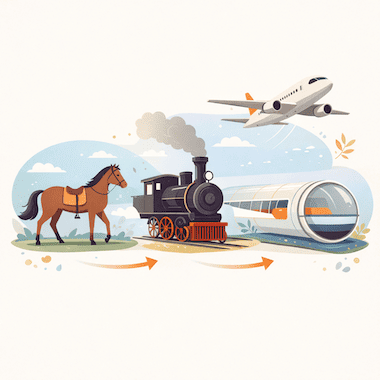
Evolution of Transportation
교통의 발전
 Learn English음성, 퀴즈, 원서까지 담은 무료 앱
핵심 단어
- transportation교통
- civilization문명
- domestication가축화
- invention발명
- navigation항해
- locomotive기관차
- empire제국
- vessel선박
- infrastructure인프라
- combustion연소
- autonomous자율적인
- colonization식민지화
단어 전체 보기 (30)
- industrialization산업화
- emission배출
- levitation자기부상
- geopolitics지정학
- suburb교외
- trade route무역로
- assembly line조립 라인
- propulsion추진
- transcontinental대륙횡단의
- perishable부패하기 쉬운
- spacecraft우주선
- sustainable지속 가능한
- canal운하
- nomadic유목의
- electrification전기화
- commute통근
- supply chain공급망
- fatality사망자
Around 1750, a stagecoach from London to Edinburgh took ten days. Today the train does it in about four and a half hours. Changes like this run through the whole history of transportation: every faster way of moving people, goods and ideas has changed how people earn a living, what they eat and how their cities look.
1750년 무렵 런던에서 에든버러까지 역마차로 가면 열흘이 걸렸습니다. 오늘날 기차는 같은 거리를 약 4시간 반 만에 달립니다. 교통의 역사는 이런 도약의 연속입니다. 사람과 물건과 생각을 더 빨리 옮기는 방법이 생길 때마다 사람들이 먹고사는 방식, 먹는 음식, 그리고 도시의 모습이 바뀌었습니다.
The story begins thousands of years ago with the first tamed horses and the first wooden wheels. It continues through sailing ships, steam trains, cars and jet planes, and today engineers are working on electric and self-driving vehicles. Again and again, new ways of traveling have not simply followed changes in society. They have helped cause them.
이야기는 수천 년 전, 처음 길들인 말과 처음 만든 나무 바퀴에서 시작됩니다. 이어서 범선, 증기 기관차, 자동차, 제트기가 등장했고, 오늘날 기술자들은 전기차와 자율주행차를 개발하고 있습니다. 새로운 이동 수단은 사회의 변화를 그저 뒤따르기만 한 것이 아닙니다. 몇 번이고 그 변화를 일으키는 데 힘을 보탰습니다.
The Wheel: An Old Idea with a Slow Start
바퀴: 천천히 퍼진 오래된 아이디어
The wheel is often called humanity's greatest invention, but it is younger than many people think. The oldest evidence of wheeled vehicles dates from around 3500 BCE, at about the same time as the first writing. Pictures and remains of early carts and wagons have been found in Mesopotamia, Central Europe and the steppes north of the Black Sea, and archaeologists still debate where the idea appeared first.
바퀴는 흔히 인류 최고의 발명으로 불리지만, 많은 사람이 생각하는 것만큼 오래되지는 않았습니다. 바퀴 달린 탈것의 가장 오래된 증거는 기원전 3500년 무렵의 것으로, 최초의 문자가 나타난 때와 비슷합니다. 초기 수레와 마차의 그림과 유물은 메소포타미아, 중부 유럽, 흑해 북쪽의 초원에서 발견되었으며, 이 아이디어가 처음 어디에서 나왔는지를 두고 고고학자들은 지금도 논쟁하고 있습니다.
The first wheels may not have been used for travel at all. Potters in Mesopotamia were already turning clay on slow wheels at about the same time, possibly even earlier. And many great civilizations did without wheeled transport. The Inca built a road network of about 40,000 kilometers across the Andes, but goods traveled on the backs of people and llamas. In ancient Mexico, wheels appear only on small clay animal figures. The builders of Egypt's pyramids moved huge stones on wooden sleds. The wheel was a good solution, but not the only one.
최초의 바퀴는 아예 이동을 위한 것이 아니었을지도 모릅니다. 메소포타미아의 도공들은 거의 같은 시기, 어쩌면 그보다 먼저 천천히 도는 물레로 진흙을 빚고 있었습니다. 또한 많은 위대한 문명이 바퀴를 이용한 운송 없이 살았습니다. 잉카 사람들은 안데스산맥을 가로질러 약 4만 킬로미터에 이르는 도로망을 건설했지만, 짐은 사람과 라마의 등에 실어 날랐습니다. 고대 멕시코에서는 바퀴가 흙으로 만든 작은 동물 인형에만 나타납니다. 이집트 피라미드를 세운 사람들은 거대한 돌을 나무 썰매로 옮겼습니다. 바퀴는 좋은 해결책이었지만 유일한 해결책은 아니었습니다.
Horses: Speed for the Ancient World
말: 고대 세계에 속도를 준 동물
The taming of the horse was probably the most important change in transportation before the age of steam. It happened on the grasslands of Eurasia, and by about 2000 BCE horses were pulling light war chariots with spoked wheels. Horses gave people something new: speed. A rider could cover in one day a distance that took several days on foot, and that changed warfare, trade and the way rulers controlled large territories.
말을 길들인 것은 아마 증기 시대 이전 교통에서 가장 중요한 변화였을 것입니다. 이 일은 유라시아의 초원에서 일어났으며, 기원전 2000년 무렵에는 말이 바큇살 달린 바퀴를 단 가벼운 전차를 끌고 있었습니다. 말은 사람들에게 새로운 것을 주었습니다. 바로 속도입니다. 말 탄 사람은 걸어서 며칠 걸리는 거리를 하루 만에 갈 수 있었고, 이것은 전쟁과 교역, 그리고 통치자가 넓은 영토를 다스리는 방식을 바꾸었습니다.
The horse changed some parts of the world more than others. The Mongol Empire of the 13th century, the largest connected land empire in history, was built on horseback. Its relay system, the Yam, had stations where messengers could change horses, so urgent news could travel a few hundred kilometers in a single day. Horses had died out in the Americas thousands of years earlier, and the Spanish brought them back from 1493. On the Great Plains of North America, peoples such as the Lakota and the Comanche built their whole way of life around the horse and became some of the strongest military powers on the continent.
말은 세계의 어떤 지역을 다른 지역보다 더 크게 바꾸었습니다. 13세기의 몽골 제국은 역사상 가장 넓은 연속된 육상 제국이었으며, 말 등 위에서 세워졌습니다. 잠이라고 불린 역참 제도에는 전령이 말을 바꿔 탈 수 있는 역이 있어서, 급한 소식은 하루에 수백 킬로미터를 갈 수 있었습니다. 아메리카에서는 말이 수천 년 전에 멸종했는데, 1493년부터 스페인 사람들이 다시 들여왔습니다. 북아메리카의 대평원에서는 라코타족과 코만치족 같은 민족이 말을 중심으로 삶의 방식 전체를 꾸렸고, 대륙에서 가장 강한 군사 세력 가운데 하나가 되었습니다.
Sailing Ships: Roads Across the Ocean
범선: 바다를 건너는 길
For most of history, water was the easiest road. Before railways, the cheapest and fastest way to move heavy goods over long distances was by boat. Phoenician traders sailed across the Mediterranean, Arab dhows linked India, East Africa and the Persian Gulf for more than a thousand years, and Chinese junks carried silk and porcelain across Asian seas. The sea did not separate people. It connected them.
역사의 대부분 동안 물길은 가장 쉬운 길이었습니다. 철도가 생기기 전에는 무거운 짐을 먼 곳까지 나르는 가장 싸고 빠른 방법이 배였습니다. 페니키아 상인들은 지중해를 건넜고, 아랍의 다우선은 천 년 넘게 인도와 동아프리카와 페르시아만을 이었으며, 중국의 정크선은 비단과 도자기를 싣고 아시아의 바다를 오갔습니다. 바다는 사람들을 갈라놓지 않았습니다. 오히려 이어 주었습니다.
In the 15th century, Portuguese and Spanish sailors began to cross the open ocean. Their caravels and carracks combined square sails with triangular lateen sails, and navigators found their position with the compass, the quadrant and the astrolabe. Vasco da Gama reached India by sea in 1498, and from the 1560s Spanish galleons sailed regularly between Mexico and Manila. For the first time, Europe, Africa, the Americas and Asia were linked in one trading system. It brought great wealth to some and terrible suffering to others, above all through the Atlantic slave trade and colonial rule.
15세기에 포르투갈과 스페인의 선원들이 넓은 대양을 건너기 시작했습니다. 그들의 캐러벨선과 캐랙선은 네모난 가로돛과 삼각형의 라틴 돛을 함께 사용했고, 항해사들은 나침반과 사분의와 아스트롤라베로 배의 위치를 알아냈습니다. 바스쿠 다 가마는 1498년에 바닷길로 인도에 도착했고, 1560년대부터는 스페인의 갈레온선이 멕시코와 마닐라 사이를 정기적으로 오갔습니다. 처음으로 유럽, 아프리카, 아메리카, 아시아가 하나의 무역 체계로 연결되었습니다. 이 체계는 어떤 이들에게는 막대한 부를, 다른 이들에게는 끔찍한 고통을 가져다주었습니다. 특히 대서양 노예 무역과 식민 지배가 그러했습니다.
The Age of Steam
증기의 시대
In the early 19th century, the steam engine moved onto wheels and changed the meaning of distance. In 1829, George Stephenson's locomotive Rocket won a competition called the Rainhill Trials, reaching about 48 kilometers per hour. A year later the Liverpool and Manchester Railway opened, the first line to link two cities with steam trains only. Within a few decades, railways had spread across Britain, then Europe, and then the rest of the world.
19세기 초, 증기 기관이 바퀴 위에 올라가면서 거리의 의미 자체가 바뀌었습니다. 1829년 조지 스티븐슨의 기관차 로켓호는 레인힐 시험이라는 대회에서 시속 약 48킬로미터를 내며 우승했습니다. 1년 뒤에는 리버풀 맨체스터 철도가 개통되었는데, 이것은 증기 기관차만으로 두 도시를 이은 최초의 노선입니다. 몇십 년 만에 철도는 영국 전역으로, 이어 유럽으로, 그리고 세계 곳곳으로 퍼져 나갔습니다.
The railway changed far more than travel times. Fresh milk, fish and vegetables could reach city markets, letters and newspapers arrived the next day, and workers could live outside the city and come in each morning. Trains also needed fixed timetables, so Britain adopted one standard time in the 1840s, and American railroads introduced time zones in 1883. When the first transcontinental railroad in the United States was completed in 1869, a trip from New York to California fell from months to about a week. At sea, steamships replaced sailing ships, and by the end of the century the Atlantic crossing took about a week instead of a month or more.
철도가 바꾼 것은 이동 시간만이 아니었습니다. 신선한 우유와 생선과 채소가 도시의 시장에 닿을 수 있게 되었고, 편지와 신문은 다음 날 도착했으며, 노동자들은 도시 밖에 살면서 매일 아침 도시로 출근할 수 있게 되었습니다. 열차에는 정해진 시간표도 필요했기 때문에, 영국은 1840년대에 하나의 표준시를 도입했고 미국 철도 회사들은 1883년에 시간대를 도입했습니다. 1869년 미국 최초의 대륙 횡단 철도가 완성되자, 뉴욕에서 캘리포니아까지 가는 여정은 몇 달에서 약 일주일로 줄었습니다. 바다에서는 증기선이 범선을 대신했고, 19세기 말에는 대서양을 건너는 데 한 달 이상이 아니라 약 일주일이면 충분했습니다.
The Car: Freedom at a Price
자동차: 대가가 따르는 자유
Karl Benz's Patent-Motorwagen, patented in 1886, is usually seen as the first real automobile. But cars only became an everyday product after Henry Ford introduced the moving assembly line in 1913. Building a Model T suddenly took about an hour and a half instead of more than twelve hours, and its price kept falling until ordinary workers could buy one. This changed how people traveled, and before long it changed where they lived and worked too.
1886년 카를 벤츠가 특허를 받은 파텐트 모토르바겐은 흔히 최초의 진정한 자동차로 여겨집니다. 하지만 자동차가 일상적인 상품이 된 것은 1913년 헨리 포드가 이동식 조립 라인을 도입한 뒤였습니다. 모델 T 한 대를 조립하는 데 걸리는 시간이 12시간 이상에서 갑자기 약 1시간 30분으로 줄었고, 가격도 계속 내려가 마침내 평범한 노동자도 살 수 있게 되었습니다. 이것은 사람들이 이동하는 방식을 바꾸었고, 곧 사람들이 사는 곳과 일하는 곳까지 바꾸었습니다.
In the 20th century, the car reshaped towns and cities. People moved out to the suburbs and drove to work, and shopping centers and offices grew up along the new highways. Oil became one of the most important goods in world politics. The car also brought heavy costs: polluted air, greenhouse gases that heat the planet, more than a million deaths on the roads every year, and cities planned for cars rather than for people. Few inventions have given people so much freedom and done so much damage at the same time.
20세기에 자동차는 마을과 도시의 모습을 새로 만들었습니다. 사람들은 교외로 이사해 차로 출근했고, 새로 생긴 고속도로를 따라 쇼핑센터와 사무실이 들어섰습니다. 석유는 세계 정치에서 가장 중요한 상품 가운데 하나가 되었습니다. 그러나 자동차는 큰 대가도 가져왔습니다. 더러워진 공기, 지구를 데우는 온실가스, 해마다 100만 명이 넘는 교통사고 사망자, 그리고 사람이 아니라 자동차를 위해 설계된 도시입니다. 이렇게 많은 자유를 주면서 동시에 이렇게 큰 피해를 준 발명은 드뭅니다.
Into the Air
하늘로
On December 17, 1903, near Kitty Hawk, North Carolina, Orville and Wilbur Wright made the first controlled, powered flight in an airplane. Their longest flight that day lasted 59 seconds and covered about 260 meters. Just 66 years later, in 1969, two astronauts walked on the Moon. Few technologies have developed so quickly.
1903년 12월 17일, 노스캐롤라이나주 키티호크 근처에서 오빌 라이트와 윌버 라이트 형제가 동력 비행기로 처음으로 조종 비행에 성공했습니다. 그날 가장 긴 비행은 59초 동안 이어졌고 약 260미터를 날았습니다. 불과 66년 뒤인 1969년, 두 우주 비행사가 달 위를 걸었습니다. 이토록 빠르게 발전한 기술은 드뭅니다.
Passenger jets came into regular service in the 1950s, and the Boeing 707, which started flying passengers in 1958, made long-distance flights common. A trip from London to New York that could take six weeks by sailing ship now takes about seven or eight hours. Cheap flights made mass tourism possible and helped companies build supply chains around the world. Today there are around 100,000 flights every day, carrying more than 12 million passengers.
제트 여객기는 1950년대에 정기 노선에 투입되었고, 1958년부터 승객을 태운 보잉 707은 장거리 비행을 흔한 일로 만들었습니다. 범선으로 6주가 걸리기도 했던 런던에서 뉴욕까지의 여행이 지금은 7~8시간 정도면 됩니다. 값싼 항공편은 대중 관광을 가능하게 했고, 기업들이 전 세계에 공급망을 구축하도록 도왔습니다. 오늘날에는 매일 약 10만 편의 항공기가 1,200만 명이 넘는 승객을 실어 나릅니다.
The Future: Electric and Self-Driving
미래: 전기와 자율주행
Transportation is going through its biggest change since the age of steam. Electric cars are replacing petrol and diesel cars faster every year. In Norway, nearly all new cars sold are now electric, and China sells more electric cars than the rest of the world combined. Many governments have set targets to end or sharply cut sales of new petrol and diesel cars. Better batteries, more charging stations and lower prices make electric cars practical for more and more people.
교통은 지금 증기의 시대 이후 가장 큰 변화를 겪고 있습니다. 전기차가 휘발유차와 디젤차를 대신하는 속도는 해마다 빨라지고 있습니다. 노르웨이에서는 새로 팔리는 차의 거의 전부가 이미 전기차이며, 중국은 나머지 세계를 모두 합친 것보다 더 많은 전기차를 판매합니다. 많은 나라의 정부가 휘발유차와 디젤차 신차 판매를 끝내거나 크게 줄이겠다는 목표를 세웠습니다. 더 좋은 배터리, 더 많은 충전소, 낮아진 가격 덕분에 전기차는 점점 더 많은 사람에게 실용적인 선택이 되고 있습니다.
Self-driving cars and trucks are moving from tests to real streets: robotaxis with no one at the wheel already carry paying passengers in several American and Chinese cities. Supporters say they could prevent many crashes, because human mistakes are involved in the great majority of them. High-speed rail keeps growing in Europe and Asia, and China alone has more than 45,000 kilometers of it, a lower-emission alternative to short flights. The hyperloop, an idea for capsules racing through low-pressure tubes, has been tested, but some of the best-known companies working on it have closed. SpaceX even suggests that rockets could one day carry passengers between cities on Earth, linking almost any two places in under an hour.
자율주행 승용차와 트럭은 시험 단계를 넘어 실제 거리로 나오고 있습니다. 운전석에 아무도 없는 로보택시가 이미 미국과 중국의 여러 도시에서 요금을 내는 승객을 태우고 있습니다. 지지하는 사람들은 사고의 대부분에 사람의 실수가 관련되어 있으므로 자율주행차가 많은 사고를 막을 수 있다고 말합니다. 고속철도는 유럽과 아시아에서 계속 늘어나고 있으며, 중국에만 4만 5,000킬로미터가 넘는 노선이 있습니다. 고속철도는 단거리 항공편을 대신할 수 있는, 배출가스가 더 적은 수단입니다. 저압 튜브 안을 캡슐이 빠르게 달리는 하이퍼루프 구상은 시험까지 이루어졌지만, 이 분야에서 가장 잘 알려진 회사 몇 곳은 문을 닫았습니다. 스페이스X는 언젠가 로켓이 지구의 도시와 도시 사이로 승객을 실어 나르고, 거의 어떤 두 곳이든 1시간 안에 이어 줄 수 있다고까지 말합니다.
A Few Surprising Facts
몇 가지 놀라운 사실
The first speeding fine was given in 1896 to Walter Arnold in Kent, England. He was driving at 8 mph (about 13 km/h), four times the limit of 2 mph.
역사상 첫 과속 벌금은 1896년 잉글랜드 켄트의 월터 아널드에게 부과되었습니다. 그는 시속 8마일(약 13킬로미터)로 달렸는데, 이는 제한 속도인 시속 2마일의 네 배였습니다.
Japan's Shinkansen bullet trains have carried more than 10 billion passengers since 1964, and no passenger has ever died in a derailment or collision.
일본의 신칸센 고속 열차는 1964년 이후 100억 명이 넘는 승객을 실어 날랐지만, 탈선이나 충돌로 목숨을 잃은 승객은 한 명도 없습니다.
The London Underground, opened in 1863, is the oldest metro in the world. Its first trains ran on steam, so the tunnels were full of smoke.
1863년에 개통한 런던 지하철은 세계에서 가장 오래된 지하철입니다. 초기 열차는 증기로 달렸기 때문에 터널이 연기로 가득했습니다.
The Panama Canal, opened in 1914, cut the sea route from New York to San Francisco from about 22,500 kilometers around Cape Horn to about 9,500.
1914년에 개통한 파나마 운하는 뉴욕에서 샌프란시스코까지의 바닷길을 혼곶을 도는 약 2만 2,500킬로미터에서 약 9,500킬로미터로 줄였습니다.
For every kilometer, a person on a bicycle uses less energy than any other traveler, even someone walking.
1킬로미터를 갈 때 자전거를 탄 사람은 다른 어떤 여행자보다, 심지어 걷는 사람보다도 에너지를 적게 씁니다.
Voyager 1, launched in 1977, is the most distant object people have ever built. It is now more than 25 billion kilometers from Earth.
1977년에 발사된 보이저 1호는 사람이 만든 물체 가운데 가장 멀리 있는 물체입니다. 지금은 지구에서 250억 킬로미터 넘게 떨어져 있습니다.
How Transportation Shapes Society
교통이 사회를 만드는 방식
Each big change in transportation has changed the way societies are organized. The horse made nomadic empires possible. Sailing ships created world trade and colonial empires. Railways drove industry and helped hold together large countries such as the United States. The car created suburbs and economies that depend on oil, and the airplane made global tourism and worldwide supply chains possible. Each new technology gave people new freedoms, and each one also created new dependencies.
교통의 큰 변화는 그때마다 사회가 조직되는 방식도 바꾸었습니다. 말은 유목 제국을 가능하게 했습니다. 범선은 세계 무역과 식민 제국을 낳았습니다. 철도는 산업을 이끌었고 미국 같은 큰 나라가 하나로 묶이도록 도왔습니다. 자동차는 교외와 석유에 의존하는 경제를 만들었고, 비행기는 세계 관광과 전 세계에 걸친 공급망을 가능하게 했습니다. 새로운 기술은 모두 사람들에게 새로운 자유를 주었고, 동시에 모두 새로운 의존을 만들어 냈습니다.
The next change, driven by electric motors and automation, may be just as large. Cities that were planned around cars could be redesigned for people on foot and on bicycles. If self-driving vehicles work as promised, they could bring down the number of road deaths, which is now about 1.2 million around the world each year. Knowing how earlier changes played out can help us make better choices about the next one.
전기 모터와 자동화가 이끄는 다음 변화도 그만큼 클 수 있습니다. 자동차를 중심으로 계획된 도시는 걷는 사람과 자전거 타는 사람을 위해 다시 설계될 수 있습니다. 자율주행차가 약속대로 작동한다면, 현재 전 세계에서 해마다 약 120만 명에 이르는 교통사고 사망자 수를 줄일 수 있을 것입니다. 과거의 변화가 어떻게 전개되었는지 아는 것은 다음 변화에 대해 더 나은 선택을 하는 데 도움이 됩니다.
Conclusion
맺음말
From the first carts rolling through Mesopotamia to a spacecraft traveling far beyond the planets, transportation shows the same pattern again and again. Each generation has found ways to travel farther, faster and more cheaply than the one before.
메소포타미아를 굴러가던 최초의 수레에서 행성들 너머 멀리 날아가는 우주 탐사선에 이르기까지, 교통의 역사에는 같은 흐름이 되풀이됩니다. 모든 세대가 앞 세대보다 더 멀리, 더 빨리, 더 싸게 이동하는 방법을 찾아냈습니다.
But transportation has never been only about getting from one place to another. It also decides who can travel, what it costs, and what it does to the places around us. The challenge now is not mainly to go faster. It is to travel in ways that are cleaner, fairer and safer for the people who will live on this planet after us.
그러나 교통은 한 번도 그저 한곳에서 다른 곳으로 가는 일에 그친 적이 없습니다. 누가 이동할 수 있는지, 비용이 얼마나 드는지, 우리 주변의 장소에 어떤 영향을 주는지도 결정합니다. 지금의 과제는 무엇보다 더 빨리 가는 것이 아닙니다. 우리 뒤에 이 행성에서 살아갈 사람들을 위해 더 깨끗하고, 더 공정하고, 더 안전한 방식으로 이동하는 것입니다.
무료 앱에서는 이 글을 음성으로 듣고, 단어를 누르면 뜻을 바로 볼 수 있습니다.