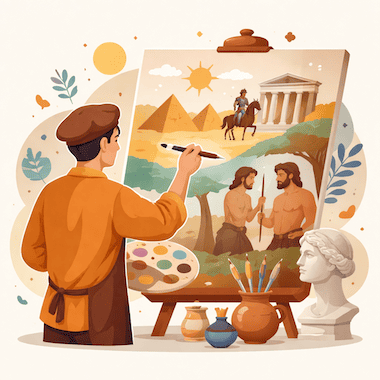
Storytelling Through Art
예술로 이야기하기
 Learn English음성, 퀴즈, 원서까지 담은 무료 앱
핵심 단어
- composition구성
- perspective원근법
- pigment색소
- portrait초상화
- fresco프레스코
- etching에칭
- realism사실주의
- abstraction추상
- woodblock print목판화
- symbolism상징주의
- anatomy해부학
- mural벽화
단어 전체 보기 (30)
- self-portrait자화상
- piety경건함
- atrocity잔학 행위
- shading음영
- legitimacy정당성
- antiquity고대
- meditation명상
- ritual의식
- anguish고뇌
- testimony증언
- auction경매
- genealogy계보
- stencil스텐실
- tomb무덤
- carving조각
- infrared적외선
- photography사진
- existential실존적인
Long before people could write, they told stories with pictures. The cave paintings of Lascaux in southwestern France, found by four teenagers in 1940, are about 17,000 years old, and they are not random marks. Bulls, horses and deer are painted with care and skill, and some scenes may show hunts or rituals.
인류는 글을 쓸 줄 알기 훨씬 전부터 그림으로 이야기를 전했습니다. 프랑스 남서부의 라스코 동굴은 1940년에 십 대 소년 네 명이 발견했는데, 그곳의 벽화는 약 1만 7000년 전의 것이며 결코 아무렇게나 그은 낙서가 아닙니다. 황소와 말, 사슴이 정성껏 능숙하게 그려져 있고, 일부 장면은 사냥이나 의식을 나타낸 것일 수도 있습니다.
Paintings can do something that words can't: they let you see a moment from centuries ago as if you were standing in the room. A painting shows how people dressed, what they valued, how they saw themselves and what their world looked like. If you learn to read paintings as historical sources, you get a view of the past that no written text can give you.
그림은 말로는 할 수 없는 일을 해냅니다. 수백 년 전의 한순간을 마치 그 방 안에 서 있는 것처럼 보여 주는 것입니다. 그림 한 점은 사람들이 어떻게 옷을 입었는지, 무엇을 소중히 여겼는지, 스스로를 어떻게 보았는지, 그리고 그들의 세계가 어떤 모습이었는지 보여 줍니다. 그림을 역사 자료로 읽는 법을 배우면, 어떤 글도 줄 수 없는 방식으로 과거를 바라볼 수 있습니다.
Cave Art: The First Stories
동굴 미술: 최초의 이야기
The Chauvet Cave in southern France holds some of the oldest paintings in Europe, made about 36,000 years ago. Its horses, lions, mammoths and rhinoceroses are drawn with real skill. The artists used shading and the natural shape of the rock to make the animals look solid, and they drew some legs and heads several times, as if the animals were moving. Even older cave art has been found on the Indonesian island of Sulawesi, where a painted scene of human figures and a wild pig is at least 51,000 years old.
프랑스 남부의 쇼베 동굴에는 유럽에서 가장 오래된 축에 드는 벽화가 남아 있는데, 약 3만 6000년 전에 그려졌습니다. 이곳의 말, 사자, 매머드, 코뿔소는 뛰어난 솜씨로 그려져 있습니다. 화가들은 명암과 바위의 자연스러운 굴곡을 이용해 동물을 입체적으로 보이게 했고, 다리와 머리를 여러 번 겹쳐 그려 마치 동물이 움직이는 것처럼 표현했습니다. 이보다 더 오래된 동굴 미술은 인도네시아의 술라웨시섬에서 발견되었는데, 사람 형상과 멧돼지를 그린 장면은 적어도 5만 1000년 전의 것입니다.
Hand stencils are found in caves all over the world. People pressed a hand against the wall and blew paint around it, leaving its outline on the rock. Some on Sulawesi are around 40,000 years old, and the Cave of the Hands in Argentina has hundreds of them, some made about 9,000 years ago. No one knows exactly what they meant. Perhaps the message was the simplest one possible: I was here.
손 스텐실은 전 세계의 동굴에서 발견됩니다. 사람들은 손을 벽에 대고 그 주위에 물감을 불어서 바위에 손의 윤곽을 남겼습니다. 술라웨시섬의 일부 손 스텐실은 약 4만 년 전의 것이며, 아르헨티나의 '손의 동굴'(쿠에바 데 라스 마노스)에는 수백 개가 있는데 그중 일부는 약 9000년 전에 만들어졌습니다. 그것이 정확히 무엇을 뜻했는지는 아무도 모릅니다. 어쩌면 그 메시지는 가장 단순한 것, '나는 여기 있었다'였을지도 모릅니다.
Egyptian Art: Order and Eternity
이집트 미술: 질서와 영원
Ancient Egyptian art followed strict rules that changed very little in 3,000 years. A figure usually has its head and legs in profile, while the eye and the shoulders face the viewer. To modern eyes this looks strange, but Egyptian artists were not clumsy. They chose this style on purpose, because of what their art was for.
고대 이집트 미술은 엄격한 규칙을 따랐고, 그 규칙은 3000년 동안 거의 바뀌지 않았습니다. 인물은 보통 머리와 다리는 옆모습인데, 눈과 어깨는 보는 사람을 향하고 있습니다. 오늘날 우리 눈에는 이상해 보이지만 이집트 화가들이 서툴렀던 것은 아닙니다. 그들은 미술의 목적에 맞추어 일부러 이 양식을 택했습니다.
An Egyptian painting was not meant to show what one person sees from one spot. It showed each part of the body in its clearest and most complete form, so that the whole person was recorded. A pharaoh was painted larger than the people around him because he was more important, not because the artist didn't understand proportions. The scenes on tomb walls had a practical job, too: Egyptians believed that the food, servants and pleasures painted there would serve the dead person in the afterlife. Art was meant to make things happen.
이집트 그림은 한 사람이 한 지점에서 보는 모습을 보여 주려는 것이 아니었습니다. 몸의 각 부분을 가장 분명하고 완전한 형태로 그려서 한 사람을 온전히 기록하려 했습니다. 파라오가 주변 사람들보다 크게 그려진 것은 화가가 비례를 몰라서가 아니라 파라오가 더 중요한 존재였기 때문입니다. 무덤 벽에 그린 장면에도 실용적인 역할이 있었습니다. 이집트인들은 그곳에 그려진 음식과 하인, 온갖 즐거움이 저승에서 죽은 이를 섬길 것이라고 믿었습니다. 미술은 무언가를 실제로 일어나게 하기 위한 것이었습니다.
Renaissance Art: Rediscovering the Human
르네상스 미술: 인간의 재발견
The European Renaissance, which lasted roughly from the 14th to the 16th century, changed what art was for. Medieval painting mostly served the Church. Its figures were flat and stylized, and their size and position showed religious importance, not how things really looked. Renaissance artists turned their attention to the human body, the natural world and the art of ancient Greece and Rome.
대략 14세기부터 16세기까지 이어진 유럽의 르네상스는 미술의 목적을 바꾸어 놓았습니다. 중세 회화는 주로 교회를 위한 것이었습니다. 인물은 평면적이고 양식화되어 있었으며, 그 크기와 위치는 실제 모습이 아니라 종교적 중요도를 나타냈습니다. 르네상스 화가들은 인간의 몸과 자연, 그리고 고대 그리스와 로마의 미술로 눈을 돌렸습니다.
Leonardo da Vinci dissected human bodies to understand muscles and bones. Michelangelo painted the ceiling of the Sistine Chapel between 1508 and 1512, and Raphael filled The School of Athens with lifelike figures of ancient thinkers. Renaissance art was also a tool of power. A portrait of a ruler or a rich merchant was carefully planned to show wealth, faith and the right to rule. The pose, the clothes, the objects and the background of such a portrait can tell you as much about 15th-century Italian politics as a written document.
레오나르도 다 빈치는 근육과 뼈를 이해하려고 인체를 해부했습니다. 미켈란젤로는 1508년부터 1512년까지 시스티나 성당의 천장화를 그렸고, 라파엘로는 〈아테네 학당〉을 고대 사상가들의 생생한 모습으로 가득 채웠습니다. 르네상스 미술은 권력의 도구이기도 했습니다. 통치자나 부유한 상인의 초상화는 부와 신앙심, 통치할 권리를 보여 주도록 세심하게 계획되었습니다. 그런 초상화 속의 자세와 옷차림, 물건과 배경은 15세기 이탈리아의 정치에 대해 문서 못지않게 많은 것을 알려 줍니다.
Hidden Stories in Famous Paintings
명화에 숨은 이야기
Many famous paintings hide meanings that most viewers miss. Jan van Eyck's Arnolfini Portrait (1434), in the National Gallery in London, is full of symbols: a single candle burning in daylight, a small dog often read as a sign of loyalty, and a round mirror that reflects two more people in the doorway. Above the mirror, van Eyck wrote in Latin: "Jan van Eyck was here." A famous theory says the painting records a marriage, with the artist as a witness, but many experts now doubt it.
많은 명화에는 대부분의 관람객이 놓치는 의미가 숨어 있습니다. 런던 내셔널 갤러리에 있는 얀 반 에이크의 〈아르놀피니 부부의 초상〉(1434년)은 상징으로 가득합니다. 대낮에 홀로 켜진 촛불 하나, 흔히 충실함의 상징으로 해석되는 작은 개, 그리고 문간에 선 두 사람을 더 비추는 둥근 거울이 그렇습니다. 거울 위에는 반 에이크가 라틴어로 '얀 반 에이크가 여기 있었다'라고 적어 놓았습니다. 이 그림이 결혼을 기록한 것이고 화가가 증인이었다는 유명한 학설이 있지만, 오늘날에는 많은 전문가가 이를 의심합니다.
Diego Velázquez's Las Meninas (1656), in the Prado Museum in Madrid, plays a clever game with the viewer. Velázquez painted himself at work on a huge canvas, next to the young princess Margarita and her maids of honor. A mirror on the back wall shows King Philip IV and Queen Mariana, who seem to be standing exactly where we stand. The painting leaves it unclear who is really being painted and who is watching, and critics have argued about it for more than 350 years.
마드리드 프라도 미술관에 있는 디에고 벨라스케스의 〈시녀들〉(라스 메니나스, 1656년)은 보는 사람과 교묘한 놀이를 벌입니다. 벨라스케스는 어린 마르가리타 공주와 시녀들 곁에서 거대한 캔버스를 앞에 두고 작업하는 자기 모습을 그렸습니다. 뒷벽의 거울에는 펠리페 4세 국왕과 마리아나 왕비가 비치는데, 두 사람은 바로 우리가 서 있는 자리에 서 있는 것처럼 보입니다. 이 그림은 실제로 누가 그려지고 있고 누가 보고 있는지를 분명히 밝히지 않으며, 비평가들은 350년이 넘도록 이를 두고 논쟁하고 있습니다.
Art as Protest and Revolution
저항과 혁명의 예술
Artists have often used their work to criticize power and to record cruelty. Between 1810 and 1820, Francisco Goya made a series of more than 80 prints called The Disasters of War about the fighting that followed Napoleon's invasion of Spain. They show executions, hunger and mutilated bodies, and they make no one a hero. The series was so harsh that it was not published until 1863, 35 years after Goya's death, and it is still hard to look at today.
예술가들은 종종 작품을 통해 권력을 비판하고 잔혹한 행위를 기록했습니다. 프란시스코 고야는 1810년부터 1820년 사이에 나폴레옹의 스페인 침공 이후 벌어진 전쟁을 다룬 80점이 넘는 판화 연작 〈전쟁의 참화〉를 제작했습니다. 이 판화들은 처형과 굶주림, 훼손된 시신을 보여 주며 누구도 영웅으로 그리지 않습니다. 연작이 너무나 참혹했기 때문에 고야가 세상을 떠나고 35년이 지난 1863년에야 출판되었으며, 지금도 보기 힘든 작품입니다.
Pablo Picasso painted Guernica in 1937, after German and Italian planes supporting Franco bombed the Basque town of Guernica during the Spanish Civil War. Its broken, screaming figures show the terror of an attack on ordinary people. The painting traveled to exhibitions in Europe and the United States and made the bombing known around the world. Picasso did not want it to go to Spain until democracy returned, so it stayed at the Museum of Modern Art in New York until 1981. Today it hangs in the Museo Reina Sofía in Madrid.
파블로 피카소는 1937년에 〈게르니카〉를 그렸습니다. 스페인 내전 중에 프랑코를 지원하던 독일과 이탈리아의 비행기가 바스크 지방의 작은 도시 게르니카를 폭격한 뒤였습니다. 부서지고 비명을 지르는 인물들은 평범한 사람들을 향한 공격의 공포를 보여 줍니다. 이 그림은 유럽과 미국의 전시회를 돌며 폭격 소식을 전 세계에 알렸습니다. 피카소는 민주주의가 돌아오기 전에는 그림이 스페인으로 가지 않기를 바랐고, 그래서 그림은 1981년까지 뉴욕 현대미술관에 머물렀습니다. 지금은 마드리드의 레이나 소피아 미술관에 걸려 있습니다.
Non-Western Art Traditions
서양 밖의 미술 전통
The history of art is much wider than the European tradition that fills most textbooks. Chinese landscape painting, called shan shui ("mountain and water"), reached a high point between the 10th and 14th centuries, with works such as Fan Kuan's Travelers among Mountains and Streams from around 1000. These painters did not try to copy a real view. They wanted to capture the spirit, or qi, of a landscape, and they usually worked indoors, combining memories of many walks into one ideal scene.
미술의 역사는 대부분의 교과서를 채우고 있는 유럽의 전통보다 훨씬 넓습니다. '산과 물'이라는 뜻의 중국 산수화는 10세기에서 14세기 사이에 절정에 이르렀는데, 1000년 무렵 범관이 그린 〈계산행려도〉가 대표적인 작품입니다. 이 화가들은 실제 풍경을 그대로 옮기려 하지 않았습니다. 그들은 풍경의 정신, 곧 '기(氣)'를 담아내고자 했으며, 주로 실내에서 작업하며 여러 번의 산책에서 얻은 기억을 하나의 이상적인 풍경으로 합쳤습니다.
In Japan, ukiyo-e woodblock prints of the 17th to 19th centuries showed everyday life: kabuki actors, sumo wrestlers, famous views and the pleasure districts of Edo, known as the "floating world." Their bold lines and flat colors influenced Van Gogh, Monet and Toulouse-Lautrec. In Ghana, kente cloth is woven in bright geometric patterns, and many of the patterns have names that come from proverbs, historical events or famous people. Every culture has found its own way to tell stories with images.
일본에서는 17세기부터 19세기까지 우키요에 목판화가 일상생활을 그렸습니다. 가부키 배우, 스모 선수, 이름난 풍경, 그리고 '뜬세상'이라 불린 에도의 유흥가가 그 소재였습니다. 우키요에의 대담한 선과 평평한 색채는 반 고흐와 모네, 툴루즈로트레크에게 영향을 주었습니다. 가나에서는 켄테라는 천을 화려한 기하학 무늬로 짜는데, 그 무늬 가운데 상당수는 속담이나 역사적 사건, 유명한 인물에서 따온 이름을 갖고 있습니다. 모든 문화는 그림으로 이야기를 전하는 저마다의 방법을 찾아냈습니다.
Modern Art: When Painting Became Personal
근대 미술: 회화가 개인적인 것이 되었을 때
When photography became public in 1839, painters no longer had to record exactly how things looked. If a camera could do that, painting could show how things felt and what they meant. In the decades that followed, artists experimented more than ever before, and the idea of what art could be changed completely.
1839년 사진술이 대중에게 공개되자 화가들은 더 이상 사물의 모습을 정확하게 기록할 필요가 없어졌습니다. 카메라가 그 일을 할 수 있다면 회화는 사람이 무엇을 느끼고 사물이 무엇을 의미하는지를 보여 줄 수 있었습니다. 그 뒤 수십 년 동안 예술가들은 어느 때보다 많은 실험을 했고, 예술이 무엇일 수 있는가에 대한 생각은 완전히 바뀌었습니다.
Vincent van Gogh painted The Starry Night in 1889 at a mental hospital in Saint-Rémy in southern France. Its swirling sky is not what the night really looked like; it shows what the night felt like to him. Edvard Munch painted The Scream in 1893. He wrote that the idea came to him on an evening walk, when he felt a great scream passing through nature. So the figure is less a person screaming than a picture of fear itself. Works like these led the way to abstract art, in which color and shape express feelings without showing real objects at all.
빈센트 반 고흐는 1889년 프랑스 남부 생레미의 정신 요양원에서 〈별이 빛나는 밤〉을 그렸습니다. 소용돌이치는 하늘은 밤의 실제 모습이 아니라 그가 느낀 밤의 모습을 보여 줍니다. 에드바르 뭉크는 1893년에 〈절규〉를 그렸습니다. 뭉크는 저녁 산책을 하다가 자연을 꿰뚫고 지나가는 거대한 비명을 느꼈을 때 이 그림을 구상했다고 썼습니다. 그러니 그림 속 인물은 소리 지르는 사람이라기보다 공포 그 자체를 그린 모습입니다. 이런 작품들은 색과 형태가 실제 사물을 전혀 그리지 않고도 감정을 표현하는 추상 미술로 가는 길을 열었습니다.
Surprising Facts About Art
미술에 관한 놀라운 사실
X-rays and infrared scans often reveal different pictures under the paint of Renaissance masterpieces, because artists painted over earlier work or changed their minds.
X선과 적외선으로 조사하면 르네상스 걸작의 물감 아래에서 전혀 다른 그림이 드러나는 경우가 많습니다. 화가들이 예전 작품 위에 덧그리거나 그리는 도중에 생각을 바꾸었기 때문입니다.
The Mona Lisa became world famous only after an Italian worker, Vincenzo Peruggia, stole it from the Louvre in 1911. It was missing for more than two years.
〈모나리자〉는 1911년 이탈리아인 노동자 빈첸초 페루자가 루브르 박물관에서 훔쳐 간 뒤에야 세계적으로 유명해졌습니다. 그림은 2년 넘게 행방이 묘연했습니다.
A popular story says Thomas Gainsborough painted The Blue Boy (around 1770) to prove Joshua Reynolds wrong about the color blue, but Reynolds made his famous remark in 1778, years later.
토머스 게인즈버러가 조슈아 레이놀즈의 파란색에 대한 주장이 틀렸음을 보여 주려고 〈파란 옷을 입은 소년〉(1770년경)을 그렸다는 이야기가 널리 알려져 있습니다. 하지만 레이놀즈가 그 유명한 말을 한 것은 몇 년 뒤인 1778년이었습니다.
Leonardo da Vinci began the Mona Lisa around 1503 and was still working on it more than ten years later. He took it with him to France, where he died in 1519.
레오나르도 다 빈치는 1503년 무렵 〈모나리자〉를 그리기 시작했고, 10년이 훨씬 지나서도 여전히 손을 보고 있었습니다. 그는 이 그림을 프랑스로 가져갔고, 1519년에 그곳에서 세상을 떠났습니다.
The most expensive painting ever sold at auction is Salvator Mundi, attributed to Leonardo da Vinci. It sold for $450 million in 2017.
경매에서 팔린 그림 가운데 가장 비싼 작품은 레오나르도 다 빈치의 작품으로 여겨지는 〈살바토르 문디〉입니다. 이 그림은 2017년에 4억 5000만 달러에 팔렸습니다.
About 55 of Frida Kahlo's roughly 140 paintings are self-portraits. She said she painted herself because she was often alone and was "the subject I know best."
프리다 칼로가 그린 약 140점의 그림 가운데 55점 정도가 자화상입니다. 그녀는 자주 혼자 있었고 자신이 '가장 잘 아는 주제'였기 때문에 자기 자신을 그린다고 말했습니다.
Learning to Look
보는 법 배우기
From cave walls to museum galleries, painting is one of the oldest ways people have recorded their lives. Every painting was made by someone who wanted to say something, show something or keep something from being forgotten. When you look carefully at a painting, you meet the mind of a person from a very different world.
동굴 벽에서 미술관 전시실에 이르기까지, 그림은 사람들이 자신의 삶을 기록해 온 가장 오래된 방법 가운데 하나입니다. 모든 그림은 무언가를 말하거나 보여 주거나 잊히지 않게 지키고 싶었던 누군가가 그린 것입니다. 그림 한 점을 찬찬히 들여다보면, 전혀 다른 세상을 살았던 사람의 마음과 만나게 됩니다.
Art history is more than a list of techniques and styles. It also tells us what people feared, worshipped, celebrated, mourned and fought for. A great painting is one person's vision and, at the same time, a record of its age. Seen this way, a visit to a museum is also a lesson in history.
미술사는 기법과 양식을 나열한 목록 그 이상입니다. 사람들이 무엇을 두려워하고, 무엇을 숭배하고, 무엇을 기념하고, 무엇을 애도했으며, 무엇을 위해 싸웠는지도 알려 줍니다. 위대한 그림은 한 사람의 시선이면서 동시에 그 시대의 기록입니다. 이렇게 보면 미술관에 가는 일은 역사 수업을 듣는 일이기도 합니다.
무료 앱에서는 이 글을 음성으로 듣고, 단어를 누르면 뜻을 바로 볼 수 있습니다.