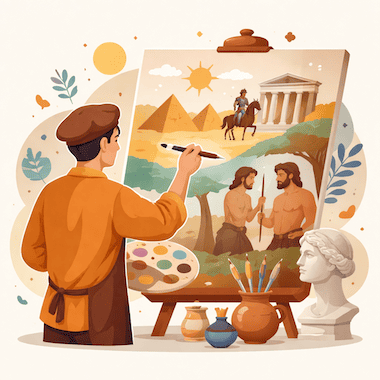
Storytelling Through Art
Contar historias a través del arte
 Learn EnglishApp gratis con audio, tests y libros reales
Palabras clave
- compositioncomposición
- perspectiveperspectiva
- pigmentpigmento
- portraitretrato
- frescofresco
- etchinggrabado al aguafuerte
- realismrealismo
- abstractionabstracción
- woodblock printgrabado en madera
- symbolismsimbolismo
- anatomyanatomía
- muralmural
Ver las 30 palabras
- self-portraitautorretrato
- pietypiedad
- atrocityatrocidad
- shadingsombreado
- legitimacylegitimidad
- antiquityantigüedad
- meditationmeditación
- ritualritual
- anguishangustia
- testimonytestimonio
- auctionsubasta
- genealogygenealogía
- stencilplantilla
- tombtumba
- carvingtalla
- infraredinfrarrojo
- photographyfotografía
- existentialexistencial
Long before people could write, they told stories with pictures. The cave paintings of Lascaux in southwestern France, found by four teenagers in 1940, are about 17,000 years old, and they are not random marks. Bulls, horses and deer are painted with care and skill, and some scenes may show hunts or rituals.
Mucho antes de saber escribir, los seres humanos contaban historias con imágenes. Las pinturas de la cueva de Lascaux, en el suroeste de Francia, descubiertas en 1940 por cuatro adolescentes, tienen unos 17 000 años y no son simples garabatos. Toros, caballos y ciervos están pintados con cuidado y habilidad, y algunas escenas quizá muestren cacerías o rituales.
Paintings can do something that words can't: they let you see a moment from centuries ago as if you were standing in the room. A painting shows how people dressed, what they valued, how they saw themselves and what their world looked like. If you learn to read paintings as historical sources, you get a view of the past that no written text can give you.
La pintura puede hacer algo que las palabras no pueden: nos permite ver un momento de hace siglos como si estuviéramos en la misma habitación. Un cuadro muestra cómo vestía la gente, qué valoraba, cómo se veía a sí misma y cómo era su mundo. Quien aprende a leer los cuadros como fuentes históricas obtiene una visión del pasado que ningún texto escrito puede ofrecer.
Cave Art: The First Stories
Arte rupestre: las primeras historias
The Chauvet Cave in southern France holds some of the oldest paintings in Europe, made about 36,000 years ago. Its horses, lions, mammoths and rhinoceroses are drawn with real skill. The artists used shading and the natural shape of the rock to make the animals look solid, and they drew some legs and heads several times, as if the animals were moving. Even older cave art has been found on the Indonesian island of Sulawesi, where a painted scene of human figures and a wild pig is at least 51,000 years old.
La cueva de Chauvet, en el sur de Francia, guarda algunas de las pinturas más antiguas de Europa, hechas hace unos 36 000 años. Sus caballos, leones, mamuts y rinocerontes están dibujados con gran maestría. Los artistas usaron el sombreado y la forma natural de la roca para dar volumen a los animales, y dibujaron algunas patas y cabezas varias veces, como si los animales estuvieran en movimiento. En la isla indonesia de Sulawesi se ha encontrado arte rupestre aún más antiguo: allí, una escena pintada con figuras humanas y un jabalí tiene al menos 51 000 años.
Hand stencils are found in caves all over the world. People pressed a hand against the wall and blew paint around it, leaving its outline on the rock. Some on Sulawesi are around 40,000 years old, and the Cave of the Hands in Argentina has hundreds of them, some made about 9,000 years ago. No one knows exactly what they meant. Perhaps the message was the simplest one possible: I was here.
En cuevas de todo el mundo hay plantillas de manos. La gente apoyaba una mano en la pared y soplaba pintura a su alrededor, de modo que su contorno quedaba en la roca. Algunas de Sulawesi tienen unos 40 000 años, y en la Cueva de las Manos, en Argentina, hay cientos, algunas hechas hace unos 9000 años. Nadie sabe con exactitud qué significaban. Quizá el mensaje era el más sencillo posible: estuve aquí.
Egyptian Art: Order and Eternity
Arte egipcio: orden y eternidad
Ancient Egyptian art followed strict rules that changed very little in 3,000 years. A figure usually has its head and legs in profile, while the eye and the shoulders face the viewer. To modern eyes this looks strange, but Egyptian artists were not clumsy. They chose this style on purpose, because of what their art was for.
El arte del antiguo Egipto seguía reglas estrictas que apenas cambiaron en 3000 años. Una figura suele tener la cabeza y las piernas de perfil, mientras que el ojo y los hombros miran al espectador. A nuestros ojos resulta extraño, pero los artistas egipcios no eran torpes. Eligieron este estilo a propósito, por la función que tenía su arte.
An Egyptian painting was not meant to show what one person sees from one spot. It showed each part of the body in its clearest and most complete form, so that the whole person was recorded. A pharaoh was painted larger than the people around him because he was more important, not because the artist didn't understand proportions. The scenes on tomb walls had a practical job, too: Egyptians believed that the food, servants and pleasures painted there would serve the dead person in the afterlife. Art was meant to make things happen.
Una pintura egipcia no pretendía mostrar lo que una persona ve desde un solo punto. Mostraba cada parte del cuerpo en su forma más clara y completa, para que quedara registrada la persona entera. El faraón se pintaba más grande que quienes lo rodeaban porque era más importante, no porque el artista no conociera las proporciones. Las escenas de las paredes de las tumbas también tenían una función práctica: los egipcios creían que la comida, los sirvientes y los placeres pintados allí servirían al difunto en el más allá. El arte debía hacer que las cosas sucedieran.
Renaissance Art: Rediscovering the Human
Arte del Renacimiento: el redescubrimiento del ser humano
The European Renaissance, which lasted roughly from the 14th to the 16th century, changed what art was for. Medieval painting mostly served the Church. Its figures were flat and stylized, and their size and position showed religious importance, not how things really looked. Renaissance artists turned their attention to the human body, the natural world and the art of ancient Greece and Rome.
El Renacimiento europeo, que duró aproximadamente del siglo XIV al XVI, cambió la finalidad del arte. La pintura medieval servía sobre todo a la Iglesia. Sus figuras eran planas y estilizadas, y su tamaño y posición indicaban su importancia religiosa, no el aspecto real de las cosas. Los artistas del Renacimiento centraron su atención en el cuerpo humano, la naturaleza y el arte de la antigua Grecia y Roma.
Leonardo da Vinci dissected human bodies to understand muscles and bones. Michelangelo painted the ceiling of the Sistine Chapel between 1508 and 1512, and Raphael filled The School of Athens with lifelike figures of ancient thinkers. Renaissance art was also a tool of power. A portrait of a ruler or a rich merchant was carefully planned to show wealth, faith and the right to rule. The pose, the clothes, the objects and the background of such a portrait can tell you as much about 15th-century Italian politics as a written document.
Leonardo da Vinci diseccionaba cadáveres para entender los músculos y los huesos. Miguel Ángel pintó la bóveda de la Capilla Sixtina entre 1508 y 1512, y Rafael llenó La escuela de Atenas de figuras de pensadores antiguos llenas de vida. El arte renacentista era también un instrumento de poder. El retrato de un gobernante o de un rico comerciante se planeaba con cuidado para mostrar riqueza, devoción y derecho a gobernar. La postura, la ropa, los objetos y el fondo de un retrato así pueden contarnos tanto sobre la política de la Italia del siglo XV como un documento escrito.
Hidden Stories in Famous Paintings
Historias ocultas en cuadros famosos
Many famous paintings hide meanings that most viewers miss. Jan van Eyck's Arnolfini Portrait (1434), in the National Gallery in London, is full of symbols: a single candle burning in daylight, a small dog often read as a sign of loyalty, and a round mirror that reflects two more people in the doorway. Above the mirror, van Eyck wrote in Latin: "Jan van Eyck was here." A famous theory says the painting records a marriage, with the artist as a witness, but many experts now doubt it.
Muchos cuadros famosos esconden significados que la mayoría de los espectadores pasa por alto. El matrimonio Arnolfini (1434), de Jan van Eyck, que se conserva en la National Gallery de Londres, está lleno de símbolos: una sola vela encendida a plena luz del día, un perrito que suele interpretarse como signo de fidelidad y un espejo redondo que refleja a dos personas más en la puerta. Encima del espejo, van Eyck escribió en latín: «Jan van Eyck estuvo aquí». Según una teoría famosa, el cuadro deja constancia de un matrimonio con el pintor como testigo, pero hoy muchos expertos lo ponen en duda.
Diego Velázquez's Las Meninas (1656), in the Prado Museum in Madrid, plays a clever game with the viewer. Velázquez painted himself at work on a huge canvas, next to the young princess Margarita and her maids of honor. A mirror on the back wall shows King Philip IV and Queen Mariana, who seem to be standing exactly where we stand. The painting leaves it unclear who is really being painted and who is watching, and critics have argued about it for more than 350 years.
Las meninas (1656), de Diego Velázquez, en el Museo del Prado de Madrid, juega con el espectador de forma muy ingeniosa. Velázquez se pintó a sí mismo trabajando ante un lienzo enorme, junto a la pequeña infanta Margarita y sus damas de honor. Un espejo en la pared del fondo muestra al rey Felipe IV y a la reina Mariana, que parecen estar justo donde estamos nosotros. El cuadro no deja claro a quién se está pintando y quién está mirando, y los críticos llevan más de 350 años discutiéndolo.
Art as Protest and Revolution
El arte como protesta y revolución
Artists have often used their work to criticize power and to record cruelty. Between 1810 and 1820, Francisco Goya made a series of more than 80 prints called The Disasters of War about the fighting that followed Napoleon's invasion of Spain. They show executions, hunger and mutilated bodies, and they make no one a hero. The series was so harsh that it was not published until 1863, 35 years after Goya's death, and it is still hard to look at today.
Los artistas han usado a menudo su obra para criticar el poder y dejar constancia de la crueldad. Entre 1810 y 1820, Francisco de Goya realizó una serie de más de 80 grabados, Los desastres de la guerra, sobre la lucha que siguió a la invasión napoleónica de España. Muestran fusilamientos, hambre y cuerpos mutilados, y no convierten a nadie en héroe. La serie era tan dura que no se publicó hasta 1863, 35 años después de la muerte de Goya, y todavía hoy cuesta mirarla.
Pablo Picasso painted Guernica in 1937, after German and Italian planes supporting Franco bombed the Basque town of Guernica during the Spanish Civil War. Its broken, screaming figures show the terror of an attack on ordinary people. The painting traveled to exhibitions in Europe and the United States and made the bombing known around the world. Picasso did not want it to go to Spain until democracy returned, so it stayed at the Museum of Modern Art in New York until 1981. Today it hangs in the Museo Reina Sofía in Madrid.
Pablo Picasso pintó el Guernica en 1937, después de que aviones alemanes e italianos que apoyaban a Franco bombardearan la villa vasca de Guernica durante la Guerra Civil española. Sus figuras rotas y gritando muestran el terror de un ataque contra gente corriente. El cuadro se expuso en Europa y en Estados Unidos y dio a conocer el bombardeo en todo el mundo. Picasso no quería que fuera a España hasta que volviera la democracia, así que permaneció en el Museo de Arte Moderno de Nueva York hasta 1981. Hoy se exhibe en el Museo Reina Sofía de Madrid.
Non-Western Art Traditions
Tradiciones artísticas no occidentales
The history of art is much wider than the European tradition that fills most textbooks. Chinese landscape painting, called shan shui ("mountain and water"), reached a high point between the 10th and 14th centuries, with works such as Fan Kuan's Travelers among Mountains and Streams from around 1000. These painters did not try to copy a real view. They wanted to capture the spirit, or qi, of a landscape, and they usually worked indoors, combining memories of many walks into one ideal scene.
La historia del arte es mucho más amplia que la tradición europea que llena la mayoría de los libros de texto. La pintura de paisaje china, llamada shan shui («montaña y agua»), alcanzó su apogeo entre los siglos X y XIV, con obras como Viajeros entre montañas y arroyos, de Fan Kuan, pintada hacia el año 1000. Estos pintores no intentaban copiar un paisaje real. Querían captar su espíritu, el qi, y solían trabajar bajo techo, combinando en una escena ideal los recuerdos de muchos paseos.
In Japan, ukiyo-e woodblock prints of the 17th to 19th centuries showed everyday life: kabuki actors, sumo wrestlers, famous views and the pleasure districts of Edo, known as the "floating world." Their bold lines and flat colors influenced Van Gogh, Monet and Toulouse-Lautrec. In Ghana, kente cloth is woven in bright geometric patterns, and many of the patterns have names that come from proverbs, historical events or famous people. Every culture has found its own way to tell stories with images.
En Japón, las estampas ukiyo-e de los siglos XVII al XIX mostraban la vida cotidiana: actores de kabuki, luchadores de sumo, paisajes célebres y los barrios de placer de Edo, conocidos como el «mundo flotante». Sus líneas firmes y sus colores planos influyeron en Van Gogh, Monet y Toulouse-Lautrec. En Ghana, la tela kente se teje con dibujos geométricos de colores vivos, y muchos de esos dibujos tienen nombres que proceden de proverbios, hechos históricos o personajes famosos. Cada cultura ha encontrado su propia manera de contar historias con imágenes.
Modern Art: When Painting Became Personal
Arte moderno: cuando la pintura se volvió personal
When photography became public in 1839, painters no longer had to record exactly how things looked. If a camera could do that, painting could show how things felt and what they meant. In the decades that followed, artists experimented more than ever before, and the idea of what art could be changed completely.
Cuando la fotografía se presentó al público en 1839, los pintores dejaron de estar obligados a reproducir con exactitud el aspecto de las cosas. Si una cámara podía hacerlo, la pintura podía mostrar lo que se sentía y lo que las cosas significaban. En las décadas siguientes, los artistas experimentaron como nunca, y la idea de lo que podía ser el arte cambió por completo.
Vincent van Gogh painted The Starry Night in 1889 at a mental hospital in Saint-Rémy in southern France. Its swirling sky is not what the night really looked like; it shows what the night felt like to him. Edvard Munch painted The Scream in 1893. He wrote that the idea came to him on an evening walk, when he felt a great scream passing through nature. So the figure is less a person screaming than a picture of fear itself. Works like these led the way to abstract art, in which color and shape express feelings without showing real objects at all.
Vincent van Gogh pintó La noche estrellada en 1889 en un hospital psiquiátrico de Saint-Rémy, en el sur de Francia. Su cielo en remolinos no muestra cómo era la noche en realidad, sino lo que él sentía al verla. Edvard Munch pintó El grito en 1893. Escribió que la idea le vino durante un paseo al atardecer, cuando sintió un gran grito que atravesaba la naturaleza. Por eso la figura es menos una persona que grita que una imagen del propio miedo. Obras como estas abrieron el camino al arte abstracto, en el que el color y la forma expresan sentimientos sin representar ningún objeto real.
Surprising Facts About Art
Datos sorprendentes sobre el arte
X-rays and infrared scans often reveal different pictures under the paint of Renaissance masterpieces, because artists painted over earlier work or changed their minds.
Las radiografías y los análisis con infrarrojos revelan a menudo otras imágenes bajo la pintura de obras maestras del Renacimiento, porque los artistas pintaban sobre obras anteriores o cambiaban de idea.
The Mona Lisa became world famous only after an Italian worker, Vincenzo Peruggia, stole it from the Louvre in 1911. It was missing for more than two years.
La Gioconda solo se hizo famosa en todo el mundo después de que un trabajador italiano, Vincenzo Peruggia, la robara del Louvre en 1911. Estuvo desaparecida más de dos años.
A popular story says Thomas Gainsborough painted The Blue Boy (around 1770) to prove Joshua Reynolds wrong about the color blue, but Reynolds made his famous remark in 1778, years later.
Según una historia muy difundida, Thomas Gainsborough pintó El niño azul (hacia 1770) para demostrar que Joshua Reynolds se equivocaba sobre el color azul, pero Reynolds hizo su famoso comentario en 1778, años después.
Leonardo da Vinci began the Mona Lisa around 1503 and was still working on it more than ten years later. He took it with him to France, where he died in 1519.
Leonardo da Vinci empezó La Gioconda hacia 1503 y más de diez años después seguía trabajando en ella. Se la llevó consigo a Francia, donde murió en 1519.
The most expensive painting ever sold at auction is Salvator Mundi, attributed to Leonardo da Vinci. It sold for $450 million in 2017.
El cuadro más caro jamás vendido en una subasta es el Salvator Mundi, atribuido a Leonardo da Vinci. Se vendió por 450 millones de dólares en 2017.
About 55 of Frida Kahlo's roughly 140 paintings are self-portraits. She said she painted herself because she was often alone and was "the subject I know best."
Unos 55 de los cerca de 140 cuadros de Frida Kahlo son autorretratos. Ella decía que se pintaba a sí misma porque pasaba mucho tiempo sola y porque era «el motivo que mejor conozco».
Learning to Look
Aprender a mirar
From cave walls to museum galleries, painting is one of the oldest ways people have recorded their lives. Every painting was made by someone who wanted to say something, show something or keep something from being forgotten. When you look carefully at a painting, you meet the mind of a person from a very different world.
De las paredes de las cuevas a las salas de los museos, la pintura es una de las formas más antiguas en que las personas han dejado constancia de su vida. Cada cuadro lo hizo alguien que quería decir algo, mostrar algo o evitar que algo se olvidara. Quien mira con atención un cuadro se encuentra con la mente de una persona de un mundo muy distinto.
Art history is more than a list of techniques and styles. It also tells us what people feared, worshipped, celebrated, mourned and fought for. A great painting is one person's vision and, at the same time, a record of its age. Seen this way, a visit to a museum is also a lesson in history.
La historia del arte es más que una lista de técnicas y estilos. También nos cuenta qué temían, adoraban, celebraban y lloraban las personas, y por qué luchaban. Un gran cuadro es la visión de una sola persona y, al mismo tiempo, un testimonio de su época. Vista así, una visita al museo es también una clase de historia.
En la app gratuita puedes escuchar este texto en voz alta y tocar cualquier palabra para ver qué significa.