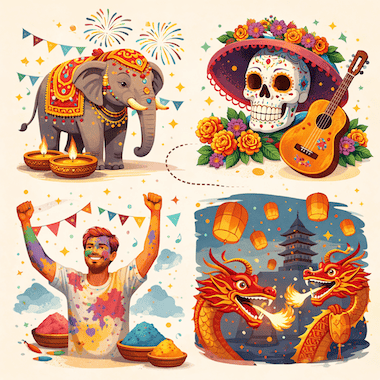
Festivals Around the Globe
Fiestas de todo el mundo
 Learn EnglishApp gratis con audio, tests y libros reales
Palabras clave
- festivalfestival
- ceremonyceremonia
- processionprocesión
- ritualritual
- pilgrimperegrino
- heritagepatrimonio
- solsticesolsticio
- altaraltar
- harvestcosecha
- costumedisfraz
- sacredsagrado
- deitydeidad
Ver las 30 palabras
- reenactmentrecreación histórica
- offeringofrenda
- bonfirehoguera
- spectatorespectador
- indigenousindígena
- communalcomunal
- mythmito
- fertilityfertilidad
- mourningduelo
- torchantorcha
- baptismbautismo
- archerytiro con arco
- lanternlinterna
- preservationpreservación
- empathyempatía
- exuberantexuberante
- feastfestín
- conquestconquista
Every culture on Earth has its festivals. From the snowy north of Scandinavia to the deserts of Africa, people have always set aside special days to honor their gods, welcome a new season, remember the dead or simply have a good time together.
Todas las culturas de la Tierra tienen sus fiestas. Desde el norte nevado de Escandinavia hasta los desiertos de África, la gente siempre ha reservado días especiales para honrar a sus dioses, dar la bienvenida a una nueva estación, recordar a los muertos o simplemente pasarlo bien juntos.
Some celebrations, like New Year's Eve, are known almost everywhere. Thousands of others are hardly known outside their own region. Here are a few of them, from Ethiopia to Mongolia, and what people actually do on those days.
Algunas celebraciones, como la Nochevieja, se conocen casi en todas partes. Otras miles apenas son conocidas fuera de su región. Aquí tienes algunas de ellas, de Etiopía a Mongolia, y lo que la gente hace de verdad esos días.
Timkat: Epiphany in Ethiopia
Timkat: la Epifanía en Etiopía
Timkat is the Ethiopian Orthodox celebration of Epiphany, the day that remembers the baptism of Jesus in the Jordan River. It falls on January 19, or January 20 in leap years. On the eve of the feast, priests carry the tabots out of the churches. A tabot is a tablet that stands for the Ark of the Covenant, and it is so holy that it is always wrapped in rich cloth and kept out of sight.
El Timkat es la fiesta de la Epifanía de la Iglesia ortodoxa etíope, que recuerda el bautismo de Jesús en el río Jordán. Cae el 19 de enero, o el 20 en los años bisiestos. La víspera, los sacerdotes sacan los tabots de las iglesias. Un tabot es una tabla que representa el Arca de la Alianza, y es tan sagrado que siempre se envuelve en telas lujosas y se mantiene oculto a la vista.
Crowds dressed in white follow the procession to a pool or river, where they spend the night singing and praying. At dawn the priests bless the water, and many people jump in or get splashed to renew their baptism. One of the biggest celebrations takes place in Gondar, where people leap into the pool of Fasilides' Bath, built in the 17th century. UNESCO added Timkat to its list of Intangible Cultural Heritage in 2019.
Multitudes vestidas de blanco siguen la procesión hasta un estanque o un río, donde pasan la noche cantando y rezando. Al amanecer, los sacerdotes bendicen el agua, y muchos se lanzan a ella o se dejan salpicar para renovar su bautismo. Una de las mayores celebraciones tiene lugar en Gondar, donde la gente salta a la piscina de los Baños de Fasilidas, construidos en el siglo XVII. La UNESCO incluyó el Timkat en su lista del Patrimonio Cultural Inmaterial en 2019.
Up Helly Aa: Fire in the Scottish Winter
Up Helly Aa: fuego en el invierno escocés
On the last Tuesday of January, about a thousand people with burning torches march through the dark streets of Lerwick, the main town of Scotland's Shetland Islands. This is Up Helly Aa, one of the largest fire festivals in Europe. At the front marches the Jarl Squad, dressed as Vikings with helmets, shields and axes.
El último martes de enero, unas mil personas con antorchas encendidas desfilan por las calles oscuras de Lerwick, la principal localidad de las islas Shetland, en Escocia. Es el Up Helly Aa, una de las mayores fiestas del fuego de Europa. Al frente marcha el Jarl Squad, vestido de vikingos con cascos, escudos y hachas.
The march ends at a wooden Viking ship, or galley, built for the occasion. The costumed marchers, called guizers, throw their torches into it and watch it burn. The festival is younger than it looks: the Victorians invented the Viking theme in the 1880s, and the first galley was burned in 1889. After the fire, the guizers visit local halls, where music and dancing go on until morning. Since 2023, women and girls can march in the procession too.
El desfile termina junto a un barco vikingo de madera, la galera, construido para la ocasión. Los participantes disfrazados, llamados guizers, le lanzan sus antorchas y lo ven arder. La fiesta es más reciente de lo que parece: fueron los victorianos quienes inventaron la temática vikinga en la década de 1880, y la primera galera se quemó en 1889. Después del fuego, los guizers recorren los salones del pueblo, donde la música y el baile siguen hasta la mañana. Desde 2023, las mujeres y las niñas también pueden desfilar.
Songkran: Thailand's Water Festival
Songkran: la fiesta del agua de Tailandia
Songkran is the Thai New Year, officially celebrated from April 13 to 15. It falls in the hottest part of the year, just before the rainy season. The tradition began quietly: people poured scented water over statues of the Buddha and over the hands of older relatives to show respect and ask for their blessing.
El Songkran es el Año Nuevo tailandés y se celebra oficialmente del 13 al 15 de abril. Coincide con la época más calurosa del año, justo antes de la estación de lluvias. La tradición empezó de forma tranquila: la gente vertía agua perfumada sobre las estatuas de Buda y sobre las manos de los familiares mayores para mostrarles respeto y pedirles su bendición.
Today the whole country seems to turn into one huge water fight. In Bangkok and Chiang Mai, the streets fill with people carrying water guns, buckets and hoses, and nobody stays dry. Many people still visit temples, give food to monks and build small piles of sand in the temple grounds. The water has a meaning too: it washes away the bad luck of the old year. In 2023, UNESCO added Songkran to its Intangible Cultural Heritage list.
Hoy el país entero parece convertirse en una enorme guerra de agua. En Bangkok y Chiang Mai, las calles se llenan de gente con pistolas de agua, cubos y mangueras, y nadie se queda seco. Aun así, muchos siguen visitando los templos, dan comida a los monjes y hacen pequeños montones de arena en los recintos de los templos. El agua también tiene un significado: se lleva la mala suerte del año viejo. En 2023, la UNESCO añadió el Songkran a su lista del Patrimonio Cultural Inmaterial.
Día de los Muertos: Celebrating the Departed
Día de los Muertos: una fiesta para los difuntos
Mexico's Day of the Dead is celebrated on November 1 and 2. Outsiders often imagine a sad or gloomy holiday, but it is closer to a family reunion. People believe that on these days the souls of the dead come back to visit the living, and they prepare a warm welcome for them.
El Día de los Muertos de México se celebra el 1 y el 2 de noviembre. Desde fuera, muchos imaginan una fiesta triste o lúgubre, pero se parece más a una reunión familiar. Se cree que en estos días las almas de los muertos vuelven a visitar a los vivos, y la gente les prepara una cálida bienvenida.
Families build altars called ofrendas and decorate them with orange marigolds, candles, photos and the favorite food and drinks of the people they have lost. In many towns, families spend the night in the cemetery, eating, playing music and telling stories about the dead. Skulls, or calaveras, are everywhere, often made of sugar and painted in bright colors. The festival mixes the traditions of the Aztecs and other indigenous peoples with the Catholic feasts of All Saints and All Souls, and UNESCO recognized it in 2008.
Las familias montan altares llamados ofrendas y los adornan con flores de cempasúchil, velas, fotos y la comida y bebida favoritas de sus seres queridos fallecidos. En muchos pueblos, las familias pasan la noche en el cementerio comiendo, tocando música y contando historias sobre los difuntos. Las calaveras están por todas partes, a menudo hechas de azúcar y pintadas de colores vivos. La fiesta mezcla las tradiciones de los aztecas y otros pueblos indígenas con las fiestas católicas de Todos los Santos y los Fieles Difuntos, y la UNESCO la reconoció en 2008.
Holi: The Festival of Colors
Holi: la fiesta de los colores
Holi is one of the best-known Hindu festivals. It is celebrated in India and Nepal and by South Asian communities around the world. It takes place at the full moon in late February or March, marks the end of winter and the victory of good over evil, and is famous for its clouds of colored powder.
El Holi es una de las fiestas hindúes más conocidas. Se celebra en la India y Nepal y en comunidades del sur de Asia de todo el mundo. Tiene lugar con la luna llena, a finales de febrero o en marzo, marca el fin del invierno y la victoria del bien sobre el mal, y es famoso por sus nubes de polvo de colores.
It starts the night before with Holika Dahan, when people light bonfires. They remember the legend of the demoness Holika, who burned in a fire while the boy Prahlad, a devoted follower of Vishnu, walked out unharmed. The next morning, people of all ages go out and throw colored powder and water at friends, neighbors and strangers alike. For one day, many of the usual barriers between rich and poor, old and young are relaxed. The colors also recall the god Krishna, who, according to legend, playfully covered Radha and her friends in color.
Empieza la noche anterior con el Holika Dahan, cuando se encienden hogueras. Se recuerda la leyenda de la demonia Holika, que ardió en el fuego mientras el niño Prahlad, fiel devoto de Visnú, salió ileso. A la mañana siguiente, gente de todas las edades sale a la calle y lanza polvo de colores y agua a amigos, vecinos y desconocidos por igual. Durante un día se relajan muchas de las barreras habituales entre ricos y pobres, mayores y jóvenes. Los colores también recuerdan al dios Krishna, que, según la leyenda, cubría de color a Radha y sus amigas en broma.
Inti Raymi: Festival of the Sun
Inti Raymi: la fiesta del Sol
Every year on June 24, the Inca Festival of the Sun comes back to life in Cusco, Peru. In Quechua, Inti Raymi means 'Festival of the Sun'. It was one of the most important ceremonies of the Inca Empire, held around the winter solstice in the Southern Hemisphere to honor the sun god Inti.
Cada 24 de junio, la fiesta inca del Sol vuelve a la vida en Cuzco, Perú. En quechua, Inti Raymi significa fiesta del Sol. Fue una de las ceremonias más importantes del Imperio inca y se celebraba en torno al solsticio de invierno del hemisferio sur para honrar al dios Sol, Inti.
After the conquest, the Spanish colonial authorities banned the festival in the 16th century. It was brought back in 1944 as a staged performance. Today, hundreds of actors in rich costumes play the Sapa Inca, the emperor, and his court at Sacsayhuamán, the old Inca fortress above the city. Tens of thousands of people come to watch. For many Quechua speakers, the festival is more than a show: it is a way to take pride in their language and history.
Tras la conquista, las autoridades coloniales españolas prohibieron la fiesta en el siglo XVI. En 1944 se recuperó como representación teatral. Hoy, cientos de actores con trajes vistosos interpretan al Sapa Inca, el emperador, y a su corte en Sacsayhuamán, la antigua fortaleza inca que domina la ciudad. Decenas de miles de personas acuden a verla. Para muchos hablantes de quechua, la fiesta es más que un espectáculo: es una forma de sentirse orgullosos de su lengua y de su historia.
Onam: Kerala's Harvest Festival
Onam: la fiesta de la cosecha de Kerala
Onam is the harvest festival of Kerala, in southern India. It lasts ten days and falls in August or September, in the Malayalam month of Chingam. People of all religions in Kerala celebrate it. According to legend, Onam marks the yearly visit of Mahabali, a kind and generous king who ruled the land long ago and comes back once a year to see his people.
El Onam es la fiesta de la cosecha de Kerala, en el sur de la India. Dura diez días y cae en agosto o septiembre, en el mes de Chingam del calendario malayalam. En Kerala lo celebran personas de todas las religiones. Según la leyenda, el Onam marca la visita anual de Mahabali, un rey bondadoso y generoso que gobernó aquellas tierras hace mucho tiempo y vuelve una vez al año para ver a su pueblo.
Families make flower carpets called pookalam in front of their homes and add more flowers each day, so the designs grow bigger and more detailed. The high point is the Onam Sadya, a vegetarian feast of more than twenty dishes served on a banana leaf. In the same season, villages hold races of long snake boats, known as Vallam Kali, with about a hundred rowers in each boat, while huge crowds cheer from the riverbanks.
Las familias hacen alfombras de flores llamadas pookalam delante de sus casas y añaden flores cada día, de modo que los dibujos se vuelven cada vez más grandes y detallados. El momento culminante es el Onam Sadya, un banquete vegetariano de más de veinte platos servido sobre una hoja de plátano. En la misma época, los pueblos organizan regatas de largas barcas serpiente, llamadas Vallam Kali, con unos cien remeros en cada barca, mientras enormes multitudes animan desde las orillas.
Naadam: Mongolia's Festival of Three Games
Naadam: la fiesta de los tres juegos de Mongolia
Every July, Mongolia celebrates Naadam, a national festival built around three traditional sports: wrestling, horse racing and archery. The biggest Naadam opens in the capital, Ulaanbaatar, on July 11. The games go back many centuries, to a time when nomad armies used them to keep their warriors fit.
Cada mes de julio, Mongolia celebra el Naadam, una fiesta nacional en torno a tres deportes tradicionales: la lucha, las carreras de caballos y el tiro con arco. El Naadam más grande comienza el 11 de julio en la capital, Ulán Bator. Estos juegos se remontan a muchos siglos atrás, a una época en que los ejércitos nómadas los usaban para mantener en forma a sus guerreros.
The horse races are the most surprising part: the riders are children, some only five years old, and they race across the open steppe for 15 to 30 kilometers, depending on the age of the horses. The wrestlers wear tight open vests and pointed boots, and a match ends only when one of them touches the ground with his back, knee or elbow. Archers shoot at rows of small leather targets from up to 75 meters away. UNESCO added Naadam to its Intangible Cultural Heritage list in 2010.
Las carreras de caballos son lo más sorprendente: los jinetes son niños, algunos de solo cinco años, y recorren entre 15 y 30 kilómetros por la estepa abierta, según la edad de los caballos. Los luchadores llevan chalecos ajustados abiertos por delante y botas de punta curvada, y un combate solo termina cuando uno de ellos toca el suelo con la espalda, la rodilla o el codo. Los arqueros disparan a hileras de pequeñas dianas de cuero desde hasta 75 metros. La UNESCO incluyó el Naadam en su lista del Patrimonio Cultural Inmaterial en 2010.
Festival Facts from Around the World
Datos curiosos sobre fiestas del mundo
At La Tomatina in Buñol, Spain, about 20,000 people throw more than 100 tons of tomatoes at each other in one hour every August.
En la Tomatina de Buñol, en España, unas 20.000 personas se lanzan más de 100 toneladas de tomates en una hora cada mes de agosto.
At Japan's Hadaka Matsuri, or Naked Festival, thousands of men in loincloths fight to grab sacred sticks that are said to bring a year of good luck.
En el Hadaka Matsuri japonés, o Fiesta Desnuda, miles de hombres en taparrabos luchan por hacerse con unos palos sagrados que, según se dice, traen un año de buena suerte.
The Carnival of Oruro in Bolivia is famous for its devil dancers, and its main parade can last around 20 hours.
El Carnaval de Oruro, en Bolivia, es famoso por sus bailarines de la diablada, y su desfile principal puede durar unas 20 horas.
Burning Man brings about 70,000 people to Nevada's Black Rock Desert, where they build a temporary city, burn a giant wooden figure and then remove every trace.
Burning Man reúne a unas 70.000 personas en el desierto de Black Rock, en Nevada, donde construyen una ciudad temporal, queman una enorme figura de madera y luego eliminan todo rastro.
Finland's Wife Carrying World Championship goes back to a legend about a 19th-century robber who stole women from nearby villages.
El Campeonato Mundial de Carrera con la Esposa a Cuestas, en Finlandia, se basa en la leyenda de un bandido del siglo XIX que robaba mujeres de las aldeas vecinas.
During Taiwan's Lantern Festival, thousands of paper sky lanterns carrying people's written wishes rise into the night over the town of Pingxi.
Durante la Fiesta de los Faroles de Taiwán, miles de farolillos de papel con deseos escritos se elevan en la noche sobre el pueblo de Pingxi.
Why Festivals Matter
Por qué importan las fiestas
Festivals are more than entertainment. Researchers have found that celebrating together brings people closer, gives them a clearer sense of who they are and offers a break from the stress of daily life. Dancing, singing or eating with hundreds of others gives people a strong feeling of belonging.
Las fiestas son más que entretenimiento. Los investigadores han comprobado que celebrar juntos une a las personas, les da una idea más clara de quiénes son y ofrece un respiro del estrés diario. Bailar, cantar o comer con cientos de personas da un fuerte sentimiento de pertenencia.
Local festivals also keep old things alive. Songs, dances, crafts, recipes and sometimes whole languages survive because people need them for one special day each year. And for visitors, a festival is often the easiest way to understand how other people see the world.
Las fiestas locales también mantienen vivo lo antiguo. Canciones, bailes, oficios, recetas y a veces lenguas enteras sobreviven porque la gente las necesita para un día especial cada año. Y para los visitantes, una fiesta suele ser la forma más fácil de entender cómo ven el mundo otras personas.
Conclusion
Conclusión
From burning Viking ships in Shetland to flower carpets in Kerala, from naked men at a Japanese temple to paper lanterns over Taiwan, festivals show how differently people celebrate. Each one tells you something about the place where it began.
Desde barcos vikingos en llamas en las Shetland hasta alfombras de flores en Kerala, desde hombres desnudos en un templo japonés hasta farolillos de papel sobre Taiwán, las fiestas muestran lo distintas que son las maneras de celebrar. Cada una cuenta algo del lugar donde nació.
Some are solemn and some are silly. Some are hundreds of years old, while others, like Burning Man, started only a few decades ago. But all of them bring people together: with their neighbors, with nature, with the past and with something bigger than themselves.
Algunas son solemnes y otras, disparatadas. Algunas tienen cientos de años, mientras que otras, como Burning Man, nacieron hace apenas unas décadas. Pero todas unen a la gente: con sus vecinos, con la naturaleza, con el pasado y con algo más grande que ellos mismos.
En la app gratuita puedes escuchar este texto en voz alta y tocar cualquier palabra para ver qué significa.