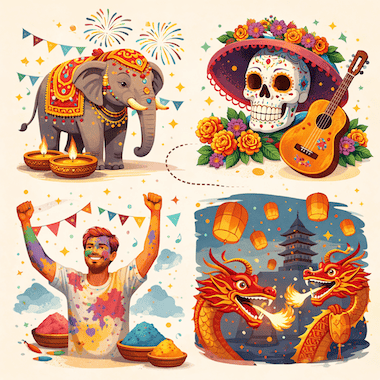
Festivals Around the Globe
Feste in tutto il mondo
 Learn EnglishApp gratuita con audio, quiz e libri veri
Parole chiave
- festivalfestival
- ceremonycerimonia
- processionprocessione
- ritualrituale
- pilgrimpellegrino
- heritagepatrimonio
- solsticesolstizio
- altaraltare
- harvestraccolta
- costumecostume
- sacredsacro
- deitydivinità
Tutte le 30 parole
- reenactmentrievocazione
- offeringofferta
- bonfirefalò
- spectatorspettatore
- indigenousindigeno
- communalcomunitario
- mythmito
- fertilityfertilità
- mourninglutto
- torchtorcia
- baptismbattesimo
- archerytiro con l'arco
- lanternlanterna
- preservationpreservazione
- empathyempatia
- exuberantesuberante
- feastbanchetto
- conquestconquista
Every culture on Earth has its festivals. From the snowy north of Scandinavia to the deserts of Africa, people have always set aside special days to honor their gods, welcome a new season, remember the dead or simply have a good time together.
Ogni cultura della Terra ha le sue feste. Dal nord innevato della Scandinavia ai deserti dell'Africa, le persone hanno sempre riservato giorni speciali per onorare i propri dèi, accogliere una nuova stagione, ricordare i morti o semplicemente divertirsi insieme.
Some celebrations, like New Year's Eve, are known almost everywhere. Thousands of others are hardly known outside their own region. Here are a few of them, from Ethiopia to Mongolia, and what people actually do on those days.
Alcune celebrazioni, come la notte di Capodanno, sono conosciute quasi ovunque. Migliaia di altre sono poco note fuori dalla loro regione. Eccone alcune, dall'Etiopia alla Mongolia, con quello che la gente fa davvero in quei giorni.
Timkat: Epiphany in Ethiopia
Timkat: l'Epifania in Etiopia
Timkat is the Ethiopian Orthodox celebration of Epiphany, the day that remembers the baptism of Jesus in the Jordan River. It falls on January 19, or January 20 in leap years. On the eve of the feast, priests carry the tabots out of the churches. A tabot is a tablet that stands for the Ark of the Covenant, and it is so holy that it is always wrapped in rich cloth and kept out of sight.
Il Timkat è la festa dell'Epifania della Chiesa ortodossa etiope, che ricorda il battesimo di Gesù nel fiume Giordano. Cade il 19 gennaio, o il 20 negli anni bisestili. La vigilia, i sacerdoti portano i tabot fuori dalle chiese. Il tabot è una tavola che rappresenta l'Arca dell'Alleanza, ed è così sacro che viene sempre avvolto in stoffe preziose e tenuto lontano dagli sguardi.
Crowds dressed in white follow the procession to a pool or river, where they spend the night singing and praying. At dawn the priests bless the water, and many people jump in or get splashed to renew their baptism. One of the biggest celebrations takes place in Gondar, where people leap into the pool of Fasilides' Bath, built in the 17th century. UNESCO added Timkat to its list of Intangible Cultural Heritage in 2019.
Folle vestite di bianco seguono la processione fino a una vasca o a un fiume, dove passano la notte cantando e pregando. All'alba i sacerdoti benedicono l'acqua, e molti vi si tuffano o si fanno spruzzare per rinnovare il proprio battesimo. Una delle celebrazioni più grandi si svolge a Gondar, dove ci si tuffa nella vasca dei Bagni di Fasilide, costruiti nel XVII secolo. L'UNESCO ha inserito il Timkat nella lista del patrimonio culturale immateriale nel 2019.
Up Helly Aa: Fire in the Scottish Winter
Up Helly Aa: fuoco nell'inverno scozzese
On the last Tuesday of January, about a thousand people with burning torches march through the dark streets of Lerwick, the main town of Scotland's Shetland Islands. This is Up Helly Aa, one of the largest fire festivals in Europe. At the front marches the Jarl Squad, dressed as Vikings with helmets, shields and axes.
L'ultimo martedì di gennaio, circa mille persone con torce accese sfilano per le strade buie di Lerwick, il centro principale delle isole Shetland, in Scozia. È l'Up Helly Aa, una delle più grandi feste del fuoco d'Europa. In testa marcia la Jarl Squad, vestita da vichinghi con elmi, scudi e asce.
The march ends at a wooden Viking ship, or galley, built for the occasion. The costumed marchers, called guizers, throw their torches into it and watch it burn. The festival is younger than it looks: the Victorians invented the Viking theme in the 1880s, and the first galley was burned in 1889. After the fire, the guizers visit local halls, where music and dancing go on until morning. Since 2023, women and girls can march in the procession too.
Il corteo si conclude davanti a una nave vichinga di legno, la galea, costruita per l'occasione. I partecipanti in costume, chiamati guizers, vi lanciano le torce e la guardano bruciare. La festa è più giovane di quanto sembri: il tema vichingo fu inventato dai vittoriani negli anni Ottanta dell'Ottocento, e la prima galea fu bruciata nel 1889. Dopo il rogo, i guizers fanno il giro delle sale del paese, dove musica e balli continuano fino al mattino. Dal 2023 anche donne e ragazze possono sfilare nel corteo.
Songkran: Thailand's Water Festival
Songkran: la festa dell'acqua in Thailandia
Songkran is the Thai New Year, officially celebrated from April 13 to 15. It falls in the hottest part of the year, just before the rainy season. The tradition began quietly: people poured scented water over statues of the Buddha and over the hands of older relatives to show respect and ask for their blessing.
Il Songkran è il Capodanno thailandese e si celebra ufficialmente dal 13 al 15 aprile. Cade nel periodo più caldo dell'anno, poco prima della stagione delle piogge. La tradizione è nata in modo tranquillo: si versava acqua profumata sulle statue del Buddha e sulle mani dei parenti anziani per mostrare rispetto e chiedere la loro benedizione.
Today the whole country seems to turn into one huge water fight. In Bangkok and Chiang Mai, the streets fill with people carrying water guns, buckets and hoses, and nobody stays dry. Many people still visit temples, give food to monks and build small piles of sand in the temple grounds. The water has a meaning too: it washes away the bad luck of the old year. In 2023, UNESCO added Songkran to its Intangible Cultural Heritage list.
Oggi l'intero paese sembra trasformarsi in un'enorme battaglia d'acqua. A Bangkok e a Chiang Mai le strade si riempiono di persone con pistole ad acqua, secchi e tubi, e nessuno resta asciutto. Molti però visitano ancora i templi, offrono cibo ai monaci e costruiscono piccoli cumuli di sabbia nei cortili dei templi. Anche l'acqua ha un significato: porta via la sfortuna dell'anno vecchio. Nel 2023 l'UNESCO ha inserito il Songkran nella lista del patrimonio culturale immateriale.
Día de los Muertos: Celebrating the Departed
Día de los Muertos: una festa per i defunti
Mexico's Day of the Dead is celebrated on November 1 and 2. Outsiders often imagine a sad or gloomy holiday, but it is closer to a family reunion. People believe that on these days the souls of the dead come back to visit the living, and they prepare a warm welcome for them.
In Messico il Giorno dei Morti si celebra il 1° e il 2 novembre. Da fuori lo si immagina spesso come una festa triste o cupa, ma assomiglia piuttosto a una riunione di famiglia. Si crede che in questi giorni le anime dei morti tornino a far visita ai vivi, e per loro si prepara un'accoglienza calorosa.
Families build altars called ofrendas and decorate them with orange marigolds, candles, photos and the favorite food and drinks of the people they have lost. In many towns, families spend the night in the cemetery, eating, playing music and telling stories about the dead. Skulls, or calaveras, are everywhere, often made of sugar and painted in bright colors. The festival mixes the traditions of the Aztecs and other indigenous peoples with the Catholic feasts of All Saints and All Souls, and UNESCO recognized it in 2008.
Le famiglie allestiscono altari chiamati ofrendas e li decorano con calendule arancioni, candele, fotografie e i cibi e le bevande preferiti dei loro cari scomparsi. In molte città le famiglie passano la notte al cimitero, mangiando, suonando musica e raccontando storie sui defunti. I teschi, o calaveras, sono ovunque, spesso fatti di zucchero e dipinti a colori vivaci. La festa unisce le tradizioni degli Aztechi e di altri popoli indigeni alle feste cattoliche di Ognissanti e della Commemorazione dei defunti, e l'UNESCO l'ha riconosciuta nel 2008.
Holi: The Festival of Colors
Holi: la festa dei colori
Holi is one of the best-known Hindu festivals. It is celebrated in India and Nepal and by South Asian communities around the world. It takes place at the full moon in late February or March, marks the end of winter and the victory of good over evil, and is famous for its clouds of colored powder.
L'Holi è una delle feste indù più conosciute. Si celebra in India e in Nepal e nelle comunità sudasiatiche di tutto il mondo. Cade con la luna piena, a fine febbraio o a marzo, segna la fine dell'inverno e la vittoria del bene sul male, ed è famosa per le sue nuvole di polvere colorata.
It starts the night before with Holika Dahan, when people light bonfires. They remember the legend of the demoness Holika, who burned in a fire while the boy Prahlad, a devoted follower of Vishnu, walked out unharmed. The next morning, people of all ages go out and throw colored powder and water at friends, neighbors and strangers alike. For one day, many of the usual barriers between rich and poor, old and young are relaxed. The colors also recall the god Krishna, who, according to legend, playfully covered Radha and her friends in color.
Comincia la sera prima con l'Holika Dahan, quando si accendono grandi falò. Si ricorda la leggenda della demone Holika, che bruciò nel fuoco mentre il giovane Prahlad, fedele devoto di Visnù, ne uscì illeso. La mattina dopo persone di ogni età scendono in strada e lanciano polvere colorata e acqua ad amici, vicini e sconosciuti. Per un giorno molte delle solite barriere tra ricchi e poveri, anziani e giovani si allentano. I colori ricordano anche il dio Krishna, che secondo la leggenda per gioco copriva di colore Radha e le sue amiche.
Inti Raymi: Festival of the Sun
Inti Raymi: la festa del Sole
Every year on June 24, the Inca Festival of the Sun comes back to life in Cusco, Peru. In Quechua, Inti Raymi means 'Festival of the Sun'. It was one of the most important ceremonies of the Inca Empire, held around the winter solstice in the Southern Hemisphere to honor the sun god Inti.
Ogni anno, il 24 giugno, la festa inca del Sole torna in vita a Cusco, in Perù. In quechua Inti Raymi significa festa del Sole. Era una delle cerimonie più importanti dell'Impero inca e si teneva intorno al solstizio d'inverno dell'emisfero australe per onorare il dio Sole, Inti.
After the conquest, the Spanish colonial authorities banned the festival in the 16th century. It was brought back in 1944 as a staged performance. Today, hundreds of actors in rich costumes play the Sapa Inca, the emperor, and his court at Sacsayhuamán, the old Inca fortress above the city. Tens of thousands of people come to watch. For many Quechua speakers, the festival is more than a show: it is a way to take pride in their language and history.
Dopo la conquista, le autorità coloniali spagnole vietarono la festa nel XVI secolo. Nel 1944 fu ripresa come rappresentazione teatrale. Oggi centinaia di attori in costumi sfarzosi interpretano il Sapa Inca, cioè l'imperatore, e la sua corte a Sacsayhuamán, l'antica fortezza inca che domina la città. Decine di migliaia di persone vengono a vederla. Per molti parlanti quechua la festa è più di uno spettacolo: è un modo per essere orgogliosi della propria lingua e della propria storia.
Onam: Kerala's Harvest Festival
Onam: la festa del raccolto del Kerala
Onam is the harvest festival of Kerala, in southern India. It lasts ten days and falls in August or September, in the Malayalam month of Chingam. People of all religions in Kerala celebrate it. According to legend, Onam marks the yearly visit of Mahabali, a kind and generous king who ruled the land long ago and comes back once a year to see his people.
L'Onam è la festa del raccolto del Kerala, nell'India meridionale. Dura dieci giorni e cade ad agosto o a settembre, nel mese di Chingam del calendario malayalam. In Kerala la festeggiano persone di tutte le religioni. Secondo la leggenda, l'Onam segna la visita annuale di Mahabali, un re buono e generoso che governò quella terra molto tempo fa e torna una volta all'anno a vedere il suo popolo.
Families make flower carpets called pookalam in front of their homes and add more flowers each day, so the designs grow bigger and more detailed. The high point is the Onam Sadya, a vegetarian feast of more than twenty dishes served on a banana leaf. In the same season, villages hold races of long snake boats, known as Vallam Kali, with about a hundred rowers in each boat, while huge crowds cheer from the riverbanks.
Le famiglie creano davanti a casa tappeti di fiori chiamati pookalam e ogni giorno aggiungono nuovi fiori, così i disegni diventano sempre più grandi e ricchi di dettagli. Il momento culminante è l'Onam Sadya, un banchetto vegetariano di oltre venti piatti servito su una foglia di banano. Nello stesso periodo i villaggi organizzano gare di lunghe barche serpente, chiamate Vallam Kali, con circa cento rematori per barca, mentre folle enormi fanno il tifo dalle rive.
Naadam: Mongolia's Festival of Three Games
Naadam: la festa dei tre giochi della Mongolia
Every July, Mongolia celebrates Naadam, a national festival built around three traditional sports: wrestling, horse racing and archery. The biggest Naadam opens in the capital, Ulaanbaatar, on July 11. The games go back many centuries, to a time when nomad armies used them to keep their warriors fit.
Ogni luglio la Mongolia celebra il Naadam, una festa nazionale costruita intorno a tre sport tradizionali: la lotta, le corse di cavalli e il tiro con l'arco. Il Naadam più grande si apre l'11 luglio nella capitale, Ulan Bator. Questi giochi risalgono a molti secoli fa, a un'epoca in cui gli eserciti nomadi li usavano per tenere in forma i loro guerrieri.
The horse races are the most surprising part: the riders are children, some only five years old, and they race across the open steppe for 15 to 30 kilometers, depending on the age of the horses. The wrestlers wear tight open vests and pointed boots, and a match ends only when one of them touches the ground with his back, knee or elbow. Archers shoot at rows of small leather targets from up to 75 meters away. UNESCO added Naadam to its Intangible Cultural Heritage list in 2010.
Le corse di cavalli sono la parte più sorprendente: i fantini sono bambini, alcuni di appena cinque anni, e corrono nella steppa aperta per 15-30 chilometri, a seconda dell'età dei cavalli. I lottatori indossano giubbetti attillati aperti sul petto e stivali con la punta all'insù, e un incontro finisce solo quando uno dei due tocca terra con la schiena, il ginocchio o il gomito. Gli arcieri tirano a file di piccoli bersagli di cuoio da una distanza fino a 75 metri. L'UNESCO ha inserito il Naadam nella lista del patrimonio culturale immateriale nel 2010.
Festival Facts from Around the World
Curiosità sulle feste del mondo
At La Tomatina in Buñol, Spain, about 20,000 people throw more than 100 tons of tomatoes at each other in one hour every August.
Alla Tomatina di Buñol, in Spagna, ogni agosto circa 20.000 persone si lanciano più di 100 tonnellate di pomodori in un'ora.
At Japan's Hadaka Matsuri, or Naked Festival, thousands of men in loincloths fight to grab sacred sticks that are said to bring a year of good luck.
All'Hadaka Matsuri giapponese, la Festa dei nudi, migliaia di uomini con il solo perizoma lottano per afferrare dei bastoni sacri che si dice portino un anno di fortuna.
The Carnival of Oruro in Bolivia is famous for its devil dancers, and its main parade can last around 20 hours.
Il Carnevale di Oruro, in Bolivia, è famoso per i suoi ballerini vestiti da diavoli, e la sua sfilata principale può durare circa 20 ore.
Burning Man brings about 70,000 people to Nevada's Black Rock Desert, where they build a temporary city, burn a giant wooden figure and then remove every trace.
Burning Man porta circa 70.000 persone nel deserto di Black Rock, in Nevada, dove costruiscono una città temporanea, bruciano una gigantesca figura di legno e poi cancellano ogni traccia.
Finland's Wife Carrying World Championship goes back to a legend about a 19th-century robber who stole women from nearby villages.
Il Campionato mondiale di trasporto della moglie, in Finlandia, nasce dalla leggenda di un brigante dell'Ottocento che rapiva le donne dei villaggi vicini.
During Taiwan's Lantern Festival, thousands of paper sky lanterns carrying people's written wishes rise into the night over the town of Pingxi.
Durante la Festa delle lanterne di Taiwan, migliaia di lanterne volanti di carta con i desideri scritti dalla gente salgono nella notte sopra la cittadina di Pingxi.
Why Festivals Matter
Perché le feste contano
Festivals are more than entertainment. Researchers have found that celebrating together brings people closer, gives them a clearer sense of who they are and offers a break from the stress of daily life. Dancing, singing or eating with hundreds of others gives people a strong feeling of belonging.
Le feste sono più di un divertimento. I ricercatori hanno scoperto che festeggiare insieme avvicina le persone, dà loro un'idea più chiara di chi sono e offre una pausa dallo stress della vita quotidiana. Ballare, cantare o mangiare con centinaia di altre persone dà un forte senso di appartenenza.
Local festivals also keep old things alive. Songs, dances, crafts, recipes and sometimes whole languages survive because people need them for one special day each year. And for visitors, a festival is often the easiest way to understand how other people see the world.
Le feste locali tengono in vita anche ciò che è antico. Canti, danze, mestieri, ricette e a volte intere lingue sopravvivono perché la gente ne ha bisogno per un giorno speciale ogni anno. E per chi viene da fuori, una festa è spesso il modo più semplice per capire come gli altri vedono il mondo.
Conclusion
Conclusione
From burning Viking ships in Shetland to flower carpets in Kerala, from naked men at a Japanese temple to paper lanterns over Taiwan, festivals show how differently people celebrate. Each one tells you something about the place where it began.
Dalle navi vichinghe in fiamme nelle Shetland ai tappeti di fiori del Kerala, dagli uomini nudi in un tempio giapponese alle lanterne di carta sopra Taiwan, le feste mostrano quanto siano diversi i modi di festeggiare. Ognuna racconta qualcosa del luogo in cui è nata.
Some are solemn and some are silly. Some are hundreds of years old, while others, like Burning Man, started only a few decades ago. But all of them bring people together: with their neighbors, with nature, with the past and with something bigger than themselves.
Alcune sono solenni, altre buffe. Alcune hanno centinaia di anni, altre, come Burning Man, sono nate solo pochi decenni fa. Ma tutte uniscono le persone: con i vicini, con la natura, con il passato e con qualcosa di più grande di loro.
Nell'app gratuita puoi ascoltare il testo letto ad alta voce e toccare ogni parola per vederne il significato.