Cats and Humans
Gatti e umani
 Learn EnglishApp gratuita con audio, quiz e libri veri
Parole chiave
- domesticatedaddomesticato
- fascinationfascino
- affectionateaffettuoso
- mysteriousmisterioso
- rodentroditore
- descenddiscendere
- revereriverire
- fertilityfertilità
- mourninglutto
- witchcraftstregoneria
- persecutionpersecuzione
- plaguepeste
Tutte le 30 parole
- consequenceconseguenza
- charmamuleto
- folklorefolclore
- supernaturalsoprannaturale
- philosophicalfilosofico
- companioncompagno
- frequencyfrequenza
- phenomenonfenomeno
- anxietyansia
- behaviorcomportamento
- vocalizationvocalizzazione
- endearingadorabile
- reflexriflesso
- approximatelyapprossimativamente
- clowdergruppo di gatti
- kittengattino
- enduringduraturo
- domesticitydomesticità
Cats share our homes, our sofas and quite often our beds. They can be independent one minute and affectionate the next, and even after thousands of years at our side they still seem a little wild. Hundreds of millions of cats live as pets around the world, and online they are everywhere, starring in an endless stream of videos and memes.
I gatti condividono con noi la casa, il divano e molto spesso anche il letto. Possono essere indipendenti un momento e affettuosi quello dopo, e anche dopo migliaia di anni al nostro fianco conservano qualcosa di selvatico. Nel mondo vivono come animali domestici centinaia di milioni di gatti, e su internet sono ovunque, protagonisti di un flusso infinito di video e meme.
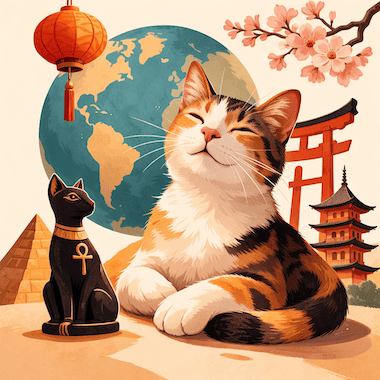
How did a small desert hunter end up in so many human homes? The story runs from the first farming villages to Egyptian temples, medieval festivals and Japanese shops, and finally to our phones. Along the way, it says a lot about what people want from the animals they live with.
Come ha fatto un piccolo cacciatore del deserto a entrare in così tante case? La storia va dai primi villaggi agricoli ai templi egizi, dalle feste medievali ai negozi giapponesi, fino ad arrivare ai nostri telefoni. Lungo il percorso racconta molto di ciò che le persone cercano negli animali con cui vivono.
Where Domestic Cats Came From
Da dove viene il gatto domestico
Dogs were shaped by humans for jobs like hunting and herding. Cats, most scientists believe, largely domesticated themselves. About 10,000 years ago, people in the Middle East began farming and storing grain, and the grain attracted mice and rats. The mice, in turn, attracted wild cats.
I cani sono stati plasmati dall'uomo per compiti come la caccia e la guardia delle greggi. I gatti invece, secondo la maggior parte degli scienziati, si sono in gran parte addomesticati da soli. Circa 10.000 anni fa, in Medio Oriente, gli uomini cominciarono a coltivare la terra e a conservare il grano, e il grano attirava topi e ratti. I topi, a loro volta, attiravano i gatti selvatici.
Farmers were happy to let the cats stay, since they kept pests down. Over many generations, the cats that were less afraid of people did better in the villages, and slowly they became tamer. Genetic studies show that all domestic cats descend from the Near Eastern wildcat, Felis silvestris lybica. Neither side was really in charge: both simply gained from the arrangement.
I contadini lasciavano volentieri che i gatti restassero, perché tenevano a bada i roditori. Nel corso di molte generazioni, i gatti che avevano meno paura delle persone se la cavavano meglio nei villaggi e a poco a poco diventarono più mansueti. Gli studi genetici dimostrano che tutti i gatti domestici discendono dal gatto selvatico del Vicino Oriente, Felis silvestris lybica. Nessuna delle due parti comandava davvero: entrambe ci guadagnavano e basta.
Sacred Cats in Ancient Egypt
I gatti sacri dell'antico Egitto
Few ancient peoples loved cats as much as the Egyptians. Cats lived in Egyptian homes from early times, hunting mice and snakes, and over the centuries they became linked with the gods. The goddess Bastet, who protected homes, mothers and children, was first shown as a lioness. From around 1000 BCE she usually appeared as a cat or as a woman with a cat's head, and her temple at Bubastis became the center of a huge cat cult.
Pochi popoli antichi hanno amato i gatti quanto gli Egizi. Già in tempi remoti i gatti vivevano nelle case egizie, dove cacciavano topi e serpenti, e nel corso dei secoli furono associati agli dèi. La dea Bastet, protettrice della casa, delle madri e dei bambini, all'inizio era raffigurata come una leonessa. Dal 1000 a.C. circa compariva di solito come una gatta o come una donna con la testa di gatto, e il suo tempio a Bubasti divenne il centro di un grande culto del gatto.
Greek writers who visited Egypt reported that killing a cat, even by accident, could cost a person their life, and that when a family cat died, everyone in the house shaved their eyebrows in mourning. Cats were mummified and buried in special cemeteries. In 1888 a farmer at Beni Hasan found one that held hundreds of thousands of cat mummies. Many tons of them were shipped to England and ground into fertilizer.
Alcuni autori greci che visitarono l'Egitto riferiscono che uccidere un gatto, anche per sbaglio, poteva costare la vita, e che quando moriva il gatto di famiglia tutti in casa si radevano le sopracciglia in segno di lutto. I gatti venivano mummificati e sepolti in cimiteri appositi. Nel 1888 un contadino di Beni Hasan ne scoprì uno che conteneva centinaia di migliaia di mummie di gatto. Molte tonnellate furono spedite in Inghilterra e macinate per farne fertilizzante.
Cats in Europe: From Helpers to Suspects
I gatti in Europa: da aiutanti a sospettati
In medieval Europe, cats were valued for catching mice, but many people also saw them as creatures of the night, linked with witches and the devil. Black cats had the worst reputation. In some towns, killing cats even became part of public festivals: in Paris, cats were burned in the Midsummer bonfire, and in Ypres, in Flanders, live cats were thrown from a tower until 1817.
Nell'Europa medievale i gatti erano apprezzati perché catturavano i topi, ma molti li consideravano anche creature della notte, legate alle streghe e al diavolo. I gatti neri avevano la fama peggiore. In alcune città uccidere i gatti diventò addirittura parte delle feste popolari: a Parigi si bruciavano gatti nel falò di San Giovanni, e a Ypres, nelle Fiandre, si gettavano gatti vivi da una torre fino al 1817.
A popular story says that Europeans killed so many cats that rats took over and spread the Black Death in the 14th century. Historians find little evidence for this. The plague reached Europe in 1347, while the great witch hunts came much later, mostly between about 1450 and 1750. Cats can also catch the plague themselves.
Secondo una storia molto diffusa, gli europei avrebbero ucciso così tanti gatti che i ratti si moltiplicarono e diffusero la peste nera nel Trecento. Gli storici trovano poche prove a sostegno. La peste arrivò in Europa nel 1347, mentre le grandi cacce alle streghe vennero molto più tardi, soprattutto tra il 1450 e il 1750 circa. Inoltre anche i gatti possono ammalarsi di peste.
Cats in Japan and China
I gatti in Giappone e in Cina
In Japan, cats have a much happier reputation. The maneki-neko, or 'beckoning cat', is a small figure of a cat with one paw raised, as if waving customers inside. It sits by the door of many shops and restaurants to bring good business, and it has become a familiar symbol of Japan around the world.
In Giappone i gatti godono di una fama molto migliore. Il maneki-neko, o "gatto che chiama", è una piccola statuina di gatto con una zampa alzata, come se facesse cenno ai clienti di entrare. Si trova accanto alla porta di molti negozi e ristoranti per portare buoni affari ed è diventato in tutto il mondo un simbolo familiare del Giappone.
Japanese folklore also has darker cats. The bakeneko is a cat that can change its shape, often into a person, and the nekomata is a cat demon with a tail split in two. In China, cats appear in paintings as wishes for a long life. The word for cat, mao, sounds like the first half of maodie, an old word for very old age, so a picture of a cat with a butterfly (die) means 'may you live to a great age'.
Il folclore giapponese conosce anche gatti più cupi. Il bakeneko è un gatto capace di cambiare forma, spesso trasformandosi in una persona, e il nekomata è un demone felino con la coda divisa in due. In Cina i gatti compaiono nei dipinti come augurio di lunga vita. La parola per gatto, mao, suona come la prima metà di maodie, un'antica parola che indica l'età molto avanzata, così l'immagine di un gatto con una farfalla (die) significa "che tu possa vivere fino a tarda età".
Cats in Literature and Art
I gatti nella letteratura e nell'arte
Writers have loved cats for a long time. Lewis Carroll created the grinning Cheshire Cat in Alice's Adventures in Wonderland (1865), a cat that slowly disappears until only its smile is left. In 1939 T. S. Eliot published Old Possum's Book of Practical Cats, a collection of funny poems that Andrew Lloyd Webber turned into the hit musical Cats in 1981.
Gli scrittori amano i gatti da molto tempo. Lewis Carroll creò il sorridente Stregatto in Alice nel Paese delle Meraviglie (1865), un gatto che svanisce lentamente finché non resta che il suo sorriso. Nel 1939 T. S. Eliot pubblicò Old Possum's Book of Practical Cats, una raccolta di poesie divertenti che Andrew Lloyd Webber trasformò nel 1981 nel celebre musical Cats.
Artists have been just as keen. A cat hunts birds in a wall painting from the tomb of Nebamun in Egypt, and the Japanese artist Utagawa Kuniyoshi filled his woodblock prints with cats. In Paris, Édouard Manet put a black cat at the foot of the bed in his painting Olympia, and Pierre Bonnard painted cats in many of his quiet scenes of home life.
Nemmeno i pittori sono stati da meno. In un dipinto murale della tomba di Nebamun, in Egitto, un gatto caccia uccelli, e l'artista giapponese Utagawa Kuniyoshi riempì di gatti le sue xilografie. A Parigi Édouard Manet mise un gatto nero ai piedi del letto nel suo quadro Olympia, e Pierre Bonnard dipinse gatti in molte delle sue tranquille scene di vita domestica.
The Psychology of Cat Ownership
La psicologia di chi ha un gatto
Psychologists have long asked why so many people feel close to their cats. Research suggests that living with a pet can lower stress and blood pressure. One large American study published in 2008 found that people who had owned a cat were less likely to die of a heart attack, although it could not prove that the cats were the reason. Some researchers have also suggested that the low sound of a purr, at about 25 to 150 Hz, helps with healing, but this has not been proven.
Gli psicologi si chiedono da tempo perché così tante persone si sentano tanto legate ai loro gatti. Le ricerche indicano che vivere con un animale domestico può ridurre lo stress e la pressione sanguigna. Un ampio studio americano pubblicato nel 2008 ha rilevato che chi aveva avuto un gatto moriva meno spesso di infarto, anche se non ha potuto dimostrare che il merito fosse dei gatti. Alcuni ricercatori hanno anche ipotizzato che il suono basso delle fusa, tra circa 25 e 150 Hz, favorisca la guarigione, ma non è stato dimostrato.
Cats also give people company without needing constant attention the way dogs do. They don't need walks, and they cope well in small apartments, which suits people with busy lives. Some psychologists add that a cat's affection feels special because it has to be earned: when a cat chooses your lap, it feels like a compliment.
I gatti fanno compagnia senza pretendere un'attenzione continua come i cani. Non c'è bisogno di portarli a passeggio e si adattano bene ai piccoli appartamenti, cosa comoda per chi ha una vita piena di impegni. Alcuni psicologi aggiungono che l'affetto di un gatto ha un valore speciale proprio perché bisogna guadagnarselo: quando un gatto sceglie le tue ginocchia, sembra un complimento.
Cats and the Internet
I gatti e internet
Cats found a new stage on the internet. Early hits like Keyboard Cat, a cat that seems to play an electric keyboard, spread across YouTube in the late 2000s. In the 2010s Grumpy Cat and Lil Bub became celebrities, with millions of fans, books and even films of their own.
Su internet i gatti hanno trovato un nuovo palcoscenico. I primi successi, come Keyboard Cat, un gatto che sembra suonare una tastiera elettrica, si diffusero su YouTube alla fine degli anni Duemila. Negli anni Dieci Grumpy Cat e Lil Bub diventarono delle celebrità, con milioni di fan, libri e perfino film tutti loro.
In 2015 a researcher at Indiana University asked nearly 7,000 people about watching cat videos. Most said the videos gave them more energy and made them feel happier and less anxious. Seen this way, internet cats are just the newest chapter of a very old friendship: people once kept cats in temples, and now they keep them on their phones.
Nel 2015 una ricercatrice dell'Università dell'Indiana interrogò quasi 7.000 persone sulla loro esperienza con i video di gatti. La maggior parte disse che i video davano loro più energia e li facevano sentire più felici e meno ansiosi. Visti così, i gatti di internet sono soltanto l'ultimo capitolo di un'amicizia molto antica: un tempo si tenevano i gatti nei templi, oggi li si tiene nel telefono.
The Science of Cat Behavior
La scienza del comportamento felino
Scientists still have a lot to learn about how cats behave. With each other, cats communicate mostly through body language and scent, along with hisses, growls and purrs. Adult cats rarely meow at other cats. Kittens meow to their mothers, but grown cats seem to keep the meow mainly for talking to humans.
Gli scienziati hanno ancora molto da imparare sul comportamento dei gatti. Tra di loro i gatti comunicano soprattutto con il linguaggio del corpo e con gli odori, oltre che con soffi, ringhi e fusa. I gatti adulti miagolano raramente agli altri gatti. I gattini miagolano alla madre, ma i gatti adulti sembrano riservare il miagolio soprattutto alle conversazioni con gli esseri umani.
Other habits are harder to explain: knocking things off tables, squeezing into boxes that are far too small, bringing dead mice to their owners as 'gifts', or racing around the house in the middle of the night. Some of these may come from hunting instincts or a need for safe, tight spaces, but many questions are still open.
Altre abitudini sono più difficili da spiegare: far cadere gli oggetti dai tavoli, infilarsi in scatole troppo piccole, portare topi morti ai padroni come "regali" o correre per casa in piena notte. Alcune potrebbero derivare dall'istinto di caccia o dal bisogno di spazi stretti e sicuri, ma molte domande restano aperte.
Quick Facts About Cats
Curiosità in breve sui gatti
Cats sleep about 12 to 16 hours a day.
I gatti dormono circa 12-16 ore al giorno.
A group of cats is called a 'clowder', and a group of kittens is called a 'kindle'.
In inglese un gruppo di gatti si chiama "clowder" e un gruppo di gattini "kindle".
The oldest known burial of a cat with a human, about 9,500 years old, was found in Cyprus.
La più antica sepoltura conosciuta di un gatto insieme a un essere umano risale a circa 9.500 anni fa ed è stata trovata a Cipro.
Cats can twist in the air to land on their feet, a skill called the 'righting reflex', but they don't always land safely.
I gatti sanno girarsi in aria per atterrare sulle zampe, un'abilità chiamata "riflesso di raddrizzamento", ma non sempre atterrano senza farsi male.
The loudest purr on record belongs to Merlin, a cat from England, whose purr measured 67.8 decibels.
Le fusa più forti mai registrate appartengono a Merlin, un gatto inglese: hanno raggiunto 67,8 decibel.
There are more than 500 million domestic cats in the world, including strays.
Nel mondo ci sono più di 500 milioni di gatti domestici, compresi i randagi.
Ten Thousand Years Together
Diecimila anni insieme
From Egyptian temples to today's living rooms and social media feeds, cats have lived alongside people for about 10,000 years. They have been worshipped and feared, burned at festivals and turned into lucky charms, but people have never stopped keeping them.
Dai templi egizi ai salotti e ai social network di oggi, i gatti vivono accanto alle persone da circa 10.000 anni. Sono stati venerati e temuti, bruciati durante le feste e trasformati in portafortuna, ma la gente non ha mai smesso di tenerli con sé.
Unlike most domestic animals, the cat still does much as it pleases. It hunts, sleeps and chooses its friends, and it stays with us because it wants to. After ten thousand years, people still seem to like it that way.
A differenza della maggior parte degli animali domestici, il gatto fa ancora più o meno quello che vuole. Caccia, dorme, si sceglie gli amici e resta con noi perché lo desidera. Dopo diecimila anni, alla gente sembra che vada ancora bene così.
Nell'app gratuita puoi ascoltare il testo letto ad alta voce e toccare ogni parola per vederne il significato.