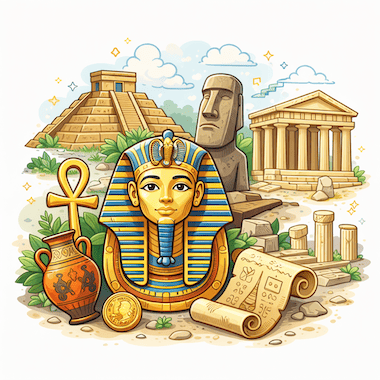
Ancient Civilizations
Antiche civiltà
 Learn EnglishApp gratuita con audio, quiz e libri veri
Parole chiave
- civilizationciviltà
- archaeologistarcheologo
- sophisticatedsofisticato
- ingeniousingegnoso
- interconnectedinterconnesso
- precisionprecisione
- scholarstudioso
- assumptionassunzione
- flourishfiorire
- advancedavanzato
- drainagedrenaggio
- sewagefognatura
Tutte le 30 parole
- standardizedstandardizzato
- unsolvedirrisolto
- enduringduraturo
- laboreroperaio
- contributioncontributo
- astronomerastronomo
- predictionpredizione
- aqueductacquedotto
- durabledurevole
- sustainablesostenibile
- masterpiececapolavoro
- decodeddecodificato
- mummymummia
- hierarchygerarchia
- relicreliquia
- ambitionambizione
- instabilityinstabilità
- fragilefragile
The ancient world is full of surprises. For a long time, historians assumed that early civilizations were simple, rough drafts of our own. But the more archaeologists dig, the clearer it becomes that ancient peoples were inventive, well organized and in closer contact with each other than anyone expected.
Il mondo antico è pieno di sorprese. Per molto tempo gli storici hanno pensato che le prime civiltà fossero semplici abbozzi, ancora grezzi, della nostra. Ma più gli archeologi scavano, più diventa chiaro che i popoli antichi erano ingegnosi, ben organizzati e molto più in contatto tra loro di quanto ci si aspettasse.
They built cities on careful grid plans, moved goods across seas and deserts, and followed the sky with great accuracy. Some of their work still puzzles engineers today. Their stories make us rethink easy ideas about progress and about what it means to be civilized.
Costruivano città secondo accurati schemi a griglia, trasportavano merci attraverso mari e deserti e osservavano il cielo con grande precisione. Alcune delle loro opere lasciano perplessi ancora oggi gli ingegneri. Le loro storie ci spingono a ripensare idee comode sul progresso e su che cosa significhi essere civili.
The Indus Valley: The Forgotten Giant
La valle dell'Indo: il gigante dimenticato
Around 2500 BCE, while the Egyptians were building the pyramids at Giza and the cities of Mesopotamia were growing rich, a third great civilization was flourishing in what is now Pakistan and northwest India. Later historians knew almost nothing about it until excavations began in the 1920s. Today we call it the Indus Valley Civilization, and in some ways it was the most advanced urban society of its time.
Intorno al 2500 a.C., mentre gli egizi costruivano le piramidi di Giza e le città della Mesopotamia si arricchivano, una terza grande civiltà fioriva negli attuali Pakistan e India nordoccidentale. Gli storici delle epoche successive non ne sapevano quasi nulla fino agli scavi iniziati negli anni Venti del Novecento. Oggi la chiamiamo civiltà della valle dell'Indo e, per certi aspetti, fu la società urbana più avanzata del suo tempo.
Its largest cities, Mohenjo-daro and Harappa, were laid out on a grid, with main streets running north to south and east to west. Most houses had a bathroom connected to covered drains along the street, a level of public sanitation that Europe would not see until the Romans. Merchants used the same standard stone weights across a huge area, larger than Egypt and Mesopotamia combined. And yet we still cannot read their writing. The Indus script, found on thousands of small seals and tablets, is one of the great unsolved puzzles of archaeology.
Le sue città più grandi, Mohenjo-daro e Harappa, erano costruite a griglia, con le strade principali orientate da nord a sud e da est a ovest. La maggior parte delle case aveva un bagno collegato a canali di scolo coperti lungo la strada, un livello di igiene pubblica che l'Europa avrebbe conosciuto solo con i romani. I mercanti usavano gli stessi pesi di pietra standard su un territorio enorme, più vasto dell'Egitto e della Mesopotamia messi insieme. Eppure non sappiamo ancora leggere la loro scrittura. La scrittura dell'Indo, ritrovata su migliaia di piccoli sigilli e tavolette, è uno dei grandi enigmi irrisolti dell'archeologia.
Ancient Egypt: Stranger Than You Think
L'antico Egitto: più strano di quanto pensi
Ancient Egyptian civilization lasted for more than 3,000 years. That is so long that Cleopatra lived closer in time to the Moon landing than to the building of the Great Pyramid. Even so, there is a lot about Egypt that most people have never heard.
La civiltà dell'antico Egitto durò più di 3.000 anni. Un periodo così lungo che Cleopatra visse più vicina nel tempo allo sbarco sulla Luna che alla costruzione della Grande Piramide. Eppure dell'Egitto ci sono molte cose di cui la maggior parte delle persone non ha mai sentito parlare.
The pyramids were not built by slaves, as many films suggest. They were built by organized crews of workers, many of them skilled, who lived in a town next to the site at Giza. Bakeries and animal bones found there show that they ate bread, fish and plenty of meat and drank beer, and their skeletons show broken bones that had been set and healed. The crews gave themselves names like “Friends of Khufu” and “Drunkards of Menkaure,” which they painted on the stones. Records from a later village of tomb builders, Deir el-Medina, show that workers there could take days off when they were sick, or even after a scorpion sting.
Le piramidi non furono costruite da schiavi, come suggeriscono molti film. Le eressero squadre organizzate di operai, molti dei quali specializzati, che vivevano in un villaggio accanto al cantiere di Giza. I forni per il pane e le ossa di animali trovati sul posto mostrano che mangiavano pane, pesce e molta carne e bevevano birra, e nei loro scheletri si vedono fratture che erano state ridotte e si erano saldate. Le squadre si davano nomi come «Amici di Cheope» e «Ubriachi di Micerino», che dipingevano sulle pietre. I documenti di Deir el-Medina, un villaggio più tardo di costruttori di tombe, mostrano che lì gli operai potevano assentarsi quando erano malati, o persino dopo la puntura di uno scorpione.
The Maya: Masters of Time
I maya: maestri del tempo
The Maya flourished for more than 2,000 years in what is now southern Mexico, Guatemala and Belize. Most people know them for their stone pyramids and for the abandonment of many of their great cities in the 9th century. But the Maya were also skilled astronomers and mathematicians.
La civiltà maya fiorì per più di 2.000 anni negli attuali Messico meridionale, Guatemala e Belize. Quasi tutti la conoscono per le piramidi di pietra e per l'abbandono di molte sue grandi città nel IX secolo. Ma i maya erano anche abili astronomi e matematici.
They developed the idea of zero on their own, many centuries before it reached Europe through Arabic mathematics. A Maya book known as the Dresden Codex contains tables that predicted eclipses and followed the movements of Venus over many years. Their Long Count calendar counted days from a starting point in 3114 BCE, and some inscriptions mention dates millions of years in the past. The Maya themselves never disappeared: about six million people speak Mayan languages today.
Svilupparono il concetto di zero in modo autonomo, molti secoli prima che arrivasse in Europa attraverso la matematica araba. Un libro maya noto come Codice di Dresda contiene tavole che permettevano di prevedere le eclissi e di seguire i movimenti di Venere per molti anni. Il loro calendario del Lungo Computo contava i giorni a partire da una data iniziale nel 3114 a.C., e alcune iscrizioni citano date di milioni di anni fa. I maya non sono mai scomparsi: oggi circa sei milioni di persone parlano lingue maya.
Ancient Rome: Engineering a World
L'antica Roma: l'ingegneria di un impero
Rome is the ancient civilization most familiar to Westerners, but its numbers are still impressive. Around 100 CE, the city had about a million people, and no European city was that large again until London around 1800. By the 3rd century, eleven aqueducts brought fresh water to Rome's fountains and public baths. The state handed out free grain to citizens, and a great sewer, the Cloaca Maxima, carried waste into the Tiber. Parts of it still drain water today.
Roma è la civiltà antica più familiare agli occidentali, ma i suoi numeri impressionano ancora. Intorno al 100 d.C. la città contava circa un milione di abitanti, e nessuna città europea raggiunse di nuovo quelle dimensioni fino a Londra, verso il 1800. Nel III secolo undici acquedotti portavano acqua fresca alle fontane e alle terme pubbliche di Roma. Lo Stato distribuiva grano gratis ai cittadini, e una grande fogna, la Cloaca Massima, scaricava i liquami nel Tevere. Alcuni suoi tratti scaricano acqua ancora oggi.
Roman concrete, called opus caementicium, is one of the most durable building materials ever made. Roman harbor walls built 2,000 years ago still stand in the sea, taking the force of the waves. Scientists have found out why: seawater reacts with the volcanic ash in the mix and forms new crystals that make the concrete stronger over time. Modern concrete does the opposite and slowly breaks down in seawater. Engineers are now studying the Roman recipe to make longer-lasting, greener building materials.
Il calcestruzzo romano, chiamato opus caementicium, è uno dei materiali da costruzione più durevoli mai realizzati. Moli portuali romani costruiti 2.000 anni fa sono ancora in piedi nel mare e resistono alla forza delle onde. Gli scienziati hanno scoperto il perché: l'acqua di mare reagisce con la cenere vulcanica dell'impasto e forma nuovi cristalli che rendono il calcestruzzo più resistente con il tempo. Il calcestruzzo moderno fa l'opposto e nell'acqua di mare si degrada lentamente. Oggi gli ingegneri studiano la ricetta romana per creare materiali più durevoli e più ecologici.
The Inca Empire: Mountain Builders
L'Impero inca: costruttori d'alta quota
The Inca Empire grew in western South America from the early 1400s until the Spanish conquest in 1533. It was the largest state in the Americas before Columbus, covering about 2 million square kilometers from southern Colombia to central Chile. A network of roads about 40,000 kilometers long held it together across deserts, forests and high mountains.
L'Impero inca si espanse nella parte occidentale del Sud America dall'inizio del Quattrocento fino alla conquista spagnola del 1533. Fu lo Stato più grande delle Americhe prima di Colombo e copriva circa 2 milioni di chilometri quadrati, dal sud della Colombia al Cile centrale. Una rete di strade lunga circa 40.000 chilometri lo teneva unito attraverso deserti, foreste e alte montagne.
The Inca had no iron tools, did not use the wheel for transport and had no writing in the usual sense. Even so, they built stone walls high in the Andes whose blocks fit together so closely, without mortar, that a knife blade cannot slip between them. In Cusco, many of these walls have survived strong earthquakes that badly damaged later Spanish buildings. To keep records, the Inca used the quipu, a set of knotted strings that stored numbers and perhaps stories. Researchers can read the numbers, but much of the system is still a mystery.
Gli inca non avevano strumenti di ferro, non usavano la ruota per i trasporti e non avevano una scrittura nel senso comune. Eppure costruirono in alto sulle Ande muri di pietra i cui blocchi combaciano senza malta in modo così preciso che tra l'uno e l'altro non passa la lama di un coltello. A Cuzco molti di questi muri hanno resistito a forti terremoti che hanno danneggiato gravemente edifici spagnoli più recenti. Per tenere i registri gli inca usavano il quipu, un insieme di cordicelle annodate che conservava numeri e forse racconti. I ricercatori sanno leggere i numeri, ma gran parte del sistema resta un mistero.
Ancient Trade: More Connected Than We Thought
Il commercio antico: un mondo più connesso di quanto pensassimo
Modern archaeology keeps showing how connected the ancient world was. For a long time, scholars pictured early civilizations as islands, each developing on its own. The evidence now tells a different story.
L'archeologia moderna continua a mostrare quanto fosse connesso il mondo antico. A lungo gli studiosi hanno immaginato le prime civiltà come isole, ognuna con uno sviluppo tutto suo. Oggi le prove raccontano un'altra storia.
Blue glass beads made in Egypt and Mesopotamia have been found in Bronze Age graves in Denmark, buried around 1400 BCE. Silk, probably from Asia, was identified in the hair of an Egyptian mummy from about 1000 BCE. Roman coins have turned up at Oc Eo, an ancient port in what is now southern Vietnam. Some researchers have even reported traces of tobacco and coca, plants from the Americas, in Egyptian mummies, but most scholars think those samples were contaminated. How goods traveled such distances is still being studied and debated.
Perline di vetro blu prodotte in Egitto e in Mesopotamia sono state trovate in Danimarca, in tombe dell'età del bronzo risalenti a circa il 1400 a.C. Nei capelli di una mummia egizia del 1000 a.C. circa è stata individuata della seta, probabilmente proveniente dall'Asia. A Óc Eo, un antico porto nell'attuale Vietnam meridionale, sono venute alla luce monete romane. Alcuni ricercatori hanno perfino segnalato tracce di tabacco e coca, piante delle Americhe, in mummie egizie, ma la maggior parte degli studiosi ritiene che quei campioni fossero contaminati. Come le merci percorressero distanze simili è ancora oggetto di studio e di dibattito.
Çatalhöyük: A Town Before Cities
Çatalhöyük: una città prima delle città
On the Konya Plain in central Turkey lies Çatalhöyük, one of the oldest and largest Neolithic settlements in the world. People lived there from about 7100 BCE for well over a thousand years. At its peak, it was home to several thousand people, a huge number for its time.
Nella pianura di Konya, in Turchia centrale, si trova Çatalhöyük, uno dei più antichi e grandi insediamenti neolitici del mondo. Fu abitato a partire dal 7100 a.C. circa per ben più di mille anni. Nel suo periodo di massima espansione ospitava diverse migliaia di persone, un numero enorme per l'epoca.
The settlement had no streets. Houses were built wall to wall, and people walked across the roofs and climbed down into their homes by ladder. Archaeologists have found very little sign of rich and poor: no palaces, no grand tombs, no wealthy neighborhoods. The dead were buried under the floors of the houses, and their bones show that men and women ate much the same food and lived very similar lives. People painted animals and hunting scenes on their walls, and some covered the skulls of their ancestors in plaster and kept them at home. Çatalhöyük shows that a large community could be organized very differently from most of the societies that came after it.
L'insediamento non aveva strade. Le case erano costruite una addossata all'altra: si camminava sui tetti e si scendeva in casa con una scala a pioli. Gli archeologi hanno trovato pochissimi segni di differenze tra ricchi e poveri: niente palazzi, niente tombe sfarzose, niente quartieri benestanti. I morti venivano sepolti sotto i pavimenti delle case, e le loro ossa mostrano che uomini e donne mangiavano più o meno lo stesso cibo e facevano vite molto simili. Gli abitanti dipingevano animali e scene di caccia sulle pareti, e alcuni ricoprivano di gesso i crani degli antenati e li tenevano in casa. Çatalhöyük dimostra che una grande comunità poteva organizzarsi in modo molto diverso dalla maggior parte delle società venute dopo.
Surprising Facts About the Ancient World
Curiosità sorprendenti sul mondo antico
The Sumerians of Mesopotamia created cuneiform, one of the first writing systems, around 3200 BCE.
I sumeri della Mesopotamia crearono la scrittura cuneiforme, uno dei primi sistemi di scrittura, intorno al 3200 a.C.
Hero of Alexandria described a steam-powered spinning ball, the aeolipile, in the 1st century CE, about 1,700 years before the Industrial Revolution.
Erone di Alessandria descrisse nel I secolo d.C. una sfera rotante azionata dal vapore, l'eolipila, circa 1.700 anni prima della rivoluzione industriale.
Around 400 CE, Teotihuacan in Mexico had perhaps 100,000 people, which made it one of the largest cities in the world.
Intorno al 400 d.C. Teotihuacan, in Messico, aveva forse 100.000 abitanti, il che ne faceva una delle città più grandi del mondo.
The Antikythera mechanism, a Greek device from around 100 BCE, is often called the first analog computer: its gears modeled the movements of the sun, the moon and probably the planets.
Il meccanismo di Anticitera, un congegno greco del 100 a.C. circa, viene spesso definito il primo computer analogico: i suoi ingranaggi riproducevano i movimenti del Sole, della Luna e probabilmente dei pianeti.
Egyptians cleaned their teeth with powders made from burnt eggshells and ash from ox hooves, and more than 4,600 years ago an official named Hesy-Ra held the title “chief of dentists.”
Gli egizi si pulivano i denti con polveri a base di gusci d'uovo bruciati e cenere di zoccoli di bue, e più di 4.600 anni fa un funzionario di nome Hesy-Ra portava il titolo di «capo dei dentisti».
The Persian Royal Road, built under Darius I around 500 BCE, ran about 2,700 kilometers from Sardis to Susa. Royal messengers could cover it in little more than a week, while ordinary travelers needed about three months.
La Strada Reale persiana, costruita sotto Dario I intorno al 500 a.C., si snodava per circa 2.700 chilometri da Sardi a Susa. I messaggeri reali la percorrevano in poco più di una settimana, mentre ai viaggiatori comuni servivano circa tre mesi.
What Ancient Civilizations Tell Us About Ourselves
Che cosa ci dicono di noi le civiltà antiche
The more we learn about ancient civilizations, the harder it is to see human progress as a simple climb upward. Harappa had covered drains in its streets, which most European towns of the Middle Ages lacked. The Maya followed Venus and predicted eclipses for centuries. Parts of the Inca roads are still in use today, more than 500 years after they were built.
Più impariamo sulle civiltà antiche, più è difficile vedere il progresso umano come una semplice salita. Harappa aveva canali di scolo coperti nelle sue strade, che mancavano alla maggior parte delle città europee del Medioevo. I maya seguirono Venere e previdero eclissi per secoli. Alcuni tratti delle strade inca sono ancora in uso, più di 500 anni dopo la loro costruzione.
These civilizations also show how fragile even great societies can be. Every one of them eventually declined or changed beyond recognition, often because of a mix of climate change, political conflict, war and damage to the land. Those problems are not limited to the past. Societies today face many of the same ones.
Queste civiltà mostrano anche quanto possano essere fragili perfino le grandi società. Tutte finirono per declinare o per trasformarsi fino a diventare irriconoscibili, spesso per un insieme di cambiamenti climatici, conflitti politici, guerre e degrado del territorio. Questi problemi non appartengono solo al passato. Le società di oggi ne affrontano molti.
Conclusion
Conclusione
Ancient civilizations were not primitive. The people who built Mohenjo-daro, calculated eclipses in the forests of the Yucatán or cut roads through the Andes had the same brains and abilities that we have today. They were creative and ambitious, and like us, they could achieve great things or fail badly.
Le civiltà antiche non erano primitive. Le persone che costruirono Mohenjo-daro, calcolarono eclissi nelle foreste dello Yucatán o tracciarono strade attraverso le Ande avevano il nostro stesso cervello e le nostre stesse capacità. Erano creative e ambiziose e, come noi, potevano realizzare grandi cose o fallire clamorosamente.
Their tools were different from ours, but the hopes and needs that drove them were much the same. Studying them tells us where we come from, and it helps us see our own time more clearly.
I loro strumenti erano diversi dai nostri, ma le speranze e i bisogni che le spingevano erano in gran parte gli stessi. Studiarle ci dice da dove veniamo e ci aiuta a vedere con più chiarezza il nostro tempo.
Nell'app gratuita puoi ascoltare il testo letto ad alta voce e toccare ogni parola per vederne il significato.