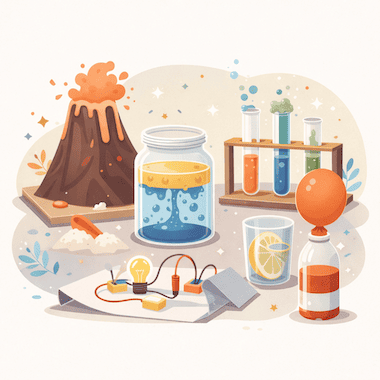
Simple Science Experiments
Semplici esperimenti scientifici
 Learn EnglishApp gratuita con audio, quiz e libri veri
Parole chiave
- experimentesperimento
- chemical reactionreazione chimica
- buoyancygalleggiabilità
- densitydensità
- crystallizationcristallizzazione
- atmospheric pressurepressione atmosferica
- oxidationossidazione
- surface tensiontensione superficiale
- magnetic fieldcampo magnetico
- moleculemolecola
- saturatedsaturo
- combustioncombustione
Tutte le 30 parole
- evaporateevaporare
- hypothesisipotesi
- electromagneticelettromagnetico
- acidacido
- gravitygravità
- emulsificationemulsificazione
- oxygenossigeno
- observationosservazione
- dissolvedissolvere
- carbon dioxidebiossido di carbonio
- radiationradiazione
- inquiryindagine
- phenomenonfenomeno
- latticereticolo
- penicillinpenicillina
- magnetmagnete
- solar energyenergia solare
- critical thinkingpensiero critico
Science doesn't only happen in laboratories full of expensive equipment and people in white coats. Many basic ideas in physics, chemistry and biology can be shown on a kitchen table with things you already have at home: vinegar, salt, milk, a glass bottle or a sewing needle.
La scienza non si fa solo nei laboratori pieni di apparecchi costosi e di persone in camice bianco. Molte idee di base della fisica, della chimica e della biologia si possono mostrare sul tavolo di cucina con cose che abbiamo già in casa: aceto, sale, latte, una bottiglia di vetro o un ago da cucito.
Experiments like these are fun, but they also teach something useful: the world follows rules that we can discover and understand. When a child watches baking soda fizz in vinegar and asks why, they are doing what scientists do: watching carefully and looking for an explanation. Here are some of the best experiments to try at home, with a short explanation of what is really going on in each one.
Esperimenti come questi sono divertenti, ma insegnano anche qualcosa di utile: il mondo segue regole che possiamo scoprire e capire. Quando un bambino vede il bicarbonato frizzare nell'aceto e chiede perché, sta facendo quello che fanno gli scienziati: osserva con attenzione e cerca una spiegazione. Ecco alcuni dei migliori esperimenti da fare in casa, ognuno con una breve spiegazione di ciò che succede davvero.
The Baking Soda Volcano: A Chemical Reaction
Il vulcano di bicarbonato: una reazione chimica
Baking soda and vinegar is the classic piece of kitchen chemistry. Baking soda is sodium bicarbonate, a base, and vinegar contains acetic acid. When the two meet, they react and produce carbon dioxide gas, water and a salt called sodium acetate. The carbon dioxide is what makes the mixture fizz and bubble.
Bicarbonato e aceto sono il classico esempio di chimica in cucina. Il bicarbonato di sodio è una base, e l'aceto contiene acido acetico. Quando si incontrano, reagiscono e producono anidride carbonica, acqua e un sale chiamato acetato di sodio. È l'anidride carbonica a far frizzare e gorgogliare il miscuglio.
For a better show, put a pile of baking soda in a small cup or bottle, then add a few drops of food coloring and a squirt of dish soap to the vinegar before you pour it in. The soap traps the gas in bubbles, so you get a thick, colorful foam that pours over the sides like lava. The idea behind it, that acids and bases react with each other, is one of the basics of chemistry. Acids and bases are all around us: in lemon juice and soap, in cleaning products and in our own stomachs, where hydrochloric acid helps break down food.
Per un effetto più spettacolare, metti un mucchietto di bicarbonato in un bicchierino o in una bottiglia, poi aggiungi all'aceto qualche goccia di colorante alimentare e uno spruzzo di detersivo per piatti prima di versarlo. Il detersivo intrappola il gas nelle bolle, così si forma una schiuma densa e colorata che trabocca come lava. L'idea alla base, cioè che acidi e basi reagiscono tra loro, è uno dei fondamenti della chimica. Acidi e basi sono ovunque: nel succo di limone e nel sapone, nei detersivi e perfino nel nostro stomaco, dove l'acido cloridrico aiuta a scomporre il cibo.
Dancing Raisins: Density and Buoyancy
L'uvetta che balla: densità e galleggiamento
Drop a few raisins into a glass of sparkling water or clear soda. At first they sink to the bottom. Then, one by one, they slowly rise to the top, sink again and keep going up and down for a long time. The raisins are showing you how density and buoyancy work.
Metti qualche acino di uvetta in un bicchiere di acqua frizzante o di una bibita gassata trasparente. All'inizio gli acini vanno a fondo. Poi, uno alla volta, risalgono lentamente in superficie, affondano di nuovo e continuano a salire e scendere a lungo. L'uvetta ti mostra come funzionano la densità e il galleggiamento.
A raisin sinks because it is denser than the liquid. On the bottom, though, bubbles of carbon dioxide stick to its wrinkled skin. Each bubble works like a tiny life jacket: the raisin and its bubbles take up more space without getting much heavier, so together they become less dense than the water and float up. At the surface many of the bubbles burst, the raisin is denser than the water again, and down it goes. This goes on until the drink goes flat. Many fish use a similar trick: they control their depth by adding gas to an organ called the swim bladder or letting gas out of it.
Un acino di uvetta affonda perché è più denso del liquido. Sul fondo, però, bollicine di anidride carbonica si attaccano alla sua buccia rugosa. Ogni bollicina funziona come un minuscolo giubbotto salvagente: l'acino e le sue bollicine occupano più spazio senza diventare molto più pesanti, quindi insieme sono meno densi dell'acqua e salgono. In superficie molte bollicine scoppiano, l'acino torna più denso dell'acqua e riscende. Il ciclo continua finché la bibita non si sgasa. Molti pesci usano un trucco simile: regolano la profondità riempiendo di gas un organo chiamato vescica natatoria oppure svuotandolo.
Growing Crystals: Order in Matter
Far crescere i cristalli: l'ordine della materia
Growing crystals is one of the most rewarding experiments you can do at home, and all you need is salt or sugar, hot water and patience. The process is called crystallization, and it shows how neatly matter is organized at the smallest scale.
Far crescere i cristalli è uno degli esperimenti casalinghi più gratificanti, e servono solo sale o zucchero, acqua calda e pazienza. Il processo si chiama cristallizzazione e mostra quanto sia ordinata la materia su scala piccolissima.
Stir salt into hot water until no more will dissolve. This is called a saturated solution. Pour it into a glass and hang a rough piece of string into it from a pencil laid across the top. Over the next few days the water slowly evaporates, and the liquid that is left can't hold all the salt. The extra salt comes out of the solution and settles on the string. Little by little, small crystals with flat faces and straight edges appear. Salt crystals are often shaped like tiny cubes, because inside them sodium and chloride ions are arranged in a cubic pattern that repeats millions of times. Nobody designs this shape; it comes from the chemistry itself.
Mescola sale nell'acqua calda finché non si scioglie più. Questa si chiama soluzione satura. Versala in un bicchiere e immergici un pezzo di spago ruvido legato a una matita appoggiata di traverso sul bordo. Nei giorni successivi l'acqua evapora lentamente e il liquido che resta non riesce più a trattenere tutto il sale. Il sale in eccesso si separa dalla soluzione e si deposita sullo spago. A poco a poco compaiono piccoli cristalli con facce piatte e spigoli dritti. I cristalli di sale hanno spesso la forma di minuscoli cubi, perché al loro interno gli ioni di sodio e di cloruro sono disposti secondo uno schema cubico che si ripete milioni di volte. Nessuno progetta questa forma: nasce dalla chimica stessa.
The Egg in a Bottle: Air Pressure at Work
L'uovo nella bottiglia: la pressione dell'aria al lavoro
This classic experiment shows the force of the air around us. You need a glass bottle whose neck is a little narrower than a peeled hard-boiled egg, and a few thin strips of paper. With an adult's help, light the paper, drop it into the bottle and quickly set the egg on the opening. Soon after the flame goes out, the egg is squeezed through the neck and drops into the bottle, sometimes with a loud pop.
Questo esperimento classico mostra la forza dell'aria che ci circonda. Serve una bottiglia di vetro con il collo un po' più stretto di un uovo sodo sgusciato, più qualche striscia sottile di carta. Con l'aiuto di un adulto, accendi la carta, lasciala cadere nella bottiglia e appoggia subito l'uovo sull'imboccatura. Poco dopo che la fiamma si è spenta, l'uovo viene spinto attraverso il collo e cade nella bottiglia, a volte con un forte schiocco.
Here is what happens. The fire heats the air in the bottle, the air expands, and some of it escapes past the egg. When the flame goes out, the air that is left cools and its pressure drops. Now the air outside pushes harder than the air inside, and it forces the egg into the bottle. People often say that the fire uses up the oxygen, but that has only a small effect; the cooling of the air does most of the work. The same difference in pressure makes suction cups stick to tiles and lets you drink through a straw. We rarely notice air pressure, but at sea level it presses on every square centimeter of your body with the weight of about one kilogram.
Ecco che cosa succede. Il fuoco scalda l'aria nella bottiglia, l'aria si espande e una parte sfugge attorno all'uovo. Quando la fiamma si spegne, l'aria rimasta si raffredda e la sua pressione cala. A quel punto l'aria esterna spinge più forte di quella interna e fa entrare l'uovo nella bottiglia. Si dice spesso che il fuoco consumi l'ossigeno, ma questo conta poco; gran parte del lavoro la fa il raffreddamento dell'aria. La stessa differenza di pressione fa aderire le ventose alle piastrelle e ci permette di bere con la cannuccia. Raramente ci accorgiamo della pressione dell'aria, ma al livello del mare preme su ogni centimetro quadrato del nostro corpo con il peso di circa un chilogrammo.
A Homemade Compass: Earth's Magnetic Field
Una bussola fatta in casa: il campo magnetico terrestre
You can make a working compass with a steel sewing needle, a small magnet, a bowl of water and a leaf or a thin slice of cork. Stroke the needle with one end of the magnet about 30 times, always in the same direction. This lines up tiny magnetic regions inside the steel and turns the needle into a weak magnet for a while. Lay the needle on the leaf and float it on still water. It will slowly turn until it points north and south, in line with Earth's magnetic field.
Si può costruire una bussola funzionante con un ago da cucito d'acciaio, una piccola calamita, una ciotola d'acqua e una foglia o una fettina sottile di sughero. Strofina l'ago con un'estremità della calamita una trentina di volte, sempre nella stessa direzione. In questo modo minuscole zone magnetiche all'interno dell'acciaio si allineano e l'ago diventa per un po' una debole calamita. Appoggia l'ago sulla foglia e falla galleggiare sull'acqua ferma. L'ago ruoterà lentamente finché non indicherà il nord e il sud, allineato con il campo magnetico terrestre.
The compass is one of the great inventions in the history of navigation. In 1088 the Chinese scholar Shen Kuo described a magnetized needle that pointed north and south, and a few decades later Chinese sailors were using compasses at sea. By the end of the 12th century they had reached Europe too. For centuries nobody knew why they worked. Only in 1600 did the English scientist William Gilbert suggest that Earth itself behaves like a giant magnet. Earth's magnetic field does more than guide compass needles: it also turns aside most of the solar wind, a stream of charged particles from the Sun, and so helps protect our atmosphere.
La bussola è una delle grandi invenzioni della storia della navigazione. Nel 1088 lo studioso cinese Shen Kuo descrisse un ago magnetizzato che indicava il nord e il sud, e qualche decennio dopo i marinai cinesi usavano già la bussola in mare. Alla fine del XII secolo era arrivata anche in Europa. Per secoli nessuno seppe perché funzionasse. Solo nel 1600 lo scienziato inglese William Gilbert ipotizzò che la Terra stessa si comporti come una gigantesca calamita. Il campo magnetico terrestre non si limita a orientare gli aghi delle bussole: devia anche la maggior parte del vento solare, un flusso di particelle cariche che arriva dal Sole, e così aiuta a proteggere la nostra atmosfera.
Milk and Food Coloring: Surface Tension
Latte e colorante: la tensione superficiale
Pour some whole milk into a shallow plate and add drops of different food coloring near the middle. Now dip a cotton swab in dish soap and touch it to the center of the milk. The colors suddenly rush outward and swirl around the plate in bright, changing patterns. Few experiments you can do at home look this impressive.
Versa un po' di latte intero in un piatto fondo e aggiungi gocce di coloranti alimentari di vari colori vicino al centro. Ora intingi un cotton fioc nel detersivo per piatti e tocca il centro del latte. All'improvviso i colori schizzano verso l'esterno e vorticano nel piatto formando disegni vivaci e sempre diversi. Pochi esperimenti casalinghi sono così d'effetto.
The explanation has to do with surface tension and fat. Water molecules at the surface of the milk pull on each other, so the surface acts a bit like a thin, stretched skin. Soap weakens this pull where it touches the milk. The rest of the surface, which still pulls strongly, drags the liquid away toward the edges and carries the colors with it. At the same time, soap molecules attach to tiny drops of fat and protein in the milk and keep the liquid moving for a while. The food coloring simply makes this movement visible. Soap cleans greasy plates in a similar way: one end of a soap molecule is attracted to water and the other end to fat, so soap surrounds bits of grease and lets the water wash them away.
La spiegazione ha a che fare con la tensione superficiale e con i grassi. Le molecole d'acqua sulla superficie del latte si attraggono a vicenda, quindi la superficie si comporta un po' come una pelle sottile e tesa. Il detersivo indebolisce questa attrazione nel punto in cui tocca il latte. Il resto della superficie, che tira ancora con forza, trascina il liquido verso i bordi e porta con sé i colori. Allo stesso tempo, le molecole di detersivo si legano a minuscole goccioline di grasso e di proteine del latte e mantengono il liquido in movimento ancora per un po'. Il colorante rende solo visibile questo movimento. Il detersivo pulisce i piatti unti in modo simile: un'estremità della sua molecola è attratta dall'acqua e l'altra dal grasso, così il detersivo avvolge i residui di unto e permette all'acqua di portarli via.
Invisible Ink: Chemistry You Can Read
Inchiostro invisibile: chimica da leggere
Invisible ink isn't only a children's game. Spies used it for centuries, including during the American Revolution and both World Wars. The simplest version uses lemon juice. Dip a cotton swab in lemon juice and write a message on white paper. Let it dry completely, and the writing disappears. To read it, ask an adult to run a hot iron over the paper, and the letters slowly appear in brown.
L'inchiostro invisibile non è solo un gioco da bambini. Le spie lo hanno usato per secoli, anche durante la guerra d'indipendenza americana e le due guerre mondiali. La versione più semplice si fa con il succo di limone. Intingi un cotton fioc nel succo di limone e scrivi un messaggio su un foglio bianco. Lascialo asciugare del tutto e la scritta sparirà. Per leggerla, chiedi a un adulto di passare un ferro da stiro caldo sul foglio: le lettere compariranno lentamente in marrone.
The chemistry is simple. Lemon juice contains sugars, citric acid and other substances. When they are heated, they break down and start to burn at a lower temperature than paper does, so the writing turns brown while the paper around it stays white. Part of this change is oxidation, a reaction with the oxygen in the air. Oxidation is one of the most common chemical reactions around us: it helps turn a cut apple brown and old paper yellow, and it is also what makes iron rust.
La chimica è semplice. Il succo di limone contiene zuccheri, acido citrico e altre sostanze. Quando vengono scaldate, si decompongono e cominciano a bruciare a una temperatura più bassa della carta, perciò la scritta diventa marrone mentre la carta intorno resta bianca. Una parte di questo cambiamento è un'ossidazione, cioè una reazione con l'ossigeno dell'aria. L'ossidazione è una delle reazioni chimiche più comuni intorno a noi: contribuisce a far annerire una mela tagliata e ingiallire la carta vecchia, ed è anche ciò che fa arrugginire il ferro.
More Experiments Worth Trying
Altri esperimenti da provare
Paper bridge: fold a sheet of paper back and forth like an accordion and lay it across two stacks of books. The folded sheet can hold many times its own weight, because the folds spread the force. Engineers use the same idea in bridges and in corrugated cardboard.
Ponte di carta: piega un foglio a fisarmonica e appoggialo tra due pile di libri. Il foglio piegato può reggere molte volte il proprio peso, perché le pieghe distribuiscono la forza. Gli ingegneri usano la stessa idea nei ponti e nel cartone ondulato.
Oobleck: mix about two parts cornstarch with one part water. Hit it quickly and it feels solid; move your fingers through it slowly and it flows like a liquid. It is a non-Newtonian fluid, which means it doesn't flow the way ordinary liquids like water do.
Oobleck: mescola circa due parti di amido di mais con una parte d'acqua. Se lo colpisci in fretta sembra solido; se ci passi le dita lentamente, scorre come un liquido. È un fluido non newtoniano, cioè non scorre come i liquidi comuni, per esempio l'acqua.
Homemade butter: pour heavy cream into a jar, close the lid tightly and shake hard for 10 to 15 minutes. The tiny fat droplets in the cream bump into each other and stick together until a lump of butter separates from a thin liquid called buttermilk. Cream is an emulsion, and shaking breaks it apart.
Burro fatto in casa: versa della panna fresca in un barattolo, chiudi bene il coperchio e agita con forza per 10 o 15 minuti. Le minuscole goccioline di grasso della panna si urtano e si attaccano tra loro finché un panetto di burro non si separa da un liquido leggero chiamato latticello. La panna è un'emulsione, e agitandola la si rompe.
Pepper and soap: sprinkle ground pepper over a bowl of water and touch the middle with a finger dipped in dish soap. The pepper rushes to the edges at once, because the soap lowers the surface tension in the middle.
Pepe e sapone: cospargi pepe macinato su una ciotola d'acqua e tocca il centro con un dito intinto nel detersivo per piatti. Il pepe scappa subito verso i bordi, perché il detersivo abbassa la tensione superficiale al centro.
Solar oven: line the inside of a pizza box with aluminum foil and cover the opening with plastic wrap. In strong sunlight it can get hot enough to melt cheese or chocolate, which shows how sunlight turns into heat and how a closed space traps it.
Forno solare: rivesti l'interno di un cartone della pizza con carta stagnola e copri l'apertura con pellicola trasparente. Sotto un sole forte può diventare abbastanza caldo da sciogliere formaggio o cioccolato, e mostra come la luce del sole si trasforma in calore e come uno spazio chiuso lo trattiene.
Candle and glass: stand a lit candle in a plate of colored water and cover it with a glass. After the flame goes out, water rises into the glass. Most of the rise comes from the hot air inside cooling and shrinking, not from the candle using up the oxygen, as many people believe.
Candela e bicchiere: metti una candela accesa in un piatto di acqua colorata e coprila con un bicchiere. Dopo che la fiamma si è spenta, l'acqua sale nel bicchiere. La risalita dipende soprattutto dall'aria calda all'interno che si raffredda e si contrae, e non dalla candela che consuma l'ossigeno, come crede molta gente.
Why Home Science Matters
Perché la scienza in casa è importante
Many famous scientists started out with very simple equipment. Michael Faraday grew up poor in London and had little schooling. At 14 he became an apprentice to a bookbinder, read the science books that passed through the shop and tried out their experiments with homemade equipment. Later, working at the Royal Institution, he discovered electromagnetic induction in 1831. This is the principle behind the generators that produce most of our electricity today.
Molti scienziati famosi hanno cominciato con attrezzature semplicissime. Michael Faraday crebbe povero a Londra e andò poco a scuola. A 14 anni diventò apprendista presso un rilegatore, lesse i libri di scienza che passavano per la bottega e ne provò gli esperimenti con strumenti costruiti da lui. Più tardi, lavorando alla Royal Institution, scoprì l'induzione elettromagnetica nel 1831. Su questo principio si basano i generatori che oggi producono la maggior parte della nostra elettricità.
Doing science is less about equipment than about a way of thinking: asking questions, planning tests, predicting what will happen and changing your ideas when the evidence says so. These skills can be learned at any age and on any budget. An experiment that doesn't go as expected isn't a failure if it leads to a new question. Some important discoveries began as surprises: Alexander Fleming found penicillin in 1928 when mold grew on one of his dishes of bacteria, Wilhelm Röntgen discovered X-rays in 1895, and Percy Spencer came up with the microwave oven after a chocolate bar melted in his pocket while he stood next to radar equipment.
Fare scienza dipende meno dall'attrezzatura che da un modo di pensare: fare domande, progettare prove, prevedere che cosa succederà e cambiare idea quando i dati lo richiedono. Sono capacità che si possono imparare a qualsiasi età e con qualsiasi budget. Un esperimento che non va come previsto non è un fallimento se porta a una nuova domanda. Alcune scoperte importanti sono nate da una sorpresa: Alexander Fleming trovò la penicillina nel 1928 quando su una delle sue piastre di batteri crebbe della muffa, Wilhelm Röntgen scoprì i raggi X nel 1895 e Percy Spencer ebbe l'idea del forno a microonde dopo che una barretta di cioccolato gli si era sciolta in tasca mentre si trovava accanto a un apparecchio radar.
Science in Everyday Life
La scienza nella vita di tutti i giorni
Science is everywhere at home: in the bubbles in a glass of soda, the frost on a winter window, the colors of a sunset and the way soap removes grease. All of these everyday things can be explained, and many of them can be tested with simple experiments. In some ways a home is a good laboratory, because the questions come from real life.
La scienza è ovunque in casa: nelle bollicine di un bicchiere di bibita, nella brina su una finestra d'inverno, nei colori di un tramonto e nel modo in cui il sapone toglie l'unto. Tutte queste cose quotidiane si possono spiegare, e molte si possono verificare con esperimenti semplici. In un certo senso la casa è un buon laboratorio, perché le domande nascono dalla vita reale.
So when something in the kitchen, garden or bathroom surprises you, don't simply move on. Stop, look closely and try to work out what is behind it: a force, a chemical reaction or something alive. Noticing something odd and asking why is exactly how scientists begin.
Quindi, quando in cucina, in giardino o in bagno qualcosa ti sorprende, non passare oltre. Fermati, guarda da vicino e cerca di capire che cosa c'è dietro: una forza, una reazione chimica o qualcosa di vivo. Notare qualcosa di strano e chiedersi perché è esattamente il modo in cui cominciano gli scienziati.
Nell'app gratuita puoi ascoltare il testo letto ad alta voce e toccare ogni parola per vederne il significato.