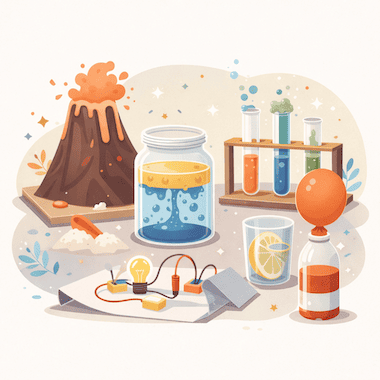
Simple Science Experiments
簡単な科学実験
 Learn English音声・クイズ・本が使える無料アプリ
重要単語
- experiment実験
- chemical reaction化学反応
- buoyancy浮力
- density密度
- crystallization結晶化
- atmospheric pressure大気圧
- oxidation酸化
- surface tension表面張力
- magnetic field磁場
- molecule分子
- saturated飽和した
- combustion燃焼
すべての単語(30)
- evaporate蒸発する
- hypothesis仮説
- electromagnetic電磁の
- acid酸
- gravity重力
- emulsification乳化
- oxygen酸素
- observation観察
- dissolve溶かす
- carbon dioxide二酸化炭素
- radiation放射線
- inquiry探究
- phenomenon現象
- lattice格子
- penicillinペニシリン
- magnet磁石
- solar energy太陽エネルギー
- critical thinking批判的思考
Science doesn't only happen in laboratories full of expensive equipment and people in white coats. Many basic ideas in physics, chemistry and biology can be shown on a kitchen table with things you already have at home: vinegar, salt, milk, a glass bottle or a sewing needle.
科学は、高価な装置がずらりと並び、白衣を着た人たちが働く実験室の中だけで行われるものではありません。物理学や化学、生物学の基本的な考え方の多くは、酢や塩、牛乳、ガラス瓶、縫い針など、家にすでにあるものを使って台所のテーブルの上で示すことができます。
Experiments like these are fun, but they also teach something useful: the world follows rules that we can discover and understand. When a child watches baking soda fizz in vinegar and asks why, they are doing what scientists do: watching carefully and looking for an explanation. Here are some of the best experiments to try at home, with a short explanation of what is really going on in each one.
こうした実験は楽しいだけでなく、役に立つことも教えてくれます。世界は、私たちが発見し理解できるルールに従って動いているということです。重曹が酢の中で泡立つのを見て「どうして?」と尋ねる子どもは、まさに科学者と同じことをしています。注意深く観察し、説明を求めているのです。ここでは、家で試せる特におすすめの実験をいくつか紹介し、それぞれで実際に何が起きているのかを簡単に説明します。
The Baking Soda Volcano: A Chemical Reaction
重曹の火山:化学反応
Baking soda and vinegar is the classic piece of kitchen chemistry. Baking soda is sodium bicarbonate, a base, and vinegar contains acetic acid. When the two meet, they react and produce carbon dioxide gas, water and a salt called sodium acetate. The carbon dioxide is what makes the mixture fizz and bubble.
重曹と酢は、台所でできる化学実験の定番です。重曹は炭酸水素ナトリウムという塩基で、酢には酢酸が含まれています。この二つが出会うと反応が起き、二酸化炭素のガスと水、そして酢酸ナトリウムという塩ができます。混ぜたものがシュワシュワと泡立つのは、この二酸化炭素のせいです。
For a better show, put a pile of baking soda in a small cup or bottle, then add a few drops of food coloring and a squirt of dish soap to the vinegar before you pour it in. The soap traps the gas in bubbles, so you get a thick, colorful foam that pours over the sides like lava. The idea behind it, that acids and bases react with each other, is one of the basics of chemistry. Acids and bases are all around us: in lemon juice and soap, in cleaning products and in our own stomachs, where hydrochloric acid helps break down food.
もっと見ごたえのある実験にするには、小さなカップか瓶に重曹を山盛りに入れ、酢を注ぐ前に食用色素を数滴と台所用洗剤を少し酢に加えておきます。洗剤がガスを泡の中に閉じ込めるので、溶岩のように縁からあふれ出す、濃くてカラフルな泡ができます。この実験の土台にある、酸と塩基が互いに反応するという考え方は、化学の基本の一つです。酸や塩基は身の回りのどこにでもあります。レモン汁や石けんにも、掃除用の洗剤にも、そして私たち自身の胃の中にもあり、胃では塩酸が食べ物の分解を助けています。
Dancing Raisins: Density and Buoyancy
踊るレーズン:密度と浮力
Drop a few raisins into a glass of sparkling water or clear soda. At first they sink to the bottom. Then, one by one, they slowly rise to the top, sink again and keep going up and down for a long time. The raisins are showing you how density and buoyancy work.
炭酸水か透明な炭酸飲料を入れたグラスに、レーズンを数粒落としてみましょう。最初、レーズンは底に沈みます。やがて一粒ずつゆっくりと水面に浮かび上がり、また沈み、長いあいだ上がったり下がったりを繰り返します。レーズンは、密度と浮力の仕組みを見せてくれているのです。
A raisin sinks because it is denser than the liquid. On the bottom, though, bubbles of carbon dioxide stick to its wrinkled skin. Each bubble works like a tiny life jacket: the raisin and its bubbles take up more space without getting much heavier, so together they become less dense than the water and float up. At the surface many of the bubbles burst, the raisin is denser than the water again, and down it goes. This goes on until the drink goes flat. Many fish use a similar trick: they control their depth by adding gas to an organ called the swim bladder or letting gas out of it.
レーズンが沈むのは、液体より密度が大きいからです。ところが底にいるあいだに、しわの多い皮に二酸化炭素の泡がくっつきます。泡の一つひとつが小さな救命胴衣のような働きをします。レーズンと泡を合わせると、重さはほとんど変わらないのに体積が増えるため、全体として水より密度が小さくなり、浮かび上がるのです。水面では泡の多くがはじけ、レーズンはまた水より密度が大きくなって沈んでいきます。これは飲み物の炭酸が抜けるまで続きます。多くの魚も似たような方法を使っています。浮き袋と呼ばれる器官にガスを入れたり出したりして、泳ぐ深さを調節しているのです。
Growing Crystals: Order in Matter
結晶を育てる:物質の中の秩序
Growing crystals is one of the most rewarding experiments you can do at home, and all you need is salt or sugar, hot water and patience. The process is called crystallization, and it shows how neatly matter is organized at the smallest scale.
結晶づくりは、家でできる実験の中でも特に達成感のあるものの一つで、必要なのは塩か砂糖、お湯、そして根気だけです。この過程は結晶化と呼ばれ、物質がごく小さなスケールでどれほど整然と並んでいるかを教えてくれます。
Stir salt into hot water until no more will dissolve. This is called a saturated solution. Pour it into a glass and hang a rough piece of string into it from a pencil laid across the top. Over the next few days the water slowly evaporates, and the liquid that is left can't hold all the salt. The extra salt comes out of the solution and settles on the string. Little by little, small crystals with flat faces and straight edges appear. Salt crystals are often shaped like tiny cubes, because inside them sodium and chloride ions are arranged in a cubic pattern that repeats millions of times. Nobody designs this shape; it comes from the chemistry itself.
お湯に塩を入れてかき混ぜ、もうそれ以上溶けなくなるまで加えます。これを飽和溶液といいます。それをグラスに注ぎ、グラスの上に横に渡した鉛筆から、ざらざらした糸を溶液の中に垂らします。それから数日のあいだに水はゆっくりと蒸発し、残った液体はすべての塩を溶かしておけなくなります。溶けきれなくなった塩は溶液から出てきて、糸の上にたまっていきます。少しずつ、平らな面とまっすぐな辺をもつ小さな結晶が現れます。塩の結晶が小さな立方体の形をしていることが多いのは、その内部でナトリウムイオンと塩化物イオンが立方体の模様に並び、それが何百万回も繰り返されているからです。この形は誰かが設計したものではなく、化学そのものから生まれるのです。
The Egg in a Bottle: Air Pressure at Work
瓶の中の卵:空気の圧力の働き
This classic experiment shows the force of the air around us. You need a glass bottle whose neck is a little narrower than a peeled hard-boiled egg, and a few thin strips of paper. With an adult's help, light the paper, drop it into the bottle and quickly set the egg on the opening. Soon after the flame goes out, the egg is squeezed through the neck and drops into the bottle, sometimes with a loud pop.
この定番の実験は、私たちの周りにある空気の力を見せてくれます。用意するのは、口が殻をむいたゆで卵より少しだけ細いガラス瓶と、細い紙切れ数枚です。大人に手伝ってもらって紙に火をつけ、瓶の中に落とし、すぐに卵を瓶の口に載せます。炎が消えてまもなく、卵は瓶の首を押し通されて中に落ちます。ときには大きな「ポン」という音がします。
Here is what happens. The fire heats the air in the bottle, the air expands, and some of it escapes past the egg. When the flame goes out, the air that is left cools and its pressure drops. Now the air outside pushes harder than the air inside, and it forces the egg into the bottle. People often say that the fire uses up the oxygen, but that has only a small effect; the cooling of the air does most of the work. The same difference in pressure makes suction cups stick to tiles and lets you drink through a straw. We rarely notice air pressure, but at sea level it presses on every square centimeter of your body with the weight of about one kilogram.
何が起きているのか説明しましょう。火が瓶の中の空気を温めると、空気は膨張し、その一部は卵のすき間から外へ逃げます。炎が消えると、残った空気は冷えて圧力が下がります。すると外の空気が中の空気より強く押すようになり、卵を瓶の中へ押し込むのです。火が酸素を使い切るからだとよく言われますが、その影響はわずかで、ほとんどは空気が冷えることによるものです。同じ圧力の差によって、吸盤はタイルにくっつき、私たちはストローで飲み物を飲むことができます。ふだん空気の圧力に気づくことはめったにありませんが、海面の高さでは、私たちの体の1平方センチメートルごとに、およそ1キログラムの重さに当たる力で押しているのです。
A Homemade Compass: Earth's Magnetic Field
手作りの方位磁針:地球の磁場
You can make a working compass with a steel sewing needle, a small magnet, a bowl of water and a leaf or a thin slice of cork. Stroke the needle with one end of the magnet about 30 times, always in the same direction. This lines up tiny magnetic regions inside the steel and turns the needle into a weak magnet for a while. Lay the needle on the leaf and float it on still water. It will slowly turn until it points north and south, in line with Earth's magnetic field.
鋼の縫い針、小さな磁石、水を入れたボウル、そして木の葉か薄く切ったコルクがあれば、ちゃんと使える方位磁針を作れます。磁石の片方の端で針を30回ほど、必ず同じ向きにこすります。こうすると鋼の中の小さな磁気の領域が同じ向きにそろい、針はしばらくのあいだ弱い磁石になります。針を葉の上に載せ、静かな水に浮かべましょう。針はゆっくりと回り、やがて地球の磁場に沿って南北を指します。
The compass is one of the great inventions in the history of navigation. In 1088 the Chinese scholar Shen Kuo described a magnetized needle that pointed north and south, and a few decades later Chinese sailors were using compasses at sea. By the end of the 12th century they had reached Europe too. For centuries nobody knew why they worked. Only in 1600 did the English scientist William Gilbert suggest that Earth itself behaves like a giant magnet. Earth's magnetic field does more than guide compass needles: it also turns aside most of the solar wind, a stream of charged particles from the Sun, and so helps protect our atmosphere.
方位磁針は、航海の歴史における偉大な発明の一つです。1088年、中国の学者沈括が南北を指す磁化した針について書き記し、その数十年後には中国の船乗りが海の上で方位磁針を使っていました。12世紀の終わりには、方位磁針はヨーロッパにも伝わっていました。それから何百年ものあいだ、なぜ方位磁針が南北を指すのかは誰にもわかりませんでした。地球そのものが巨大な磁石のようにふるまうと唱えたのは、1600年、イギリスの科学者ウィリアム・ギルバートが初めてでした。地球の磁場は方位磁針を導くだけではありません。太陽から届く電気を帯びた粒子の流れである太陽風の大部分をそらし、それによって私たちの大気を守る助けにもなっています。
Milk and Food Coloring: Surface Tension
牛乳と食用色素:表面張力
Pour some whole milk into a shallow plate and add drops of different food coloring near the middle. Now dip a cotton swab in dish soap and touch it to the center of the milk. The colors suddenly rush outward and swirl around the plate in bright, changing patterns. Few experiments you can do at home look this impressive.
浅いお皿に成分無調整の牛乳を少し注ぎ、真ん中あたりにいろいろな色の食用色素を数滴たらします。次に綿棒に台所用洗剤をつけ、牛乳の中心にそっと触れてみましょう。色が突然外側へ広がり、お皿の中で渦を巻きながら、鮮やかで次々と変わる模様を描きます。家でできる実験の中で、これほど見ごたえのあるものはなかなかありません。
The explanation has to do with surface tension and fat. Water molecules at the surface of the milk pull on each other, so the surface acts a bit like a thin, stretched skin. Soap weakens this pull where it touches the milk. The rest of the surface, which still pulls strongly, drags the liquid away toward the edges and carries the colors with it. At the same time, soap molecules attach to tiny drops of fat and protein in the milk and keep the liquid moving for a while. The food coloring simply makes this movement visible. Soap cleans greasy plates in a similar way: one end of a soap molecule is attracted to water and the other end to fat, so soap surrounds bits of grease and lets the water wash them away.
これは表面張力と脂肪に関係しています。牛乳の表面にある水の分子はたがいに引き合っているので、表面は薄くぴんと張った膜のようにふるまいます。洗剤は、牛乳に触れたところでこの引き合う力を弱めます。まだ強く引っ張っている残りの表面が液体を縁のほうへ引き寄せ、色もいっしょに運んでいくのです。同時に、洗剤の分子は牛乳の中の小さな脂肪やたんぱく質の粒にくっつき、しばらくのあいだ液体を動かし続けます。食用色素は、この動きを目に見えるようにしているだけです。洗剤が油汚れのついたお皿をきれいにするのも、同じような仕組みです。洗剤の分子は一方の端が水に、もう一方の端が油になじむので、油汚れを包み込み、水で洗い流せるようにするのです。
Invisible Ink: Chemistry You Can Read
見えないインク:読める化学
Invisible ink isn't only a children's game. Spies used it for centuries, including during the American Revolution and both World Wars. The simplest version uses lemon juice. Dip a cotton swab in lemon juice and write a message on white paper. Let it dry completely, and the writing disappears. To read it, ask an adult to run a hot iron over the paper, and the letters slowly appear in brown.
見えないインクは、子どもの遊びにとどまりません。スパイたちは何百年ものあいだこれを使ってきました。アメリカ独立戦争や二つの世界大戦でも使われています。いちばん簡単なのはレモン汁を使う方法です。綿棒をレモン汁にひたし、白い紙にメッセージを書きます。完全に乾かすと、文字は見えなくなります。読むときは、大人に頼んで熱したアイロンを紙の上にかけてもらいましょう。文字が茶色くゆっくりと浮かび上がってきます。
The chemistry is simple. Lemon juice contains sugars, citric acid and other substances. When they are heated, they break down and start to burn at a lower temperature than paper does, so the writing turns brown while the paper around it stays white. Part of this change is oxidation, a reaction with the oxygen in the air. Oxidation is one of the most common chemical reactions around us: it helps turn a cut apple brown and old paper yellow, and it is also what makes iron rust.
仕組みは簡単です。レモン汁には糖分やクエン酸、そのほかの物質が含まれています。これらは熱せられると分解し、紙よりも低い温度で焦げ始めます。そのため、周りの紙は白いままなのに、文字だけが茶色く変わるのです。この変化の一部は酸化、つまり空気中の酸素との反応です。酸化は私たちの身の回りで最もよく起きる化学反応の一つで、切ったりんごが茶色くなったり、古い紙が黄ばんだりする原因の一つでもあり、鉄がさびるのも酸化によるものです。
More Experiments Worth Trying
ほかにも試してみたい実験
Paper bridge: fold a sheet of paper back and forth like an accordion and lay it across two stacks of books. The folded sheet can hold many times its own weight, because the folds spread the force. Engineers use the same idea in bridges and in corrugated cardboard.
紙の橋:紙を一枚、アコーディオンのように山折りと谷折りを繰り返して折り、二つに積んだ本の山のあいだに渡します。折った紙は、自分の重さの何倍もの重さを支えられます。折り目が力を分散させるからです。技術者たちは同じ考え方を橋や段ボールに生かしています。
Oobleck: mix about two parts cornstarch with one part water. Hit it quickly and it feels solid; move your fingers through it slowly and it flows like a liquid. It is a non-Newtonian fluid, which means it doesn't flow the way ordinary liquids like water do.
ウーブレック:コーンスターチ2に対して水1くらいの割合で混ぜます。すばやくたたくと固体のように感じますが、指をゆっくり入れると液体のように流れます。これは非ニュートン流体と呼ばれ、水のような普通の液体とは流れ方が違うのです。
Homemade butter: pour heavy cream into a jar, close the lid tightly and shake hard for 10 to 15 minutes. The tiny fat droplets in the cream bump into each other and stick together until a lump of butter separates from a thin liquid called buttermilk. Cream is an emulsion, and shaking breaks it apart.
手作りバター:瓶に生クリームを入れ、ふたをしっかり閉めて、10分から15分ほど力いっぱい振ります。生クリームの中の小さな脂肪の粒がぶつかり合ってくっつき、やがてバターのかたまりが、バターミルクと呼ばれるさらっとした液体から分かれます。生クリームは乳濁液で、振ることでそれが壊れるのです。
Pepper and soap: sprinkle ground pepper over a bowl of water and touch the middle with a finger dipped in dish soap. The pepper rushes to the edges at once, because the soap lowers the surface tension in the middle.
コショウと洗剤:ボウルに張った水の上にコショウをふりかけ、台所用洗剤をつけた指で真ん中に触れます。コショウは一瞬で縁のほうへ逃げていきます。洗剤が真ん中の表面張力を下げるからです。
Solar oven: line the inside of a pizza box with aluminum foil and cover the opening with plastic wrap. In strong sunlight it can get hot enough to melt cheese or chocolate, which shows how sunlight turns into heat and how a closed space traps it.
ソーラーオーブン:ピザの箱の内側にアルミホイルを貼り、開いた部分を食品用ラップでおおいます。日差しが強ければ、チーズやチョコレートが溶けるほど熱くなります。日光が熱に変わる仕組みと、閉じた空間が熱を閉じ込める仕組みがわかります。
Candle and glass: stand a lit candle in a plate of colored water and cover it with a glass. After the flame goes out, water rises into the glass. Most of the rise comes from the hot air inside cooling and shrinking, not from the candle using up the oxygen, as many people believe.
ろうそくとコップ:色水を張ったお皿に火のついたろうそくを立て、コップをかぶせます。炎が消えたあと、コップの中に水が上がってきます。水が上がる主な理由は、多くの人が思っているようにろうそくが酸素を使い切るからではなく、中の熱い空気が冷えて縮むからです。
Why Home Science Matters
家庭で科学をすることの大切さ
Many famous scientists started out with very simple equipment. Michael Faraday grew up poor in London and had little schooling. At 14 he became an apprentice to a bookbinder, read the science books that passed through the shop and tried out their experiments with homemade equipment. Later, working at the Royal Institution, he discovered electromagnetic induction in 1831. This is the principle behind the generators that produce most of our electricity today.
有名な科学者の多くは、とても簡単な道具から始めました。マイケル・ファラデーはロンドンの貧しい家庭に育ち、学校にはほとんど通えませんでした。14歳で製本屋に弟子入りすると、店を通っていく科学の本を読み、そこに書かれた実験を手作りの道具で試してみました。その後、王立研究所で働いていた1831年に、電磁誘導を発見しました。今日、私たちの電気の大部分をつくる発電機は、この原理に基づいています。
Doing science is less about equipment than about a way of thinking: asking questions, planning tests, predicting what will happen and changing your ideas when the evidence says so. These skills can be learned at any age and on any budget. An experiment that doesn't go as expected isn't a failure if it leads to a new question. Some important discoveries began as surprises: Alexander Fleming found penicillin in 1928 when mold grew on one of his dishes of bacteria, Wilhelm Röntgen discovered X-rays in 1895, and Percy Spencer came up with the microwave oven after a chocolate bar melted in his pocket while he stood next to radar equipment.
科学で大事なのは、道具よりも考え方です。問いを立て、確かめる方法を考え、どうなるかを予測し、証拠が示すなら考えを改めることです。こうした力は、何歳でも、どんな予算でも身につけられます。予想どおりにいかなかった実験も、新しい問いにつながるなら失敗ではありません。重要な発見の中には、驚きから始まったものもあります。アレクサンダー・フレミングは1928年、細菌を培養していた皿の一つにカビが生えたことからペニシリンを見つけました。ヴィルヘルム・レントゲンは1895年にX線を発見し、パーシー・スペンサーはレーダー装置のそばに立っていたときにポケットのチョコレートバーが溶けたことから、電子レンジを思いつきました。
Science in Everyday Life
日常の中の科学
Science is everywhere at home: in the bubbles in a glass of soda, the frost on a winter window, the colors of a sunset and the way soap removes grease. All of these everyday things can be explained, and many of them can be tested with simple experiments. In some ways a home is a good laboratory, because the questions come from real life.
科学は家の中のいたるところにあります。炭酸飲料のグラスの泡にも、冬の窓につく霜にも、夕焼けの色にも、石けんが油汚れを落とす仕組みにもあるのです。こうした身近なことはどれも説明がつき、その多くは簡単な実験で確かめることができます。ある意味で、家はよい実験室です。問いが実際の暮らしの中から生まれてくるからです。
So when something in the kitchen, garden or bathroom surprises you, don't simply move on. Stop, look closely and try to work out what is behind it: a force, a chemical reaction or something alive. Noticing something odd and asking why is exactly how scientists begin.
ですから、台所や庭、お風呂場で何かに驚いたときは、そのまま通り過ぎないでください。立ち止まってよく見て、その裏に何があるのかを考えてみましょう。力なのか、化学反応なのか、それとも生き物の働きなのか。不思議なことに気づいて「なぜ?」と問うこと、それこそが科学者の出発点なのです。
無料アプリなら、この文章の音声を聞いたり、単語をタップして意味を確かめたりできます。