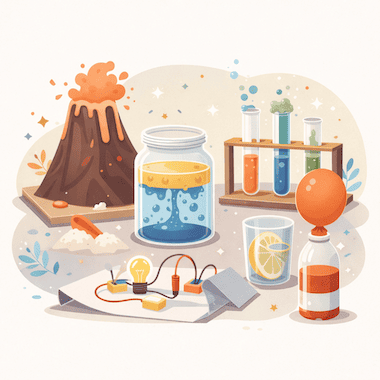
Simple Science Experiments
간단한 과학 실험
 Learn English음성, 퀴즈, 원서까지 담은 무료 앱
핵심 단어
- experiment실험
- chemical reaction화학 반응
- buoyancy부력
- density밀도
- crystallization결정화
- atmospheric pressure대기압
- oxidation산화
- surface tension표면 장력
- magnetic field자기장
- molecule분자
- saturated포화된
- combustion연소
단어 전체 보기 (30)
- evaporate증발하다
- hypothesis가설
- electromagnetic전자기의
- acid산
- gravity중력
- emulsification유화
- oxygen산소
- observation관찰
- dissolve녹이다
- carbon dioxide이산화탄소
- radiation방사선
- inquiry탐구
- phenomenon현상
- lattice격자
- penicillin페니실린
- magnet자석
- solar energy태양 에너지
- critical thinking비판적 사고
Science doesn't only happen in laboratories full of expensive equipment and people in white coats. Many basic ideas in physics, chemistry and biology can be shown on a kitchen table with things you already have at home: vinegar, salt, milk, a glass bottle or a sewing needle.
과학은 값비싼 장비로 가득하고 흰 가운을 입은 사람들이 일하는 실험실에서만 이루어지는 것이 아닙니다. 물리학, 화학, 생물학의 기본 원리 가운데 상당수는 식초, 소금, 우유, 유리병, 바느질 바늘처럼 집에 이미 있는 물건으로 부엌 식탁 위에서 보여 줄 수 있습니다.
Experiments like these are fun, but they also teach something useful: the world follows rules that we can discover and understand. When a child watches baking soda fizz in vinegar and asks why, they are doing what scientists do: watching carefully and looking for an explanation. Here are some of the best experiments to try at home, with a short explanation of what is really going on in each one.
이런 실험은 재미있을 뿐 아니라 쓸모 있는 것도 가르쳐 줍니다. 세상은 우리가 발견하고 이해할 수 있는 규칙에 따라 움직인다는 사실입니다. 베이킹소다가 식초 속에서 거품을 내는 것을 보고 왜 그런지 묻는 아이는 과학자들이 하는 일을 그대로 하고 있는 셈입니다. 주의 깊게 관찰하고 설명을 찾는 것입니다. 아래에서는 집에서 해 볼 만한 좋은 실험 몇 가지를 소개하고, 각 실험에서 실제로 어떤 일이 일어나는지 짧게 설명합니다.
The Baking Soda Volcano: A Chemical Reaction
베이킹소다 화산: 화학 반응
Baking soda and vinegar is the classic piece of kitchen chemistry. Baking soda is sodium bicarbonate, a base, and vinegar contains acetic acid. When the two meet, they react and produce carbon dioxide gas, water and a salt called sodium acetate. The carbon dioxide is what makes the mixture fizz and bubble.
베이킹소다와 식초는 부엌 화학 실험의 고전입니다. 베이킹소다는 탄산수소나트륨이라는 염기이고, 식초에는 아세트산이 들어 있습니다. 둘이 만나면 반응이 일어나 이산화탄소 기체와 물, 그리고 아세트산나트륨이라는 염이 생깁니다. 혼합물이 쉬익 하며 부글부글 거품을 내는 것은 바로 이산화탄소 때문입니다.
For a better show, put a pile of baking soda in a small cup or bottle, then add a few drops of food coloring and a squirt of dish soap to the vinegar before you pour it in. The soap traps the gas in bubbles, so you get a thick, colorful foam that pours over the sides like lava. The idea behind it, that acids and bases react with each other, is one of the basics of chemistry. Acids and bases are all around us: in lemon juice and soap, in cleaning products and in our own stomachs, where hydrochloric acid helps break down food.
더 멋진 장면을 보려면 작은 컵이나 병에 베이킹소다를 수북이 담고, 식초를 붓기 전에 식초에 식용 색소 몇 방울과 주방 세제를 조금 섞어 둡니다. 세제가 기체를 거품 속에 가두기 때문에 용암처럼 가장자리로 넘쳐흐르는 짙고 알록달록한 거품이 생깁니다. 이 실험의 바탕에 있는 생각, 즉 산과 염기가 서로 반응한다는 것은 화학의 기초 가운데 하나입니다. 산과 염기는 우리 주변 어디에나 있습니다. 레몬즙과 비누에도, 청소용품에도, 그리고 우리 위 속에도 있는데, 위에서는 염산이 음식을 분해하는 것을 돕습니다.
Dancing Raisins: Density and Buoyancy
춤추는 건포도: 밀도와 부력
Drop a few raisins into a glass of sparkling water or clear soda. At first they sink to the bottom. Then, one by one, they slowly rise to the top, sink again and keep going up and down for a long time. The raisins are showing you how density and buoyancy work.
탄산수나 투명한 탄산음료를 담은 컵에 건포도 몇 알을 떨어뜨려 보십시오. 처음에는 바닥으로 가라앉습니다. 그러다 하나씩 천천히 수면으로 떠올랐다가 다시 가라앉고, 오랫동안 이렇게 오르내리기를 되풀이합니다. 건포도는 밀도와 부력이 어떻게 작용하는지를 보여 줍니다.
A raisin sinks because it is denser than the liquid. On the bottom, though, bubbles of carbon dioxide stick to its wrinkled skin. Each bubble works like a tiny life jacket: the raisin and its bubbles take up more space without getting much heavier, so together they become less dense than the water and float up. At the surface many of the bubbles burst, the raisin is denser than the water again, and down it goes. This goes on until the drink goes flat. Many fish use a similar trick: they control their depth by adding gas to an organ called the swim bladder or letting gas out of it.
건포도가 가라앉는 것은 액체보다 밀도가 크기 때문입니다. 그런데 바닥에 있는 동안 주름진 껍질에 이산화탄소 거품이 달라붙습니다. 거품 하나하나가 작은 구명조끼 역할을 합니다. 건포도와 거품은 무게는 거의 늘지 않으면서 차지하는 부피가 커지기 때문에, 함께 있으면 물보다 밀도가 작아져 위로 떠오릅니다. 수면에서 거품이 많이 터지면 건포도는 다시 물보다 밀도가 커져 가라앉습니다. 이 과정은 음료의 김이 빠질 때까지 계속됩니다. 많은 물고기도 비슷한 방법을 씁니다. 부레라는 기관에 기체를 채우거나 빼서 헤엄치는 깊이를 조절합니다.
Growing Crystals: Order in Matter
결정 기르기: 물질 속의 질서
Growing crystals is one of the most rewarding experiments you can do at home, and all you need is salt or sugar, hot water and patience. The process is called crystallization, and it shows how neatly matter is organized at the smallest scale.
결정 기르기는 집에서 할 수 있는 실험 가운데 가장 보람 있는 것 중 하나이며, 필요한 것은 소금이나 설탕, 뜨거운 물, 그리고 인내심뿐입니다. 이 과정을 결정화라고 하며, 물질이 가장 작은 규모에서 얼마나 질서 있게 배열되어 있는지를 보여 줍니다.
Stir salt into hot water until no more will dissolve. This is called a saturated solution. Pour it into a glass and hang a rough piece of string into it from a pencil laid across the top. Over the next few days the water slowly evaporates, and the liquid that is left can't hold all the salt. The extra salt comes out of the solution and settles on the string. Little by little, small crystals with flat faces and straight edges appear. Salt crystals are often shaped like tiny cubes, because inside them sodium and chloride ions are arranged in a cubic pattern that repeats millions of times. Nobody designs this shape; it comes from the chemistry itself.
뜨거운 물에 소금을 넣고 더 이상 녹지 않을 때까지 저어 줍니다. 이것을 포화 용액이라고 합니다. 이 용액을 유리컵에 붓고, 컵 위에 가로로 걸쳐 놓은 연필에 거친 실을 묶어 용액 속으로 늘어뜨립니다. 그 후 며칠 동안 물이 천천히 증발하면 남은 액체는 소금을 모두 녹인 채로 있을 수 없게 됩니다. 남는 소금은 용액에서 빠져나와 실에 달라붙습니다. 조금씩 평평한 면과 곧은 모서리를 가진 작은 결정이 나타납니다. 소금 결정이 작은 정육면체 모양인 경우가 많은 것은, 그 안에서 나트륨 이온과 염화 이온이 수백만 번 되풀이되는 정육면체 무늬로 배열되어 있기 때문입니다. 이 모양은 누가 설계한 것이 아니라 화학 그 자체에서 생겨납니다.
The Egg in a Bottle: Air Pressure at Work
병 속의 달걀: 공기 압력의 힘
This classic experiment shows the force of the air around us. You need a glass bottle whose neck is a little narrower than a peeled hard-boiled egg, and a few thin strips of paper. With an adult's help, light the paper, drop it into the bottle and quickly set the egg on the opening. Soon after the flame goes out, the egg is squeezed through the neck and drops into the bottle, sometimes with a loud pop.
이 고전적인 실험은 우리를 둘러싼 공기의 힘을 보여 줍니다. 입구가 껍질을 벗긴 삶은 달걀보다 조금 좁은 유리병과 얇은 종이 몇 조각이 필요합니다. 어른의 도움을 받아 종이에 불을 붙여 병 속에 떨어뜨리고, 재빨리 달걀을 병 입구에 올려놓습니다. 불꽃이 꺼지고 얼마 지나지 않아 달걀이 병목으로 밀려 들어가 병 안으로 떨어지는데, 때로는 퐁 하는 큰 소리가 나기도 합니다.
Here is what happens. The fire heats the air in the bottle, the air expands, and some of it escapes past the egg. When the flame goes out, the air that is left cools and its pressure drops. Now the air outside pushes harder than the air inside, and it forces the egg into the bottle. People often say that the fire uses up the oxygen, but that has only a small effect; the cooling of the air does most of the work. The same difference in pressure makes suction cups stick to tiles and lets you drink through a straw. We rarely notice air pressure, but at sea level it presses on every square centimeter of your body with the weight of about one kilogram.
그 원리는 이렇습니다. 불이 병 속 공기를 데우면 공기가 팽창하고, 그 일부가 달걀 옆으로 빠져나갑니다. 불꽃이 꺼지면 남은 공기가 식으면서 압력이 떨어집니다. 이제 바깥 공기가 안쪽 공기보다 더 세게 밀기 때문에 달걀을 병 속으로 밀어 넣습니다. 흔히 불이 산소를 다 써 버려서 그렇다고들 하지만, 그 영향은 작고 대부분의 일은 공기가 식는 것이 합니다. 같은 압력 차이 덕분에 흡착판이 타일에 붙고, 우리는 빨대로 음료를 마실 수 있습니다. 우리는 공기의 압력을 거의 느끼지 못하지만, 해수면에서 공기는 우리 몸의 1제곱센티미터마다 약 1킬로그램의 무게에 해당하는 힘으로 누르고 있습니다.
A Homemade Compass: Earth's Magnetic Field
직접 만드는 나침반: 지구의 자기장
You can make a working compass with a steel sewing needle, a small magnet, a bowl of water and a leaf or a thin slice of cork. Stroke the needle with one end of the magnet about 30 times, always in the same direction. This lines up tiny magnetic regions inside the steel and turns the needle into a weak magnet for a while. Lay the needle on the leaf and float it on still water. It will slowly turn until it points north and south, in line with Earth's magnetic field.
강철 바느질 바늘, 작은 자석, 물 한 그릇, 그리고 나뭇잎이나 얇게 썬 코르크 조각만 있으면 제대로 작동하는 나침반을 만들 수 있습니다. 자석의 한쪽 끝으로 바늘을 30번쯤, 항상 같은 방향으로 문지릅니다. 그러면 강철 속의 아주 작은 자기 영역들이 한 방향으로 정렬되어 바늘이 한동안 약한 자석이 됩니다. 바늘을 나뭇잎 위에 올려 잔잔한 물 위에 띄웁니다. 바늘은 천천히 돌다가 지구의 자기장을 따라 남북을 가리키게 됩니다.
The compass is one of the great inventions in the history of navigation. In 1088 the Chinese scholar Shen Kuo described a magnetized needle that pointed north and south, and a few decades later Chinese sailors were using compasses at sea. By the end of the 12th century they had reached Europe too. For centuries nobody knew why they worked. Only in 1600 did the English scientist William Gilbert suggest that Earth itself behaves like a giant magnet. Earth's magnetic field does more than guide compass needles: it also turns aside most of the solar wind, a stream of charged particles from the Sun, and so helps protect our atmosphere.
나침반은 항해의 역사에서 손꼽히는 위대한 발명품입니다. 1088년 중국의 학자 심괄은 남북을 가리키는 자화된 바늘에 대해 기록했고, 그로부터 수십 년 뒤 중국 선원들은 바다에서 나침반을 사용하고 있었습니다. 12세기 말에는 나침반이 유럽에도 전해졌습니다. 그 뒤 수백 년 동안 나침반이 왜 작동하는지 아는 사람은 없었습니다. 1600년이 되어서야 영국의 과학자 윌리엄 길버트가 지구 자체가 거대한 자석처럼 행동한다는 생각을 내놓았습니다. 지구의 자기장은 나침반 바늘의 방향을 정해 주는 데 그치지 않습니다. 태양에서 오는 전하를 띤 입자의 흐름인 태양풍의 대부분을 비껴가게 하여 우리의 대기를 보호하는 데에도 도움을 줍니다.
Milk and Food Coloring: Surface Tension
우유와 식용 색소: 표면 장력
Pour some whole milk into a shallow plate and add drops of different food coloring near the middle. Now dip a cotton swab in dish soap and touch it to the center of the milk. The colors suddenly rush outward and swirl around the plate in bright, changing patterns. Few experiments you can do at home look this impressive.
얕은 접시에 일반 우유를 조금 붓고, 가운데 근처에 여러 가지 색의 식용 색소를 몇 방울 떨어뜨립니다. 이제 면봉에 주방 세제를 묻혀 우유 한가운데에 대 보십시오. 색깔들이 갑자기 바깥쪽으로 퍼져 나가며 접시 안에서 소용돌이치고, 밝고 끊임없이 변하는 무늬를 만들어 냅니다. 집에서 할 수 있는 실험 가운데 이만큼 눈길을 끄는 것은 드뭅니다.
The explanation has to do with surface tension and fat. Water molecules at the surface of the milk pull on each other, so the surface acts a bit like a thin, stretched skin. Soap weakens this pull where it touches the milk. The rest of the surface, which still pulls strongly, drags the liquid away toward the edges and carries the colors with it. At the same time, soap molecules attach to tiny drops of fat and protein in the milk and keep the liquid moving for a while. The food coloring simply makes this movement visible. Soap cleans greasy plates in a similar way: one end of a soap molecule is attracted to water and the other end to fat, so soap surrounds bits of grease and lets the water wash them away.
그 원리는 표면 장력과 지방과 관계가 있습니다. 우유 표면의 물 분자들은 서로 끌어당기기 때문에, 표면은 얇고 팽팽하게 당겨진 막처럼 행동합니다. 세제는 우유에 닿은 곳에서 이 끌어당기는 힘을 약하게 만듭니다. 아직 세게 당기고 있는 나머지 표면이 액체를 가장자리 쪽으로 끌어가면서 색깔도 함께 실어 갑니다. 동시에 세제 분자는 우유 속의 아주 작은 지방과 단백질 방울에 달라붙어 한동안 액체가 계속 움직이게 합니다. 식용 색소는 이 움직임을 눈에 보이게 해 줄 뿐입니다. 세제가 기름진 접시를 닦아 내는 방식도 비슷합니다. 세제 분자의 한쪽 끝은 물에, 다른 쪽 끝은 기름에 끌리기 때문에 세제가 기름때를 감싸서 물에 씻겨 나가게 합니다.
Invisible Ink: Chemistry You Can Read
보이지 않는 잉크: 읽을 수 있는 화학
Invisible ink isn't only a children's game. Spies used it for centuries, including during the American Revolution and both World Wars. The simplest version uses lemon juice. Dip a cotton swab in lemon juice and write a message on white paper. Let it dry completely, and the writing disappears. To read it, ask an adult to run a hot iron over the paper, and the letters slowly appear in brown.
보이지 않는 잉크는 단순한 아이들 놀이가 아닙니다. 스파이들은 수백 년 동안 이것을 사용했으며, 미국 독립 전쟁과 두 차례의 세계 대전 때에도 쓰였습니다. 가장 간단한 방법은 레몬즙을 쓰는 것입니다. 면봉을 레몬즙에 적셔 흰 종이에 메시지를 씁니다. 완전히 마르면 글씨가 사라집니다. 글씨를 읽으려면 어른에게 뜨거운 다리미로 종이를 다려 달라고 부탁하십시오. 그러면 글자가 천천히 갈색으로 나타납니다.
The chemistry is simple. Lemon juice contains sugars, citric acid and other substances. When they are heated, they break down and start to burn at a lower temperature than paper does, so the writing turns brown while the paper around it stays white. Part of this change is oxidation, a reaction with the oxygen in the air. Oxidation is one of the most common chemical reactions around us: it helps turn a cut apple brown and old paper yellow, and it is also what makes iron rust.
그 화학 원리는 간단합니다. 레몬즙에는 당분, 시트르산 등 여러 물질이 들어 있습니다. 이 물질들은 열을 받으면 분해되어 종이보다 낮은 온도에서 타기 시작합니다. 그래서 주변의 종이는 하얗게 남아 있는데 글씨만 갈색으로 변합니다. 이 변화의 일부는 산화, 즉 공기 중의 산소와 일어나는 반응입니다. 산화는 우리 주변에서 가장 흔한 화학 반응 가운데 하나입니다. 자른 사과가 갈색으로 변하고 오래된 종이가 누렇게 바래는 데에도 한몫을 하며, 철이 녹스는 것도 산화 때문입니다.
More Experiments Worth Trying
더 해 볼 만한 실험들
Paper bridge: fold a sheet of paper back and forth like an accordion and lay it across two stacks of books. The folded sheet can hold many times its own weight, because the folds spread the force. Engineers use the same idea in bridges and in corrugated cardboard.
종이 다리: 종이 한 장을 아코디언처럼 앞뒤로 접어 두 무더기의 책 사이에 걸쳐 놓습니다. 접은 종이는 자기 무게의 몇 배나 되는 무게를 버틸 수 있는데, 접힌 부분이 힘을 분산하기 때문입니다. 공학자들은 같은 원리를 다리와 골판지에 활용합니다.
Oobleck: mix about two parts cornstarch with one part water. Hit it quickly and it feels solid; move your fingers through it slowly and it flows like a liquid. It is a non-Newtonian fluid, which means it doesn't flow the way ordinary liquids like water do.
우블렉: 옥수수 전분 두 부분과 물 한 부분 정도를 섞습니다. 빠르게 내리치면 고체처럼 느껴지지만, 손가락을 천천히 넣으면 액체처럼 흐릅니다. 이것은 비뉴턴 유체로, 물 같은 보통 액체와는 흐르는 방식이 다르다는 뜻입니다.
Homemade butter: pour heavy cream into a jar, close the lid tightly and shake hard for 10 to 15 minutes. The tiny fat droplets in the cream bump into each other and stick together until a lump of butter separates from a thin liquid called buttermilk. Cream is an emulsion, and shaking breaks it apart.
집에서 만드는 버터: 병에 생크림을 붓고 뚜껑을 꼭 닫은 뒤 10분에서 15분 동안 힘껏 흔듭니다. 크림 속의 아주 작은 지방 방울들이 서로 부딪치며 엉겨 붙다가, 결국 버터 덩어리가 버터밀크라는 묽은 액체와 분리됩니다. 크림은 에멀션이며, 흔들면 이것이 깨집니다.
Pepper and soap: sprinkle ground pepper over a bowl of water and touch the middle with a finger dipped in dish soap. The pepper rushes to the edges at once, because the soap lowers the surface tension in the middle.
후추와 세제: 물을 담은 그릇에 후춧가루를 뿌리고, 주방 세제를 묻힌 손가락으로 가운데를 건드립니다. 후춧가루가 순식간에 가장자리로 달아나는데, 세제가 가운데의 표면 장력을 낮추기 때문입니다.
Solar oven: line the inside of a pizza box with aluminum foil and cover the opening with plastic wrap. In strong sunlight it can get hot enough to melt cheese or chocolate, which shows how sunlight turns into heat and how a closed space traps it.
태양열 오븐: 피자 상자 안쪽에 알루미늄 포일을 붙이고 열린 부분을 비닐 랩으로 덮습니다. 햇빛이 강하면 치즈나 초콜릿이 녹을 만큼 뜨거워질 수 있습니다. 이를 통해 햇빛이 어떻게 열로 바뀌는지, 그리고 닫힌 공간이 어떻게 그 열을 가두는지 알 수 있습니다.
Candle and glass: stand a lit candle in a plate of colored water and cover it with a glass. After the flame goes out, water rises into the glass. Most of the rise comes from the hot air inside cooling and shrinking, not from the candle using up the oxygen, as many people believe.
촛불과 유리컵: 색깔 물을 담은 접시에 불을 붙인 초를 세우고 유리컵을 덮습니다. 불꽃이 꺼지면 물이 컵 안으로 올라옵니다. 물이 올라오는 것은 많은 사람이 생각하듯 초가 산소를 다 써 버려서가 아니라, 주로 컵 안의 뜨거운 공기가 식으면서 줄어들기 때문입니다.
Why Home Science Matters
집에서 하는 과학이 중요한 이유
Many famous scientists started out with very simple equipment. Michael Faraday grew up poor in London and had little schooling. At 14 he became an apprentice to a bookbinder, read the science books that passed through the shop and tried out their experiments with homemade equipment. Later, working at the Royal Institution, he discovered electromagnetic induction in 1831. This is the principle behind the generators that produce most of our electricity today.
유명한 과학자들 가운데 상당수는 아주 단순한 도구로 시작했습니다. 마이클 패러데이는 런던의 가난한 집에서 자라 학교 교육을 거의 받지 못했습니다. 열네 살에 제본업자의 견습생이 된 그는 작업장을 거쳐 가는 과학책을 읽고, 책에 나오는 실험을 직접 만든 도구로 해 보았습니다. 훗날 왕립연구소에서 일하던 그는 1831년 전자기 유도를 발견했습니다. 오늘날 우리가 쓰는 전기의 대부분을 만들어 내는 발전기는 이 원리에 바탕을 두고 있습니다.
Doing science is less about equipment than about a way of thinking: asking questions, planning tests, predicting what will happen and changing your ideas when the evidence says so. These skills can be learned at any age and on any budget. An experiment that doesn't go as expected isn't a failure if it leads to a new question. Some important discoveries began as surprises: Alexander Fleming found penicillin in 1928 when mold grew on one of his dishes of bacteria, Wilhelm Röntgen discovered X-rays in 1895, and Percy Spencer came up with the microwave oven after a chocolate bar melted in his pocket while he stood next to radar equipment.
과학을 한다는 것은 장비보다는 생각하는 방식의 문제입니다. 질문을 던지고, 실험을 계획하고, 무슨 일이 일어날지 예측하고, 증거가 그렇다고 말하면 생각을 바꾸는 것입니다. 이런 능력은 몇 살이든, 예산이 얼마든 기를 수 있습니다. 예상대로 되지 않은 실험도 새로운 질문으로 이어진다면 실패가 아닙니다. 중요한 발견 중에는 뜻밖의 일에서 시작된 것도 있습니다. 알렉산더 플레밍은 1928년 세균을 기르던 접시 하나에 곰팡이가 자란 것을 보고 페니실린을 발견했고, 빌헬름 뢴트겐은 1895년 X선을 발견했으며, 퍼시 스펜서는 레이더 장비 옆에 서 있다가 주머니 속 초콜릿 바가 녹은 것을 계기로 전자레인지를 생각해 냈습니다.
Science in Everyday Life
일상 속의 과학
Science is everywhere at home: in the bubbles in a glass of soda, the frost on a winter window, the colors of a sunset and the way soap removes grease. All of these everyday things can be explained, and many of them can be tested with simple experiments. In some ways a home is a good laboratory, because the questions come from real life.
과학은 집 안 곳곳에 있습니다. 탄산음료 한 잔의 거품에도, 겨울 창문에 낀 성에에도, 노을의 빛깔에도, 비누가 기름때를 없애는 방식에도 있습니다. 이런 일상적인 현상은 모두 설명할 수 있으며, 그중 많은 것은 간단한 실험으로 확인해 볼 수 있습니다. 어떤 의미에서 집은 좋은 실험실입니다. 질문이 실제 생활에서 나오기 때문입니다.
So when something in the kitchen, garden or bathroom surprises you, don't simply move on. Stop, look closely and try to work out what is behind it: a force, a chemical reaction or something alive. Noticing something odd and asking why is exactly how scientists begin.
그러니 부엌이나 정원, 욕실에서 무언가가 놀라움을 준다면 그냥 지나치지 마십시오. 멈춰 서서 자세히 보고, 그 뒤에 무엇이 있는지 알아내려고 해 보십시오. 어떤 힘일 수도, 화학 반응일 수도, 살아 있는 무언가일 수도 있습니다. 이상한 것을 알아차리고 왜 그런지 묻는 것, 과학자들도 바로 거기서 시작합니다.
무료 앱에서는 이 글을 음성으로 듣고, 단어를 누르면 뜻을 바로 볼 수 있습니다.