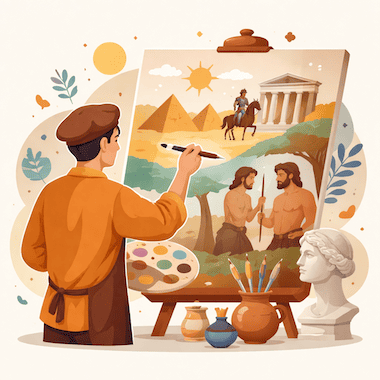
Storytelling Through Art
Raccontare storie con l'arte
 Learn EnglishApp gratuita con audio, quiz e libri veri
Parole chiave
- compositioncomposizione
- perspectiveprospettiva
- pigmentpigmento
- portraitritratto
- frescoaffresco
- etchingacquaforte
- realismrealismo
- abstractionastrazione
- woodblock printxilografia
- symbolismsimbolismo
- anatomyanatomia
- muralmurale
Tutte le 30 parole
- self-portraitautoritratto
- pietypietà
- atrocityatrocità
- shadingombreggiatura
- legitimacylegittimità
- antiquityantichità
- meditationmeditazione
- ritualrituale
- anguishangoscia
- testimonytestimonianza
- auctionasta
- genealogygenealogia
- stencilstencil
- tombtomba
- carvingintaglio
- infraredinfrarosso
- photographyfotografia
- existentialesistenziale
Long before people could write, they told stories with pictures. The cave paintings of Lascaux in southwestern France, found by four teenagers in 1940, are about 17,000 years old, and they are not random marks. Bulls, horses and deer are painted with care and skill, and some scenes may show hunts or rituals.
Molto prima di saper scrivere, gli esseri umani raccontavano storie con le immagini. Le pitture della grotta di Lascaux, nel sud-ovest della Francia, scoperte nel 1940 da quattro ragazzi, hanno circa 17.000 anni e non sono segni tracciati a caso. Tori, cavalli e cervi sono dipinti con cura e abilità, e alcune scene forse mostrano cacce o riti.
Paintings can do something that words can't: they let you see a moment from centuries ago as if you were standing in the room. A painting shows how people dressed, what they valued, how they saw themselves and what their world looked like. If you learn to read paintings as historical sources, you get a view of the past that no written text can give you.
La pittura sa fare qualcosa che le parole non sanno fare: ci permette di vedere un momento di secoli fa come se fossimo lì, nella stanza. Un dipinto mostra come si vestivano le persone, a che cosa davano valore, come vedevano sé stesse e che aspetto aveva il loro mondo. Chi impara a leggere i dipinti come fonti storiche ottiene uno sguardo sul passato che nessun testo scritto può offrire.
Cave Art: The First Stories
L'arte delle caverne: le prime storie
The Chauvet Cave in southern France holds some of the oldest paintings in Europe, made about 36,000 years ago. Its horses, lions, mammoths and rhinoceroses are drawn with real skill. The artists used shading and the natural shape of the rock to make the animals look solid, and they drew some legs and heads several times, as if the animals were moving. Even older cave art has been found on the Indonesian island of Sulawesi, where a painted scene of human figures and a wild pig is at least 51,000 years old.
La grotta Chauvet, nel sud della Francia, custodisce alcune delle pitture più antiche d'Europa, realizzate circa 36.000 anni fa. I suoi cavalli, leoni, mammut e rinoceronti sono disegnati con grande maestria. Gli artisti usarono il chiaroscuro e la forma naturale della roccia per dare volume agli animali, e disegnarono alcune zampe e alcune teste più volte, come se gli animali fossero in movimento. Un'arte rupestre ancora più antica è stata trovata sull'isola indonesiana di Sulawesi, dove una scena dipinta con figure umane e un cinghiale ha almeno 51.000 anni.
Hand stencils are found in caves all over the world. People pressed a hand against the wall and blew paint around it, leaving its outline on the rock. Some on Sulawesi are around 40,000 years old, and the Cave of the Hands in Argentina has hundreds of them, some made about 9,000 years ago. No one knows exactly what they meant. Perhaps the message was the simplest one possible: I was here.
Gli stencil di mani si trovano in grotte di tutto il mondo. Si appoggiava una mano alla parete e vi si soffiava intorno del colore, lasciandone il contorno sulla roccia. Alcuni a Sulawesi hanno circa 40.000 anni, e la Cueva de las Manos, la "grotta delle mani" in Argentina, ne conta centinaia, alcuni fatti circa 9.000 anni fa. Nessuno sa con certezza che cosa significassero. Forse il messaggio era il più semplice possibile: io sono stato qui.
Egyptian Art: Order and Eternity
L'arte egizia: ordine ed eternità
Ancient Egyptian art followed strict rules that changed very little in 3,000 years. A figure usually has its head and legs in profile, while the eye and the shoulders face the viewer. To modern eyes this looks strange, but Egyptian artists were not clumsy. They chose this style on purpose, because of what their art was for.
L'arte dell'antico Egitto seguiva regole rigide, cambiate pochissimo in 3.000 anni. Una figura ha di solito la testa e le gambe di profilo, mentre l'occhio e le spalle sono rivolti verso chi guarda. Ai nostri occhi sembra strano, ma gli artisti egizi non erano maldestri. Scelsero questo stile di proposito, per lo scopo a cui serviva la loro arte.
An Egyptian painting was not meant to show what one person sees from one spot. It showed each part of the body in its clearest and most complete form, so that the whole person was recorded. A pharaoh was painted larger than the people around him because he was more important, not because the artist didn't understand proportions. The scenes on tomb walls had a practical job, too: Egyptians believed that the food, servants and pleasures painted there would serve the dead person in the afterlife. Art was meant to make things happen.
Un dipinto egizio non voleva mostrare ciò che una persona vede da un solo punto. Mostrava ogni parte del corpo nella sua forma più chiara e completa, così che la persona fosse rappresentata per intero. Il faraone era dipinto più grande delle persone intorno a lui perché era più importante, non perché l'artista non conoscesse le proporzioni. Anche le scene sulle pareti delle tombe avevano una funzione pratica: gli egizi credevano che il cibo, i servitori e i piaceri dipinti lì avrebbero servito il defunto nell'aldilà. L'arte doveva far accadere le cose.
Renaissance Art: Rediscovering the Human
L'arte del Rinascimento: la riscoperta dell'uomo
The European Renaissance, which lasted roughly from the 14th to the 16th century, changed what art was for. Medieval painting mostly served the Church. Its figures were flat and stylized, and their size and position showed religious importance, not how things really looked. Renaissance artists turned their attention to the human body, the natural world and the art of ancient Greece and Rome.
Il Rinascimento europeo, che durò all'incirca dal XIV al XVI secolo, cambiò lo scopo dell'arte. La pittura medievale serviva soprattutto la Chiesa. Le sue figure erano piatte e stilizzate, e la loro grandezza e posizione indicavano l'importanza religiosa, non l'aspetto reale delle cose. Gli artisti del Rinascimento rivolsero la loro attenzione al corpo umano, alla natura e all'arte dell'antica Grecia e di Roma.
Leonardo da Vinci dissected human bodies to understand muscles and bones. Michelangelo painted the ceiling of the Sistine Chapel between 1508 and 1512, and Raphael filled The School of Athens with lifelike figures of ancient thinkers. Renaissance art was also a tool of power. A portrait of a ruler or a rich merchant was carefully planned to show wealth, faith and the right to rule. The pose, the clothes, the objects and the background of such a portrait can tell you as much about 15th-century Italian politics as a written document.
Leonardo da Vinci sezionava cadaveri per capire muscoli e ossa. Michelangelo dipinse la volta della Cappella Sistina tra il 1508 e il 1512, e Raffaello riempì La Scuola di Atene di figure di pensatori antichi piene di vita. L'arte rinascimentale era anche uno strumento di potere. Il ritratto di un sovrano o di un ricco mercante era studiato con cura per mostrarne la ricchezza, la devozione e il diritto a governare. La posa, gli abiti, gli oggetti e lo sfondo di un ritratto del genere possono dirci sulla politica dell'Italia del Quattrocento quanto un documento scritto.
Hidden Stories in Famous Paintings
Storie nascoste nei dipinti famosi
Many famous paintings hide meanings that most viewers miss. Jan van Eyck's Arnolfini Portrait (1434), in the National Gallery in London, is full of symbols: a single candle burning in daylight, a small dog often read as a sign of loyalty, and a round mirror that reflects two more people in the doorway. Above the mirror, van Eyck wrote in Latin: "Jan van Eyck was here." A famous theory says the painting records a marriage, with the artist as a witness, but many experts now doubt it.
Molti dipinti famosi nascondono significati che sfuggono alla maggior parte di chi li guarda. Il Ritratto dei coniugi Arnolfini (1434) di Jan van Eyck, alla National Gallery di Londra, è pieno di simboli: una sola candela accesa in pieno giorno, un cagnolino spesso interpretato come segno di fedeltà e uno specchio rotondo che riflette altre due persone sulla porta. Sopra lo specchio van Eyck scrisse in latino: "Jan van Eyck fu qui". Secondo una teoria famosa, il dipinto documenta un matrimonio con il pittore come testimone, ma oggi molti esperti ne dubitano.
Diego Velázquez's Las Meninas (1656), in the Prado Museum in Madrid, plays a clever game with the viewer. Velázquez painted himself at work on a huge canvas, next to the young princess Margarita and her maids of honor. A mirror on the back wall shows King Philip IV and Queen Mariana, who seem to be standing exactly where we stand. The painting leaves it unclear who is really being painted and who is watching, and critics have argued about it for more than 350 years.
Las Meninas (1656) di Diego Velázquez, al Museo del Prado di Madrid, fa un gioco ingegnoso con lo spettatore. Velázquez si ritrasse mentre lavora a un'enorme tela, accanto alla piccola infanta Margherita e alle sue damigelle. Uno specchio sulla parete di fondo mostra il re Filippo IV e la regina Marianna, che sembrano trovarsi esattamente dove ci troviamo noi. Il dipinto lascia in sospeso chi venga davvero ritratto e chi stia guardando, e i critici ne discutono da più di 350 anni.
Art as Protest and Revolution
L'arte come protesta e rivoluzione
Artists have often used their work to criticize power and to record cruelty. Between 1810 and 1820, Francisco Goya made a series of more than 80 prints called The Disasters of War about the fighting that followed Napoleon's invasion of Spain. They show executions, hunger and mutilated bodies, and they make no one a hero. The series was so harsh that it was not published until 1863, 35 years after Goya's death, and it is still hard to look at today.
Gli artisti hanno spesso usato le loro opere per criticare il potere e testimoniare la crudeltà. Tra il 1810 e il 1820 Francisco Goya realizzò una serie di oltre 80 incisioni, I disastri della guerra, sui combattimenti seguiti all'invasione della Spagna da parte di Napoleone. Mostrano esecuzioni, fame e corpi mutilati, e non fanno di nessuno un eroe. La serie era così dura che fu pubblicata solo nel 1863, 35 anni dopo la morte di Goya, ed è difficile da guardare ancora oggi.
Pablo Picasso painted Guernica in 1937, after German and Italian planes supporting Franco bombed the Basque town of Guernica during the Spanish Civil War. Its broken, screaming figures show the terror of an attack on ordinary people. The painting traveled to exhibitions in Europe and the United States and made the bombing known around the world. Picasso did not want it to go to Spain until democracy returned, so it stayed at the Museum of Modern Art in New York until 1981. Today it hangs in the Museo Reina Sofía in Madrid.
Pablo Picasso dipinse Guernica nel 1937, dopo che aerei tedeschi e italiani al fianco di Franco avevano bombardato la cittadina basca di Guernica durante la guerra civile spagnola. Le sue figure spezzate e urlanti mostrano il terrore di un attacco contro gente comune. Il quadro fu esposto in Europa e negli Stati Uniti e fece conoscere il bombardamento in tutto il mondo. Picasso non voleva che andasse in Spagna prima del ritorno della democrazia, così rimase al Museum of Modern Art di New York fino al 1981. Oggi è esposto al Museo Reina Sofía di Madrid.
Non-Western Art Traditions
Tradizioni artistiche non occidentali
The history of art is much wider than the European tradition that fills most textbooks. Chinese landscape painting, called shan shui ("mountain and water"), reached a high point between the 10th and 14th centuries, with works such as Fan Kuan's Travelers among Mountains and Streams from around 1000. These painters did not try to copy a real view. They wanted to capture the spirit, or qi, of a landscape, and they usually worked indoors, combining memories of many walks into one ideal scene.
La storia dell'arte è molto più ampia della tradizione europea che riempie la maggior parte dei manuali. La pittura di paesaggio cinese, chiamata shan shui ("montagna e acqua"), raggiunse il suo apice tra il X e il XIV secolo, con opere come Viaggiatori tra monti e ruscelli di Fan Kuan, dipinta intorno all'anno 1000. Questi pittori non cercavano di copiare un paesaggio reale. Volevano coglierne lo spirito, il qi, e lavoravano di solito al chiuso, unendo i ricordi di molte passeggiate in un'unica scena ideale.
In Japan, ukiyo-e woodblock prints of the 17th to 19th centuries showed everyday life: kabuki actors, sumo wrestlers, famous views and the pleasure districts of Edo, known as the "floating world." Their bold lines and flat colors influenced Van Gogh, Monet and Toulouse-Lautrec. In Ghana, kente cloth is woven in bright geometric patterns, and many of the patterns have names that come from proverbs, historical events or famous people. Every culture has found its own way to tell stories with images.
In Giappone le stampe ukiyo-e, dal XVII al XIX secolo, raffiguravano la vita quotidiana: attori di kabuki, lottatori di sumo, vedute celebri e i quartieri di piacere di Edo, chiamati "mondo fluttuante". Le loro linee decise e i colori piatti influenzarono Van Gogh, Monet e Toulouse-Lautrec. In Ghana il tessuto kente è tessuto con motivi geometrici dai colori vivaci, e molti di questi motivi hanno nomi tratti da proverbi, fatti storici o personaggi famosi. Ogni cultura ha trovato il proprio modo di raccontare storie per immagini.
Modern Art: When Painting Became Personal
L'arte moderna: quando la pittura diventò personale
When photography became public in 1839, painters no longer had to record exactly how things looked. If a camera could do that, painting could show how things felt and what they meant. In the decades that followed, artists experimented more than ever before, and the idea of what art could be changed completely.
Quando la fotografia fu presentata al pubblico nel 1839, i pittori non furono più costretti a registrare con esattezza l'aspetto delle cose. Se poteva farlo una macchina fotografica, la pittura poteva mostrare che cosa si provava e che cosa significavano le cose. Nei decenni successivi gli artisti sperimentarono come mai prima, e l'idea stessa di che cosa potesse essere l'arte cambiò del tutto.
Vincent van Gogh painted The Starry Night in 1889 at a mental hospital in Saint-Rémy in southern France. Its swirling sky is not what the night really looked like; it shows what the night felt like to him. Edvard Munch painted The Scream in 1893. He wrote that the idea came to him on an evening walk, when he felt a great scream passing through nature. So the figure is less a person screaming than a picture of fear itself. Works like these led the way to abstract art, in which color and shape express feelings without showing real objects at all.
Vincent van Gogh dipinse Notte stellata nel 1889 in un ospedale psichiatrico di Saint-Rémy, nel sud della Francia. Il suo cielo pieno di vortici non mostra com'era davvero la notte, ma ciò che lui provava guardandola. Edvard Munch dipinse L'urlo nel 1893. Scrisse che l'idea gli era venuta durante una passeggiata serale, quando aveva sentito un grande urlo attraversare la natura. La figura, quindi, non è tanto una persona che urla quanto un'immagine della paura stessa. Opere come queste aprirono la strada all'arte astratta, in cui colore e forma esprimono emozioni senza rappresentare alcun oggetto reale.
Surprising Facts About Art
Curiosità sorprendenti sull'arte
X-rays and infrared scans often reveal different pictures under the paint of Renaissance masterpieces, because artists painted over earlier work or changed their minds.
Le radiografie e le indagini a infrarossi rivelano spesso immagini diverse sotto il colore dei capolavori del Rinascimento, perché gli artisti dipingevano sopra lavori precedenti o cambiavano idea.
The Mona Lisa became world famous only after an Italian worker, Vincenzo Peruggia, stole it from the Louvre in 1911. It was missing for more than two years.
La Gioconda diventò famosa in tutto il mondo solo dopo che un operaio italiano, Vincenzo Peruggia, la rubò dal Louvre nel 1911. Rimase introvabile per più di due anni.
A popular story says Thomas Gainsborough painted The Blue Boy (around 1770) to prove Joshua Reynolds wrong about the color blue, but Reynolds made his famous remark in 1778, years later.
Secondo una storia molto diffusa, Thomas Gainsborough dipinse Il ragazzo blu (1770 circa) per smentire Joshua Reynolds sul colore blu, ma Reynolds fece la sua famosa osservazione nel 1778, anni dopo.
Leonardo da Vinci began the Mona Lisa around 1503 and was still working on it more than ten years later. He took it with him to France, where he died in 1519.
Leonardo da Vinci iniziò la Gioconda intorno al 1503 e più di dieci anni dopo ci lavorava ancora. La portò con sé in Francia, dove morì nel 1519.
The most expensive painting ever sold at auction is Salvator Mundi, attributed to Leonardo da Vinci. It sold for $450 million in 2017.
Il dipinto più caro mai venduto all'asta è il Salvator Mundi, attribuito a Leonardo da Vinci. Fu venduto per 450 milioni di dollari nel 2017.
About 55 of Frida Kahlo's roughly 140 paintings are self-portraits. She said she painted herself because she was often alone and was "the subject I know best."
Circa 55 dei quasi 140 dipinti di Frida Kahlo sono autoritratti. Lei diceva di dipingere sé stessa perché era spesso sola e perché era "il soggetto che conosco meglio".
Learning to Look
Imparare a guardare
From cave walls to museum galleries, painting is one of the oldest ways people have recorded their lives. Every painting was made by someone who wanted to say something, show something or keep something from being forgotten. When you look carefully at a painting, you meet the mind of a person from a very different world.
Dalle pareti delle grotte alle sale dei musei, la pittura è uno dei modi più antichi con cui le persone hanno registrato la propria vita. Ogni dipinto è stato fatto da qualcuno che voleva dire qualcosa, mostrare qualcosa o salvare qualcosa dall'oblio. Chi guarda con attenzione un dipinto incontra la mente di una persona vissuta in un mondo molto diverso.
Art history is more than a list of techniques and styles. It also tells us what people feared, worshipped, celebrated, mourned and fought for. A great painting is one person's vision and, at the same time, a record of its age. Seen this way, a visit to a museum is also a lesson in history.
La storia dell'arte è più di un elenco di tecniche e stili. Ci racconta anche che cosa le persone hanno temuto, adorato, festeggiato e pianto, e per che cosa hanno lottato. Un grande dipinto è la visione di una sola persona e, allo stesso tempo, una testimonianza della sua epoca. Vista così, una visita al museo è anche una lezione di storia.
Nell'app gratuita puoi ascoltare il testo letto ad alta voce e toccare ogni parola per vederne il significato.