Storytelling Through Art
Contar histórias através da arte
 Learn EnglishApp grátis com áudio, quizzes e livros de verdade
Palavras-chave
- compositioncomposição
- perspectiveperspectiva
- pigmentpigmento
- portraitretrato
- frescoafresco
- etchingágua-forte
- realismrealismo
- abstractionabstração
- woodblock printxilogravura
- symbolismsimbolismo
- anatomyanatomia
- muralmural
Ver as 30 palavras
- self-portraitautorretrato
- pietypiedade
- atrocityatrocidade
- shadingsombreado
- legitimacylegitimidade
- antiquityantiguidade
- meditationmeditação
- ritualritual
- anguishangústia
- testimonytestemunho
- auctionleilão
- genealogygenealogia
- stencilestêncil
- tombtúmulo
- carvingentalhe
- infraredinfravermelho
- photographyfotografia
- existentialexistencial
Long before people could write, they told stories with pictures. The cave paintings of Lascaux in southwestern France, found by four teenagers in 1940, are about 17,000 years old, and they are not random marks. Bulls, horses and deer are painted with care and skill, and some scenes may show hunts or rituals.
Muito antes de saberem escrever, os seres humanos contavam histórias com imagens. As pinturas da gruta de Lascaux, no sudoeste de França, descobertas em 1940 por quatro adolescentes, têm cerca de 17 000 anos e não são rabiscos ao acaso. Touros, cavalos e veados estão pintados com cuidado e habilidade, e algumas cenas talvez mostrem caçadas ou rituais.
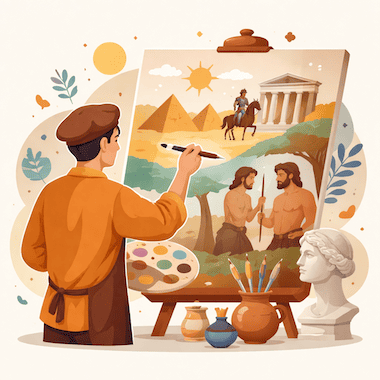
Paintings can do something that words can't: they let you see a moment from centuries ago as if you were standing in the room. A painting shows how people dressed, what they valued, how they saw themselves and what their world looked like. If you learn to read paintings as historical sources, you get a view of the past that no written text can give you.
A pintura consegue fazer algo que as palavras não conseguem: deixa-nos ver um momento de há séculos como se estivéssemos na mesma sala. Um quadro mostra como as pessoas se vestiam, o que valorizavam, como se viam a si próprias e como era o seu mundo. Quem aprende a ler os quadros como fontes históricas ganha uma visão do passado que nenhum texto escrito pode dar.
Cave Art: The First Stories
Arte rupestre: as primeiras histórias
The Chauvet Cave in southern France holds some of the oldest paintings in Europe, made about 36,000 years ago. Its horses, lions, mammoths and rhinoceroses are drawn with real skill. The artists used shading and the natural shape of the rock to make the animals look solid, and they drew some legs and heads several times, as if the animals were moving. Even older cave art has been found on the Indonesian island of Sulawesi, where a painted scene of human figures and a wild pig is at least 51,000 years old.
A gruta Chauvet, no sul de França, guarda algumas das pinturas mais antigas da Europa, feitas há cerca de 36 000 anos. Os seus cavalos, leões, mamutes e rinocerontes estão desenhados com grande mestria. Os artistas usaram o sombreado e a forma natural da rocha para dar volume aos animais, e desenharam algumas patas e cabeças várias vezes, como se os animais estivessem em movimento. Foi encontrada arte rupestre ainda mais antiga na ilha indonésia de Sulawesi, onde uma cena pintada com figuras humanas e um javali tem pelo menos 51 000 anos.
Hand stencils are found in caves all over the world. People pressed a hand against the wall and blew paint around it, leaving its outline on the rock. Some on Sulawesi are around 40,000 years old, and the Cave of the Hands in Argentina has hundreds of them, some made about 9,000 years ago. No one knows exactly what they meant. Perhaps the message was the simplest one possible: I was here.
Há mãos em negativo em grutas de todo o mundo. As pessoas encostavam uma mão à parede e sopravam tinta à volta, deixando o seu contorno na rocha. Algumas em Sulawesi têm cerca de 40 000 anos, e a Cueva de las Manos, a «Gruta das Mãos» na Argentina, tem centenas delas, algumas feitas há cerca de 9000 anos. Ninguém sabe ao certo o que significavam. Talvez a mensagem fosse a mais simples possível: estive aqui.
Egyptian Art: Order and Eternity
Arte egípcia: ordem e eternidade
Ancient Egyptian art followed strict rules that changed very little in 3,000 years. A figure usually has its head and legs in profile, while the eye and the shoulders face the viewer. To modern eyes this looks strange, but Egyptian artists were not clumsy. They chose this style on purpose, because of what their art was for.
A arte do antigo Egito seguia regras rígidas que mudaram muito pouco em 3000 anos. Uma figura tem normalmente a cabeça e as pernas de perfil, enquanto o olho e os ombros estão virados para quem observa. Aos nossos olhos parece estranho, mas os artistas egípcios não eram desajeitados. Escolheram este estilo de propósito, por causa da função da sua arte.
An Egyptian painting was not meant to show what one person sees from one spot. It showed each part of the body in its clearest and most complete form, so that the whole person was recorded. A pharaoh was painted larger than the people around him because he was more important, not because the artist didn't understand proportions. The scenes on tomb walls had a practical job, too: Egyptians believed that the food, servants and pleasures painted there would serve the dead person in the afterlife. Art was meant to make things happen.
Uma pintura egípcia não pretendia mostrar o que uma pessoa vê a partir de um só ponto. Mostrava cada parte do corpo na sua forma mais clara e completa, para que a pessoa ficasse registada por inteiro. O faraó era pintado maior do que as pessoas à sua volta porque era mais importante, e não porque o artista não conhecesse as proporções. As cenas nas paredes dos túmulos também tinham uma função prática: os egípcios acreditavam que a comida, os servos e os prazeres ali pintados serviriam o morto no além. A arte devia fazer as coisas acontecerem.
Renaissance Art: Rediscovering the Human
Arte do Renascimento: a redescoberta do ser humano
The European Renaissance, which lasted roughly from the 14th to the 16th century, changed what art was for. Medieval painting mostly served the Church. Its figures were flat and stylized, and their size and position showed religious importance, not how things really looked. Renaissance artists turned their attention to the human body, the natural world and the art of ancient Greece and Rome.
O Renascimento europeu, que durou aproximadamente do século XIV ao XVI, mudou a finalidade da arte. A pintura medieval servia sobretudo a Igreja. As suas figuras eram planas e estilizadas, e o seu tamanho e posição mostravam a importância religiosa, não o aspeto real das coisas. Os artistas do Renascimento voltaram a sua atenção para o corpo humano, a natureza e a arte da Grécia e da Roma antigas.
Leonardo da Vinci dissected human bodies to understand muscles and bones. Michelangelo painted the ceiling of the Sistine Chapel between 1508 and 1512, and Raphael filled The School of Athens with lifelike figures of ancient thinkers. Renaissance art was also a tool of power. A portrait of a ruler or a rich merchant was carefully planned to show wealth, faith and the right to rule. The pose, the clothes, the objects and the background of such a portrait can tell you as much about 15th-century Italian politics as a written document.
Leonardo da Vinci dissecava cadáveres para compreender os músculos e os ossos. Miguel Ângelo pintou o teto da Capela Sistina entre 1508 e 1512, e Rafael encheu A Escola de Atenas de figuras de pensadores antigos cheias de vida. A arte renascentista era também um instrumento de poder. O retrato de um governante ou de um mercador rico era cuidadosamente pensado para mostrar riqueza, devoção e o direito de governar. A pose, a roupa, os objetos e o fundo de um retrato destes podem dizer-nos tanto sobre a política da Itália do século XV como um documento escrito.
Hidden Stories in Famous Paintings
Histórias escondidas em quadros famosos
Many famous paintings hide meanings that most viewers miss. Jan van Eyck's Arnolfini Portrait (1434), in the National Gallery in London, is full of symbols: a single candle burning in daylight, a small dog often read as a sign of loyalty, and a round mirror that reflects two more people in the doorway. Above the mirror, van Eyck wrote in Latin: "Jan van Eyck was here." A famous theory says the painting records a marriage, with the artist as a witness, but many experts now doubt it.
Muitos quadros famosos escondem significados que escapam à maioria de quem os vê. O Casal Arnolfini (1434), de Jan van Eyck, na National Gallery de Londres, está cheio de símbolos: uma única vela acesa em pleno dia, um cãozinho muitas vezes visto como sinal de fidelidade e um espelho redondo que reflete mais duas pessoas à porta. Por cima do espelho, van Eyck escreveu em latim: «Jan van Eyck esteve aqui.» Segundo uma teoria famosa, o quadro regista um casamento com o pintor como testemunha, mas hoje muitos especialistas duvidam disso.
Diego Velázquez's Las Meninas (1656), in the Prado Museum in Madrid, plays a clever game with the viewer. Velázquez painted himself at work on a huge canvas, next to the young princess Margarita and her maids of honor. A mirror on the back wall shows King Philip IV and Queen Mariana, who seem to be standing exactly where we stand. The painting leaves it unclear who is really being painted and who is watching, and critics have argued about it for more than 350 years.
As Meninas (1656), de Diego Velázquez, no Museu do Prado, em Madrid, faz um jogo engenhoso com o espectador. Velázquez pintou-se a si próprio a trabalhar numa tela enorme, ao lado da pequena infanta Margarida e das suas damas de companhia. Um espelho na parede do fundo mostra o rei Filipe IV e a rainha Mariana, que parecem estar exatamente onde nós estamos. O quadro deixa por esclarecer quem está realmente a ser pintado e quem está a observar, e os críticos discutem isso há mais de 350 anos.
Art as Protest and Revolution
A arte como protesto e revolução
Artists have often used their work to criticize power and to record cruelty. Between 1810 and 1820, Francisco Goya made a series of more than 80 prints called The Disasters of War about the fighting that followed Napoleon's invasion of Spain. They show executions, hunger and mutilated bodies, and they make no one a hero. The series was so harsh that it was not published until 1863, 35 years after Goya's death, and it is still hard to look at today.
Os artistas usaram muitas vezes a sua obra para criticar o poder e registar a crueldade. Entre 1810 e 1820, Francisco Goya fez uma série de mais de 80 gravuras, Os Desastres da Guerra, sobre os combates que se seguiram à invasão de Espanha por Napoleão. Mostram execuções, fome e corpos mutilados, e não fazem de ninguém um herói. A série era tão dura que só foi publicada em 1863, 35 anos depois da morte de Goya, e ainda hoje é difícil olhar para ela.
Pablo Picasso painted Guernica in 1937, after German and Italian planes supporting Franco bombed the Basque town of Guernica during the Spanish Civil War. Its broken, screaming figures show the terror of an attack on ordinary people. The painting traveled to exhibitions in Europe and the United States and made the bombing known around the world. Picasso did not want it to go to Spain until democracy returned, so it stayed at the Museum of Modern Art in New York until 1981. Today it hangs in the Museo Reina Sofía in Madrid.
Pablo Picasso pintou Guernica em 1937, depois de aviões alemães e italianos que apoiavam Franco terem bombardeado a vila basca de Guernica durante a Guerra Civil de Espanha. As suas figuras partidas e a gritar mostram o terror de um ataque contra pessoas comuns. O quadro foi exposto na Europa e nos Estados Unidos e deu a conhecer o bombardeamento ao mundo inteiro. Picasso não queria que fosse para Espanha antes de a democracia regressar, por isso ficou no Museu de Arte Moderna de Nova Iorque até 1981. Hoje está no Museu Reina Sofía, em Madrid.
Non-Western Art Traditions
Tradições artísticas não ocidentais
The history of art is much wider than the European tradition that fills most textbooks. Chinese landscape painting, called shan shui ("mountain and water"), reached a high point between the 10th and 14th centuries, with works such as Fan Kuan's Travelers among Mountains and Streams from around 1000. These painters did not try to copy a real view. They wanted to capture the spirit, or qi, of a landscape, and they usually worked indoors, combining memories of many walks into one ideal scene.
A história da arte é muito mais vasta do que a tradição europeia que enche a maioria dos manuais. A pintura de paisagem chinesa, chamada shan shui («montanha e água»), atingiu o seu auge entre os séculos X e XIV, com obras como Viajantes entre Montanhas e Riachos, de Fan Kuan, pintada por volta do ano 1000. Estes pintores não tentavam copiar uma paisagem real. Queriam captar o seu espírito, o qi, e trabalhavam geralmente em espaços fechados, juntando numa cena ideal as memórias de muitos passeios.
In Japan, ukiyo-e woodblock prints of the 17th to 19th centuries showed everyday life: kabuki actors, sumo wrestlers, famous views and the pleasure districts of Edo, known as the "floating world." Their bold lines and flat colors influenced Van Gogh, Monet and Toulouse-Lautrec. In Ghana, kente cloth is woven in bright geometric patterns, and many of the patterns have names that come from proverbs, historical events or famous people. Every culture has found its own way to tell stories with images.
No Japão, as gravuras ukiyo-e dos séculos XVII a XIX mostravam a vida quotidiana: atores de kabuki, lutadores de sumo, paisagens famosas e os bairros de prazer de Edo, conhecidos como o «mundo flutuante». As suas linhas firmes e cores planas influenciaram Van Gogh, Monet e Toulouse-Lautrec. No Gana, o tecido kente é tecido com padrões geométricos de cores vivas, e muitos desses padrões têm nomes que vêm de provérbios, acontecimentos históricos ou pessoas famosas. Cada cultura encontrou a sua própria forma de contar histórias com imagens.
Modern Art: When Painting Became Personal
Arte moderna: quando a pintura se tornou pessoal
When photography became public in 1839, painters no longer had to record exactly how things looked. If a camera could do that, painting could show how things felt and what they meant. In the decades that followed, artists experimented more than ever before, and the idea of what art could be changed completely.
Quando a fotografia foi apresentada ao público em 1839, os pintores deixaram de ter de registar com exatidão o aspeto das coisas. Se uma máquina fotográfica podia fazê-lo, a pintura podia mostrar o que se sentia e o que as coisas significavam. Nas décadas seguintes, os artistas experimentaram como nunca, e a própria ideia do que a arte podia ser mudou por completo.
Vincent van Gogh painted The Starry Night in 1889 at a mental hospital in Saint-Rémy in southern France. Its swirling sky is not what the night really looked like; it shows what the night felt like to him. Edvard Munch painted The Scream in 1893. He wrote that the idea came to him on an evening walk, when he felt a great scream passing through nature. So the figure is less a person screaming than a picture of fear itself. Works like these led the way to abstract art, in which color and shape express feelings without showing real objects at all.
Vincent van Gogh pintou A Noite Estrelada em 1889, num hospital psiquiátrico em Saint-Rémy, no sul de França. O seu céu em remoinhos não mostra como a noite era realmente, mas o que ele sentia ao olhá-la. Edvard Munch pintou O Grito em 1893. Escreveu que a ideia lhe surgiu num passeio ao fim da tarde, quando sentiu um grande grito a atravessar a natureza. Assim, a figura é menos uma pessoa a gritar do que uma imagem do próprio medo. Obras como estas abriram caminho à arte abstrata, em que a cor e a forma exprimem sentimentos sem mostrar qualquer objeto real.
Surprising Facts About Art
Factos surpreendentes sobre arte
X-rays and infrared scans often reveal different pictures under the paint of Renaissance masterpieces, because artists painted over earlier work or changed their minds.
Os raios X e as análises de infravermelhos revelam muitas vezes imagens diferentes sob a tinta de obras-primas do Renascimento, porque os artistas pintavam por cima de trabalhos antigos ou mudavam de ideias.
The Mona Lisa became world famous only after an Italian worker, Vincenzo Peruggia, stole it from the Louvre in 1911. It was missing for more than two years.
A Mona Lisa só se tornou mundialmente famosa depois de um operário italiano, Vincenzo Peruggia, a ter roubado do Louvre em 1911. Esteve desaparecida mais de dois anos.
A popular story says Thomas Gainsborough painted The Blue Boy (around 1770) to prove Joshua Reynolds wrong about the color blue, but Reynolds made his famous remark in 1778, years later.
Segundo uma história muito contada, Thomas Gainsborough pintou O Rapaz Azul (por volta de 1770) para provar que Joshua Reynolds estava errado sobre a cor azul, mas Reynolds fez o seu famoso comentário em 1778, anos depois.
Leonardo da Vinci began the Mona Lisa around 1503 and was still working on it more than ten years later. He took it with him to France, where he died in 1519.
Leonardo da Vinci começou a Mona Lisa por volta de 1503 e mais de dez anos depois ainda trabalhava nela. Levou-a consigo para França, onde morreu em 1519.
The most expensive painting ever sold at auction is Salvator Mundi, attributed to Leonardo da Vinci. It sold for $450 million in 2017.
O quadro mais caro alguma vez vendido em leilão é o Salvator Mundi, atribuído a Leonardo da Vinci. Foi vendido por 450 milhões de dólares em 2017.
About 55 of Frida Kahlo's roughly 140 paintings are self-portraits. She said she painted herself because she was often alone and was "the subject I know best."
Cerca de 55 dos perto de 140 quadros de Frida Kahlo são autorretratos. Ela dizia que se pintava a si própria porque estava muitas vezes sozinha e porque era «o tema que conheço melhor».
Learning to Look
Aprender a olhar
From cave walls to museum galleries, painting is one of the oldest ways people have recorded their lives. Every painting was made by someone who wanted to say something, show something or keep something from being forgotten. When you look carefully at a painting, you meet the mind of a person from a very different world.
Das paredes das grutas às salas dos museus, a pintura é uma das formas mais antigas de as pessoas registarem a sua vida. Cada quadro foi feito por alguém que queria dizer alguma coisa, mostrar alguma coisa ou impedir que algo fosse esquecido. Quem olha com atenção para um quadro encontra a mente de uma pessoa de um mundo muito diferente.
Art history is more than a list of techniques and styles. It also tells us what people feared, worshipped, celebrated, mourned and fought for. A great painting is one person's vision and, at the same time, a record of its age. Seen this way, a visit to a museum is also a lesson in history.
A história da arte é mais do que uma lista de técnicas e estilos. Também nos diz o que as pessoas temeram, adoraram, celebraram e choraram, e aquilo por que lutaram. Um grande quadro é a visão de uma só pessoa e, ao mesmo tempo, um testemunho da sua época. Vista assim, uma visita a um museu é também uma aula de história.
No app gratuito você ouve este texto em voz alta e toca em qualquer palavra para ver o significado.