Festivals Around the Globe
Festas pelo mundo
 Learn EnglishApp grátis com áudio, quizzes e livros de verdade
Palavras-chave
- festivalfestival
- ceremonycerimónia
- processionprocissão
- ritualritual
- pilgrimperegrino
- heritagepatrimónio
- solsticesolstício
- altaraltar
- harvestcolheita
- costumefantasia
- sacredsagrado
- deitydivindade
Ver as 30 palavras
- reenactmentreconstituição
- offeringoferenda
- bonfirefogueira
- spectatorespectador
- indigenousindígena
- communalcomunitário
- mythmito
- fertilityfertilidade
- mourningluto
- torchtocha
- baptismbatismo
- archerytiro com arco
- lanternlanterna
- preservationpreservação
- empathyempatia
- exuberantexuberante
- feastbanquete
- conquestconquista
Every culture on Earth has its festivals. From the snowy north of Scandinavia to the deserts of Africa, people have always set aside special days to honor their gods, welcome a new season, remember the dead or simply have a good time together.
Todas as culturas da Terra têm as suas festas. Do norte nevado da Escandinávia aos desertos de África, as pessoas sempre reservaram dias especiais para honrar os seus deuses, receber uma nova estação, lembrar os mortos ou simplesmente divertir-se em conjunto.
Some celebrations, like New Year's Eve, are known almost everywhere. Thousands of others are hardly known outside their own region. Here are a few of them, from Ethiopia to Mongolia, and what people actually do on those days.
Algumas celebrações, como a passagem de ano, são conhecidas em quase todo o lado. Milhares de outras são pouco conhecidas fora da sua região. Eis algumas delas, da Etiópia à Mongólia, e o que as pessoas fazem realmente nesses dias.
Timkat: Epiphany in Ethiopia
Timkat: a Epifania na Etiópia
Timkat is the Ethiopian Orthodox celebration of Epiphany, the day that remembers the baptism of Jesus in the Jordan River. It falls on January 19, or January 20 in leap years. On the eve of the feast, priests carry the tabots out of the churches. A tabot is a tablet that stands for the Ark of the Covenant, and it is so holy that it is always wrapped in rich cloth and kept out of sight.
O Timkat é a festa da Epifania da Igreja Ortodoxa Etíope, que lembra o batismo de Jesus no rio Jordão. Calha a 19 de janeiro, ou a 20 nos anos bissextos. Na véspera, os padres levam os tabots para fora das igrejas. Um tabot é uma placa que representa a Arca da Aliança, e é tão sagrado que está sempre envolto em panos ricos e escondido dos olhares.
Crowds dressed in white follow the procession to a pool or river, where they spend the night singing and praying. At dawn the priests bless the water, and many people jump in or get splashed to renew their baptism. One of the biggest celebrations takes place in Gondar, where people leap into the pool of Fasilides' Bath, built in the 17th century. UNESCO added Timkat to its list of Intangible Cultural Heritage in 2019.
Multidões vestidas de branco seguem a procissão até um tanque ou um rio, onde passam a noite a cantar e a rezar. Ao amanhecer, os padres benzem a água, e muitos atiram-se a ela ou deixam-se salpicar para renovar o seu batismo. Uma das maiores celebrações realiza-se em Gondar, onde as pessoas saltam para o tanque dos Banhos de Fasilides, construídos no século XVII. A UNESCO incluiu o Timkat na sua lista do Património Cultural Imaterial em 2019.
Up Helly Aa: Fire in the Scottish Winter
Up Helly Aa: fogo no inverno escocês
On the last Tuesday of January, about a thousand people with burning torches march through the dark streets of Lerwick, the main town of Scotland's Shetland Islands. This is Up Helly Aa, one of the largest fire festivals in Europe. At the front marches the Jarl Squad, dressed as Vikings with helmets, shields and axes.
Na última terça-feira de janeiro, cerca de mil pessoas com tochas acesas desfilam pelas ruas escuras de Lerwick, a principal localidade das ilhas Shetland, na Escócia. É o Up Helly Aa, uma das maiores festas do fogo da Europa. À frente marcha o Jarl Squad, vestido de vikings, com capacetes, escudos e machados.
The march ends at a wooden Viking ship, or galley, built for the occasion. The costumed marchers, called guizers, throw their torches into it and watch it burn. The festival is younger than it looks: the Victorians invented the Viking theme in the 1880s, and the first galley was burned in 1889. After the fire, the guizers visit local halls, where music and dancing go on until morning. Since 2023, women and girls can march in the procession too.
O desfile termina junto a um navio viking de madeira, a galera, construído para a ocasião. Os participantes mascarados, chamados guizers, atiram-lhe as tochas e ficam a vê-lo arder. A festa é mais recente do que parece: foram os vitorianos que inventaram o tema viking na década de 1880, e a primeira galera foi queimada em 1889. Depois do fogo, os guizers percorrem os salões da terra, onde a música e a dança continuam até de manhã. Desde 2023, também as mulheres e as raparigas podem desfilar.
Songkran: Thailand's Water Festival
Songkran: a festa da água da Tailândia
Songkran is the Thai New Year, officially celebrated from April 13 to 15. It falls in the hottest part of the year, just before the rainy season. The tradition began quietly: people poured scented water over statues of the Buddha and over the hands of older relatives to show respect and ask for their blessing.
O Songkran é o Ano Novo tailandês e celebra-se oficialmente de 13 a 15 de abril. Calha na altura mais quente do ano, mesmo antes da estação das chuvas. A tradição começou de forma tranquila: as pessoas deitavam água perfumada sobre as estátuas de Buda e sobre as mãos dos familiares mais velhos para lhes mostrar respeito e pedir a sua bênção.
Today the whole country seems to turn into one huge water fight. In Bangkok and Chiang Mai, the streets fill with people carrying water guns, buckets and hoses, and nobody stays dry. Many people still visit temples, give food to monks and build small piles of sand in the temple grounds. The water has a meaning too: it washes away the bad luck of the old year. In 2023, UNESCO added Songkran to its Intangible Cultural Heritage list.
Hoje, o país inteiro parece transformar-se numa enorme batalha de água. Em Banguecoque e Chiang Mai, as ruas enchem-se de gente com pistolas de água, baldes e mangueiras, e ninguém fica seco. Ainda assim, muitos continuam a visitar os templos, a dar comida aos monges e a fazer pequenos montes de areia nos recintos dos templos. A água também tem um significado: leva consigo o azar do ano velho. Em 2023, a UNESCO acrescentou o Songkran à sua lista do Património Cultural Imaterial.
Día de los Muertos: Celebrating the Departed
Día de los Muertos: uma festa para os que partiram
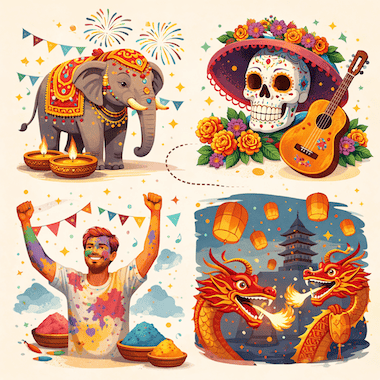
Mexico's Day of the Dead is celebrated on November 1 and 2. Outsiders often imagine a sad or gloomy holiday, but it is closer to a family reunion. People believe that on these days the souls of the dead come back to visit the living, and they prepare a warm welcome for them.
O Dia dos Mortos mexicano celebra-se a 1 e 2 de novembro. Quem está de fora imagina muitas vezes uma festa triste ou sombria, mas parece-se mais com uma reunião de família. Acredita-se que nestes dias as almas dos mortos voltam para visitar os vivos, e prepara-se para elas uma receção calorosa.
Families build altars called ofrendas and decorate them with orange marigolds, candles, photos and the favorite food and drinks of the people they have lost. In many towns, families spend the night in the cemetery, eating, playing music and telling stories about the dead. Skulls, or calaveras, are everywhere, often made of sugar and painted in bright colors. The festival mixes the traditions of the Aztecs and other indigenous peoples with the Catholic feasts of All Saints and All Souls, and UNESCO recognized it in 2008.
As famílias montam altares chamados ofrendas e enfeitam-nos com tagetes cor de laranja, velas, fotografias e a comida e bebida preferidas dos entes queridos que perderam. Em muitas terras, as famílias passam a noite no cemitério a comer, a tocar música e a contar histórias sobre os mortos. As caveiras, ou calaveras, estão por todo o lado, muitas vezes feitas de açúcar e pintadas com cores vivas. A festa mistura as tradições dos astecas e de outros povos indígenas com as festas católicas de Todos os Santos e dos Fiéis Defuntos, e a UNESCO reconheceu-a em 2008.
Holi: The Festival of Colors
Holi: a festa das cores
Holi is one of the best-known Hindu festivals. It is celebrated in India and Nepal and by South Asian communities around the world. It takes place at the full moon in late February or March, marks the end of winter and the victory of good over evil, and is famous for its clouds of colored powder.
O Holi é uma das festas hindus mais conhecidas. Celebra-se na Índia e no Nepal e em comunidades do sul da Ásia de todo o mundo. Realiza-se na lua cheia, no fim de fevereiro ou em março, assinala o fim do inverno e a vitória do bem sobre o mal, e é famoso pelas suas nuvens de pó colorido.
It starts the night before with Holika Dahan, when people light bonfires. They remember the legend of the demoness Holika, who burned in a fire while the boy Prahlad, a devoted follower of Vishnu, walked out unharmed. The next morning, people of all ages go out and throw colored powder and water at friends, neighbors and strangers alike. For one day, many of the usual barriers between rich and poor, old and young are relaxed. The colors also recall the god Krishna, who, according to legend, playfully covered Radha and her friends in color.
Começa na noite anterior com o Holika Dahan, quando se acendem fogueiras. Lembra-se a lenda da demónia Holika, que ardeu no fogo enquanto o rapaz Prahlad, fiel devoto de Vixnu, saiu ileso. Na manhã seguinte, pessoas de todas as idades saem à rua e atiram pó colorido e água a amigos, vizinhos e desconhecidos. Durante um dia, muitas das barreiras habituais entre ricos e pobres, velhos e novos ficam mais leves. As cores lembram também o deus Krishna, que, segundo a lenda, cobria Radha e as amigas de cor por brincadeira.
Inti Raymi: Festival of the Sun
Inti Raymi: a festa do Sol
Every year on June 24, the Inca Festival of the Sun comes back to life in Cusco, Peru. In Quechua, Inti Raymi means 'Festival of the Sun'. It was one of the most important ceremonies of the Inca Empire, held around the winter solstice in the Southern Hemisphere to honor the sun god Inti.
Todos os anos, a 24 de junho, a festa inca do Sol volta à vida em Cusco, no Peru. Em quíchua, Inti Raymi significa festa do Sol. Era uma das cerimónias mais importantes do Império Inca e realizava-se por volta do solstício de inverno do hemisfério sul, em honra do deus Sol, Inti.
After the conquest, the Spanish colonial authorities banned the festival in the 16th century. It was brought back in 1944 as a staged performance. Today, hundreds of actors in rich costumes play the Sapa Inca, the emperor, and his court at Sacsayhuamán, the old Inca fortress above the city. Tens of thousands of people come to watch. For many Quechua speakers, the festival is more than a show: it is a way to take pride in their language and history.
Depois da conquista, as autoridades coloniais espanholas proibiram a festa no século XVI. Em 1944 foi recuperada como espetáculo encenado. Hoje, centenas de atores com trajes vistosos interpretam o Sapa Inca, o imperador, e a sua corte em Sacsayhuamán, a antiga fortaleza inca que domina a cidade. Dezenas de milhares de pessoas vão assistir. Para muitos falantes de quíchua, a festa é mais do que um espetáculo: é uma forma de se orgulharem da sua língua e da sua história.
Onam: Kerala's Harvest Festival
Onam: a festa das colheitas de Kerala
Onam is the harvest festival of Kerala, in southern India. It lasts ten days and falls in August or September, in the Malayalam month of Chingam. People of all religions in Kerala celebrate it. According to legend, Onam marks the yearly visit of Mahabali, a kind and generous king who ruled the land long ago and comes back once a year to see his people.
O Onam é a festa das colheitas de Kerala, no sul da Índia. Dura dez dias e calha em agosto ou setembro, no mês de Chingam do calendário malaiala. Em Kerala, pessoas de todas as religiões celebram-no. Segundo a lenda, o Onam assinala a visita anual de Mahabali, um rei bondoso e generoso que governou aquela terra há muito tempo e regressa uma vez por ano para ver o seu povo.
Families make flower carpets called pookalam in front of their homes and add more flowers each day, so the designs grow bigger and more detailed. The high point is the Onam Sadya, a vegetarian feast of more than twenty dishes served on a banana leaf. In the same season, villages hold races of long snake boats, known as Vallam Kali, with about a hundred rowers in each boat, while huge crowds cheer from the riverbanks.
As famílias fazem tapetes de flores chamados pookalam à porta de casa e juntam-lhes flores todos os dias, de modo que os desenhos ficam cada vez maiores e mais detalhados. O ponto alto é o Onam Sadya, um banquete vegetariano com mais de vinte pratos servidos numa folha de bananeira. Na mesma altura, as aldeias organizam regatas de longos barcos-serpente, chamadas Vallam Kali, com cerca de cem remadores em cada barco, enquanto multidões enormes aplaudem nas margens.
Naadam: Mongolia's Festival of Three Games
Naadam: a festa dos três jogos da Mongólia
Every July, Mongolia celebrates Naadam, a national festival built around three traditional sports: wrestling, horse racing and archery. The biggest Naadam opens in the capital, Ulaanbaatar, on July 11. The games go back many centuries, to a time when nomad armies used them to keep their warriors fit.
Todos os anos, em julho, a Mongólia celebra o Naadam, uma festa nacional construída em torno de três desportos tradicionais: a luta, as corridas de cavalos e o tiro com arco. O maior Naadam começa a 11 de julho na capital, Ulan Bator. Estes jogos remontam a muitos séculos atrás, a uma época em que os exércitos nómadas os usavam para manter os seus guerreiros em forma.
The horse races are the most surprising part: the riders are children, some only five years old, and they race across the open steppe for 15 to 30 kilometers, depending on the age of the horses. The wrestlers wear tight open vests and pointed boots, and a match ends only when one of them touches the ground with his back, knee or elbow. Archers shoot at rows of small leather targets from up to 75 meters away. UNESCO added Naadam to its Intangible Cultural Heritage list in 2010.
As corridas de cavalos são a parte mais surpreendente: os cavaleiros são crianças, algumas com apenas cinco anos, e correm entre 15 e 30 quilómetros pela estepe aberta, conforme a idade dos cavalos. Os lutadores usam coletes justos abertos à frente e botas de bico revirado, e um combate só acaba quando um deles toca no chão com as costas, o joelho ou o cotovelo. Os arqueiros atiram a filas de pequenos alvos de couro a distâncias de até 75 metros. A UNESCO incluiu o Naadam na sua lista do Património Cultural Imaterial em 2010.
Festival Facts from Around the World
Curiosidades sobre festas do mundo
At La Tomatina in Buñol, Spain, about 20,000 people throw more than 100 tons of tomatoes at each other in one hour every August.
Na Tomatina de Buñol, em Espanha, cerca de 20 000 pessoas atiram umas às outras mais de 100 toneladas de tomates numa hora, todos os anos em agosto.
At Japan's Hadaka Matsuri, or Naked Festival, thousands of men in loincloths fight to grab sacred sticks that are said to bring a year of good luck.
No Hadaka Matsuri japonês, ou Festa Nua, milhares de homens de tanga lutam para agarrar paus sagrados que, segundo se diz, trazem um ano de sorte.
The Carnival of Oruro in Bolivia is famous for its devil dancers, and its main parade can last around 20 hours.
O Carnaval de Oruro, na Bolívia, é famoso pelos seus dançarinos vestidos de diabo, e o desfile principal pode durar cerca de 20 horas.
Burning Man brings about 70,000 people to Nevada's Black Rock Desert, where they build a temporary city, burn a giant wooden figure and then remove every trace.
O Burning Man leva cerca de 70 000 pessoas ao deserto de Black Rock, no Nevada, onde constroem uma cidade temporária, queimam uma enorme figura de madeira e depois apagam todos os vestígios.
Finland's Wife Carrying World Championship goes back to a legend about a 19th-century robber who stole women from nearby villages.
O Campeonato do Mundo de Carregar a Esposa, na Finlândia, tem origem na lenda de um salteador do século XIX que roubava mulheres das aldeias vizinhas.
During Taiwan's Lantern Festival, thousands of paper sky lanterns carrying people's written wishes rise into the night over the town of Pingxi.
Durante o Festival das Lanternas de Taiwan, milhares de lanternas voadoras de papel com desejos escritos sobem na noite por cima da vila de Pingxi.
Why Festivals Matter
Porque é que as festas são importantes
Festivals are more than entertainment. Researchers have found that celebrating together brings people closer, gives them a clearer sense of who they are and offers a break from the stress of daily life. Dancing, singing or eating with hundreds of others gives people a strong feeling of belonging.
As festas são mais do que diversão. Os investigadores concluíram que celebrar em conjunto aproxima as pessoas, dá-lhes uma ideia mais clara de quem são e oferece uma pausa no stress do dia a dia. Dançar, cantar ou comer com centenas de outras pessoas dá um forte sentimento de pertença.
Local festivals also keep old things alive. Songs, dances, crafts, recipes and sometimes whole languages survive because people need them for one special day each year. And for visitors, a festival is often the easiest way to understand how other people see the world.
As festas locais também mantêm vivo o que é antigo. Canções, danças, ofícios, receitas e por vezes línguas inteiras sobrevivem porque as pessoas precisam delas para um dia especial todos os anos. E, para quem visita, uma festa é muitas vezes a maneira mais fácil de perceber como os outros veem o mundo.
Conclusion
Conclusão
From burning Viking ships in Shetland to flower carpets in Kerala, from naked men at a Japanese temple to paper lanterns over Taiwan, festivals show how differently people celebrate. Each one tells you something about the place where it began.
Dos navios vikings em chamas nas Shetland aos tapetes de flores de Kerala, dos homens nus num templo japonês às lanternas de papel sobre Taiwan, as festas mostram como são diferentes as maneiras de celebrar. Cada uma diz alguma coisa sobre o lugar onde nasceu.
Some are solemn and some are silly. Some are hundreds of years old, while others, like Burning Man, started only a few decades ago. But all of them bring people together: with their neighbors, with nature, with the past and with something bigger than themselves.
Umas são solenes, outras disparatadas. Algumas têm centenas de anos, enquanto outras, como o Burning Man, nasceram há apenas algumas décadas. Mas todas aproximam as pessoas: dos vizinhos, da natureza, do passado e de algo maior do que elas próprias.
No app gratuito você ouve este texto em voz alta e toca em qualquer palavra para ver o significado.