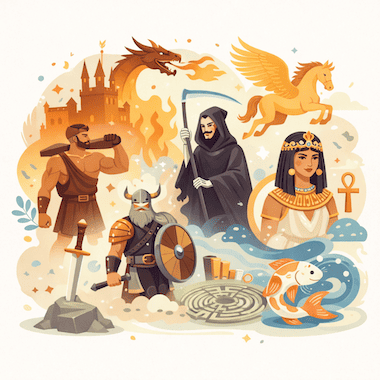
Famous Myths and Legends
Mitos e lendas famosos
 Learn EnglishApp grátis com áudio, quizzes e livros de verdade
Palavras-chave
- mythmito
- legendlenda
- immortalityimortalidade
- deitydivindade
- underworldsubmundo
- archetypearquétipo
- flooddilúvio
- trickstertrapaceiro
- questdemanda
- mortalmortal
- allegoryalegoria
- serpentserpente
Ver as 30 palavras
- epicepopeia
- prophecyprofecia
- demigodsemideus
- vengeancevingança
- creationcriação
- tragedytragédia
- rebirthrenascimento
- griefluto
- wisdomsabedoria
- cyclicalcíclico
- chivalrycavalaria
- psychepsique
- narrativenarrativa
- monstermonstro
- heroicheróico
- eclipseeclipse
- cunningastúcia
- mortalitymortalidade
Long before anyone wrote down laws or history, people told stories. Every culture we know of has its myths and legends: tales about how the world began, why people suffer and die, and where the first fire or the first rain came from. These stories entertained, but they also held communities together, passed on rules and beliefs, and gave people a shared picture of the world.
Muito antes de alguém pôr por escrito leis ou história, as pessoas contavam histórias. Todas as culturas que conhecemos têm os seus mitos e lendas: relatos sobre como o mundo começou, porque é que as pessoas sofrem e morrem, e de onde vieram o primeiro fogo ou a primeira chuva. Estas histórias entretinham, mas também mantinham as comunidades unidas, transmitiam regras e crenças e davam às pessoas uma imagem partilhada do mundo.
Myths say a lot about the people who told them. They deal with questions that every generation asks again: Where did the world come from? Why do we suffer? What happens after death? How should we treat each other? Myths are not failed attempts at science. They are serious, often clever ways of making sense of human life, and reading the myths of other cultures is one of the best ways to understand those cultures.
Os mitos dizem muito sobre os povos que os contavam. Tratam de perguntas que cada geração volta a fazer: De onde veio o mundo? Porque sofremos? O que acontece depois da morte? Como devemos tratar-nos uns aos outros? Os mitos não são tentativas falhadas de fazer ciência. São formas sérias, muitas vezes engenhosas, de dar sentido à vida humana, e ler os mitos de outras culturas é uma das melhores maneiras de compreender essas culturas.
The Epic of Gilgamesh: One of the Oldest Stories
A Epopeia de Gilgamesh: uma das histórias mais antigas
The first poems about Gilgamesh were written in Sumerian on clay tablets in Mesopotamia around 2100 BCE, which makes them some of the oldest literature we have. The best-known version, in the Akkadian language, dates from about 1200 BCE. Gilgamesh, king of the city of Uruk, is two-thirds god and one-third human. When his closest friend Enkidu dies, Gilgamesh is overwhelmed by grief and by fear of his own death, and he sets out to find the secret of eternal life.
Os primeiros poemas sobre Gilgamesh foram escritos em sumério, em tábuas de argila, na Mesopotâmia, por volta de 2100 a.C., o que faz deles alguns dos textos literários mais antigos que temos. A versão mais conhecida, em língua acádia, data de cerca de 1200 a.C. Gilgamesh, rei da cidade de Uruk, é dois terços deus e um terço humano. Quando o seu amigo mais próximo, Enkidu, morre, Gilgamesh fica dominado pelo desgosto e pelo medo da própria morte, e parte em busca do segredo da vida eterna.
His journey takes him to the edge of the world, to Utnapishtim, a man the gods made immortal after he survived a great flood. The flood story is so close to the later Biblical account of Noah that scholars believe the two are related. Utnapishtim cannot give Gilgamesh eternal life, but he tells him about a plant at the bottom of the sea that makes old people young again. Gilgamesh dives down and gets it, but on the way home he stops to bathe in a pool, and a snake carries the plant away. He returns to Uruk with nothing. The epic ends with Gilgamesh showing a companion the great walls of his city, the work that will outlast him. Storytellers have returned to the search for immortality, and its failure, ever since.
A viagem leva-o ao fim do mundo, até Utnapishtim, um homem que os deuses tornaram imortal depois de ter sobrevivido a um grande dilúvio. Esta história do dilúvio é tão parecida com o relato bíblico de Noé, posterior, que os estudiosos acreditam que as duas estão relacionadas. Utnapishtim não pode dar a vida eterna a Gilgamesh, mas fala-lhe de uma planta no fundo do mar que torna os velhos jovens outra vez. Gilgamesh mergulha e consegue apanhá-la, mas no caminho de regresso detém-se para se banhar num lago e uma serpente leva a planta. Regressa a Uruk de mãos vazias. A epopeia termina com Gilgamesh a mostrar a um companheiro as grandes muralhas da sua cidade, a obra que lhe sobreviverá. Desde então, os contadores de histórias nunca deixaram de voltar à busca da imortalidade e ao seu fracasso.
Greek Mythology: Gods Who Behave Like Humans
Mitologia grega: deuses que se comportam como humanos
What sets Greek mythology apart is how human its gods are. The gods of Mount Olympus were not perfectly good or all-knowing. They were jealous, vain and quick to take revenge, and they could be cruel as well as generous and loving. Zeus was constantly unfaithful to his wife, Hera, and Hera often punished the women he seduced instead of Zeus himself. The heroes were no better: in the Iliad, Achilles refuses to fight for the Greeks because King Agamemnon has taken away a woman he had won. These are ordinary human faults on a huge scale.
O que distingue a mitologia grega é o quanto os seus deuses são humanos. Os deuses do monte Olimpo não eram perfeitamente bons nem sabiam tudo. Eram ciumentos, vaidosos e prontos a vingar-se, e podiam ser tão cruéis como generosos e afetuosos. Zeus traía constantemente a mulher, Hera, e Hera castigava muitas vezes as mulheres que ele seduzia, em vez de castigar o próprio Zeus. Os heróis não eram melhores: na Ilíada, Aquiles recusa-se a lutar pelos gregos porque o rei Agamémnon lhe tirou uma mulher que ele tinha ganho como despojo. São defeitos humanos comuns, numa escala enorme.
Because of this, Greek myths are full of psychology and moral questions. Sigmund Freud used the story of Oedipus, who unknowingly kills his father and marries his mother, to describe what he called the Oedipus complex. The beautiful young Narcissus, who fell in love with his own reflection, gave us the word “narcissism.” Prometheus stole fire from the gods and gave it to humans. As punishment, Zeus had him chained to a rock, where an eagle ate his liver every day, until the hero Heracles finally set him free. In Western art and literature, Prometheus became the classic image of the rebel who defies power to help others.
Por isso, os mitos gregos estão cheios de psicologia e de questões morais. Sigmund Freud usou a história de Édipo, que, sem saber, mata o pai e casa com a mãe, para descrever aquilo a que chamou complexo de Édipo. O belo jovem Narciso, que se apaixonou pelo próprio reflexo, deu-nos a palavra «narcisismo». Prometeu roubou o fogo aos deuses e deu-o aos humanos. Como castigo, Zeus mandou acorrentá-lo a um rochedo, onde uma águia lhe comia o fígado todos os dias, até que o herói Héracles finalmente o libertou. Na arte e na literatura ocidentais, Prometeu tornou-se a imagem clássica do rebelde que desafia o poder para ajudar os outros.
Norse Mythology: A World Built to End
Mitologia nórdica: um mundo feito para acabar
Norse mythology was the religion of Scandinavia in the Viking Age. Most of what we know about it comes from Icelandic texts written down in the 13th century, about two hundred years after Iceland became Christian. Its most unusual feature is that the gods know they are going to lose. At Ragnarök, the “fate of the gods,” the world tree Yggdrasil will shake, monsters will break free, and the gods will die in a final battle. Odin will be swallowed by the giant wolf Fenrir. Thor will kill the world serpent Jörmungandr, take nine steps, and fall dead from its poison.
A mitologia nórdica era a religião da Escandinávia na Era Viking. Quase tudo o que sabemos sobre ela vem de textos islandeses escritos no século XIII, cerca de duzentos anos depois de a Islândia se ter tornado cristã. A sua característica mais invulgar é que os deuses sabem que vão perder. No Ragnarök, o «destino dos deuses», a árvore do mundo Yggdrasil vai tremer, os monstros vão libertar-se e os deuses vão morrer numa batalha final. Odin será engolido pelo lobo gigante Fenrir. Thor matará a serpente do mundo, Jörmungandr, dará nove passos e cairá morto pelo seu veneno.
Knowing the end does not make the Norse gods give up. They prepare for the battle anyway, and Odin gathers the bravest dead warriors in his hall, Valhalla, to fight beside him on the last day. The myths do not end in complete darkness either: after Ragnarök a new, green earth rises from the sea, and a few gods and two humans survive to begin again. The same Germanic gods, under their Old English names, gave English four days of the week: Tuesday is named after Tiw (the Norse Tyr), Wednesday after Woden (Odin), Thursday after Thunor (Thor), and Friday after Frig (Frigg).
Saber o fim não leva os deuses nórdicos a desistir. Mesmo assim preparam-se para a batalha, e Odin reúne no seu salão, o Valhalla, os guerreiros mortos mais corajosos, para que lutem a seu lado no último dia. Os mitos também não acabam na escuridão total: depois do Ragnarök, uma terra nova e verde ergue-se do mar, e alguns deuses e dois humanos sobrevivem para recomeçar. Os mesmos deuses germânicos, com os seus nomes em inglês antigo, deram ao inglês quatro dias da semana: Tuesday tem o nome de Tiw (o Tyr nórdico), Wednesday o de Woden (Odin), Thursday o de Thunor (Thor) e Friday o de Frig (Frigg).
The Legend of King Arthur: History or Myth?
A lenda do rei Artur: história ou mito?
Few legends have lasted in the Western world as long as the story of King Arthur: the boy who pulled a sword from a stone, gathered the Knights of the Round Table, sent them in search of the Holy Grail, and ruled at Camelot until his kingdom fell apart. The legend has been told for more than a thousand years, and every age has retold it in its own way.
Poucas lendas duraram tanto no mundo ocidental como a história do rei Artur: o rapaz que tirou uma espada de uma pedra, reuniu os cavaleiros da Távola Redonda, os enviou em busca do Santo Graal e reinou em Camelot até o seu reino se desmoronar. A lenda é contada há mais de mil anos, e cada época recontou-a à sua maneira.
Whether a real Arthur ever lived is still debated. A Latin history from the 9th century and some early Welsh poems mention a war leader called Arthur who fought against Saxon invaders of Britain around the year 500. Most of the famous legend, however, came later. In about 1136, Geoffrey of Monmouth wrote a “history” of the kings of Britain that gave Arthur his sword, his queen Guinevere and the wizard Merlin. The French poet Chrétien de Troyes added Lancelot and the Grail in the late 12th century, and in 1485 the English writer Thomas Malory collected the stories in Le Morte d'Arthur. Arthur is less a historical person than a picture onto which each generation paints its own idea of a good king.
Se existiu um Artur verdadeiro continua a ser debatido. Uma história em latim do século IX e alguns poemas galeses antigos mencionam um chefe guerreiro chamado Artur, que combateu os invasores saxões da Britânia por volta do ano 500. A maior parte da famosa lenda, porém, surgiu mais tarde. Por volta de 1136, Godofredo de Monmouth escreveu uma «história» dos reis da Britânia que deu a Artur a sua espada, a rainha Guinevere e o mago Merlim. O poeta francês Chrétien de Troyes acrescentou Lancelote e o Graal no final do século XII, e em 1485 o escritor inglês Thomas Malory reuniu as histórias em A Morte de Artur. Artur é menos uma figura histórica do que uma tela onde cada geração pinta a sua própria ideia de um bom rei.
Myths from the Americas: The Popol Vuh
Mitos das Américas: o Popol Vuh
The Popol Vuh is the sacred book of the K'iche' Maya of Guatemala. It was written down in the K'iche' language with Latin letters in the 16th century, a few decades after the Spanish conquest, and the copy that survives was made by a Spanish priest around 1701. It tells how the gods tried several times to make beings who could speak and honor them. The animals could only screech and howl. People made of mud fell apart, and people made of wood had no hearts or minds. Only the fourth attempt worked: humans made from maize dough. For the Maya, maize was not just food; it was what people themselves were made of.
O Popol Vuh é o livro sagrado dos maias quiché da Guatemala. Foi escrito no século XVI, poucas décadas depois da conquista espanhola, em língua quiché e com letras latinas, e a cópia que sobreviveu foi feita por um padre espanhol por volta de 1701. Conta como os deuses tentaram várias vezes criar seres capazes de falar e de os honrar. Os animais só sabiam guinchar e uivar. As pessoas feitas de lama desfizeram-se, e as feitas de madeira não tinham coração nem entendimento. Só a quarta tentativa resultou: seres humanos feitos de massa de milho. Para os maias, o milho não era apenas alimento; era a própria matéria de que as pessoas eram feitas.
The Popol Vuh also tells the story of the Hero Twins, Hunahpu and Xbalanque. They go down into Xibalba, the underworld, play a dangerous ball game against its lords of death, and defeat them with tricks rather than strength. At one point they even let themselves be killed and then come back to life. In the end, the twins rise into the sky and become the Sun and the Moon. The story is about death and rebirth and about cleverness beating brute force, ideas that appear in myths all over the world.
O Popol Vuh conta também a história dos Gémeos Heróis, Hunahpu e Xbalanque. Descem a Xibalba, o mundo subterrâneo, jogam um perigoso jogo de bola contra os seus senhores da morte e vencem-nos com astúcia e não com força. A certa altura chegam a deixar-se matar e depois voltam à vida. No fim, os gémeos sobem ao céu e tornam-se o Sol e a Lua. A história fala de morte e renascimento, e da inteligência que vence a força bruta, ideias que surgem em mitos de todo o mundo.
African Mythology: Anansi the Spider
Mitologia africana: Anansi, a aranha
Anansi, a trickster in the shape of a spider, is one of the best-known characters in West African folklore. His stories come from the Akan people of present-day Ghana. In one famous tale, all the stories in the world belong to the sky god Nyame. Anansi asks to buy them, and Nyame sets a price that seems impossible: Anansi must bring him a python, a leopard, a swarm of hornets and a fairy. Using only tricks, Anansi captures all four, and since then the stories have been called Anansi's stories.
Anansi, um trapaceiro com forma de aranha, é uma das personagens mais conhecidas do folclore da África Ocidental. As suas histórias vêm do povo akan, no atual Gana. Num conto famoso, todas as histórias do mundo pertencem ao deus do céu, Nyame. Anansi pede para as comprar, e Nyame fixa um preço que parece impossível: Anansi tem de lhe levar uma pitão, um leopardo, um enxame de vespões e uma fada. Só com artimanhas, Anansi apanha os quatro, e desde então as histórias chamam-se as histórias de Anansi.
Enslaved Africans carried the Anansi stories across the Atlantic. They took root in Jamaica and other parts of the Caribbean and in the American South, where the spider sometimes became “Aunt Nancy.” The tales changed over time, but Anansi stayed the same: a small, weak creature who beats the powerful by using his head. For people who had no power and no rights, his victories were more than entertainment. Today Anansi also appears in modern fiction, for example in Neil Gaiman's novel Anansi Boys (2005).
Os africanos escravizados levaram as histórias de Anansi para o outro lado do Atlântico. Criaram raízes na Jamaica e noutras partes das Caraíbas, e no sul dos Estados Unidos, onde a aranha passou por vezes a chamar-se «Aunt Nancy» (tia Nancy). Os contos mudaram com o tempo, mas Anansi continuou o mesmo: uma criatura pequena e fraca que vence os poderosos usando a cabeça. Para pessoas sem poder e sem direitos, as suas vitórias eram mais do que um divertimento. Hoje Anansi aparece também na ficção moderna, por exemplo no romance de Neil Gaiman Os Filhos de Anansi (2005).
Shared Themes in World Myths
Temas comuns nos mitos do mundo
Scholars who compare myths have found that many themes appear in cultures far apart from each other. Flood stories are a good example. The Mesopotamian flood of Utnapishtim and the Biblical flood of Noah are probably related, but similar tales exist in India, where the god Vishnu warns the first man, Manu; in Greece, where Deucalion and his wife survive in a wooden chest; and in Aztec Mexico. Trickster figures appear on almost every continent too: clever troublemakers like Anansi, the Norse Loki or Coyote in many Native American tales, who break the rules and make fun of the powerful.
Os estudiosos que comparam mitos descobriram que muitos temas aparecem em culturas muito distantes umas das outras. As histórias de dilúvios são um bom exemplo. O dilúvio mesopotâmico de Utnapishtim e o dilúvio bíblico de Noé estão provavelmente relacionados, mas existem relatos semelhantes na Índia, onde o deus Vixnu avisa o primeiro homem, Manu; na Grécia, onde Deucalião e a mulher sobrevivem numa arca de madeira; e no México asteca. Também há figuras de trapaceiros em quase todos os continentes: desordeiros astutos como Anansi, o nórdico Loki ou Coiote, em muitas histórias dos povos nativos da América do Norte, que quebram as regras e troçam dos poderosos.
The psychologist Carl Jung explained these repeated patterns with his idea of archetypes: basic images and types of story that, he believed, all humans share deep in the unconscious mind. Many scholars today doubt Jung's theory and point to trade, migration and common human experience instead. Whatever the reason, people separated by oceans and thousands of years have told similar stories about floods, heroes, creation and death, perhaps because they all faced the same things: love, loss, fear and the wish to understand their place in the world.
O psicólogo Carl Jung explicou estes padrões repetidos com a sua ideia de arquétipos: imagens e tipos de história básicos que, segundo ele, todos os seres humanos partilham no fundo do inconsciente. Hoje muitos estudiosos duvidam da teoria de Jung e apontam antes para o comércio, as migrações e a experiência humana comum. Seja qual for a razão, povos separados por oceanos e por milhares de anos contaram histórias parecidas sobre dilúvios, heróis, a criação e a morte, talvez porque todos enfrentavam as mesmas coisas: o amor, a perda, o medo e o desejo de compreender o seu lugar no mundo.
Quick Facts About Myths
Factos breves sobre os mitos
The word “mythology” comes from the Greek mythos (story) and logos (word, study). In Greek it meant “telling stories”; today it also means the study of myths.
A palavra «mitologia» vem do grego mythos (relato) e logos (palavra, estudo). Em grego significava «contar histórias»; hoje também designa o estudo dos mitos.
The ancient Olympic Games were held at Olympia in honor of Zeus. The modern Games, first held in Athens in 1896, were inspired by them.
Os antigos Jogos Olímpicos realizavam-se em Olímpia em honra de Zeus. Os Jogos modernos, realizados pela primeira vez em Atenas em 1896, inspiraram-se neles.
Atlantis first appears in two dialogues by the Greek philosopher Plato, written around 360 BCE. Most scholars believe Plato made it up to illustrate his ideas.
A Atlântida aparece pela primeira vez em dois diálogos do filósofo grego Platão, escritos por volta de 360 a.C. A maioria dos estudiosos acredita que Platão a inventou para ilustrar as suas ideias.
In the Japanese myth of Amaterasu, the sun goddess hides in a cave and the world goes dark. Some scholars think the story may remember a real solar eclipse.
No mito japonês de Amaterasu, a deusa do sol esconde-se numa gruta e o mundo fica às escuras. Alguns estudiosos pensam que a história pode guardar a memória de um eclipse solar real.
The Polynesian trickster Maui is said to have pulled islands out of the sea with a magic fishhook. In Māori tradition, New Zealand's North Island is the fish he caught.
Diz-se que Maui, o trapaceiro da mitologia polinésia, tirou ilhas do mar com um anzol mágico. Segundo a tradição maori, a Ilha do Norte da Nova Zelândia é o peixe que ele pescou.
Folklorists have recorded hundreds of versions of the Cinderella story around the world. One of the oldest is the Chinese tale of Ye Xian, written down in the 9th century.
Os folcloristas registaram centenas de versões da história da Gata Borralheira em todo o mundo. Uma das mais antigas é o conto chinês de Ye Xian, posto por escrito no século IX.
Why Myths Last
Porque é que os mitos perduram
Myths and legends have outlived empires, burned libraries and even the religions that first told them. They survive because they deal with things that do not change: who we are, where we came from and how we should live.
Os mitos e as lendas sobreviveram a impérios, a bibliotecas queimadas e até às religiões que primeiro os contaram. Perduram porque tratam de coisas que não mudam: quem somos, de onde viemos e como devemos viver.
Gilgamesh still grieves for his friend, Prometheus still steals fire, Anansi still tricks the sky god, and the Hero Twins still outwit the lords of the underworld. These stories are not true as history, and they do not need to be. People keep retelling them because they still recognize themselves in them.
Gilgamesh continua a chorar o amigo, Prometeu continua a roubar o fogo, Anansi continua a enganar o deus do céu e os Gémeos Heróis continuam a iludir os senhores do mundo subterrâneo. Estas histórias não são verdadeiras como história, e não precisam de o ser. As pessoas continuam a contá-las porque ainda se reconhecem nelas.
No app gratuito você ouve este texto em voz alta e toca em qualquer palavra para ver o significado.