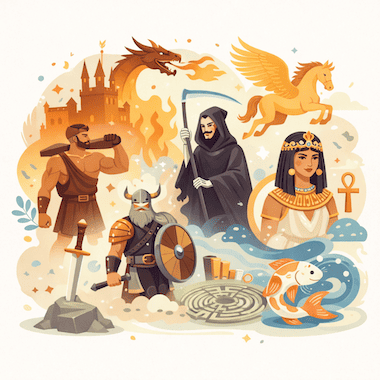
Famous Myths and Legends
Mitos y leyendas famosos
 Learn EnglishApp gratis con audio, tests y libros reales
Palabras clave
- mythmito
- legendleyenda
- immortalityinmortalidad
- deitydeidad
- underworldinframundo
- archetypearquetipo
- flooddiluvio
- tricksterembaucador
- questbúsqueda
- mortalmortal
- allegoryalegoría
- serpentserpiente
Ver las 30 palabras
- epicépica
- prophecyprofecía
- demigodsemidiós
- vengeancevenganza
- creationcreación
- tragedytragedia
- rebirthrenacimiento
- griefduelo
- wisdomsabiduría
- cyclicalcíclico
- chivalrycaballería
- psychepsique
- narrativenarrativa
- monstermonstruo
- heroicheroico
- eclipseeclipse
- cunningastucia
- mortalitymortalidad
Long before anyone wrote down laws or history, people told stories. Every culture we know of has its myths and legends: tales about how the world began, why people suffer and die, and where the first fire or the first rain came from. These stories entertained, but they also held communities together, passed on rules and beliefs, and gave people a shared picture of the world.
Mucho antes de que nadie pusiera por escrito leyes o historia, la gente contaba historias. Todas las culturas que conocemos tienen sus mitos y leyendas: relatos sobre cómo empezó el mundo, por qué las personas sufren y mueren, y de dónde vinieron el primer fuego o la primera lluvia. Estas historias entretenían, pero también mantenían unidas a las comunidades, transmitían normas y creencias y daban a la gente una imagen compartida del mundo.
Myths say a lot about the people who told them. They deal with questions that every generation asks again: Where did the world come from? Why do we suffer? What happens after death? How should we treat each other? Myths are not failed attempts at science. They are serious, often clever ways of making sense of human life, and reading the myths of other cultures is one of the best ways to understand those cultures.
Los mitos dicen mucho de los pueblos que los contaban. Tratan preguntas que cada generación vuelve a hacerse: ¿De dónde viene el mundo? ¿Por qué sufrimos? ¿Qué pasa después de la muerte? ¿Cómo debemos tratarnos unos a otros? Los mitos no son intentos fallidos de hacer ciencia. Son formas serias, a menudo ingeniosas, de dar sentido a la vida humana, y leer los mitos de otras culturas es una de las mejores maneras de entender esas culturas.
The Epic of Gilgamesh: One of the Oldest Stories
La epopeya de Gilgamesh: una de las historias más antiguas
The first poems about Gilgamesh were written in Sumerian on clay tablets in Mesopotamia around 2100 BCE, which makes them some of the oldest literature we have. The best-known version, in the Akkadian language, dates from about 1200 BCE. Gilgamesh, king of the city of Uruk, is two-thirds god and one-third human. When his closest friend Enkidu dies, Gilgamesh is overwhelmed by grief and by fear of his own death, and he sets out to find the secret of eternal life.
Los primeros poemas sobre Gilgamesh se escribieron en sumerio sobre tablillas de arcilla en Mesopotamia hacia el 2100 a. C., lo que los convierte en una de las obras literarias más antiguas que conservamos. La versión más conocida, en lengua acadia, data de hacia el 1200 a. C. Gilgamesh, rey de la ciudad de Uruk, es dos tercios dios y un tercio humano. Cuando muere su mejor amigo, Enkidu, Gilgamesh queda destrozado por el dolor y por el miedo a su propia muerte, y parte en busca del secreto de la vida eterna.
His journey takes him to the edge of the world, to Utnapishtim, a man the gods made immortal after he survived a great flood. The flood story is so close to the later Biblical account of Noah that scholars believe the two are related. Utnapishtim cannot give Gilgamesh eternal life, but he tells him about a plant at the bottom of the sea that makes old people young again. Gilgamesh dives down and gets it, but on the way home he stops to bathe in a pool, and a snake carries the plant away. He returns to Uruk with nothing. The epic ends with Gilgamesh showing a companion the great walls of his city, the work that will outlast him. Storytellers have returned to the search for immortality, and its failure, ever since.
Su viaje lo lleva al confín del mundo, hasta Utnapishtim, un hombre al que los dioses hicieron inmortal después de que sobreviviera a un gran diluvio. Este relato del diluvio se parece tanto al posterior relato bíblico de Noé que los estudiosos creen que ambos están relacionados. Utnapishtim no puede darle la vida eterna a Gilgamesh, pero le habla de una planta del fondo del mar que devuelve la juventud a los ancianos. Gilgamesh se sumerge y la consigue, pero en el camino de vuelta se detiene a bañarse en un estanque y una serpiente se lleva la planta. Regresa a Uruk con las manos vacías. La epopeya termina con Gilgamesh mostrando a un compañero las grandes murallas de su ciudad, la obra que lo sobrevivirá. Desde entonces, los narradores no han dejado de volver a la búsqueda de la inmortalidad y a su fracaso.
Greek Mythology: Gods Who Behave Like Humans
Mitología griega: dioses que se comportan como humanos
What sets Greek mythology apart is how human its gods are. The gods of Mount Olympus were not perfectly good or all-knowing. They were jealous, vain and quick to take revenge, and they could be cruel as well as generous and loving. Zeus was constantly unfaithful to his wife, Hera, and Hera often punished the women he seduced instead of Zeus himself. The heroes were no better: in the Iliad, Achilles refuses to fight for the Greeks because King Agamemnon has taken away a woman he had won. These are ordinary human faults on a huge scale.
Lo que distingue a la mitología griega es lo humanos que son sus dioses. Los dioses del monte Olimpo no eran perfectamente buenos ni lo sabían todo. Eran celosos, vanidosos y rápidos en vengarse, y podían ser tan crueles como generosos y cariñosos. Zeus engañaba constantemente a su esposa, Hera, y Hera a menudo castigaba a las mujeres que él seducía en lugar de castigar al propio Zeus. Los héroes no eran mejores: en la Ilíada, Aquiles se niega a luchar por los griegos porque el rey Agamenón le ha quitado una mujer que él había ganado como botín. Son defectos humanos corrientes a una escala enorme.
Because of this, Greek myths are full of psychology and moral questions. Sigmund Freud used the story of Oedipus, who unknowingly kills his father and marries his mother, to describe what he called the Oedipus complex. The beautiful young Narcissus, who fell in love with his own reflection, gave us the word “narcissism.” Prometheus stole fire from the gods and gave it to humans. As punishment, Zeus had him chained to a rock, where an eagle ate his liver every day, until the hero Heracles finally set him free. In Western art and literature, Prometheus became the classic image of the rebel who defies power to help others.
Por eso los mitos griegos están llenos de psicología y de preguntas morales. Sigmund Freud se sirvió de la historia de Edipo, que sin saberlo mata a su padre y se casa con su madre, para describir lo que llamó complejo de Edipo. El bello joven Narciso, que se enamoró de su propio reflejo, nos dejó la palabra «narcisismo». Prometeo robó el fuego a los dioses y se lo dio a los humanos. Como castigo, Zeus lo hizo encadenar a una roca, donde un águila le comía el hígado cada día, hasta que el héroe Heracles por fin lo liberó. En el arte y la literatura de Occidente, Prometeo se convirtió en la imagen clásica del rebelde que desafía al poder para ayudar a los demás.
Norse Mythology: A World Built to End
Mitología nórdica: un mundo hecho para terminar
Norse mythology was the religion of Scandinavia in the Viking Age. Most of what we know about it comes from Icelandic texts written down in the 13th century, about two hundred years after Iceland became Christian. Its most unusual feature is that the gods know they are going to lose. At Ragnarök, the “fate of the gods,” the world tree Yggdrasil will shake, monsters will break free, and the gods will die in a final battle. Odin will be swallowed by the giant wolf Fenrir. Thor will kill the world serpent Jörmungandr, take nine steps, and fall dead from its poison.
La mitología nórdica era la religión de Escandinavia en la era vikinga. Casi todo lo que sabemos de ella procede de textos islandeses escritos en el siglo XIII, unos doscientos años después de que Islandia se hiciera cristiana. Su rasgo más insólito es que los dioses saben que van a perder. En el Ragnarök, el «destino de los dioses», el árbol del mundo Yggdrasil temblará, los monstruos se soltarán y los dioses morirán en una batalla final. Odín será devorado por el lobo gigante Fenrir. Thor matará a la serpiente del mundo, Jörmungandr, dará nueve pasos y caerá muerto por su veneno.
Knowing the end does not make the Norse gods give up. They prepare for the battle anyway, and Odin gathers the bravest dead warriors in his hall, Valhalla, to fight beside him on the last day. The myths do not end in complete darkness either: after Ragnarök a new, green earth rises from the sea, and a few gods and two humans survive to begin again. The same Germanic gods, under their Old English names, gave English four days of the week: Tuesday is named after Tiw (the Norse Tyr), Wednesday after Woden (Odin), Thursday after Thunor (Thor), and Friday after Frig (Frigg).
Conocer el final no hace que los dioses nórdicos se rindan. Aun así se preparan para la batalla, y Odín reúne en su salón, el Valhalla, a los guerreros muertos más valientes para que luchen a su lado el último día. Los mitos tampoco terminan en la oscuridad total: después del Ragnarök surge del mar una tierra nueva y verde, y unos pocos dioses y dos humanos sobreviven para empezar de nuevo. Estos mismos dioses germánicos, con sus nombres en inglés antiguo, dieron al inglés cuatro días de la semana: Tuesday lleva el nombre de Tiw (el Tyr nórdico), Wednesday el de Woden (Odín), Thursday el de Thunor (Thor) y Friday el de Frig (Frigg).
The Legend of King Arthur: History or Myth?
La leyenda del rey Arturo: ¿historia o mito?
Few legends have lasted in the Western world as long as the story of King Arthur: the boy who pulled a sword from a stone, gathered the Knights of the Round Table, sent them in search of the Holy Grail, and ruled at Camelot until his kingdom fell apart. The legend has been told for more than a thousand years, and every age has retold it in its own way.
Pocas leyendas han durado tanto en el mundo occidental como la historia del rey Arturo: el muchacho que sacó una espada de una piedra, reunió a los caballeros de la Mesa Redonda, los envió en busca del Santo Grial y reinó en Camelot hasta que su reino se derrumbó. La leyenda se cuenta desde hace más de mil años, y cada época la ha contado a su manera.
Whether a real Arthur ever lived is still debated. A Latin history from the 9th century and some early Welsh poems mention a war leader called Arthur who fought against Saxon invaders of Britain around the year 500. Most of the famous legend, however, came later. In about 1136, Geoffrey of Monmouth wrote a “history” of the kings of Britain that gave Arthur his sword, his queen Guinevere and the wizard Merlin. The French poet Chrétien de Troyes added Lancelot and the Grail in the late 12th century, and in 1485 the English writer Thomas Malory collected the stories in Le Morte d'Arthur. Arthur is less a historical person than a picture onto which each generation paints its own idea of a good king.
Si existió un Arturo real sigue siendo objeto de debate. Una historia en latín del siglo IX y algunos poemas galeses antiguos mencionan a un caudillo llamado Arturo que luchó contra los invasores sajones de Britania hacia el año 500. Sin embargo, la mayor parte de la famosa leyenda llegó después. Hacia 1136, Godofredo de Monmouth escribió una «historia» de los reyes de Britania que le dio a Arturo su espada, su reina Ginebra y el mago Merlín. El poeta francés Chrétien de Troyes añadió a Lancelot y el Grial a finales del siglo XII, y en 1485 el escritor inglés Thomas Malory reunió los relatos en La muerte de Arturo. Arturo es menos un personaje histórico que un lienzo sobre el que cada generación pinta su propia idea de un buen rey.
Myths from the Americas: The Popol Vuh
Mitos de América: el Popol Vuh
The Popol Vuh is the sacred book of the K'iche' Maya of Guatemala. It was written down in the K'iche' language with Latin letters in the 16th century, a few decades after the Spanish conquest, and the copy that survives was made by a Spanish priest around 1701. It tells how the gods tried several times to make beings who could speak and honor them. The animals could only screech and howl. People made of mud fell apart, and people made of wood had no hearts or minds. Only the fourth attempt worked: humans made from maize dough. For the Maya, maize was not just food; it was what people themselves were made of.
El Popol Vuh es el libro sagrado de los mayas k'iche' de Guatemala. Se escribió en el siglo XVI, pocas décadas después de la conquista española, en lengua k'iche' y con letras latinas, y la copia que se conserva la hizo un sacerdote español hacia 1701. Cuenta cómo los dioses intentaron varias veces crear seres que pudieran hablar y honrarlos. Los animales solo sabían chillar y aullar. Los hombres de barro se deshicieron, y los de madera no tenían corazón ni entendimiento. Solo el cuarto intento salió bien: seres humanos hechos de masa de maíz. Para los mayas, el maíz no era solo alimento, sino la materia misma de la que estaban hechas las personas.
The Popol Vuh also tells the story of the Hero Twins, Hunahpu and Xbalanque. They go down into Xibalba, the underworld, play a dangerous ball game against its lords of death, and defeat them with tricks rather than strength. At one point they even let themselves be killed and then come back to life. In the end, the twins rise into the sky and become the Sun and the Moon. The story is about death and rebirth and about cleverness beating brute force, ideas that appear in myths all over the world.
El Popol Vuh también narra la historia de los Gemelos Héroes, Hunahpú e Ixbalanqué. Bajan a Xibalbá, el inframundo, juegan un peligroso juego de pelota contra sus señores de la muerte y los vencen con astucia, no con fuerza. En un momento llegan incluso a dejarse matar para después volver a la vida. Al final, los gemelos suben al cielo y se convierten en el Sol y la Luna. La historia trata de la muerte y el renacimiento, y de la inteligencia que vence a la fuerza bruta, ideas que aparecen en mitos de todo el mundo.
African Mythology: Anansi the Spider
Mitología africana: Anansi, la araña
Anansi, a trickster in the shape of a spider, is one of the best-known characters in West African folklore. His stories come from the Akan people of present-day Ghana. In one famous tale, all the stories in the world belong to the sky god Nyame. Anansi asks to buy them, and Nyame sets a price that seems impossible: Anansi must bring him a python, a leopard, a swarm of hornets and a fairy. Using only tricks, Anansi captures all four, and since then the stories have been called Anansi's stories.
Anansi, un pícaro embaucador con forma de araña, es uno de los personajes más conocidos del folclore de África occidental. Sus historias proceden del pueblo akan, en la actual Ghana. En un cuento famoso, todas las historias del mundo pertenecen al dios del cielo, Nyame. Anansi pide comprarlas, y Nyame le pone un precio que parece imposible: Anansi tiene que traerle una pitón, un leopardo, un enjambre de avispones y un hada. Solo con engaños, Anansi atrapa a los cuatro, y desde entonces las historias se llaman las historias de Anansi.
Enslaved Africans carried the Anansi stories across the Atlantic. They took root in Jamaica and other parts of the Caribbean and in the American South, where the spider sometimes became “Aunt Nancy.” The tales changed over time, but Anansi stayed the same: a small, weak creature who beats the powerful by using his head. For people who had no power and no rights, his victories were more than entertainment. Today Anansi also appears in modern fiction, for example in Neil Gaiman's novel Anansi Boys (2005).
Los africanos esclavizados llevaron las historias de Anansi al otro lado del Atlántico. Arraigaron en Jamaica y en otras partes del Caribe, y en el sur de Estados Unidos, donde la araña se convirtió a veces en «Aunt Nancy» (tía Nancy). Los cuentos cambiaron con el tiempo, pero Anansi siguió siendo el mismo: una criatura pequeña y débil que vence a los poderosos usando la cabeza. Para personas sin poder ni derechos, sus victorias eran más que un entretenimiento. Hoy Anansi aparece también en la ficción moderna, por ejemplo en la novela de Neil Gaiman Los hijos de Anansi (2005).
Shared Themes in World Myths
Temas comunes en los mitos del mundo
Scholars who compare myths have found that many themes appear in cultures far apart from each other. Flood stories are a good example. The Mesopotamian flood of Utnapishtim and the Biblical flood of Noah are probably related, but similar tales exist in India, where the god Vishnu warns the first man, Manu; in Greece, where Deucalion and his wife survive in a wooden chest; and in Aztec Mexico. Trickster figures appear on almost every continent too: clever troublemakers like Anansi, the Norse Loki or Coyote in many Native American tales, who break the rules and make fun of the powerful.
Los estudiosos que comparan mitos han descubierto que muchos temas aparecen en culturas muy alejadas entre sí. Los relatos de diluvios son un buen ejemplo. El diluvio mesopotámico de Utnapishtim y el diluvio bíblico de Noé probablemente están relacionados, pero hay relatos parecidos en la India, donde el dios Visnú advierte al primer hombre, Manu; en Grecia, donde Deucalión y su esposa sobreviven en un arcón de madera; y en el México azteca. También hay personajes embaucadores en casi todos los continentes: alborotadores astutos como Anansi, el nórdico Loki o Coyote en muchos relatos de los pueblos indígenas de Norteamérica, que rompen las reglas y se burlan de los poderosos.
The psychologist Carl Jung explained these repeated patterns with his idea of archetypes: basic images and types of story that, he believed, all humans share deep in the unconscious mind. Many scholars today doubt Jung's theory and point to trade, migration and common human experience instead. Whatever the reason, people separated by oceans and thousands of years have told similar stories about floods, heroes, creation and death, perhaps because they all faced the same things: love, loss, fear and the wish to understand their place in the world.
El psicólogo Carl Jung explicó estos patrones repetidos con su idea de los arquetipos: imágenes y tipos de relato básicos que, según él, todos los seres humanos compartimos en lo más hondo del inconsciente. Hoy muchos estudiosos dudan de la teoría de Jung y señalan, en cambio, el comercio, las migraciones y la experiencia humana común. Sea cual sea la razón, pueblos separados por océanos y por miles de años han contado historias parecidas sobre diluvios, héroes, la creación y la muerte, quizá porque todos se enfrentaban a lo mismo: el amor, la pérdida, el miedo y el deseo de entender su lugar en el mundo.
Quick Facts About Myths
Datos breves sobre los mitos
The word “mythology” comes from the Greek mythos (story) and logos (word, study). In Greek it meant “telling stories”; today it also means the study of myths.
La palabra «mitología» viene del griego mythos (relato) y logos (palabra, estudio). En griego significaba «contar historias»; hoy también designa el estudio de los mitos.
The ancient Olympic Games were held at Olympia in honor of Zeus. The modern Games, first held in Athens in 1896, were inspired by them.
Los antiguos Juegos Olímpicos se celebraban en Olimpia en honor de Zeus. Los Juegos modernos, celebrados por primera vez en Atenas en 1896, se inspiraron en ellos.
Atlantis first appears in two dialogues by the Greek philosopher Plato, written around 360 BCE. Most scholars believe Plato made it up to illustrate his ideas.
La Atlántida aparece por primera vez en dos diálogos del filósofo griego Platón, escritos hacia el 360 a. C. La mayoría de los estudiosos cree que Platón la inventó para ilustrar sus ideas.
In the Japanese myth of Amaterasu, the sun goddess hides in a cave and the world goes dark. Some scholars think the story may remember a real solar eclipse.
En el mito japonés de Amaterasu, la diosa del sol se esconde en una cueva y el mundo se queda a oscuras. Algunos estudiosos creen que el relato podría recordar un eclipse solar real.
The Polynesian trickster Maui is said to have pulled islands out of the sea with a magic fishhook. In Māori tradition, New Zealand's North Island is the fish he caught.
Se dice que Maui, el embaucador de la mitología polinesia, sacó islas del mar con un anzuelo mágico. Según la tradición maorí, la Isla Norte de Nueva Zelanda es el pez que pescó.
Folklorists have recorded hundreds of versions of the Cinderella story around the world. One of the oldest is the Chinese tale of Ye Xian, written down in the 9th century.
Los folcloristas han recogido cientos de versiones de la historia de Cenicienta en todo el mundo. Una de las más antiguas es el cuento chino de Ye Xian, puesto por escrito en el siglo IX.
Why Myths Last
Por qué perduran los mitos
Myths and legends have outlived empires, burned libraries and even the religions that first told them. They survive because they deal with things that do not change: who we are, where we came from and how we should live.
Los mitos y las leyendas han sobrevivido a imperios, a bibliotecas quemadas e incluso a las religiones que los contaron primero. Perduran porque tratan de cosas que no cambian: quiénes somos, de dónde venimos y cómo debemos vivir.
Gilgamesh still grieves for his friend, Prometheus still steals fire, Anansi still tricks the sky god, and the Hero Twins still outwit the lords of the underworld. These stories are not true as history, and they do not need to be. People keep retelling them because they still recognize themselves in them.
Gilgamesh sigue llorando a su amigo, Prometeo sigue robando el fuego, Anansi sigue engañando al dios del cielo y los Gemelos Héroes siguen burlando a los señores del inframundo. Estas historias no son ciertas como historia, y no necesitan serlo. La gente sigue contándolas porque todavía se reconoce en ellas.
En la app gratuita puedes escuchar este texto en voz alta y tocar cualquier palabra para ver qué significa.