Natural Wonders and How They Work
Maravillas naturales y cómo se producen
 Learn EnglishApp gratis con audio, tests y libros reales
Palabras clave
- auroraaurora
- bioluminescencebioluminiscencia
- solar windviento solar
- atmosphereatmósfera
- migrationmigración
- static electricityelectricidad estática
- glacierglaciar
- eruptionerupción
- sedimentsedimento
- plasmaplasma
- condensationcondensación
- phenomenonfenómeno
Ver las 30 palabras
- organismorganismo
- magnetic fieldcampo magnético
- folklorefolclore
- aweasombro
- lakebedlecho lacustre
- particlepartícula
- stationaryestacionario
- habitathábitat
- compassbrújula
- thunderstormtormenta eléctrica
- mineralmineral
- synchronizedsincronizado
- spectrographicespectrográfico
- etherealetéreo
- anxietyansiedad
- intricateintrincado
- spectacularespectacular
- isolatedaislado
Some things in nature look so strange that they feel like magic, even when you know the science behind them. Green curtains of light ripple across Arctic skies. Waves glow bright blue on a dark beach. Smooth, saucer-shaped clouds hang perfectly still above a mountain. In one California desert, heavy stones slide across a dry lakebed and leave long tracks behind them.
Algunas cosas de la naturaleza parecen tan extrañas que dan la impresión de ser magia, incluso cuando se conoce la ciencia que las explica. Cortinas de luz verde ondean en los cielos árticos. Las olas brillan de un azul intenso en una playa a oscuras. Nubes lisas, con forma de platillo, se quedan completamente quietas sobre una montaña. Y en un desierto de California, unas piedras pesadas se deslizan por el lecho de un lago seco y dejan largas huellas tras de sí.
None of this is a miracle. Every one of these events follows the same laws of physics, chemistry and biology as the rest of nature. Knowing how they work doesn't spoil them, though. For many people it makes them even more impressive. Here are some of the most spectacular natural phenomena on Earth and what causes them.
Nada de esto es un milagro. Cada uno de estos fenómenos obedece a las mismas leyes de la física, la química y la biología que el resto de la naturaleza. Aun así, saber cómo funcionan no les quita el encanto. A mucha gente, de hecho, le resultan todavía más impresionantes. Estos son algunos de los fenómenos naturales más espectaculares de la Tierra y lo que los provoca.
The Northern Lights: Curtains in the Sky
La aurora boreal: cortinas en el cielo
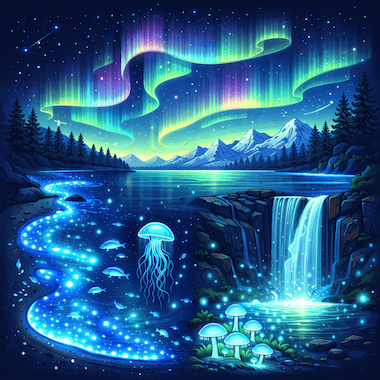
The aurora borealis, or northern lights, is probably the most famous light show in nature. Waves of green, pink and violet light ripple across the night sky in a wide ring around the North Pole, over places like northern Norway, Iceland, Alaska and northern Canada. For centuries the lights have shaped local legends, and today thousands of tourists travel north every winter just to see them.
La aurora boreal es probablemente el espectáculo de luz más famoso de la naturaleza. Ondas de luz verde, rosa y violeta recorren el cielo nocturno en un amplio anillo alrededor del Polo Norte, sobre lugares como el norte de Noruega, Islandia, Alaska y el norte de Canadá. Durante siglos, estas luces han inspirado leyendas locales, y hoy miles de turistas viajan al norte cada invierno solo para verlas.
The aurora begins with the Sun, which constantly sends out a stream of charged particles called the solar wind. Earth's magnetic field steers some of these particles toward the polar regions. There they crash into gases high in the atmosphere, mostly 100 to 300 kilometers up, and make them give off light. Oxygen glows green or red, while nitrogen adds blue and purple. When the Sun is very active, the aurora spreads much farther from the poles: in May 2024, people saw it as far south as Italy and Texas. The Southern Hemisphere has its own version, the aurora australis, or southern lights.
La aurora empieza en el Sol, que emite sin cesar una corriente de partículas cargadas llamada viento solar. El campo magnético de la Tierra dirige parte de esas partículas hacia las regiones polares. Allí chocan con los gases de la alta atmósfera, sobre todo entre 100 y 300 kilómetros de altura, y hacen que emitan luz. El oxígeno brilla en verde o rojo, mientras que el nitrógeno aporta tonos azules y morados. Cuando el Sol está muy activo, la aurora se extiende mucho más lejos de los polos: en mayo de 2024 se vio incluso en Italia y en Texas. El hemisferio sur tiene su propia versión, la aurora austral.
Bioluminescence: The Glowing Sea
Bioluminiscencia: el mar que brilla
On some nights, the waves breaking on a beach glow an electric blue-green. Move your hand through the water and it leaves a trail of cold, ghostly light. This is bioluminescence, light made by living things. It is far more common than most people realize, but most of it happens where nobody sees it, in the darkness of the deep ocean.
Algunas noches, las olas que rompen en la playa brillan con un azul verdoso eléctrico. Si mueves la mano por el agua, deja una estela de luz fría y fantasmal. Es la bioluminiscencia, la luz que producen los seres vivos. Es mucho más común de lo que la mayoría cree, pero casi toda ocurre donde nadie la ve, en la oscuridad del océano profundo.
The glowing waves are usually caused by dinoflagellates, tiny single-celled plankton that flash blue when the water around them moves. The light comes from a chemical reaction: a molecule called luciferin reacts with oxygen, helped by an enzyme called luciferase. Jellyfish, squid and many deep-sea fish make light too, and so do fireflies on land. A 2017 study off the coast of California found that about three quarters of the animals living in the open ocean can glow. They use light to find food, attract mates and confuse predators. Mosquito Bay in Puerto Rico and Vaadhoo Island in the Maldives are famous for their glowing water.
Las olas luminosas suelen deberse a los dinoflagelados, un plancton diminuto de una sola célula que emite destellos azules cuando el agua se mueve a su alrededor. La luz procede de una reacción química: una molécula llamada luciferina reacciona con el oxígeno gracias a una enzima llamada luciferasa. Las medusas, los calamares y muchos peces de las profundidades también producen luz, igual que las luciérnagas en tierra firme. Un estudio realizado en 2017 frente a la costa de California descubrió que alrededor de tres cuartas partes de los animales que viven en mar abierto pueden brillar. Usan la luz para encontrar alimento, atraer pareja y confundir a sus depredadores. Mosquito Bay, en Puerto Rico, y la isla de Vaadhoo, en las Maldivas, son famosas por sus aguas luminosas.
Ball Lightning: Still a Mystery
Los rayos en bola: un misterio sin resolver
Ball lightning is the strangest and least understood event in our weather. For centuries, people have described glowing balls of light, anywhere from the size of a golf ball to the size of a beach ball, that appear during thunderstorms. They float through the air for a few seconds, sometimes drift into rooms or even pass through windows, and then either fade quietly or disappear with a loud bang.
El rayo en bola es el fenómeno meteorológico más extraño y peor comprendido. Desde hace siglos, hay testigos que describen bolas de luz, desde el tamaño de una pelota de golf hasta el de un balón de playa, que aparecen durante las tormentas. Flotan en el aire unos segundos, a veces entran en una habitación o incluso atraviesan una ventana, y después se apagan en silencio o desaparecen con un fuerte estallido.
Because it is rare and lasts only seconds, ball lightning was very hard to study, and some scientists doubted that it existed at all. Then, in 2012, Chinese researchers who were studying ordinary lightning on the Tibetan Plateau happened to record a glowing ball with their cameras and instruments. It shone for about a second and a half, and its light showed silicon, iron and calcium, elements found in soil. This supports a popular theory: a lightning strike turns soil into hot vapor, and that cloud glows as it burns. Other theories involve plasma or microwaves, and scientists still don't agree on the cause.
Como es raro y dura solo unos segundos, el rayo en bola era muy difícil de estudiar, y algunos científicos dudaban incluso de que existiera. Pero en 2012, unos investigadores chinos que estudiaban rayos corrientes en la meseta del Tíbet grabaron por casualidad una bola luminosa con sus cámaras e instrumentos. Brilló durante segundo y medio, y su luz mostraba silicio, hierro y calcio, elementos que se encuentran en el suelo. Esto respalda una teoría muy extendida: un rayo convierte la tierra en vapor caliente, y esa nube brilla mientras arde. Otras teorías hablan de plasma o de microondas, y los científicos aún no se ponen de acuerdo sobre la causa.
Volcanic Lightning: Fire Meets Storm
Rayos volcánicos: el fuego se encuentra con la tormenta
During some volcanic eruptions, lightning flashes through the huge cloud of ash rising from the volcano. Scientists sometimes call this a “dirty thunderstorm.” It is one of the most frightening sights in nature, and one of the oldest on record: the Roman writer Pliny the Younger described flashes like lightning in the dark cloud over Mount Vesuvius in AD 79.
En algunas erupciones volcánicas, los rayos atraviesan la enorme nube de ceniza que sale del volcán. Los científicos lo llaman a veces «tormenta sucia». Es una de las imágenes más aterradoras de la naturaleza y una de las más antiguas de las que hay registro: el escritor romano Plinio el Joven describió destellos parecidos a relámpagos en la nube oscura que cubría el Vesubio en el año 79 d. C.
The lightning comes from electric charge. Inside the ash cloud, bits of rock and ash rub and crash into each other, and if the cloud rises high enough, ice forms in it too. These collisions build up positive and negative charges in different parts of the cloud, much as in an ordinary thunderstorm, until the charge is released as lightning. Volcanic lightning has been seen over Eyjafjallajökull in Iceland in 2010, over Mount Etna in Sicily and over Sakurajima in Japan. The 2022 eruption of Hunga Tonga in the Pacific produced the most intense lightning ever recorded, with hundreds of thousands of flashes in less than a day.
Los rayos se deben a la carga eléctrica. Dentro de la nube de ceniza, los fragmentos de roca y ceniza se rozan y chocan entre sí, y si la nube sube lo suficiente, también se forma hielo. Estos choques acumulan cargas positivas y negativas en distintas partes de la nube, de forma muy parecida a lo que ocurre en una tormenta normal, hasta que la carga se libera en forma de rayo. Se han visto rayos volcánicos sobre el Eyjafjallajökull, en Islandia, en 2010, sobre el Etna, en Sicilia, y sobre el Sakurajima, en Japón. La erupción del Hunga Tonga, en el Pacífico, en 2022 produjo la actividad eléctrica más intensa jamás registrada, con cientos de miles de rayos en menos de un día.
The Sailing Stones of Death Valley
Las piedras navegantes del Valle de la Muerte
On Racetrack Playa, a dry lakebed in a remote corner of Death Valley in California, rocks sit at the ends of long tracks in the cracked mud. Some of the tracks are straight, others curve or zigzag, and some of the rocks weigh more than 300 kilograms. The tracks clearly showed that the stones moved, but for decades nobody had ever seen one move.
En Racetrack Playa, el lecho seco de un lago en un rincón remoto del Valle de la Muerte, en California, hay rocas al final de largas huellas marcadas en el barro agrietado. Algunas huellas son rectas, otras hacen curvas o zigzags, y algunas de las rocas pesan más de 300 kilos. Las huellas demostraban claramente que las piedras se movían, pero durante décadas nadie había visto moverse ninguna.
Geologists puzzled over the stones for more than 60 years. The answer finally came in December 2013, when a team using GPS trackers and time-lapse cameras caught the rocks in motion. In winter, rain and melting snow sometimes form a shallow pond on the playa. On cold nights its surface freezes into a sheet of ice only a few millimeters thick. On a sunny day the ice breaks into large floating panels, and a light wind pushes them across the water. The panels push the rocks ahead of them, a few meters per minute, and the stones leave tracks in the soft mud underneath. So the stones don't move by themselves, and they don't float: thin, almost invisible ice pushes them.
Los geólogos estuvieron más de 60 años intentando resolver el enigma. La respuesta llegó por fin en diciembre de 2013, cuando un equipo con rastreadores GPS y cámaras de lapso de tiempo captó las rocas en movimiento. En invierno, la lluvia y la nieve derretida forman a veces una charca poco profunda en la playa seca. En las noches frías, su superficie se congela en una capa de hielo de solo unos milímetros de grosor. En un día soleado, el hielo se rompe en grandes placas flotantes que un viento suave empuja por el agua. Las placas empujan las rocas por delante a unos pocos metros por minuto, y las piedras dejan huellas en el barro blando que hay debajo. Así que las piedras no se mueven solas ni flotan: las empuja un hielo fino, casi invisible.
Lenticular Clouds: Nature's UFOs
Nubes lenticulares: los ovnis de la naturaleza
Lenticular clouds, known to scientists as altocumulus lenticularis, look like something from another world. They are smooth, lens-shaped discs that hang over or just behind mountain peaks, sometimes stacked like a pile of plates. Strong winds blow all around them, yet they stay in the same place for a long time. Not surprisingly, people often report them as UFOs.
Las nubes lenticulares, que los científicos llaman altocumulus lenticularis, parecen salidas de otro mundo. Son discos lisos con forma de lente que flotan sobre las cumbres de las montañas o justo detrás de ellas, a veces apilados como un montón de platos. A su alrededor soplan vientos fuertes y, sin embargo, permanecen mucho tiempo en el mismo sitio. No es de extrañar que la gente las confunda a menudo con ovnis.
They form when a steady, moist wind blows over a mountain. The mountain pushes the air up and sets off a series of waves in the air behind it, a bit like the ripples in a stream behind a rock. Where the air rises to the top of a wave, it cools and its moisture turns into cloud. Where it sinks again, it warms up and the cloud disappears. Air keeps flowing through the cloud, but because the cloud keeps forming on one side and disappearing on the other, it seems to stand still. Lenticular clouds are often seen over lone mountains such as Mount Fuji in Japan, Mount Rainier in the United States and the Matterhorn in the Alps.
Se forman cuando un viento húmedo y constante sopla sobre una montaña. La montaña empuja el aire hacia arriba y genera detrás de ella una serie de ondas en el aire, algo parecido a las ondas que se forman en un arroyo detrás de una roca. Donde el aire sube a la cresta de una onda, se enfría y su humedad se convierte en nube. Donde vuelve a bajar, se calienta y la nube desaparece. El aire sigue atravesando la nube, pero como esta se forma sin parar por un lado y se deshace por el otro, parece inmóvil. Las nubes lenticulares se ven a menudo sobre montañas aisladas como el monte Fuji en Japón, el monte Rainier en Estados Unidos y el Cervino en los Alpes.
The Monarch Butterfly Migration
La migración de la mariposa monarca
Every fall, hundreds of millions of monarch butterflies fly south from Canada and the northern United States. Some travel more than 4,000 kilometers to reach the fir forests in the mountains of central Mexico. There they spend the winter packed together on the trees in such huge numbers that their weight can bend the branches.
Cada otoño, cientos de millones de mariposas monarca vuelan hacia el sur desde Canadá y el norte de Estados Unidos. Algunas recorren más de 4.000 kilómetros para llegar a los bosques de oyamel de las montañas del centro de México. Allí pasan el invierno apiñadas en los árboles, en cantidades tan enormes que su peso puede doblar las ramas.
The strangest part is that no single butterfly makes the whole round trip. The monarchs that leave Mexico in spring lay eggs in the southern United States and die. Their young continue north, and only after three or four generations does a new generation fly all the way back. So the butterflies that arrive in Mexico each fall have never been there before: they are usually the great-great-grandchildren of the ones that left. Scientists believe they find their way with a sun compass, corrected for the time of day by a clock in their antennae, and they may also sense Earth's magnetic field. How an insect with such a tiny brain finds a small patch of forest it has never seen is still not fully understood.
Lo más sorprendente es que ninguna mariposa hace sola el viaje completo de ida y vuelta. Las monarcas que salen de México en primavera ponen sus huevos en el sur de Estados Unidos y mueren. Sus crías siguen hacia el norte, y solo al cabo de tres o cuatro generaciones una nueva generación vuela todo el camino de vuelta. Por eso, las mariposas que llegan a México cada otoño nunca han estado allí: suelen ser las tataranietas de las que se marcharon. Los científicos creen que se orientan con una brújula solar, que un reloj situado en sus antenas ajusta según la hora del día, y que quizá también perciben el campo magnético de la Tierra. Cómo un insecto con un cerebro tan diminuto encuentra un pequeño trozo de bosque que nunca ha visto todavía no se entiende del todo.
More Wonders Worth Knowing
Otras maravillas que vale la pena conocer
Over Lake Maracaibo in Venezuela, Catatumbo lightning can flash up to 280 times an hour on about 140 to 160 nights a year, which makes the lake the place with the most lightning on Earth.
Sobre el lago de Maracaibo, en Venezuela, el relámpago del Catatumbo puede destellar hasta 280 veces por hora durante unas 140 a 160 noches al año, lo que convierte al lago en el lugar con más rayos de la Tierra.
The Zhangye Danxia landforms in China are hills striped in red, orange and yellow, made of layers of sandstone that built up over millions of years and were later folded by moving tectonic plates.
El relieve de Danxia en Zhangye, China, está formado por colinas con franjas rojas, naranjas y amarillas, hechas de capas de arenisca que se acumularon durante millones de años y que luego plegó el movimiento de las placas tectónicas.
Frost flowers are delicate ice crystals that grow on thin, new sea ice in the polar regions, forming feathery shapes up to about four centimeters tall.
Las flores de escarcha son delicados cristales de hielo que crecen sobre el hielo marino joven y fino de las regiones polares y forman figuras plumosas de hasta unos cuatro centímetros de altura.
Spotted Lake (Kliluk) in British Columbia, Canada, turns into a patchwork of colorful pools each summer as its water evaporates and leaves behind minerals such as magnesium sulfate.
El lago Spotted (Kliluk), en la Columbia Británica, Canadá, se convierte cada verano en un mosaico de charcas de colores a medida que el agua se evapora y deja minerales como el sulfato de magnesio.
A murmuration, the swirling flight of thousands of starlings, has no leader: studies show that each bird keeps track of about seven of its nearest neighbors.
Una murmuración, el vuelo en remolino de miles de estorninos, no tiene líder: los estudios muestran que cada ave sigue a unos siete de sus vecinos más cercanos.
Blood Falls in Antarctica pours out salty water from a lake trapped under Taylor Glacier for more than a million years; the water is clear underground, but its iron rusts in the air and turns it red.
Las Blood Falls de la Antártida vierten agua salada de un lago atrapado bajo el glaciar Taylor desde hace más de un millón de años; bajo tierra el agua es transparente, pero su hierro se oxida al contacto con el aire y la tiñe de rojo.
Why Natural Wonders Matter
Por qué importan las maravillas naturales
Long before science could explain them, natural phenomena found their way into stories and beliefs. In Finnish folklore, the northern lights were sparks thrown into the sky by the tail of a fox running across the snow, and the Finnish word for them, revontulet, means “fox fires.” The Sami people of northern Scandinavia treated the lights with respect and told children not to wave or whistle at them. In Mexico, the monarchs arrive around the Day of the Dead in early November, and many people believe they carry the souls of the dead.
Mucho antes de que la ciencia pudiera explicarlos, los fenómenos naturales entraron en los relatos y las creencias. En el folclore finlandés, la aurora boreal eran chispas que un zorro lanzaba al cielo con la cola mientras corría por la nieve, y la palabra finlandesa para designarla, revontulet, significa «fuegos del zorro». El pueblo sami del norte de Escandinavia trataba estas luces con respeto y advertía a los niños que no las saludaran con la mano ni les silbaran. En México, las monarcas llegan hacia el Día de Muertos, a principios de noviembre, y mucha gente cree que traen consigo las almas de los difuntos.
These events still affect us today. Psychologists who study awe, the feeling we get in front of something so vast that we can't fully take it in, have linked it to lower stress, a stronger sense of connection to other people and more generous behavior. Standing under the aurora or on a beach full of glowing waves, many people say they feel small, but in a good way.
Estos fenómenos todavía nos afectan hoy. Los psicólogos que estudian el asombro, la emoción que sentimos ante algo tan inmenso que no podemos abarcarlo del todo, lo han relacionado con menos estrés, una mayor sensación de conexión con los demás y un comportamiento más generoso. Bajo la aurora o en una playa llena de olas luminosas, muchas personas dicen sentirse pequeñas, pero de una forma agradable.
Conclusion
Conclusión
Auroras, glowing seas, sailing stones and migrating butterflies all have scientific explanations, or at least good working theories. Some, like ball lightning, still keep part of their secret, and discoveries keep coming: the sailing stones were caught moving for the first time only in 2013.
Las auroras, los mares luminosos, las piedras navegantes y las mariposas migratorias tienen todos una explicación científica, o al menos buenas teorías de trabajo. Algunos, como el rayo en bola, todavía guardan parte de su secreto, y los descubrimientos no paran: las piedras navegantes no se vieron moverse por primera vez hasta 2013.
Science has not taken the wonder out of these events. Knowing that a butterfly steers by the Sun with the help of a clock in its antennae, or that a wave glows because of billions of tiny plankton, only makes them more interesting. Many of these sights are also easy to reach. A winter trip to the far north or a dark beach on a warm night may be enough to see one for yourself.
La ciencia no les ha quitado la magia a estos fenómenos. Saber que una mariposa se guía por el Sol con ayuda de un reloj en sus antenas, o que una ola brilla gracias a miles de millones de diminutos organismos del plancton, solo los hace más interesantes. Además, muchos de estos espectáculos son fáciles de ver. Un viaje de invierno al extremo norte o una playa oscura en una noche cálida pueden bastar para contemplar uno con tus propios ojos.
En la app gratuita puedes escuchar este texto en voz alta y tocar cualquier palabra para ver qué significa.