Natural Wonders and How They Work
As maravilhas da natureza e como acontecem
 Learn EnglishApp grátis com áudio, quizzes e livros de verdade
Palavras-chave
- auroraaurora
- bioluminescencebioluminescência
- solar windvento solar
- atmosphereatmosfera
- migrationmigração
- static electricityeletricidade estática
- glacierglaciar
- eruptionerupção
- sedimentsedimento
- plasmaplasma
- condensationcondensação
- phenomenonfenómeno
Ver as 30 palavras
- organismorganismo
- magnetic fieldcampo magnético
- folklorefolclore
- aweadmiração
- lakebedleito do lago
- particlepartícula
- stationaryestacionário
- habitathabitat
- compassbússola
- thunderstormtrovoada
- mineralmineral
- synchronizedsincronizado
- spectrographicespectrográfico
- etherealetéreo
- anxietyansiedade
- intricateintrincado
- spectacularespetacular
- isolatedisolado
Some things in nature look so strange that they feel like magic, even when you know the science behind them. Green curtains of light ripple across Arctic skies. Waves glow bright blue on a dark beach. Smooth, saucer-shaped clouds hang perfectly still above a mountain. In one California desert, heavy stones slide across a dry lakebed and leave long tracks behind them.
Há fenómenos naturais tão estranhos que parecem magia, mesmo quando se conhece a ciência que os explica. Cortinas de luz verde ondulam nos céus do Ártico. As ondas brilham num azul vivo numa praia às escuras. Nuvens lisas, em forma de disco voador, ficam perfeitamente paradas por cima de uma montanha. Num deserto da Califórnia, pedras pesadas deslizam pelo leito de um lago seco e deixam longos rastos atrás de si.
None of this is a miracle. Every one of these events follows the same laws of physics, chemistry and biology as the rest of nature. Knowing how they work doesn't spoil them, though. For many people it makes them even more impressive. Here are some of the most spectacular natural phenomena on Earth and what causes them.
Nada disto é um milagre. Cada um destes fenómenos obedece às mesmas leis da física, da química e da biologia que o resto da natureza. Ainda assim, saber como funcionam não lhes tira o encanto. Para muita gente, até os torna mais impressionantes. Eis alguns dos fenómenos naturais mais espetaculares da Terra e aquilo que os provoca.
The Northern Lights: Curtains in the Sky
A aurora boreal: cortinas no céu
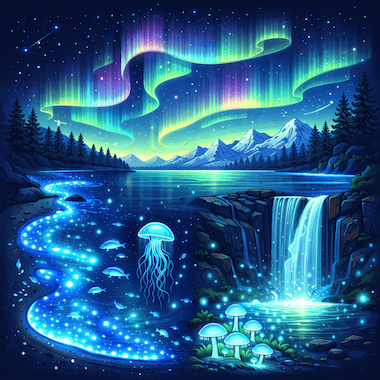
The aurora borealis, or northern lights, is probably the most famous light show in nature. Waves of green, pink and violet light ripple across the night sky in a wide ring around the North Pole, over places like northern Norway, Iceland, Alaska and northern Canada. For centuries the lights have shaped local legends, and today thousands of tourists travel north every winter just to see them.
A aurora boreal é provavelmente o espetáculo de luz mais famoso da natureza. Ondas de luz verde, cor-de-rosa e violeta percorrem o céu noturno num largo anel à volta do Polo Norte, sobre lugares como o norte da Noruega, a Islândia, o Alasca e o norte do Canadá. Há séculos que estas luzes inspiram lendas locais, e hoje milhares de turistas viajam todos os invernos para norte só para as ver.
The aurora begins with the Sun, which constantly sends out a stream of charged particles called the solar wind. Earth's magnetic field steers some of these particles toward the polar regions. There they crash into gases high in the atmosphere, mostly 100 to 300 kilometers up, and make them give off light. Oxygen glows green or red, while nitrogen adds blue and purple. When the Sun is very active, the aurora spreads much farther from the poles: in May 2024, people saw it as far south as Italy and Texas. The Southern Hemisphere has its own version, the aurora australis, or southern lights.
Tudo começa no Sol, que emite constantemente um fluxo de partículas carregadas chamado vento solar. O campo magnético da Terra encaminha parte dessas partículas para as regiões polares. Aí, chocam com os gases da alta atmosfera, sobretudo entre 100 e 300 quilómetros de altitude, e fazem-nos emitir luz. O oxigénio brilha a verde ou a vermelho, enquanto o azoto acrescenta tons de azul e roxo. Quando o Sol está muito ativo, a aurora estende-se para muito mais longe dos polos: em maio de 2024, chegou a ser vista em Itália e no Texas. O hemisfério sul tem a sua própria versão, a aurora austral.
Bioluminescence: The Glowing Sea
Bioluminescência: o mar que brilha
On some nights, the waves breaking on a beach glow an electric blue-green. Move your hand through the water and it leaves a trail of cold, ghostly light. This is bioluminescence, light made by living things. It is far more common than most people realize, but most of it happens where nobody sees it, in the darkness of the deep ocean.
Em certas noites, as ondas que rebentam na praia brilham num azul esverdeado elétrico. Se passar a mão pela água, fica um rasto de luz fria e fantasmagórica. É a bioluminescência, a luz produzida por seres vivos. É muito mais comum do que a maioria das pessoas pensa, mas quase toda acontece onde ninguém a vê, na escuridão do oceano profundo.
The glowing waves are usually caused by dinoflagellates, tiny single-celled plankton that flash blue when the water around them moves. The light comes from a chemical reaction: a molecule called luciferin reacts with oxygen, helped by an enzyme called luciferase. Jellyfish, squid and many deep-sea fish make light too, and so do fireflies on land. A 2017 study off the coast of California found that about three quarters of the animals living in the open ocean can glow. They use light to find food, attract mates and confuse predators. Mosquito Bay in Puerto Rico and Vaadhoo Island in the Maldives are famous for their glowing water.
As ondas luminosas devem-se geralmente aos dinoflagelados, plâncton minúsculo formado por uma única célula, que emite clarões azuis quando a água à sua volta se mexe. A luz resulta de uma reação química: uma molécula chamada luciferina reage com o oxigénio, com a ajuda de uma enzima chamada luciferase. As alforrecas, as lulas e muitos peixes das profundezas também produzem luz, tal como os pirilampos em terra. Um estudo feito em 2017 ao largo da Califórnia concluiu que cerca de três quartos dos animais que vivem em mar aberto conseguem brilhar. Usam a luz para encontrar alimento, atrair parceiros e confundir predadores. A Mosquito Bay, em Porto Rico, e a ilha de Vaadhoo, nas Maldivas, são famosas pelas suas águas luminosas.
Ball Lightning: Still a Mystery
Relâmpagos globulares: um mistério por resolver
Ball lightning is the strangest and least understood event in our weather. For centuries, people have described glowing balls of light, anywhere from the size of a golf ball to the size of a beach ball, that appear during thunderstorms. They float through the air for a few seconds, sometimes drift into rooms or even pass through windows, and then either fade quietly or disappear with a loud bang.
O relâmpago globular é o fenómeno meteorológico mais estranho e menos compreendido. Há séculos que testemunhas descrevem bolas de luz, do tamanho de uma bola de golfe ao de uma bola de praia, que aparecem durante trovoadas. Flutuam no ar durante alguns segundos, por vezes entram em salas ou atravessam até vidros de janelas, e depois apagam-se em silêncio ou desaparecem com um estrondo.
Because it is rare and lasts only seconds, ball lightning was very hard to study, and some scientists doubted that it existed at all. Then, in 2012, Chinese researchers who were studying ordinary lightning on the Tibetan Plateau happened to record a glowing ball with their cameras and instruments. It shone for about a second and a half, and its light showed silicon, iron and calcium, elements found in soil. This supports a popular theory: a lightning strike turns soil into hot vapor, and that cloud glows as it burns. Other theories involve plasma or microwaves, and scientists still don't agree on the cause.
Por ser raro e durar apenas alguns segundos, o relâmpago globular era muito difícil de estudar, e alguns cientistas duvidavam até que existisse. Mas, em 2012, investigadores chineses que estudavam relâmpagos comuns no planalto do Tibete registaram por acaso uma bola luminosa com as suas câmaras e instrumentos. A bola brilhou durante cerca de um segundo e meio, e a sua luz revelava silício, ferro e cálcio, elementos presentes no solo. Isto apoia uma teoria bastante difundida: um raio transforma a terra em vapor quente, e essa nuvem brilha enquanto arde. Outras teorias falam de plasma ou de micro-ondas, e os cientistas ainda não estão de acordo quanto à causa.
Volcanic Lightning: Fire Meets Storm
Relâmpagos vulcânicos: quando o fogo encontra a tempestade
During some volcanic eruptions, lightning flashes through the huge cloud of ash rising from the volcano. Scientists sometimes call this a “dirty thunderstorm.” It is one of the most frightening sights in nature, and one of the oldest on record: the Roman writer Pliny the Younger described flashes like lightning in the dark cloud over Mount Vesuvius in AD 79.
Em certas erupções, os relâmpagos atravessam a enorme nuvem de cinza que sobe do vulcão. Os cientistas chamam-lhe por vezes «trovoada suja». É uma das imagens mais assustadoras da natureza e uma das mais antigas de que há registo: o escritor romano Plínio, o Jovem, descreveu clarões semelhantes a relâmpagos na nuvem escura sobre o Vesúvio, no ano 79 d.C.
The lightning comes from electric charge. Inside the ash cloud, bits of rock and ash rub and crash into each other, and if the cloud rises high enough, ice forms in it too. These collisions build up positive and negative charges in different parts of the cloud, much as in an ordinary thunderstorm, until the charge is released as lightning. Volcanic lightning has been seen over Eyjafjallajökull in Iceland in 2010, over Mount Etna in Sicily and over Sakurajima in Japan. The 2022 eruption of Hunga Tonga in the Pacific produced the most intense lightning ever recorded, with hundreds of thousands of flashes in less than a day.
Os relâmpagos resultam de cargas elétricas. Dentro da nuvem de cinza, fragmentos de rocha e de cinza roçam e chocam uns com os outros, e se a nuvem subir o suficiente também se forma gelo. Estas colisões acumulam cargas positivas e negativas em diferentes partes da nuvem, tal como numa trovoada normal, até que a carga se liberta sob a forma de relâmpago. Já se viram relâmpagos vulcânicos sobre o Eyjafjallajökull, na Islândia, em 2010, sobre o Etna, na Sicília, e sobre o Sakurajima, no Japão. A erupção do Hunga Tonga, no Pacífico, em 2022, produziu a atividade elétrica mais intensa alguma vez registada, com centenas de milhares de relâmpagos em menos de um dia.
The Sailing Stones of Death Valley
As pedras deslizantes do Vale da Morte
On Racetrack Playa, a dry lakebed in a remote corner of Death Valley in California, rocks sit at the ends of long tracks in the cracked mud. Some of the tracks are straight, others curve or zigzag, and some of the rocks weigh more than 300 kilograms. The tracks clearly showed that the stones moved, but for decades nobody had ever seen one move.
Em Racetrack Playa, o leito seco de um lago num canto remoto do Vale da Morte, na Califórnia, há rochas no fim de longos rastos marcados na lama gretada. Alguns rastos são retos, outros fazem curvas ou ziguezagues, e algumas das rochas pesam mais de 300 quilos. Os rastos provavam claramente que as pedras se moviam, mas durante décadas ninguém tinha visto nenhuma mexer-se.
Geologists puzzled over the stones for more than 60 years. The answer finally came in December 2013, when a team using GPS trackers and time-lapse cameras caught the rocks in motion. In winter, rain and melting snow sometimes form a shallow pond on the playa. On cold nights its surface freezes into a sheet of ice only a few millimeters thick. On a sunny day the ice breaks into large floating panels, and a light wind pushes them across the water. The panels push the rocks ahead of them, a few meters per minute, and the stones leave tracks in the soft mud underneath. So the stones don't move by themselves, and they don't float: thin, almost invisible ice pushes them.
Os geólogos andaram mais de 60 anos às voltas com este enigma. A resposta chegou finalmente em dezembro de 2013, quando uma equipa com localizadores GPS e câmaras de time-lapse apanhou as rochas em movimento. No inverno, a chuva e a neve derretida formam por vezes um charco pouco fundo no leito do lago. Nas noites frias, a superfície congela numa camada de gelo com apenas alguns milímetros de espessura. Num dia de sol, o gelo parte-se em grandes placas flutuantes que um vento fraco empurra pela água. As placas empurram as rochas à sua frente, a alguns metros por minuto, e as pedras deixam rastos na lama mole por baixo. Ou seja, as pedras não se mexem sozinhas nem flutuam: quem as empurra é um gelo fino, quase invisível.
Lenticular Clouds: Nature's UFOs
Nuvens lenticulares: os OVNIs da natureza
Lenticular clouds, known to scientists as altocumulus lenticularis, look like something from another world. They are smooth, lens-shaped discs that hang over or just behind mountain peaks, sometimes stacked like a pile of plates. Strong winds blow all around them, yet they stay in the same place for a long time. Not surprisingly, people often report them as UFOs.
As nuvens lenticulares, a que os cientistas chamam altocumulus lenticularis, parecem vindas de outro mundo. São discos lisos em forma de lente, suspensos por cima dos cumes das montanhas ou logo atrás deles, por vezes empilhados como uma pilha de pratos. À sua volta sopram ventos fortes e, no entanto, ficam muito tempo no mesmo sítio. Não admira que sejam muitas vezes confundidas com OVNIs.
They form when a steady, moist wind blows over a mountain. The mountain pushes the air up and sets off a series of waves in the air behind it, a bit like the ripples in a stream behind a rock. Where the air rises to the top of a wave, it cools and its moisture turns into cloud. Where it sinks again, it warms up and the cloud disappears. Air keeps flowing through the cloud, but because the cloud keeps forming on one side and disappearing on the other, it seems to stand still. Lenticular clouds are often seen over lone mountains such as Mount Fuji in Japan, Mount Rainier in the United States and the Matterhorn in the Alps.
Formam-se quando um vento húmido e constante sopra por cima de uma montanha. A montanha empurra o ar para cima e cria atrás de si uma série de ondas no ar, um pouco como as ondulações de um ribeiro atrás de uma pedra. Onde o ar sobe até à crista de uma onda, arrefece e a sua humidade transforma-se em nuvem. Onde volta a descer, aquece e a nuvem desaparece. O ar continua a atravessar a nuvem, mas como esta se forma sem parar de um lado e se desfaz do outro, parece imóvel. As nuvens lenticulares veem-se muitas vezes sobre montanhas isoladas como o monte Fuji, no Japão, o monte Rainier, nos Estados Unidos, e o Matterhorn, nos Alpes.
The Monarch Butterfly Migration
A migração das borboletas-monarca
Every fall, hundreds of millions of monarch butterflies fly south from Canada and the northern United States. Some travel more than 4,000 kilometers to reach the fir forests in the mountains of central Mexico. There they spend the winter packed together on the trees in such huge numbers that their weight can bend the branches.
Todos os outonos, centenas de milhões de borboletas-monarca voam para sul a partir do Canadá e do norte dos Estados Unidos. Algumas percorrem mais de 4000 quilómetros para chegar às florestas de abetos das montanhas do centro do México. Aí passam o inverno amontoadas nas árvores, em números tão grandes que o seu peso pode vergar os ramos.
The strangest part is that no single butterfly makes the whole round trip. The monarchs that leave Mexico in spring lay eggs in the southern United States and die. Their young continue north, and only after three or four generations does a new generation fly all the way back. So the butterflies that arrive in Mexico each fall have never been there before: they are usually the great-great-grandchildren of the ones that left. Scientists believe they find their way with a sun compass, corrected for the time of day by a clock in their antennae, and they may also sense Earth's magnetic field. How an insect with such a tiny brain finds a small patch of forest it has never seen is still not fully understood.
O mais surpreendente é que nenhuma borboleta faz sozinha a viagem completa de ida e volta. As monarcas que saem do México na primavera põem ovos no sul dos Estados Unidos e morrem. As suas crias continuam para norte, e só ao fim de três ou quatro gerações é que uma nova geração faz todo o caminho de regresso. Por isso, as borboletas que chegam ao México em cada outono nunca lá estiveram: costumam ser as trinetas das que partiram. Os cientistas pensam que se orientam por uma bússola solar, acertada segundo a hora do dia por um relógio nas antenas, e que talvez também sintam o campo magnético da Terra. Como é que um inseto com um cérebro tão minúsculo encontra um pequeno pedaço de floresta que nunca viu continua a não estar totalmente explicado.
More Wonders Worth Knowing
Outras maravilhas que vale a pena conhecer
Over Lake Maracaibo in Venezuela, Catatumbo lightning can flash up to 280 times an hour on about 140 to 160 nights a year, which makes the lake the place with the most lightning on Earth.
Sobre o lago de Maracaibo, na Venezuela, o relâmpago do Catatumbo pode cair até 280 vezes por hora em cerca de 140 a 160 noites por ano, o que faz do lago o lugar com mais relâmpagos da Terra.
The Zhangye Danxia landforms in China are hills striped in red, orange and yellow, made of layers of sandstone that built up over millions of years and were later folded by moving tectonic plates.
O relevo Danxia de Zhangye, na China, é formado por colinas às riscas vermelhas, laranja e amarelas, feitas de camadas de arenito que se acumularam ao longo de milhões de anos e foram depois dobradas pelo movimento das placas tectónicas.
Frost flowers are delicate ice crystals that grow on thin, new sea ice in the polar regions, forming feathery shapes up to about four centimeters tall.
As flores de gelo são delicados cristais que crescem sobre o gelo marinho jovem e fino das regiões polares, formando estruturas plumosas com até cerca de quatro centímetros de altura.
Spotted Lake (Kliluk) in British Columbia, Canada, turns into a patchwork of colorful pools each summer as its water evaporates and leaves behind minerals such as magnesium sulfate.
O Spotted Lake (Kliluk), na Colúmbia Britânica, no Canadá, transforma-se todos os verões num mosaico de poças coloridas à medida que a água evapora e deixa minerais como o sulfato de magnésio.
A murmuration, the swirling flight of thousands of starlings, has no leader: studies show that each bird keeps track of about seven of its nearest neighbors.
Um bando de estorninhos em voo, a rodopiar aos milhares no céu, não tem líder: os estudos mostram que cada ave acompanha cerca de sete dos seus vizinhos mais próximos.
Blood Falls in Antarctica pours out salty water from a lake trapped under Taylor Glacier for more than a million years; the water is clear underground, but its iron rusts in the air and turns it red.
As Blood Falls, na Antártida, despejam água salgada de um lago preso sob o glaciar Taylor há mais de um milhão de anos; debaixo da terra a água é límpida, mas o seu ferro enferruja em contacto com o ar e tinge-a de vermelho.
Why Natural Wonders Matter
Porque é que as maravilhas naturais importam
Long before science could explain them, natural phenomena found their way into stories and beliefs. In Finnish folklore, the northern lights were sparks thrown into the sky by the tail of a fox running across the snow, and the Finnish word for them, revontulet, means “fox fires.” The Sami people of northern Scandinavia treated the lights with respect and told children not to wave or whistle at them. In Mexico, the monarchs arrive around the Day of the Dead in early November, and many people believe they carry the souls of the dead.
Muito antes de a ciência os conseguir explicar, os fenómenos naturais entraram nas histórias e nas crenças. No folclore finlandês, a aurora boreal era feita de faíscas que uma raposa lançava ao céu com a cauda ao correr pela neve, e a palavra finlandesa que a designa, revontulet, significa «fogos da raposa». O povo sami do norte da Escandinávia tratava estas luzes com respeito e dizia às crianças que não lhes acenassem nem assobiassem. No México, as monarcas chegam por volta do Dia dos Mortos, no início de novembro, e muita gente acredita que trazem as almas dos defuntos.
These events still affect us today. Psychologists who study awe, the feeling we get in front of something so vast that we can't fully take it in, have linked it to lower stress, a stronger sense of connection to other people and more generous behavior. Standing under the aurora or on a beach full of glowing waves, many people say they feel small, but in a good way.
Estes fenómenos ainda hoje nos tocam. Os psicólogos que estudam o deslumbramento, a emoção que sentimos perante algo tão vasto que não conseguimos abarcar por completo, associaram-no a menos stress, a um sentimento mais forte de ligação aos outros e a comportamentos mais generosos. Debaixo de uma aurora ou numa praia cheia de ondas luminosas, muitas pessoas dizem sentir-se pequenas, mas de uma forma boa.
Conclusion
Conclusão
Auroras, glowing seas, sailing stones and migrating butterflies all have scientific explanations, or at least good working theories. Some, like ball lightning, still keep part of their secret, and discoveries keep coming: the sailing stones were caught moving for the first time only in 2013.
As auroras, os mares luminosos, as pedras deslizantes e as borboletas migratórias têm todos uma explicação científica, ou pelo menos boas hipóteses de trabalho. Alguns, como o relâmpago globular, ainda guardam parte do seu segredo, e as descobertas continuam: as pedras deslizantes só foram vistas a mexer-se pela primeira vez em 2013.
Science has not taken the wonder out of these events. Knowing that a butterfly steers by the Sun with the help of a clock in its antennae, or that a wave glows because of billions of tiny plankton, only makes them more interesting. Many of these sights are also easy to reach. A winter trip to the far north or a dark beach on a warm night may be enough to see one for yourself.
A ciência não tirou o encanto a estes fenómenos. Saber que uma borboleta se orienta pelo Sol com a ajuda de um relógio nas antenas, ou que uma onda brilha graças a milhares de milhões de minúsculos organismos do plâncton, só os torna mais interessantes. Além disso, muitos destes espetáculos são fáceis de alcançar. Uma viagem de inverno ao extremo norte ou uma praia escura numa noite quente podem bastar para ver um com os próprios olhos.
No app gratuito você ouve este texto em voz alta e toca em qualquer palavra para ver o significado.