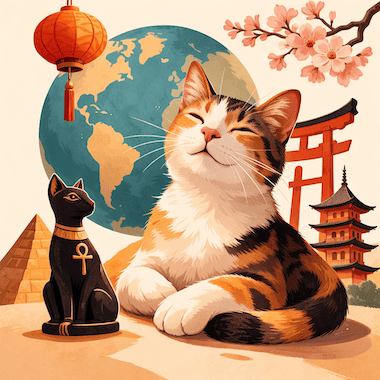
Cats and Humans
Gatos y humanos
 Learn EnglishApp gratis con audio, tests y libros reales
Palabras clave
- domesticateddomesticado
- fascinationfascinación
- affectionatecariñoso
- mysteriousmisterioso
- rodentroedor
- descenddescender
- reverereverenciar
- fertilityfertilidad
- mourningluto
- witchcraftbrujería
- persecutionpersecución
- plaguepeste
Ver las 30 palabras
- consequenceconsecuencia
- charmamuleto
- folklorefolclore
- supernaturalsobrenatural
- philosophicalfilosófico
- companioncompañero
- frequencyfrecuencia
- phenomenonfenómeno
- anxietyansiedad
- behaviorcomportamiento
- vocalizationvocalización
- endearingencantador
- reflexreflejo
- approximatelyaproximadamente
- clowdergrupo de gatos
- kittengatito
- enduringduradero
- domesticitydomesticidad
Cats share our homes, our sofas and quite often our beds. They can be independent one minute and affectionate the next, and even after thousands of years at our side they still seem a little wild. Hundreds of millions of cats live as pets around the world, and online they are everywhere, starring in an endless stream of videos and memes.
Los gatos comparten con nosotros la casa, el sofá y, muy a menudo, la cama. Pueden ser independientes en un momento y cariñosos al siguiente, y aun después de miles de años a nuestro lado siguen pareciendo un poco salvajes. En el mundo viven cientos de millones de gatos como mascotas, y en internet están por todas partes, protagonizando un torrente interminable de vídeos y memes.
How did a small desert hunter end up in so many human homes? The story runs from the first farming villages to Egyptian temples, medieval festivals and Japanese shops, and finally to our phones. Along the way, it says a lot about what people want from the animals they live with.
¿Cómo acabó un pequeño cazador del desierto en tantos hogares humanos? La historia va desde las primeras aldeas agrícolas hasta los templos egipcios, las fiestas medievales y las tiendas japonesas, y termina en nuestros móviles. Por el camino, dice mucho de lo que la gente espera de los animales con los que convive.
Where Domestic Cats Came From
De dónde vienen los gatos domésticos
Dogs were shaped by humans for jobs like hunting and herding. Cats, most scientists believe, largely domesticated themselves. About 10,000 years ago, people in the Middle East began farming and storing grain, and the grain attracted mice and rats. The mice, in turn, attracted wild cats.
Los perros fueron moldeados por el ser humano para tareas como la caza o el pastoreo. Los gatos, según la mayoría de los científicos, se domesticaron en gran parte a sí mismos. Hace unos 10.000 años, la gente de Oriente Próximo empezó a cultivar la tierra y a almacenar grano, y el grano atrajo a ratones y ratas. Los ratones, a su vez, atrajeron a los gatos salvajes.
Farmers were happy to let the cats stay, since they kept pests down. Over many generations, the cats that were less afraid of people did better in the villages, and slowly they became tamer. Genetic studies show that all domestic cats descend from the Near Eastern wildcat, Felis silvestris lybica. Neither side was really in charge: both simply gained from the arrangement.
A los agricultores les venía bien que los gatos se quedaran, porque mantenían a raya las plagas. A lo largo de muchas generaciones, los gatos que temían menos a las personas prosperaron en las aldeas y poco a poco se volvieron más mansos. Los estudios genéticos muestran que todos los gatos domésticos descienden del gato montés de Oriente Próximo, Felis silvestris lybica. Ninguna de las dos partes mandaba de verdad: ambas salían ganando con el acuerdo.
Sacred Cats in Ancient Egypt
Gatos sagrados en el antiguo Egipto
Few ancient peoples loved cats as much as the Egyptians. Cats lived in Egyptian homes from early times, hunting mice and snakes, and over the centuries they became linked with the gods. The goddess Bastet, who protected homes, mothers and children, was first shown as a lioness. From around 1000 BCE she usually appeared as a cat or as a woman with a cat's head, and her temple at Bubastis became the center of a huge cat cult.
Pocos pueblos de la Antigüedad quisieron tanto a los gatos como los egipcios. Desde muy pronto los gatos vivieron en las casas egipcias, donde cazaban ratones y serpientes, y con los siglos quedaron vinculados a los dioses. La diosa Bastet, protectora del hogar, de las madres y de los niños, se representaba al principio como una leona. A partir de alrededor del año 1000 a. C. solía aparecer como una gata o como una mujer con cabeza de gato, y su templo de Bubastis se convirtió en el centro de un enorme culto al gato.
Greek writers who visited Egypt reported that killing a cat, even by accident, could cost a person their life, and that when a family cat died, everyone in the house shaved their eyebrows in mourning. Cats were mummified and buried in special cemeteries. In 1888 a farmer at Beni Hasan found one that held hundreds of thousands of cat mummies. Many tons of them were shipped to England and ground into fertilizer.
Algunos autores griegos que visitaron Egipto contaron que matar a un gato, aunque fuera por accidente, podía costar la vida, y que cuando moría el gato de la familia, todos los de la casa se afeitaban las cejas en señal de luto. Los gatos se momificaban y se enterraban en cementerios especiales. En 1888, un campesino de Beni Hasan descubrió uno que albergaba cientos de miles de momias de gato. Muchas toneladas se enviaron a Inglaterra y se molieron para hacer abono.
Cats in Europe: From Helpers to Suspects
Los gatos en Europa: de ayudantes a sospechosos
In medieval Europe, cats were valued for catching mice, but many people also saw them as creatures of the night, linked with witches and the devil. Black cats had the worst reputation. In some towns, killing cats even became part of public festivals: in Paris, cats were burned in the Midsummer bonfire, and in Ypres, in Flanders, live cats were thrown from a tower until 1817.
En la Europa medieval se apreciaba a los gatos porque cazaban ratones, pero mucha gente también los veía como criaturas de la noche, relacionadas con las brujas y el diablo. Los gatos negros eran los peor vistos. En algunas ciudades, matar gatos llegó a formar parte de las fiestas populares: en París se quemaban gatos en la hoguera de San Juan, y en Ypres, en Flandes, se arrojaban gatos vivos desde una torre hasta 1817.
A popular story says that Europeans killed so many cats that rats took over and spread the Black Death in the 14th century. Historians find little evidence for this. The plague reached Europe in 1347, while the great witch hunts came much later, mostly between about 1450 and 1750. Cats can also catch the plague themselves.
Según una historia muy difundida, los europeos mataron tantos gatos que las ratas se multiplicaron y propagaron la peste negra en el siglo XIV. Los historiadores encuentran pocas pruebas de ello. La peste llegó a Europa en 1347, mientras que las grandes cazas de brujas fueron muy posteriores, sobre todo entre 1450 y 1750, aproximadamente. Además, los propios gatos pueden contagiarse de peste.
Cats in Japan and China
Los gatos en Japón y China
In Japan, cats have a much happier reputation. The maneki-neko, or 'beckoning cat', is a small figure of a cat with one paw raised, as if waving customers inside. It sits by the door of many shops and restaurants to bring good business, and it has become a familiar symbol of Japan around the world.
En Japón, los gatos tienen una fama mucho mejor. El maneki-neko, o «gato que llama», es una pequeña figura de un gato con una pata levantada, como si invitara a entrar a los clientes. Se coloca junto a la puerta de muchas tiendas y restaurantes para atraer la buena suerte en los negocios, y se ha convertido en un símbolo de Japón conocido en todo el mundo.
Japanese folklore also has darker cats. The bakeneko is a cat that can change its shape, often into a person, and the nekomata is a cat demon with a tail split in two. In China, cats appear in paintings as wishes for a long life. The word for cat, mao, sounds like the first half of maodie, an old word for very old age, so a picture of a cat with a butterfly (die) means 'may you live to a great age'.
El folclore japonés también tiene gatos más inquietantes. El bakeneko es un gato capaz de cambiar de forma, a menudo para convertirse en persona, y el nekomata es un demonio felino con la cola partida en dos. En China, los gatos aparecen en las pinturas como deseo de una vida larga. La palabra para gato, mao, suena como la primera mitad de maodie, una antigua palabra para la edad muy avanzada, así que un cuadro con un gato y una mariposa (die) significa «que vivas muchísimos años».
Cats in Literature and Art
Los gatos en la literatura y el arte
Writers have loved cats for a long time. Lewis Carroll created the grinning Cheshire Cat in Alice's Adventures in Wonderland (1865), a cat that slowly disappears until only its smile is left. In 1939 T. S. Eliot published Old Possum's Book of Practical Cats, a collection of funny poems that Andrew Lloyd Webber turned into the hit musical Cats in 1981.
Los escritores llevan mucho tiempo enamorados de los gatos. Lewis Carroll creó al sonriente Gato de Cheshire en Alicia en el país de las maravillas (1865), un gato que va desapareciendo hasta que solo queda su sonrisa. En 1939, T. S. Eliot publicó Old Possum's Book of Practical Cats, un libro de poemas divertidos que Andrew Lloyd Webber convirtió en 1981 en el exitoso musical Cats.
Artists have been just as keen. A cat hunts birds in a wall painting from the tomb of Nebamun in Egypt, and the Japanese artist Utagawa Kuniyoshi filled his woodblock prints with cats. In Paris, Édouard Manet put a black cat at the foot of the bed in his painting Olympia, and Pierre Bonnard painted cats in many of his quiet scenes of home life.
Los pintores no se han quedado atrás. En una pintura mural de la tumba de Nebamun, en Egipto, un gato caza pájaros, y el artista japonés Utagawa Kuniyoshi llenó sus grabados en madera de gatos. En París, Édouard Manet pintó un gato negro a los pies de la cama en su cuadro Olympia, y Pierre Bonnard incluyó gatos en muchas de sus tranquilas escenas de la vida doméstica.
The Psychology of Cat Ownership
La psicología de tener gato
Psychologists have long asked why so many people feel close to their cats. Research suggests that living with a pet can lower stress and blood pressure. One large American study published in 2008 found that people who had owned a cat were less likely to die of a heart attack, although it could not prove that the cats were the reason. Some researchers have also suggested that the low sound of a purr, at about 25 to 150 Hz, helps with healing, but this has not been proven.
Los psicólogos llevan tiempo preguntándose por qué tanta gente se siente tan unida a sus gatos. Las investigaciones indican que vivir con una mascota puede reducir el estrés y la tensión arterial. Un gran estudio estadounidense publicado en 2008 halló que las personas que habían tenido gato morían con menos frecuencia de un infarto, aunque no pudo demostrar que los gatos fueran la causa. Algunos investigadores han sugerido también que el sonido grave del ronroneo, de unos 25 a 150 Hz, ayuda a curar, pero esto no se ha demostrado.
Cats also give people company without needing constant attention the way dogs do. They don't need walks, and they cope well in small apartments, which suits people with busy lives. Some psychologists add that a cat's affection feels special because it has to be earned: when a cat chooses your lap, it feels like a compliment.
Los gatos también hacen compañía sin exigir atención constante, como ocurre con los perros. No hay que sacarlos a pasear y se adaptan bien a pisos pequeños, algo que viene bien a quienes llevan una vida ajetreada. Algunos psicólogos añaden que el cariño de un gato se valora más porque hay que ganárselo: cuando un gato elige tu regazo, parece un cumplido.
Cats and the Internet
Los gatos e internet
Cats found a new stage on the internet. Early hits like Keyboard Cat, a cat that seems to play an electric keyboard, spread across YouTube in the late 2000s. In the 2010s Grumpy Cat and Lil Bub became celebrities, with millions of fans, books and even films of their own.
Los gatos encontraron en internet un nuevo escenario. Los primeros éxitos, como Keyboard Cat, un gato que parece tocar un teclado eléctrico, se difundieron por YouTube a finales de la década de 2000. En la década de 2010, Grumpy Cat y Lil Bub se convirtieron en celebridades, con millones de seguidores, libros e incluso películas propias.
In 2015 a researcher at Indiana University asked nearly 7,000 people about watching cat videos. Most said the videos gave them more energy and made them feel happier and less anxious. Seen this way, internet cats are just the newest chapter of a very old friendship: people once kept cats in temples, and now they keep them on their phones.
En 2015, una investigadora de la Universidad de Indiana preguntó a casi 7.000 personas por su experiencia viendo vídeos de gatos. La mayoría dijo que los vídeos les daban energía y les hacían sentirse más felices y menos ansiosas. Visto así, los gatos de internet no son más que el capítulo más reciente de una amistad muy antigua: antes se tenía a los gatos en los templos y ahora se los lleva en el móvil.
The Science of Cat Behavior
La ciencia del comportamiento felino
Scientists still have a lot to learn about how cats behave. With each other, cats communicate mostly through body language and scent, along with hisses, growls and purrs. Adult cats rarely meow at other cats. Kittens meow to their mothers, but grown cats seem to keep the meow mainly for talking to humans.
A los científicos aún les queda mucho por aprender sobre el comportamiento de los gatos. Entre ellos, los gatos se comunican sobre todo mediante el lenguaje corporal y el olor, además de bufidos, gruñidos y ronroneos. Los gatos adultos rara vez maúllan a otros gatos. Los cachorros maúllan a su madre, pero los adultos parecen reservar el maullido sobre todo para hablar con los humanos.
Other habits are harder to explain: knocking things off tables, squeezing into boxes that are far too small, bringing dead mice to their owners as 'gifts', or racing around the house in the middle of the night. Some of these may come from hunting instincts or a need for safe, tight spaces, but many questions are still open.
Otras costumbres son más difíciles de explicar: tirar objetos de las mesas, meterse en cajas demasiado pequeñas, llevar ratones muertos a sus dueños como «regalos» o correr por toda la casa en plena noche. Algunas quizá se deban al instinto de caza o a la necesidad de espacios seguros y estrechos, pero muchas preguntas siguen sin respuesta.
Quick Facts About Cats
Datos breves sobre los gatos
Cats sleep about 12 to 16 hours a day.
Los gatos duermen entre 12 y 16 horas al día.
A group of cats is called a 'clowder', and a group of kittens is called a 'kindle'.
En inglés, un grupo de gatos se llama «clowder» y un grupo de gatitos, «kindle».
The oldest known burial of a cat with a human, about 9,500 years old, was found in Cyprus.
El enterramiento más antiguo que se conoce de un gato junto a un ser humano tiene unos 9.500 años y se encontró en Chipre.
Cats can twist in the air to land on their feet, a skill called the 'righting reflex', but they don't always land safely.
Los gatos pueden girar en el aire para caer de pie, una habilidad llamada «reflejo de enderezamiento», pero no siempre caen sin hacerse daño.
The loudest purr on record belongs to Merlin, a cat from England, whose purr measured 67.8 decibels.
El ronroneo más fuerte registrado pertenece a Merlin, un gato de Inglaterra, cuyo ronroneo alcanzó 67,8 decibelios.
There are more than 500 million domestic cats in the world, including strays.
Hay más de 500 millones de gatos domésticos en el mundo, incluidos los callejeros.
Ten Thousand Years Together
Diez mil años juntos
From Egyptian temples to today's living rooms and social media feeds, cats have lived alongside people for about 10,000 years. They have been worshipped and feared, burned at festivals and turned into lucky charms, but people have never stopped keeping them.
Desde los templos egipcios hasta los salones y las redes sociales de hoy, los gatos llevan unos 10.000 años viviendo junto a las personas. Han sido adorados y temidos, quemados en fiestas y convertidos en amuletos de la suerte, pero la gente nunca ha dejado de tenerlos.
Unlike most domestic animals, the cat still does much as it pleases. It hunts, sleeps and chooses its friends, and it stays with us because it wants to. After ten thousand years, people still seem to like it that way.
A diferencia de la mayoría de los animales domésticos, el gato sigue haciendo más o menos lo que le da la gana. Caza, duerme, elige a sus amigos y se queda con nosotros porque quiere. Diez mil años después, a la gente todavía parece gustarle así.
En la app gratuita puedes escuchar este texto en voz alta y tocar cualquier palabra para ver qué significa.