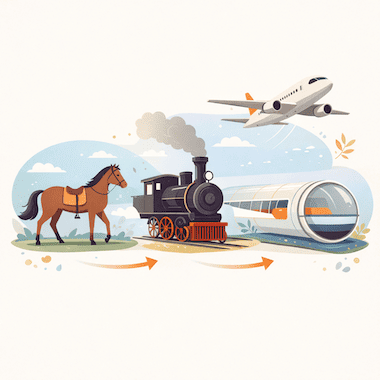
Evolution of Transportation
L'evoluzione dei trasporti
 Learn EnglishApp gratuita con audio, quiz e libri veri
Parole chiave
- transportationtrasporto
- civilizationciviltà
- domesticationaddomesticamento
- inventioninvenzione
- navigationnavigazione
- locomotivelocomotiva
- empireimpero
- vesselimbarcazione
- infrastructureinfrastruttura
- combustioncombustione
- autonomousautonomo
- colonizationcolonizzazione
Tutte le 30 parole
- industrializationindustrializzazione
- emissionemissione
- levitationlevitazione
- geopoliticsgeopolitica
- suburbsobborgo
- trade routerotta commerciale
- assembly linecatena di montaggio
- propulsionpropulsione
- transcontinentaltranscontinentale
- perishabledeperibile
- spacecraftnavicella spaziale
- sustainablesostenibile
- canalcanale
- nomadicnomade
- electrificationelettrificazione
- commutependolarismo
- supply chaincatena di approvvigionamento
- fatalityfatalità
Around 1750, a stagecoach from London to Edinburgh took ten days. Today the train does it in about four and a half hours. Changes like this run through the whole history of transportation: every faster way of moving people, goods and ideas has changed how people earn a living, what they eat and how their cities look.
Intorno al 1750 una diligenza impiegava dieci giorni da Londra a Edimburgo. Oggi il treno fa lo stesso viaggio in circa quattro ore e mezza. Salti come questo attraversano tutta la storia dei trasporti: ogni modo più rapido di spostare persone, merci e idee ha cambiato il modo in cui la gente si guadagna da vivere, ciò che mangia e l'aspetto delle sue città.
The story begins thousands of years ago with the first tamed horses and the first wooden wheels. It continues through sailing ships, steam trains, cars and jet planes, and today engineers are working on electric and self-driving vehicles. Again and again, new ways of traveling have not simply followed changes in society. They have helped cause them.
La storia comincia migliaia di anni fa con i primi cavalli addomesticati e le prime ruote di legno. Prosegue con le navi a vela, i treni a vapore, le automobili e gli aerei a reazione, e oggi gli ingegneri lavorano a veicoli elettrici e a guida autonoma. Ogni volta i nuovi modi di viaggiare non si sono limitati a seguire i cambiamenti della società. Hanno contribuito a provocarli.
The Wheel: An Old Idea with a Slow Start
La ruota: un'idea antica partita piano
The wheel is often called humanity's greatest invention, but it is younger than many people think. The oldest evidence of wheeled vehicles dates from around 3500 BCE, at about the same time as the first writing. Pictures and remains of early carts and wagons have been found in Mesopotamia, Central Europe and the steppes north of the Black Sea, and archaeologists still debate where the idea appeared first.
La ruota viene spesso definita la più grande invenzione dell'umanità, ma è più recente di quanto molti pensino. Le testimonianze più antiche di veicoli a ruote risalgono a circa il 3500 a.C., più o meno all'epoca della prima scrittura. Immagini e resti dei primi carri sono stati trovati in Mesopotamia, nell'Europa centrale e nelle steppe a nord del Mar Nero, e gli archeologi discutono ancora su dove l'idea sia nata per prima.
The first wheels may not have been used for travel at all. Potters in Mesopotamia were already turning clay on slow wheels at about the same time, possibly even earlier. And many great civilizations did without wheeled transport. The Inca built a road network of about 40,000 kilometers across the Andes, but goods traveled on the backs of people and llamas. In ancient Mexico, wheels appear only on small clay animal figures. The builders of Egypt's pyramids moved huge stones on wooden sleds. The wheel was a good solution, but not the only one.
Forse le prime ruote non servivano affatto per viaggiare. Nello stesso periodo, o forse anche prima, i vasai della Mesopotamia modellavano già l'argilla su ruote che giravano lentamente. E molte grandi civiltà hanno fatto a meno del trasporto su ruote. Gli Inca costruirono una rete di circa 40.000 chilometri di strade attraverso le Ande, ma le merci viaggiavano sulle spalle delle persone e sul dorso dei lama. Nell'antico Messico le ruote compaiono solo su piccole statuine di animali in argilla. I costruttori delle piramidi egizie spostavano enormi blocchi di pietra su slitte di legno. La ruota era una buona soluzione, ma non l'unica.
Horses: Speed for the Ancient World
Il cavallo: velocità per il mondo antico
The taming of the horse was probably the most important change in transportation before the age of steam. It happened on the grasslands of Eurasia, and by about 2000 BCE horses were pulling light war chariots with spoked wheels. Horses gave people something new: speed. A rider could cover in one day a distance that took several days on foot, and that changed warfare, trade and the way rulers controlled large territories.
L'addomesticamento del cavallo fu probabilmente il cambiamento più importante nei trasporti prima dell'era del vapore. Avvenne nelle praterie dell'Eurasia, e intorno al 2000 a.C. i cavalli tiravano già leggeri carri da guerra con ruote a raggi. Il cavallo diede alle persone qualcosa di nuovo: la velocità. Un cavaliere percorreva in un giorno una distanza che a piedi richiedeva diversi giorni, e questo cambiò la guerra, il commercio e il modo in cui i sovrani controllavano grandi territori.
The horse changed some parts of the world more than others. The Mongol Empire of the 13th century, the largest connected land empire in history, was built on horseback. Its relay system, the Yam, had stations where messengers could change horses, so urgent news could travel a few hundred kilometers in a single day. Horses had died out in the Americas thousands of years earlier, and the Spanish brought them back from 1493. On the Great Plains of North America, peoples such as the Lakota and the Comanche built their whole way of life around the horse and became some of the strongest military powers on the continent.
Il cavallo cambiò alcune parti del mondo più di altre. L'Impero mongolo del XIII secolo, il più grande impero terrestre continuo della storia, fu costruito a cavallo. Il suo sistema di staffette, lo Yam, aveva stazioni dove i messaggeri potevano cambiare cavallo, così una notizia urgente poteva percorrere qualche centinaio di chilometri in un solo giorno. Nelle Americhe i cavalli si erano estinti migliaia di anni prima, e gli spagnoli li riportarono a partire dal 1493. Nelle Grandi Pianure del Nord America, popoli come i Lakota e i Comanche costruirono tutto il loro modo di vivere intorno al cavallo e diventarono alcune delle maggiori potenze militari del continente.
Sailing Ships: Roads Across the Ocean
Le navi a vela: strade sull'oceano
For most of history, water was the easiest road. Before railways, the cheapest and fastest way to move heavy goods over long distances was by boat. Phoenician traders sailed across the Mediterranean, Arab dhows linked India, East Africa and the Persian Gulf for more than a thousand years, and Chinese junks carried silk and porcelain across Asian seas. The sea did not separate people. It connected them.
Per la maggior parte della storia l'acqua è stata la strada più facile. Prima delle ferrovie, il modo più economico e veloce per trasportare merci pesanti su lunghe distanze era la nave. I mercanti fenici attraversavano il Mediterraneo, i dhow arabi collegarono l'India, l'Africa orientale e il Golfo Persico per oltre mille anni, e le giunche cinesi portavano seta e porcellana attraverso i mari dell'Asia. Il mare non separava le persone. Le univa.
In the 15th century, Portuguese and Spanish sailors began to cross the open ocean. Their caravels and carracks combined square sails with triangular lateen sails, and navigators found their position with the compass, the quadrant and the astrolabe. Vasco da Gama reached India by sea in 1498, and from the 1560s Spanish galleons sailed regularly between Mexico and Manila. For the first time, Europe, Africa, the Americas and Asia were linked in one trading system. It brought great wealth to some and terrible suffering to others, above all through the Atlantic slave trade and colonial rule.
Nel XV secolo i marinai portoghesi e spagnoli cominciarono ad attraversare l'oceano aperto. Le loro caravelle e caracche univano vele quadre e vele latine triangolari, e i navigatori calcolavano la loro posizione con la bussola, il quadrante e l'astrolabio. Vasco da Gama raggiunse l'India via mare nel 1498 e, dagli anni Sessanta del Cinquecento, i galeoni spagnoli fecero regolarmente la spola tra il Messico e Manila. Per la prima volta Europa, Africa, Americhe e Asia erano collegate in un unico sistema di scambi. Portò grandi ricchezze ad alcuni e sofferenze terribili ad altri, soprattutto attraverso la tratta atlantica degli schiavi e il dominio coloniale.
The Age of Steam
L'era del vapore
In the early 19th century, the steam engine moved onto wheels and changed the meaning of distance. In 1829, George Stephenson's locomotive Rocket won a competition called the Rainhill Trials, reaching about 48 kilometers per hour. A year later the Liverpool and Manchester Railway opened, the first line to link two cities with steam trains only. Within a few decades, railways had spread across Britain, then Europe, and then the rest of the world.
All'inizio dell'Ottocento la macchina a vapore salì su ruote e cambiò il significato stesso della distanza. Nel 1829 la locomotiva Rocket di George Stephenson vinse una gara, le prove di Rainhill, raggiungendo circa 48 chilometri orari. Un anno dopo fu inaugurata la ferrovia Liverpool-Manchester, la prima linea a collegare due città solo con treni a vapore. Nel giro di pochi decenni le ferrovie si diffusero in Gran Bretagna, poi in Europa e infine nel resto del mondo.
The railway changed far more than travel times. Fresh milk, fish and vegetables could reach city markets, letters and newspapers arrived the next day, and workers could live outside the city and come in each morning. Trains also needed fixed timetables, so Britain adopted one standard time in the 1840s, and American railroads introduced time zones in 1883. When the first transcontinental railroad in the United States was completed in 1869, a trip from New York to California fell from months to about a week. At sea, steamships replaced sailing ships, and by the end of the century the Atlantic crossing took about a week instead of a month or more.
La ferrovia cambiò molto più dei tempi di viaggio. Latte, pesce e verdura freschi potevano arrivare ai mercati cittadini, lettere e giornali arrivavano il giorno dopo, e gli operai potevano abitare fuori città ed entrarvi ogni mattina. I treni avevano anche bisogno di orari fissi, così la Gran Bretagna adottò un'ora unica negli anni Quaranta dell'Ottocento e le ferrovie americane introdussero i fusi orari nel 1883. Quando nel 1869 fu completata la prima ferrovia transcontinentale degli Stati Uniti, un viaggio da New York alla California passò da mesi a circa una settimana. In mare le navi a vapore sostituirono quelle a vela, e alla fine del secolo la traversata dell'Atlantico durava circa una settimana invece di un mese o più.
The Car: Freedom at a Price
L'automobile: una libertà che ha un prezzo
Karl Benz's Patent-Motorwagen, patented in 1886, is usually seen as the first real automobile. But cars only became an everyday product after Henry Ford introduced the moving assembly line in 1913. Building a Model T suddenly took about an hour and a half instead of more than twelve hours, and its price kept falling until ordinary workers could buy one. This changed how people traveled, and before long it changed where they lived and worked too.
La Patent-Motorwagen di Karl Benz, brevettata nel 1886, è di solito considerata la prima vera automobile. Ma l'auto diventò un prodotto di tutti i giorni solo dopo che Henry Ford introdusse la catena di montaggio mobile nel 1913. Costruire una Model T richiedeva all'improvviso circa un'ora e mezza invece di oltre dodici, e il prezzo continuò a scendere finché anche i semplici operai poterono comprarne una. Questo cambiò il modo di viaggiare e ben presto anche il luogo in cui la gente viveva e lavorava.
In the 20th century, the car reshaped towns and cities. People moved out to the suburbs and drove to work, and shopping centers and offices grew up along the new highways. Oil became one of the most important goods in world politics. The car also brought heavy costs: polluted air, greenhouse gases that heat the planet, more than a million deaths on the roads every year, and cities planned for cars rather than for people. Few inventions have given people so much freedom and done so much damage at the same time.
Nel Novecento l'automobile trasformò paesi e città. La gente si trasferì in periferia e andava al lavoro in macchina, mentre centri commerciali e uffici sorgevano lungo le nuove autostrade. Il petrolio divenne una delle merci più importanti della politica mondiale. L'auto portò però anche costi pesanti: aria inquinata, gas serra che riscaldano il pianeta, più di un milione di morti sulle strade ogni anno e città progettate per le auto anziché per le persone. Poche invenzioni hanno dato tanta libertà e fatto tanti danni allo stesso tempo.
Into the Air
Verso il cielo
On December 17, 1903, near Kitty Hawk, North Carolina, Orville and Wilbur Wright made the first controlled, powered flight in an airplane. Their longest flight that day lasted 59 seconds and covered about 260 meters. Just 66 years later, in 1969, two astronauts walked on the Moon. Few technologies have developed so quickly.
Il 17 dicembre 1903, vicino a Kitty Hawk, nella Carolina del Nord, Orville e Wilbur Wright compirono il primo volo controllato e a motore su un aeroplano. Il loro volo più lungo quel giorno durò 59 secondi e coprì circa 260 metri. Appena 66 anni dopo, nel 1969, due astronauti camminarono sulla Luna. Poche tecnologie si sono sviluppate così in fretta.
Passenger jets came into regular service in the 1950s, and the Boeing 707, which started flying passengers in 1958, made long-distance flights common. A trip from London to New York that could take six weeks by sailing ship now takes about seven or eight hours. Cheap flights made mass tourism possible and helped companies build supply chains around the world. Today there are around 100,000 flights every day, carrying more than 12 million passengers.
Gli aerei di linea a reazione entrarono in servizio regolare negli anni Cinquanta, e il Boeing 707, che iniziò a trasportare passeggeri nel 1958, rese comuni i voli a lungo raggio. Un viaggio da Londra a New York che in nave a vela poteva durare sei settimane oggi richiede circa sette o otto ore. I voli economici hanno reso possibile il turismo di massa e hanno aiutato le aziende a costruire catene di approvvigionamento in tutto il mondo. Oggi si effettuano circa 100.000 voli al giorno, che trasportano più di 12 milioni di passeggeri.
The Future: Electric and Self-Driving
Il futuro: elettrico e a guida autonoma
Transportation is going through its biggest change since the age of steam. Electric cars are replacing petrol and diesel cars faster every year. In Norway, nearly all new cars sold are now electric, and China sells more electric cars than the rest of the world combined. Many governments have set targets to end or sharply cut sales of new petrol and diesel cars. Better batteries, more charging stations and lower prices make electric cars practical for more and more people.
I trasporti stanno vivendo il loro più grande cambiamento dall'era del vapore. Le auto elettriche sostituiscono quelle a benzina e diesel ogni anno più rapidamente. In Norvegia quasi tutte le auto nuove vendute sono ormai elettriche, e la Cina vende più auto elettriche di tutto il resto del mondo messo insieme. Molti governi si sono dati obiettivi per fermare o ridurre di molto la vendita di auto nuove a benzina e diesel. Batterie migliori, più colonnine di ricarica e prezzi in calo rendono l'auto elettrica pratica per sempre più persone.
Self-driving cars and trucks are moving from tests to real streets: robotaxis with no one at the wheel already carry paying passengers in several American and Chinese cities. Supporters say they could prevent many crashes, because human mistakes are involved in the great majority of them. High-speed rail keeps growing in Europe and Asia, and China alone has more than 45,000 kilometers of it, a lower-emission alternative to short flights. The hyperloop, an idea for capsules racing through low-pressure tubes, has been tested, but some of the best-known companies working on it have closed. SpaceX even suggests that rockets could one day carry passengers between cities on Earth, linking almost any two places in under an hour.
Le auto e i camion a guida autonoma stanno passando dai test alle strade vere: robotaxi senza nessuno al volante trasportano già passeggeri paganti in diverse città americane e cinesi. I sostenitori dicono che potrebbero evitare molti incidenti, perché nella grande maggioranza dei casi c'entra un errore umano. L'alta velocità ferroviaria continua a crescere in Europa e in Asia, e la sola Cina ne ha più di 45.000 chilometri, un'alternativa con meno emissioni ai voli brevi. L'hyperloop, l'idea di capsule che sfrecciano in tubi a bassa pressione, è stato provato, ma alcune delle aziende più note del settore hanno chiuso. SpaceX arriva a ipotizzare che un giorno i razzi possano trasportare passeggeri tra città della Terra, collegando quasi due luoghi qualsiasi in meno di un'ora.
A Few Surprising Facts
Qualche fatto sorprendente
The first speeding fine was given in 1896 to Walter Arnold in Kent, England. He was driving at 8 mph (about 13 km/h), four times the limit of 2 mph.
La prima multa per eccesso di velocità fu data nel 1896 a Walter Arnold, nel Kent, in Inghilterra. Guidava a 8 miglia orarie (circa 13 km/h), quattro volte il limite di 2 miglia.
Japan's Shinkansen bullet trains have carried more than 10 billion passengers since 1964, and no passenger has ever died in a derailment or collision.
I treni ad alta velocità Shinkansen del Giappone hanno trasportato più di 10 miliardi di passeggeri dal 1964, e nessun passeggero è mai morto in un deragliamento o in uno scontro.
The London Underground, opened in 1863, is the oldest metro in the world. Its first trains ran on steam, so the tunnels were full of smoke.
La metropolitana di Londra, aperta nel 1863, è la più antica del mondo. I primi treni andavano a vapore, perciò le gallerie erano piene di fumo.
The Panama Canal, opened in 1914, cut the sea route from New York to San Francisco from about 22,500 kilometers around Cape Horn to about 9,500.
Il Canale di Panama, aperto nel 1914, ridusse la rotta marittima tra New York e San Francisco da circa 22.500 chilometri intorno a Capo Horn a circa 9.500.
For every kilometer, a person on a bicycle uses less energy than any other traveler, even someone walking.
Per ogni chilometro, una persona in bicicletta consuma meno energia di qualsiasi altro viaggiatore, persino di chi va a piedi.
Voyager 1, launched in 1977, is the most distant object people have ever built. It is now more than 25 billion kilometers from Earth.
La Voyager 1, lanciata nel 1977, è l'oggetto più lontano mai costruito dall'uomo. Oggi si trova a più di 25 miliardi di chilometri dalla Terra.
How Transportation Shapes Society
Come i trasporti danno forma alla società
Each big change in transportation has changed the way societies are organized. The horse made nomadic empires possible. Sailing ships created world trade and colonial empires. Railways drove industry and helped hold together large countries such as the United States. The car created suburbs and economies that depend on oil, and the airplane made global tourism and worldwide supply chains possible. Each new technology gave people new freedoms, and each one also created new dependencies.
Ogni grande cambiamento nei trasporti ha cambiato anche il modo in cui le società sono organizzate. Il cavallo rese possibili gli imperi nomadi. Le navi a vela crearono il commercio mondiale e gli imperi coloniali. Le ferrovie spinsero l'industria e aiutarono a tenere unito un grande paese come gli Stati Uniti. L'auto creò le periferie ed economie che dipendono dal petrolio, e l'aereo rese possibili il turismo globale e le catene di approvvigionamento mondiali. Ogni nuova tecnologia ha dato alla gente nuove libertà, e ognuna ha creato anche nuove dipendenze.
The next change, driven by electric motors and automation, may be just as large. Cities that were planned around cars could be redesigned for people on foot and on bicycles. If self-driving vehicles work as promised, they could bring down the number of road deaths, which is now about 1.2 million around the world each year. Knowing how earlier changes played out can help us make better choices about the next one.
Il prossimo cambiamento, spinto dai motori elettrici e dall'automazione, potrebbe essere altrettanto grande. Le città pensate per le auto potrebbero essere ridisegnate per pedoni e ciclisti. Se i veicoli a guida autonoma funzioneranno come promesso, potrebbero ridurre il numero di morti sulle strade, che oggi nel mondo è di circa 1,2 milioni all'anno. Sapere come sono andati i cambiamenti passati può aiutarci a fare scelte migliori sul prossimo.
Conclusion
Conclusione
From the first carts rolling through Mesopotamia to a spacecraft traveling far beyond the planets, transportation shows the same pattern again and again. Each generation has found ways to travel farther, faster and more cheaply than the one before.
Dai primi carri che rotolavano in Mesopotamia a una sonda spaziale che viaggia ben oltre i pianeti, i trasporti mostrano sempre lo stesso schema. Ogni generazione ha trovato il modo di viaggiare più lontano, più veloce e a minor costo di quella precedente.
But transportation has never been only about getting from one place to another. It also decides who can travel, what it costs, and what it does to the places around us. The challenge now is not mainly to go faster. It is to travel in ways that are cleaner, fairer and safer for the people who will live on this planet after us.
Ma i trasporti non sono mai stati solo un modo per andare da un posto all'altro. Decidono anche chi può viaggiare, quanto costa e che effetto ha sui luoghi intorno a noi. La sfida oggi non è soprattutto andare più veloci. È viaggiare in modi più puliti, più giusti e più sicuri per chi vivrà su questo pianeta dopo di noi.
Nell'app gratuita puoi ascoltare il testo letto ad alta voce e toccare ogni parola per vederne il significato.