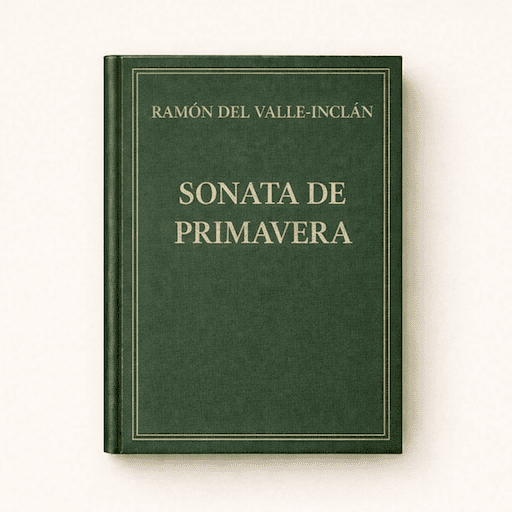
Sonata de primavera
Sonata of Spring
Ramón del Valle-Inclán · 1904
A lyrical and decadent reflection on youth, beauty, and desire.
Read the opening
The original text, each line followed by its translation.
ANOCHECÍA cuando la silla de posta traspuso la Puerta Salaria y comenzamos á cruzar la campiña llena de misterio y de rumores lejanos.
Night was falling when the post chair crossed the Salary Gate and we began to cross the countryside full of mystery and distant rumors.
Era la campiña clásica de las vides y de los olivos, con sus acueductos ruinosos, y sus colinas que tienen la graciosa ondulación de los senos femeninos.
It was the classic countryside of vineyards and olive groves, with its ruined aqueducts, and its hills that have the graceful undulation of female breasts.
La silla de posta caminaba por una vieja calzada: Las mulas del tiro sacudían pesadamente las colleras, y el golpe alegre y desigual de los cascabeles despertaba un eco en los floridos olivares.
The post chair traveled along an old road: The mules of the team shook their collars heavily, and the cheerful and uneven clanging of the bells awakened an echo in the flowering olive groves.
Antiguos sepulcros orillaban el camino y mustios cipreses dejaban caer sobre ellos su sombra venerable.
Ancient tombs lined the road, and withered cypress trees cast their venerable shade upon them.
La silla de posta seguía siempre la vieja calzada, y mis ojos fatigados de mirar en la noche, se cerraban con sueño. Al fin quedéme dormido, y no desperté hasta cerca del amanecer, cuando la luna, ya muy pálida, se desvanecía en el cielo.
The post chair followed the old road, and my eyes, tired from gazing in the night, closed with sleep. At last I fell asleep, and did not wake until near dawn, when the moon, by then very pale, was fading in the sky.
Poco después, todavía entumecido por la quietud y el frío de la noche, comencé á oir el canto de madrugueros gallos, y el murmullo bullente de un arroyo que parecía despertarse con el sol.
Shortly afterwards, still numb from the stillness and cold of the night, I began to hear the crowing of early morning roosters, and the bubbling murmur of a stream that seemed to be waking up with the sun.
A lo lejos, almenados muros se destacaban negros y sombríos sobre celajes de frío azul. Era la vieja, la noble, la piadosa ciudad de Ligura.
In the distance, crenellated walls stood out black and somber against cold blue skies. It was the old, noble, pious city of Ligura.
Entramos por la Puerta Lorencina. La silla de posta caminaba lentamente, y el cascabeleo de las mulas hallaba un eco burlón, casi sacrílego, en las calles desiertas donde crecía la yerba.
We entered through the Lorencina Gate. The post chair moved slowly, and the clattering of the mules' bells found a mocking, almost sacrilegious echo in the deserted streets where grass grew.
Tres viejas, que parecían tres sombras, esperaban acurrucadas á la puerta de una iglesia todavía cerrada, pero otras campanas distantes ya tocaban á la misa de alba.
Three old women, who looked like three shadows, waited huddled together at the door of a church that was still closed, but other distant bells were already ringing for dawn mass.
La silla de posta seguía una calle de huertos, de caserones y de conventos, una calle antigua, enlosada y resonante. Bajo los aleros sombríos revoloteaban los gorriones, y en el fondo de la calle el farol de una hornacina agonizaba.
The post chair followed a street lined with orchards, mansions, and convents—an ancient, cobbled, and echoing street. Sparrows fluttered beneath the shadowy eaves, and at the end of the street, a lantern in a niche flickered and died.
El tardo paso de las mulas me dejó vislumbrar una Madona: Sostenía al Niño en el regazo, y el Niño, riente y desnudo, tendía los brazos para alcanzar un pez que los dedos virginales de la madre le mostraban en alto, como en un juego cándido y celeste.
The slow pace of the mules allowed me to glimpse a Madonna: She held the Child in her lap, and the Child, laughing and naked, stretched out his arms to reach a fish that the mother's virginal fingers showed him aloft, as in a candid and celestial game.
La silla de posta se detuvo. Estábamos á las puertas del Colegio Clementino.
The post chair stopped. We were at the gates of the Clementine College.
Ocurría esto en los felices tiempos del Papa-Rey, y el Colegio Clementino conservaba todas sus premáticas, sus fueros y sus rentas. Todavía era retiro de ilustres varones, todavía se le llamaba noble archivo de las ciencias.
This occurred during the prosperous times of the Pope-King, and the Clementine College retained all its decrees, privileges, and revenues. It was still a retreat for illustrious men, still known as the noble archive of the sciences.
El rectorado ejercíalo desde hacía muchos años un ilustre prelado: Monseñor Estefano Gaetani, obispo de Betulia, de la familia de los Príncipes Gaetani.
The rectorship had been held for many years by an illustrious prelate: Monsignor Estefano Gaetani, bishop of Betulia, from the Gaetani Princes family.
Para aquel varón, lleno de evangélicas virtudes y de ciencia teológica, llevaba yo el capelo cardenalicio. Su Santidad había querido honrar mis juveniles años, eligiéndome entre sus guardias nobles, para tan alta misión.
For that man, full of evangelical virtues and theological knowledge, I wore the cardinal's hat. His Holiness had wished to honor my youthful years, choosing me from among his noble guards for such a high mission.
Yo soy Bibiena di Rienzo, por la línea de mi abuela paterna.
I am Bibiena di Rienzo, through my paternal grandmother's line.
Julia Aldegrina, hija del Príncipe Máximo de Bibiena, que murió en 1770, envenenado por la famosa comedianta Simoneta la Corticelli, que tiene un largo capítulo en las Memorias del Caballero de Sentgal.
Julia Aldegrina, daughter of Prince Máximo de Bibiena, who died in 1770, poisoned by the famous comedian Simoneta la Corticelli, who has a long chapter in the Memoirs of the Knight of Sentgal.
Read the whole book in the app, with audio and tap-to-translate.