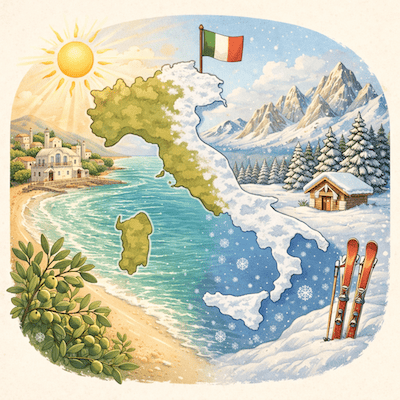
Il clima in Italia
The Climate of Italy
 Learn ItalianFree app with audio, quizzes and real books
Key words
- perenneperennial / everlasting
- variegatovaried / diverse
- vettepeaks / summits
- abitantiinhabitants / residents
- marcatemarked / distinct
- afosesultry / stiflingly hot
- nebbiosifoggy / misty
- sostanziosihearty / substantial
- quotaaltitude / height
- mitemild
- coltivazionecultivation / farming
- meridionethe South
All 25 words
- brevissimivery short
- entroterrahinterland / inland
- gelofrost / ice / freezing cold
- rigogliosilush / exuberant
- piovosarainy
- siccitàdrought
- sfidachallenge
- pungentibiting / stinging / sharp
- stagionatiaged / seasoned
- torridescorching / torrid
- afasultriness / humid heat
- serenoclear (sky)
- sinfoniasymphony
Chi pensa all'Italia immagina spesso sole, mare e spiagge dorate. In realtà il Paese è lungo e stretto ed è attraversato da grandi catene montuose: per questo il suo clima cambia moltissimo da una zona all'altra.
When people think of Italy, they usually picture sun, sea and golden beaches. In fact the country is long and narrow and is crossed by high mountain ranges, so its climate varies enormously from one area to another.
Dai ghiacciai delle Alpi fino a Lampedusa, un'isola più vicina alla Tunisia che alla Sicilia, si passa per climi molto diversi. Da questi dipendono il paesaggio, l'agricoltura e anche il modo di vivere delle persone.
From the glaciers of the Alps down to Lampedusa, an island closer to Tunisia than to Sicily, you pass through very different climates. They shape the landscape, farming and even the way people live.
Il Nord: inverni freddi ed estati afose
The North: cold winters and muggy summers
Le regioni del Nord, come il Piemonte, la Lombardia e l'Emilia-Romagna, hanno un clima di tipo continentale. D'estate fa caldo e l'aria è umida e pesante, d'inverno fa freddo e nella Pianura Padana scende spesso una nebbia così fitta che non si vede a cinquanta metri.
The northern regions, such as Piedmont, Lombardy and Emilia-Romagna, have a continental climate. Summers are hot, with humid, heavy air; winters are cold, and the Po Valley is often covered by fog so thick you can't see fifty metres ahead.
D'inverno in pianura può anche nevicare. Intorno a Vercelli e Novara si stendono le risaie più grandi d'Europa, e la cucina è fatta di piatti caldi e sostanziosi, come la polenta e i bolliti.
In winter it can even snow on the plain. Around Vercelli and Novara lie the largest rice fields in Europe, and the local cooking is all about hot, hearty dishes such as polenta and boiled meats.
Le Alpi e gli Appennini: il clima di montagna
The Alps and the Apennines: a mountain climate
Due grandi catene montuose attraversano l'Italia. Le Alpi, a nord, fermano gran parte dei venti freddi che arrivano dal Nord Europa. Così sul Lago di Garda e sul Lago di Como l'inverno è sorprendentemente mite: sulle rive crescono olivi, oleandri e perfino limoni.
Two great mountain ranges run through Italy. The Alps in the north block most of the cold winds coming from Northern Europe. That is why winters on Lake Garda and Lake Como are surprisingly mild: olive trees, oleanders and even lemons grow on their shores.
In alta montagna il clima è alpino, con estati fresche e inverni lunghi e nevosi. Località come Cortina d'Ampezzo, Courmayeur e Madonna di Campiglio attirano ogni anno sciatori da tutto il mondo. Anche sugli Appennini, d'inverno, la neve non manca.
High in the mountains the climate is alpine, with cool summers and long, snowy winters. Resorts such as Cortina d'Ampezzo, Courmayeur and Madonna di Campiglio draw skiers from all over the world every year. The Apennines get plenty of snow in winter too.
Il Centro: un clima più dolce
The Centre: a gentler climate
Più a sud, in Toscana, in Umbria e nel Lazio, il clima diventa più mite. Lungo la costa il Mar Tirreno rende gli inverni meno freddi, mentre nelle zone interne le temperature scendono di più.
Further south, in Tuscany, Umbria and Lazio, the climate becomes milder. Along the coast the Tyrrhenian Sea softens the winters, while inland temperatures drop further.
Sulle colline crescono ovunque olivi e viti, e dal Chianti ai Castelli Romani si producono vini famosi. La primavera e l'autunno sono lunghi e piacevoli, e molti viaggiatori scelgono proprio questi mesi per visitare Firenze, Siena o Roma.
Olive trees and vines grow on hillsides everywhere, and famous wines are made from Chianti to the Castelli Romani. Spring and autumn are long and pleasant, and many travellers choose exactly these months to visit Florence, Siena or Rome.
Il Sud e le isole: un assaggio d'Africa
The South and the islands: a taste of Africa
Nel Sud il clima è mediterraneo. Le estati sono lunghe, secche e molto calde, e a volte arriva lo scirocco, un vento caldo che soffia dal Sahara e porta aria pesante e sabbia rossastra.
The South has a Mediterranean climate. Summers are long, dry and very hot, and sometimes the scirocco blows in, a hot wind from the Sahara that brings heavy air and reddish sand.
In Sicilia e in Puglia d'estate si superano spesso i 40 gradi. L'11 agosto 2021, vicino a Siracusa, il termometro ha segnato 48,8 gradi, la temperatura più alta mai registrata in Europa. Gli inverni invece sono brevi e dolci, e a febbraio non è raro pranzare all'aperto.
In Sicily and Puglia temperatures often climb above 40 degrees in summer. On 11 August 2021, near Syracuse, the thermometer reached 48.8 degrees, the highest temperature ever recorded in Europe. Winters, on the other hand, are short and mild, and eating lunch outdoors in February is nothing unusual.
L'influenza del mare
The influence of the sea
L'Italia ha quasi 8.000 chilometri di coste, e il mare funziona come un grande termosifone: d'estate rinfresca, d'inverno restituisce il calore accumulato. Per questo nelle città sulla costa le temperature cambiano meno che nell'entroterra.
Italy has almost 8,000 kilometres of coastline, and the sea works like a giant radiator: it cools things down in summer and gives back the stored heat in winter. That is why temperatures in coastal towns vary less than inland.
A Milano d'inverno si gela, ma a un paio d'ore di macchina, sulla costa ligure, crescono palme e fiori anche a gennaio. Non per niente la zona di Sanremo si chiama Riviera dei Fiori.
In winter Milan freezes, yet a couple of hours' drive away, on the Ligurian coast, palms and flowers grow even in January. It's no accident that the area around Sanremo is called the Riviera dei Fiori, the Riviera of Flowers.
Le piogge: quando piove in Italia?
Rainfall: when does it rain in Italy?
In quasi tutta la penisola la stagione più piovosa è l'autunno. Ma tra le regioni ci sono grandi differenze: in alcune zone del Friuli cadono più di 3.000 millimetri di pioggia all'anno, mentre in certe parti della Sicilia e della Puglia si arriva a fatica a 500, e la siccità è un problema frequente.
Across almost the whole peninsula, autumn is the wettest season. But the regions differ enormously: parts of Friuli get more than 3,000 millimetres of rain a year, while some areas of Sicily and Puglia barely reach 500, and drought is a frequent problem.
D'estate al Nord e sugli Appennini i temporali sono frequenti, spesso nel pomeriggio e a volte con la grandine. Sulle coste del Sud, invece, tra giugno e settembre può non piovere per settimane.
In summer, thunderstorms are common in the North and in the Apennines, often in the afternoon and sometimes with hail. On the southern coasts, by contrast, weeks can go by without rain between June and September.
I venti italiani
Italy's winds
In Italia ogni vento ha un nome e un carattere. La bora è un vento freddo e violentissimo che scende su Trieste: le raffiche possono superare i 150 chilometri all'ora, e un tempo lungo alcune strade si tendevano corde a cui i passanti potevano aggrapparsi.
In Italy every wind has a name and a character of its own. The bora is a cold, extremely violent wind that sweeps down on Trieste: gusts can exceed 150 kilometres an hour, and in the past ropes were strung along some streets for passers-by to hold on to.
Il maestrale soffia da nord-ovest sulla Sardegna e porta aria fresca e mare mosso. La tramontana, che arriva da nord, spazza via le nuvole: nel Centro Italia regala giornate limpide, ma con un freddo pungente.
The mistral blows from the north-west over Sardinia, bringing cool air and rough seas. The tramontana, which comes from the north, sweeps the clouds away: in central Italy it brings clear days, but with a biting cold.
Il clima a tavola: il sole nel piatto
Climate at the table: sunshine on the plate
Il clima decide in gran parte che cosa si mangia nelle varie regioni. Il sole del Sud fa maturare pomodori dolcissimi e agrumi profumati, come i limoni della Costiera Amalfitana e le arance rosse che crescono intorno all'Etna.
Climate largely decides what people eat in the different regions. The southern sun ripens very sweet tomatoes and fragrant citrus fruit, such as the lemons of the Amalfi Coast and the blood oranges that grow around Etna.
Il Nord, più fresco e umido, ha grandi pascoli e quindi molto latte. Qui si cucina più con il burro che con l'olio, e nascono formaggi stagionati come il Parmigiano Reggiano e il Grana Padano, oltre a piatti come il risotto e la cotoletta alla milanese.
The cooler, damper North has large pastures and therefore plenty of milk. Here people cook with butter more than with oil, and this is the home of aged cheeses such as Parmigiano Reggiano and Grana Padano, as well as dishes like risotto and the Milanese cutlet.
Il cambiamento climatico
Climate change
Anche l'Italia sente gli effetti del riscaldamento globale. I ghiacciai alpini si ritirano anno dopo anno: il 3 luglio 2022 un enorme blocco di ghiaccio si è staccato dalla Marmolada, nelle Dolomiti, e ha ucciso undici escursionisti.
Italy is feeling the effects of global warming too. Alpine glaciers are shrinking year after year: on 3 July 2022 a huge block of ice broke off the Marmolada glacier in the Dolomites and killed eleven hikers.
Le estati sono sempre più calde e anche il mare si scalda. Gli eventi estremi sono più frequenti: nel maggio 2023 piogge eccezionali hanno provocato una grave alluvione in Emilia-Romagna, e migliaia di persone hanno dovuto lasciare la propria casa.
Summers are getting hotter and the sea is warming as well. Extreme weather is more frequent: in May 2023 exceptional rainfall caused severe flooding in Emilia-Romagna, and thousands of people had to leave their homes.
Le parole del meteo
Weather words
Afa: il caldo umido e soffocante delle giornate estive, soprattutto in pianura.
Afa: the humid, stifling heat of summer days, especially on the plains.
Sereno: il cielo è tutto azzurro, senza una nuvola.
Sereno: the sky is completely blue, without a single cloud.
Nuvoloso e coperto: nuvoloso quando ci sono molte nuvole, coperto quando il sole non si vede per niente.
Nuvoloso and coperto: nuvoloso when there are a lot of clouds, coperto when you can't see the sun at all.
Umido: si dice dell'aria piena di vapore acqueo, per esempio vicino ai laghi o in pianura.
Umido: said of air full of water vapour, for example near the lakes or on the plains.
Mite: una temperatura piacevole, né troppo calda né troppo fredda.
Mite: a pleasant temperature, neither too hot nor too cold.
Curiosità climatiche
Climate curiosities
In Sicilia si può sciare guardando il mare. Sull'Etna, il vulcano attivo più alto d'Europa, ci sono piste da sci, e nelle giornate limpide dall'alto si vede il Mediterraneo.
In Sicily you can ski with a view of the sea. On Etna, the highest active volcano in Europe, there are ski slopes, and on clear days you can see the Mediterranean from the top.
In Puglia, invece, la pioggia è sempre stata preziosa. Sotto molti trulli, le tipiche case di pietra con il tetto a cono, c'è una cisterna che raccoglie l'acqua piovana che scende dal tetto.
In Puglia, by contrast, rain has always been precious. Beneath many trulli, the traditional stone houses with cone-shaped roofs, there is a cistern that collects the rainwater running off the roof.
Prima di partire
Before you go
In Italia non c'è un clima unico. In una giornata di marzo si può sciare sulle Alpi la mattina e, poche ore dopo, passeggiare sul lungomare di Genova con il cappotto aperto.
Italy doesn't have a single climate. On a March day you can ski in the Alps in the morning and, a few hours later, stroll along the seafront in Genoa with your coat open.
Prima di fare la valigia conviene quindi guardare bene la cartina: ad agosto a Palermo basta una maglietta, a dicembre a Milano servono cappotto e sciarpa, e in montagna anche gli scarponi.
So before packing it pays to look carefully at the map: in August a T-shirt is enough in Palermo, in December you need a coat and scarf in Milan, and in the mountains boots as well.
In the free app you can listen to this text read aloud and tap any word to see what it means.