Il Calcio
Football: A secular religion
 Learn ItalianFree app with audio, quizzes and real books
Key words
- sconosciutostranger
- scandiscemarks / beats / rhythmically defines
- palloneball (football)
- appartenenzabelonging
- sacrosacred
- sciarpascarf
- coinvolgimentoinvolvement / engagement
- tifofandom / cheering
- scherzareto joke / to tease
- avversariaopposing / opponent
- tricoloritricolor (three-colored flags)
- corochoir / chant
All 25 words
- schemipatterns / tactics / schemes
- arbitrireferees
- allenatorecoach / manager
- salvarsito save oneself / to escape
- cavarselato get by / to manage
- scudoshield
- classificaranking / standings
- freneticamentefrantically
- votigrades / scores
- impiantifacilities / structures
- fascinocharm / appeal
- specchiomirror
- vibrantevibrant / pulsing
In Italia, per attaccare discorso con uno sconosciuto, ci sono due argomenti sicuri: il tempo e il calcio. Per molti italiani il calcio è una specie di 'religione laica', con i suoi riti, i suoi santi e il suo calendario.
In Italy, if you want to strike up a conversation with a stranger, there are two safe topics: the weather and football. For many Italians football is a kind of 'secular religion', with its own rituals, its own saints and its own calendar.
Dalla Serie A ai campetti di periferia, il pallone unisce nonni, padri e figli, che spesso tifano per la stessa squadra da tre generazioni.
From Serie A to the dusty pitches on the edge of town, football brings together grandfathers, fathers and children, who have often supported the same team for three generations.
La domenica, il giorno del rito
Sunday, the Day of the Ritual
Per decenni le partite di Serie A si sono giocate tutte la domenica alle tre del pomeriggio. Oggi, per la televisione, il campionato è sparso tra venerdì e lunedì, ma la 'domenica del pallone' resta nell'immaginario di tutti.
For decades all Serie A matches were played on Sunday at three in the afternoon. Today, because of television, the league is spread from Friday to Monday, but the 'football Sunday' lives on in everyone's imagination.
Una volta milioni di italiani seguivano le partite alla radio, con la trasmissione 'Tutto il calcio minuto per minuto', nata nel 1960. Oggi c'è chi va allo stadio con la sciarpa al collo e chi guarda la partita in TV, ma l'emozione è la stessa: novanta minuti di ansia, rabbia e, qualche volta, pura gioia.
Millions of Italians used to follow matches on the radio, on the programme 'Tutto il calcio minuto per minuto' (All the football minute by minute), which began in 1960. Today some go to the stadium with a scarf round their neck and others watch on TV, but the emotions are the same: ninety minutes of anxiety, anger and, sometimes, pure joy.
Il campanilismo e la fede calcistica
Local Pride and Football Faith
In Italia il tifo è legato a doppio filo al campanilismo, l'attaccamento alla propria città, che prende il nome dal campanile del paese. Spesso non si tifa solo per una squadra, ma per la propria città contro quella vicina.
In Italy supporting a team is closely bound up with campanilismo, attachment to your home town, named after the village bell tower (campanile). Often people don't just support a team, but their own town against the one next door.
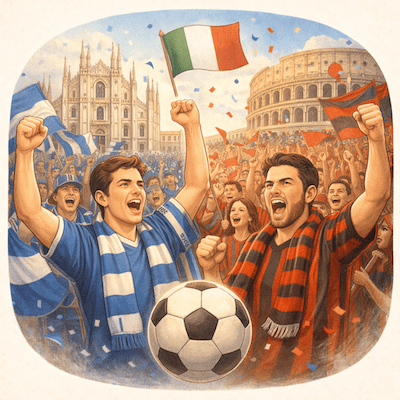
I derby sono i giorni di massima tensione: Inter contro Milan è il 'derby della Madonnina', Roma contro Lazio il 'derby della Capitale', Juventus contro Torino il 'derby della Mole'. Chi vince può prendere in giro colleghi e amici della squadra avversaria per mesi.
Derbies are the days of greatest tension: Inter against Milan is the 'derby della Madonnina', Roma against Lazio the 'derby della Capitale', Juventus against Torino the 'derby della Mole'. Whoever wins can tease colleagues and friends who support the other side for months.
Gli Azzurri, quando l'Italia si ferma
The Azzurri: When Italy Stops
C'è però un momento in cui le rivalità si dimenticano: quando gioca la Nazionale. I giocatori sono chiamati 'gli Azzurri' per il colore della maglia, l'azzurro di Casa Savoia, la famiglia reale che unificò l'Italia.
There is one moment, though, when rivalries are forgotten: when the national team plays. The players are called 'the Azzurri' after the colour of their shirts, the blue of the House of Savoy, the royal family that unified Italy.
L'Italia ha vinto quattro Mondiali (1934, 1938, 1982 e 2006) e due Europei (1968 e 2021). Nelle notti delle partite importanti le piazze si riempiono di bandiere tricolori, e un Paese di quasi 60 milioni di persone canta come un unico coro.
Italy has won four World Cups (1934, 1938, 1982 and 2006) and two European Championships (1968 and 2021). On the nights of big matches the squares fill with tricolour flags, and a country of almost 60 million people sings as a single choir.
Il bar sport, il parlamento del calcio
The Sports Bar, Football's Parliament
Il posto dove il calcio vive ogni giorno è il bar. Davanti a un caffè o a un aperitivo si discute senza fine di schemi, di errori dell'arbitro e di calciomercato.
The place where football lives every day is the bar. Over a coffee or an aperitivo people argue endlessly about tactics, refereeing mistakes and the transfer market.
Si dice che l'Italia abbia sessanta milioni di commissari tecnici: ogni tifoso è convinto di sapere meglio dell'allenatore chi deve giocare e come si vince la partita.
They say Italy has sixty million national team managers: every fan is convinced they know better than the coach who should play and how to win the match.
Lingua e calcio: metafore di tutti i giorni
Language and Football: Everyday Metaphors
Il calcio è entrato anche nella lingua di tutti i giorni. Molte espressioni nate sul campo si usano al lavoro, in famiglia e perfino in politica.
Football has also found its way into everyday language. Many expressions born on the pitch are used at work, at home and even in politics.
'Salvarsi in corner' vuol dire cavarsela all'ultimo momento. 'Fare melina' significa perdere tempo, come i giocatori che si passano la palla senza attaccare. E 'entrare a gamba tesa' vuol dire intervenire in modo duro e aggressivo in una discussione.
'Salvarsi in corner' (to save yourself with a corner) means to get out of trouble at the last moment. 'Fare melina' means to stall for time, like players who pass the ball around without attacking. And 'entrare a gamba tesa' (to go in with a straight leg) means to weigh into a discussion in a harsh, aggressive way.
Leggende immortali
Immortal Legends
L'Italia ha prodotto alcuni dei più grandi calciatori della storia: Roberto Baggio, il 'Divin Codino', famoso per il suo codino e per la sua classe; Francesco Totti, che giocò tutta la carriera nella Roma; Paolo Maldini, che difese i colori del Milan per 25 stagioni.
Italy has produced some of the greatest footballers in history: Roberto Baggio, the 'Divine Ponytail', famous for his ponytail and his elegance; Francesco Totti, who spent his whole career at Roma; and Paolo Maldini, who wore Milan's colours for 25 seasons.
Questi giocatori sono rispettati anche dai tifosi delle squadre avversarie. Totti e Maldini, in particolare, sono il simbolo di una cosa sempre più rara nel calcio moderno: la fedeltà a una sola maglia.
These players are respected even by rival fans. Totti and Maldini in particular stand for something increasingly rare in modern football: loyalty to a single shirt.
Il vocabolario del tifoso
The Fan's Vocabulary
Ecco alcune parole indispensabili per sopravvivere a una domenica di campionato in Italia:
Here are a few words you'll need to survive a league Sunday in Italy:
Tifoso: chi sostiene con passione una squadra (dal verbo 'tifare').
Tifoso: someone who passionately supports a team (from the verb 'tifare').
Curva: il settore dietro la porta dove stanno i tifosi più accesi e organizzati.
Curva: the section behind the goal where the most fervent, organised fans stand.
Fuorigioco: la posizione irregolare di un attaccante oltre l'ultimo difensore (offside).
Fuorigioco: the illegal position of an attacker beyond the last defender (offside).
Scudetto: il piccolo scudo tricolore che la squadra campione d'Italia porta sulla maglia nella stagione successiva.
Scudetto: the small tricolour shield that the Italian champions wear on their shirts the following season.
Rete o gol: quando la palla entra nella porta avversaria.
Rete or gol: when the ball goes into the opponents' net.
Il calcio e l'economia
Football and the Economy
Oltre alla passione, il calcio è un'industria. I diritti televisivi della Serie A valgono centinaia di milioni di euro all'anno, e a questi si aggiungono sponsor, biglietti e magliette vendute in tutto il mondo.
Passion aside, football is an industry. Serie A's television rights are worth hundreds of millions of euros a year, on top of sponsorship, tickets and shirts sold all over the world.
Alcuni club, come la Juventus e la Lazio, sono quotati in Borsa, e oggi diverse grandi squadre, tra cui Milan, Inter e Roma, appartengono a fondi o imprenditori americani.
Some clubs, such as Juventus and Lazio, are listed on the stock exchange, and today several big teams, including Milan, Inter and Roma, are owned by American funds or businessmen.
Il fantacalcio, la passione virtuale
Fantacalcio: Virtual Passion
Il fantacalcio, inventato in Italia nel 1990 da Riccardo Albini, è un gioco in cui gruppi di amici si 'comprano' i calciatori veri con un'asta e formano squadre virtuali. Dopo ogni giornata, milioni di persone controllano i voti dati ai giocatori dai giornali sportivi.
Fantacalcio, invented in Italy in 1990 by Riccardo Albini, is a game in which groups of friends 'buy' real players at an auction and form virtual teams. After every round of matches, millions of people check the marks given to the players by the sports papers.
Il gioco ha creato situazioni curiose: c'è chi esulta per un gol subito dalla propria squadra del cuore, solo perché a segnare è stato un attaccante della sua squadra di fantacalcio.
The game has created some odd situations: some people cheer a goal scored against the team they love, just because the scorer is a striker in their fantacalcio team.
Lo stadio come monumento
The Stadium as a Monument
Stadi come San Siro a Milano, inaugurato nel 1926, o l'Olimpico di Roma, sede delle Olimpiadi del 1960, sono considerati 'templi' del calcio. Hanno ospitato finali europee, la finale dei Mondiali del 1990 all'Olimpico e grandi concerti.
Stadiums such as San Siro in Milan, opened in 1926, and Rome's Stadio Olimpico, home of the 1960 Olympics, are seen as 'temples' of football. They have hosted European finals, the 1990 World Cup final at the Olimpico, and big concerts.
Molti stadi italiani però sono vecchi, scomodi e spesso di proprietà dei comuni. Da anni si discute di costruirne di nuovi, ma per i tifosi questi luoghi restano pieni di ricordi, di cori e di partite indimenticabili.
Many Italian stadiums, though, are old, uncomfortable and often owned by the city councils. There has been talk of building new ones for years, but for fans these places are still full of memories, chants and unforgettable matches.
Conclusione
Conclusion
Il calcio in Italia somiglia al Paese: passionale, rumoroso, a volte caotico, ma raramente indifferente.
Football in Italy resembles the country itself: passionate, noisy, sometimes chaotic, but rarely indifferent.
Per chi studia l'italiano, sapere il nome di una squadra e il risultato dell'ultima partita è un ottimo modo per rompere il ghiaccio. Basta chiedere 'Per chi tifi?' e la conversazione è assicurata.
For learners of Italian, knowing the name of a team and the score of the last match is a great way to break the ice. Just ask 'Per chi tifi?' (Who do you support?) and you're guaranteed a conversation.
In the free app you can listen to this text read aloud and tap any word to see what it means.