Parlare con le mani
Speaking with your hands
 Learn ItalianFree app with audio, quizzes and real books
Key words
- gestualitàgesticulation / gestures
- sfumaturenuances / shades
- affollaticrowded
- raggruppategrouped / bunched
- scetticismoskepticism
- ampiezzawidth / breadth / amplitude
- rassegnazioneresignation
- bruscoabrupt / sudden
- fastidioannoyance / bother
- guanciacheek
- a puntinoto perfection / spot on
- furboclever / cunning / sly
All 25 words
- indifferenzaindifference
- scacciareto drive away / to ward off
- infedeleunfaithful
- cautelacaution / prudence
- agitareto wave / to shake / to agitate
- sinceritàsincerity
- oscillawobbles / oscillates
- strofinanothey rub
- furbiziashrewdness / cunning
- teatralitheatrical
- contenutirestrained / contained
- dotetalent / gift / dowry
- inesprimibileinexpressible
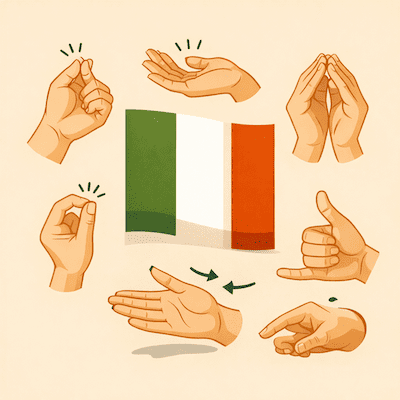
In Italia il silenzio non è mai del tutto silenzioso. Anche quando nessuno dice una parola, le mani, le spalle e il viso continuano a parlare.
In Italy, silence is never entirely silent. Even when nobody says a word, hands, shoulders and faces keep on talking.
I gesti italiani sono quasi un vocabolario parallelo: un codice che tutti conoscono e che aggiunge enfasi, emozioni e sfumature a ogni conversazione. La studiosa Isabella Poggi ne ha contati circa 250.
Italian gestures are almost a parallel vocabulary: a code that everyone knows and that adds emphasis, emotion and nuance to every conversation. The researcher Isabella Poggi has counted around 250 of them.
Perché gli italiani gesticolano così tanto?
Why Do Italians Gesture So Much?
Nessuno lo sa con certezza, ma le spiegazioni non mancano. Già nel 1832 il canonico napoletano Andrea de Jorio scrisse un libro per dimostrare che molti gesti di Napoli erano gli stessi degli antichi greci e romani.
Nobody knows for sure, but there is no shortage of explanations. As early as 1832 the Neapolitan canon Andrea de Jorio wrote a book to show that many Neapolitan gestures were the same as those of the ancient Greeks and Romans.
Un'altra teoria guarda alla storia più recente: per secoli l'Italia fu divisa in tanti stati, con dialetti molto diversi tra loro. Nei mercati affollati, tra persone che a parole non si capivano bene, i gesti diventavano una lingua comune.
Another theory looks at more recent history: for centuries Italy was split into many states, with dialects that were very different from one another. In crowded markets, among people who could not understand each other well in words, gestures became a common language.
La "mano a borsa": il gesto più famoso
The "Mano a Borsa": The Most Famous Gesture
Se c'è un gesto che rappresenta l'Italia nel mondo, è la mano con le punte delle dita unite e rivolte verso l'alto, mossa su e giù. Si chiama "mano a borsa" o "a pigna", e dal 2020 esiste perfino come emoji.
If one gesture stands for Italy around the world, it is the hand with the fingertips pressed together and pointing upwards, moved up and down. It is called the "mano a borsa" (purse hand) or "a pigna" (pine-cone hand), and since 2020 it has even existed as an emoji.
Contrariamente a quanto pensano molti stranieri, non ha niente a che fare con il cibo. Significa "Ma che dici?" o "Ma che vuoi?" ed esprime impazienza o incredulità verso chi parla.
Contrary to what many foreigners think, it has nothing to do with food. It means "What are you talking about?" or "What do you want?" and expresses impatience or disbelief towards the speaker.
La precisione del movimento
Precision of Movement
Per un italiano gesticolare non significa muovere le mani a caso. Velocità, ampiezza e forza del movimento possono cambiare del tutto il senso del messaggio.
For an Italian, gesturing does not mean waving your hands about at random. The speed, size and force of a movement can completely change the meaning of the message.
La stessa mano a borsa, mossa lentamente, può accompagnare una domanda quasi gentile; scossa in fretta, a pochi centimetri dal naso di qualcuno, diventa un segno di rabbia.
The same purse hand, moved slowly, can go with an almost polite question; shaken quickly a few centimetres from someone's nose, it becomes a sign of anger.
Gesti di apprezzamento: il cibo
Gestures of Appreciation: Food
Quando un italiano vuole dire che un piatto è squisito, raramente si accontenta delle parole. Premere l'indice sulla guancia e ruotarlo avanti e indietro significa "Buonissimo!".
When an Italian wants to say a dish is delicious, words alone are rarely enough. Pressing your index finger into your cheek and twisting it back and forth means "Delicious!"
Un altro gesto comune è unire la punta del pollice e quella dell'indice e tracciare nell'aria una linea orizzontale: vuol dire che qualcosa è perfetto, cucinato proprio "a puntino".
Another common gesture is to join the tips of the thumb and index finger and draw a horizontal line in the air: it means something is perfect, cooked just right, "a puntino".
Gesti di avvertimento
Warning Gestures
Chi si tira giù con l'indice la pelle sotto l'occhio vuole dire: "Occhio, stai attento!", oppure "Quello è un furbo, non fidarti".
Someone who pulls down the skin under their eye with their index finger means: "Watch out, be careful!" or "That one's a sly one, don't trust him."
Passare il dorso delle dita sotto il mento, dal collo verso l'esterno, significa invece "Non me ne importa niente". È un gesto di totale indifferenza, e non proprio educato.
Brushing the back of your fingers under your chin, from the neck outwards, means instead "I couldn't care less." It is a gesture of total indifference, and not exactly polite.
Le corna: un gesto dai mille significati
The Horns: A Gesture with a Thousand Meanings
Il gesto delle corna, con l'indice e il mignolo tesi, ha più di un significato. Rivolto verso il basso serve a scacciare la sfortuna e il malocchio, un po' come toccare ferro.
The horns gesture, with the index and little finger stretched out, has more than one meaning. Pointed downwards, it wards off bad luck and the evil eye, rather like touching wood.
Rivolto verso una persona, invece, è un insulto pesante: vuol dire che il suo partner la tradisce. Meglio usarlo con molta prudenza.
Pointed at a person, however, it is a serious insult: it means their partner is cheating on them. Best used with great care.
Gesti per mandare via qualcuno
Gestures for Sending Someone Away
Per mandare via qualcuno basta agitare più volte la mano verso l'esterno, con il palmo rivolto in basso, come per scacciare una mosca: "Sciò, vattene!".
To send someone away, you just flick your hand outwards a few times, palm down, as if shooing a fly: "Shoo, go away!"
Le mani giunte come in preghiera, agitate su e giù davanti al petto, sono invece una richiesta esasperata: "Ma che vuoi da me?" o "Ti prego, basta!".
Hands joined as if in prayer and shaken up and down in front of the chest are instead an exasperated plea: "What do you want from me?" or "Please, enough!"
L'importanza del contatto fisico
The Importance of Physical Contact
Spesso il gesto coinvolge anche l'altra persona. Toccare il braccio o la spalla di chi ascolta è un modo per tenerne viva l'attenzione e per creare un legame.
Often a gesture involves the other person too. Touching the listener's arm or shoulder is a way of holding their attention and creating a bond.
In Italia le persone che parlano stanno più vicine che nei paesi del Nord Europa, e il contatto fisico è visto come un segno di calore e di fiducia, non come un'invasione.
In Italy people stand closer together when they talk than in Northern European countries, and physical contact is seen as a sign of warmth and trust, not as an intrusion.
Un vocabolario senza suoni
A Vocabulary Without Sounds
Alcuni gesti sostituiscono intere frasi e permettono di comunicare a distanza, da un lato all'altro di una piazza o in un bar pieno di rumore.
Some gestures replace whole sentences and let people communicate from a distance, from one side of a square to the other or in a noisy bar.
Mano aperta che oscilla a destra e a sinistra: "così così", "più o meno".
Open hand rocking from side to side: "so-so", "more or less".
Pollice che si strofina contro l'indice e il medio: i soldi, oppure qualcosa che costa caro.
Thumb rubbing against the index and middle fingers: money, or something that costs a lot.
Mano tesa che batte sul fianco: "Ho fame!".
Flat hand tapping the side of the waist: "I'm hungry!"
Dita che si aprono e si chiudono come un becco: qualcuno parla troppo.
Fingers opening and closing like a beak: someone talks too much.
Mano che gira all'indietro sopra la spalla: "tanto tempo fa".
Hand rolling backwards over the shoulder: "a long time ago".
Gesti regionali: il Nord e il Sud
Regional Gestures: North and South
La gestualità cambia anche con la geografia. Al Sud, e soprattutto a Napoli, i gesti sono in genere più ampi, teatrali e frequenti; in Sicilia e in Calabria molti dicono "no" alzando il mento all'indietro, come si fa in Grecia.
Gestures also change with geography. In the South, and especially in Naples, gestures tend to be bigger, more theatrical and more frequent; in Sicily and Calabria many people say "no" by tilting their chin up and back, as they do in Greece.
Al Nord si gesticola meno e in modo più contenuto, ma i gesti principali sono gli stessi e li capiscono tutti, da Bolzano a Palermo.
In the North people gesture less and more discreetly, but the main gestures are the same and everyone understands them, from Bolzano to Palermo.
Conclusione: la musica del corpo
Conclusion: The Music of the Body
Nel 1958 il designer Bruno Munari pubblicò un "Supplemento al dizionario italiano", un piccolo libro di fotografie dedicato soltanto ai gesti. Da allora in molti hanno provato a catalogarli, ma nessuna lista è davvero completa.
In 1958 the designer Bruno Munari published a "Supplement to the Italian Dictionary", a small book of photographs devoted entirely to gestures. Many people have tried to catalogue them since, but no list is ever really complete.
Per chi studia l'italiano vale la pena guardare le mani oltre che ascoltare le parole. Spesso un gesto dice in un secondo quello che una frase direbbe in dieci parole.
For anyone learning Italian, it is worth watching the hands as well as listening to the words. A gesture often says in one second what a sentence would say in ten words.
In the free app you can listen to this text read aloud and tap any word to see what it means.