La Dolce Vita
La Dolce Vita: The economic boom
 Learn ItalianFree app with audio, quizzes and real books
Key words
- sfrecciadarts / speeds / whizzes
- macerierubble / ruins / debris
- vertiginosidizzying / skyrocketing
- inconfondibileunmistakable
- manifestomanifesto / poster / sign
- maestranzeskilled workers / workforce
- decadentedecadent
- percezioneperception
- divistars / idols / icons
- elettrodomesticihousehold appliances
- concepzioneconception / notion
- inimmaginabileunimaginable
All 25 words
- sartorietailors / tailor shops
- imperiempires
- irrinunciabileindispensable / essential / non-negotiable
- benesserewell-being / prosperity
- celebrareto celebrate
- assaltoassault / aggressive / rush
- catturareto capture / to catch
- sognodream
- casalinghehousewives
- spesagrocery shopping / expense
- rinascereto be reborn
- pulsantebeating / throbbing / button
- passeggerapassing / fleeting / passenger (fem.)
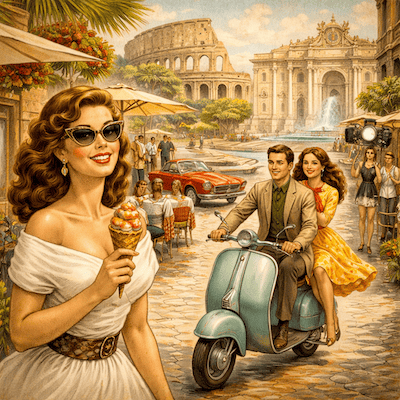
Per molti stranieri l'Italia è ancora una Vespa che sfreccia tra i vicoli di Roma, un caffè bevuto al sole in piazza, una diva in abito da sera. Quasi tutte queste immagini vengono dallo stesso periodo: gli anni del boom economico.
For many foreigners, Italy is still a Vespa zipping through the alleys of Rome, a coffee drunk in a sunny piazza, a film star in an evening gown. Almost all of these images come from the same period: the years of the economic boom.
Tra gli anni Cinquanta e i primi anni Sessanta l'Italia cambiò a una velocità mai vista. Un Paese ancora in gran parte contadino, uscito a pezzi dalla guerra, diventò in pochi anni una delle maggiori potenze industriali d'Europa.
Between the 1950s and the early 1960s, Italy changed at a speed never seen before. A country that was still largely rural, and had come out of the war in pieces, became one of Europe's leading industrial powers within a few years.
Dalle macerie al miracolo
From Rubble to Miracle
Nel 1945 l'Italia era in ginocchio: città bombardate, ponti e ferrovie distrutti, milioni di persone senza lavoro. Gli aiuti americani del Piano Marshall, arrivati a partire dal 1948, servirono a rimettere in moto le fabbriche.
In 1945 Italy was on its knees: bombed cities, ruined bridges and railways, millions of people out of work. American aid under the Marshall Plan, which began arriving in 1948, helped get the factories running again.
Tra il 1958 e il 1963 la produzione industriale crebbe così in fretta che i giornali cominciarono a parlare di "miracolo economico". Frigoriferi, televisori e automobili, fino a poco prima beni di lusso, entrarono nelle case di milioni di famiglie.
Between 1958 and 1963 industrial output grew so fast that the newspapers started talking about an "economic miracle". Fridges, televisions and cars, which had been luxuries until shortly before, found their way into millions of homes.
L'Italia su due ruote: la Vespa
Italy on Two Wheels: The Vespa
La Vespa nacque nel 1946 negli stabilimenti Piaggio di Pontedera, in Toscana. La progettò Corradino D'Ascanio, un ingegnere aeronautico che non amava le motociclette: le trovava scomode, sporche e difficili da riparare.
The Vespa was born in 1946 at the Piaggio works in Pontedera, Tuscany. It was designed by Corradino D'Ascanio, an aeronautical engineer who did not like motorcycles: he found them uncomfortable, dirty and hard to repair.
Nel suo scooter il motore era nascosto sotto la carrozzeria e si guidava stando seduti, anche in gonna o in giacca e cravatta. Quando Enrico Piaggio lo vide, pare abbia esclamato: "Sembra una vespa!". Nel 1956 uscì dalla fabbrica la Vespa numero un milione.
On his scooter the engine was hidden under the bodywork, and you rode it sitting down, even in a skirt or a jacket and tie. When Enrico Piaggio saw it, he is said to have exclaimed: "It looks like a wasp!" In 1956 the millionth Vespa left the factory.
Cinecittà: la Hollywood sul Tevere
Cinecittà: Hollywood on the Tiber
Gli studi di Cinecittà, inaugurati nel 1937, dopo la guerra attirarono le grandi case di produzione americane: a Roma girare costava meno e le maestranze erano bravissime. Qui furono realizzati kolossal come "Quo vadis?" (1951) e "Ben-Hur" (1959).
After the war the Cinecittà studios, opened in 1937, drew the big American production companies: filming in Rome was cheaper and the crews were excellent. Epics such as "Quo Vadis" (1951) and "Ben-Hur" (1959) were made here.
Le star di Hollywood passavano le serate in Via Veneto, tra caffè e alberghi di lusso. Audrey Hepburn e Gregory Peck girarono a Roma "Vacanze romane" (1953), e il loro giro in Vespa per la città diventò una delle scene più famose del film.
Hollywood stars spent their evenings on Via Veneto, among cafés and luxury hotels. Audrey Hepburn and Gregory Peck shot "Roman Holiday" (1953) in Rome, and their Vespa ride through the city became one of the film's most famous scenes.
Federico Fellini e la nascita di un mito
Federico Fellini and the Birth of a Myth
Fu Federico Fellini a dare un nome a quell'atmosfera, con il film "La dolce vita" del 1960. Marcello Mastroianni vi interpreta un giornalista che passa le notti tra feste, nobili annoiati e attrici famose, in una Roma elegante ma un po' vuota.
It was Federico Fellini who gave that atmosphere a name, with his 1960 film "La Dolce Vita". Marcello Mastroianni plays a journalist who spends his nights among parties, bored aristocrats and famous actresses, in a Rome that is elegant but somewhat empty.
La scena in cui Anita Ekberg entra di notte nella Fontana di Trevi è una delle più celebri della storia del cinema. Il film vinse la Palma d'oro a Cannes e per decenni influenzò il modo in cui il mondo immaginava l'Italia.
The scene where Anita Ekberg wades into the Trevi Fountain at night is one of the most famous in film history. The film won the Palme d'Or at Cannes and for decades shaped the way the world pictured Italy.
I paparazzi e la cultura delle celebrità
Paparazzi and Celebrity Culture
La parola "paparazzo" viene proprio da questo film: Paparazzo è il cognome del fotografo che accompagna il protagonista. In quegli anni i fotografi aspettavano i divi fuori dai locali di Via Veneto, pronti a scattare una foto rubata o, meglio ancora, a cogliere una lite.
The word "paparazzo" comes from this very film: Paparazzo is the surname of the photographer who goes around with the main character. In those years photographers waited for the stars outside the bars of Via Veneto, ready to snap a candid shot or, even better, catch a quarrel.
Le loro foto finivano sui settimanali illustrati che gli italiani compravano in edicola. Così anche chi non era mai stato a Roma si convinse che lì la vita fosse più bella e più divertente che altrove.
Their photos ended up in the illustrated weeklies that Italians bought at the newsstand. So even people who had never been to Rome became convinced that life there was more beautiful and more fun than anywhere else.
La rivoluzione degli elettrodomestici
The Household Appliance Revolution
Il benessere non era solo per i ricchi. Nelle case entrarono i primi frigoriferi e le prime lavatrici, prodotti da aziende italiane come Ignis, Zanussi e Candy. All'inizio degli anni Sessanta l'Italia era già uno dei maggiori produttori di frigoriferi d'Europa.
Prosperity was not just for the rich. The first fridges and washing machines arrived in people's homes, made by Italian companies such as Ignis, Zanussi and Candy. By the early 1960s Italy was already one of Europe's biggest refrigerator makers.
Per le donne, che facevano quasi tutto il lavoro di casa, fu un cambiamento enorme: niente più bucato a mano al lavatoio, niente più spesa ogni mattina, perché ora il cibo si conservava. Restava finalmente un po' di tempo per sé.
For women, who did almost all the housework, it was a huge change: no more washing by hand at the public wash house, no more shopping every morning, because food now kept. At last there was a little time for themselves.
La Fiat 500: l'auto per tutti
The Fiat 500: A Car for Everyone
Se la Vespa aveva messo l'Italia su due ruote, la Fiat 500 la mise su quattro. Presentata nel 1957 e progettata dall'ingegnere Dante Giacosa, era lunga meno di tre metri, consumava poco e costava molto meno delle altre automobili.
If the Vespa had put Italy on two wheels, the Fiat 500 put it on four. Launched in 1957 and designed by the engineer Dante Giacosa, it was less than three metres long, used little fuel and cost much less than other cars.
Con la "cinquecento" una famiglia poteva finalmente andare al mare la domenica o in agosto, un lusso impensabile solo dieci anni prima. La macchina rimase in produzione fino al 1975.
With the "cinquecento" a family could finally go to the seaside on a Sunday or in August, a luxury unthinkable just ten years earlier. The car stayed in production until 1975.
La nascita del Made in Italy
The Birth of Made in Italy
In questi anni il design italiano conquistò il mondo. L'idea era semplice: anche un oggetto di tutti i giorni poteva essere bello, oltre che utile. Nel 1954 nacque il Compasso d'oro, ancora oggi il premio più importante del design italiano.
In these years Italian design conquered the world. The idea was simple: an everyday object could be beautiful as well as useful. The Compasso d'Oro was founded in 1954, and it is still the most important Italian design award.
Le macchine per scrivere della Olivetti, le lampade, le sedie e le macchine per il caffè espresso finirono nelle case e nei musei di tutto il mondo. La Lettera 22 della Olivetti, per esempio, fa parte della collezione del MoMA di New York.
Olivetti typewriters, lamps, chairs and espresso machines found their way into homes and museums all over the world. Olivetti's Lettera 22, for example, is part of the collection of MoMA in New York.
Icone di stile: la moda e le dive
Style Icons: Fashion and Film Stars
Sophia Loren e Gina Lollobrigida diventarono i volti della bellezza italiana nel mondo. Le sartorie romane, come quella delle Sorelle Fontana, vestivano attrici e principesse: nel 1949 fu loro l'abito da sposa di Linda Christian per le nozze con Tyrone Power.
Sophia Loren and Gina Lollobrigida became the faces of Italian beauty around the world. Roman dressmakers such as the Fontana sisters dressed actresses and princesses: in 1949 they made Linda Christian's wedding dress for her marriage to Tyrone Power.
Il 12 febbraio 1951 l'imprenditore Giovanni Battista Giorgini organizzò a Firenze la prima sfilata di moda italiana per i compratori americani. Fu l'inizio dell'alta moda italiana come la conosciamo; nel 1959 Valentino Garavani aprì il suo atelier a Roma, in Via Condotti.
On 12 February 1951 the businessman Giovanni Battista Giorgini held the first Italian fashion show in Florence for American buyers. It marked the start of Italian high fashion as we know it; in 1959 Valentino Garavani opened his atelier in Rome, on Via Condotti.
Il rito del tempo libero
The Ritual of Free Time
Con il benessere nacquero nuove abitudini. Nei bar arrivarono i juke-box, i giovani impararono a ballare il rock and roll e il Festival di Sanremo, nato nel 1951, diventò un appuntamento fisso. Nel 1958 tutta l'Italia cantava "Nel blu dipinto di blu" di Domenico Modugno.
Prosperity brought new habits. Jukeboxes appeared in bars, young people learned to dance rock and roll, and the Sanremo Festival, founded in 1951, became a fixed date in the calendar. In 1958 the whole of Italy was singing Domenico Modugno's "Nel blu dipinto di blu".
D'estate milioni di persone scoprirono le vacanze al mare, sulla riviera romagnola o in Liguria. Dopo la dittatura e la guerra, la gente voleva soprattutto godersi la vita di tutti i giorni.
In summer millions of people discovered seaside holidays on the Romagna coast or in Liguria. After the dictatorship and the war, what people wanted most was to enjoy everyday life.
Curiosità del boom
Boom-Era Trivia
"Paparazzo" era il cognome di un personaggio del film di Fellini.
"Paparazzo" was the surname of a character in Fellini's film.
La Vespa fu progettata da Corradino D'Ascanio, un ingegnere che non amava le moto.
The Vespa was designed by Corradino D'Ascanio, an engineer who did not like motorbikes.
L'Autostrada del Sole, da Milano a Napoli, fu inaugurata nel 1964 dopo otto anni di lavori.
The Autostrada del Sole, from Milan to Naples, opened in 1964 after eight years of work.
Le trasmissioni regolari della televisione italiana iniziarono il 3 gennaio 1954.
Regular Italian television broadcasts began on 3 January 1954.
Nel 1957 a Milano aprì il primo supermercato italiano.
Italy's first supermarket opened in Milan in 1957.
Conclusione
Conclusion
A metà degli anni Sessanta il miracolo rallentò e arrivarono anni più difficili. L'immagine nata in quel periodo però è rimasta: la Vespa, la 500, Via Veneto e la Fontana di Trevi sono ancora ciò a cui molti stranieri pensano quando sentono la parola "Italia".
By the mid-1960s the miracle had slowed down and harder years followed. But the image born in that period has stayed: the Vespa, the 500, Via Veneto and the Trevi Fountain are still what many foreigners think of when they hear the word "Italy".
Ancora oggi l'espressione "dolce vita" si usa in molte lingue, dall'inglese al tedesco, per indicare una vita piacevole e senza troppe preoccupazioni.
Even today the phrase "dolce vita" is used in many languages, from English to German, to mean a pleasant life without too many worries.
In the free app you can listen to this text read aloud and tap any word to see what it means.