L'Aperitivo
L'Aperitivo: The art of opening the appetite
 Learn ItalianFree app with audio, quizzes and real books
Key words
- ritualeritual
- convivialitàconviviality
- stimolareto stimulate
- appetitoappetite
- aromatizzatoflavored / aromatic
- vibrantevibrant
- decisostrong / bold / decisive
- allungarlito dilute them / to stretch them
- frizzantesparkling / fizzy
- osteriatavern / inn
- stuzzichinisnacks / appetizers
- piluccareto nibble / to pick at food
All 25 words
- nocciolinepeanuts
- affettatisliced / cold cuts
- esagerareto exaggerate / to overdo
- territorioterritory
- sofisticatesophisticated
- precursoreprecursor / forerunner
- analcolicanon-alcoholic
- sciroppisyrups
- staccare la spinato unplug / to switch off
- roccafortistrongholds
- sopravvivesurvives
- integrarvito integrate yourself
- dimostrazionedemonstration / proof
Se c'è un momento della giornata che racconta bene lo stile di vita italiano, è l'aperitivo. Non è solo un bicchiere prima di cena: è l'ora in cui si chiude con il lavoro e ci si ritrova con gli amici.
If there's one moment of the day that captures the Italian way of life, it's the aperitivo. It isn't just a drink before dinner: it's the hour when work is done and people meet up with friends.
Un tempo era un'abitudine dei caffè eleganti frequentati dalla borghesia. Oggi, verso sera, i tavolini all'aperto si riempiono in tutte le città, dai quartieri universitari alle piazze del centro.
It used to be a habit of elegant cafés frequented by the middle classes. Today, towards evening, outdoor tables fill up in every town, from student neighbourhoods to the squares in the centre.
L'etimologia: aprire lo stomaco
The etymology: opening the stomach
La parola 'aperitivo' viene dal latino 'aperire', cioè 'aprire'. L'idea è proprio questa: una bevanda che 'apre lo stomaco', cioè fa venire fame e prepara alla cena.
The word 'aperitivo' comes from the Latin 'aperire', meaning 'to open'. That's exactly the idea: a drink that 'opens the stomach', in other words makes you hungry and gets you ready for dinner.
Per questo i drink dell'aperitivo sono di solito secchi o amari. Secondo la tradizione, il gusto amaro stimola l'appetito, mentre quello dolce tende a toglierlo.
That is why aperitivo drinks are usually dry or bitter. According to tradition, a bitter taste stimulates the appetite, while a sweet one tends to take it away.
Torino e la nascita del vermut
Turin and the birth of vermouth
La storia moderna dell'aperitivo comincia a Torino. Nel 1786 Antonio Benedetto Carpano, nella sua bottega in piazza Castello, creò il vermut: un vino bianco aromatizzato con erbe e spezie.
The modern history of the aperitivo begins in Turin. In 1786 Antonio Benedetto Carpano, in his shop on Piazza Castello, created vermouth: a white wine flavoured with herbs and spices.
Il nome viene dal tedesco Wermut, cioè assenzio, una delle erbe della ricetta. Il successo fu enorme, e Torino diventò la capitale del vermut, con marchi che esistono ancora oggi, come Cinzano e Martini.
The name comes from the German Wermut, wormwood, one of the herbs in the recipe. It was a huge success, and Turin became the capital of vermouth, with brands that still exist today, such as Cinzano and Martini.
Milano e il successo del bitter
Milan and the rise of bitters
Nella seconda metà dell'Ottocento anche Milano entrò in scena. Gaspare Campari, che nel 1860 aveva inventato a Novara il suo bitter rosso, nel 1867 aprì un caffè nella nuova Galleria Vittorio Emanuele II, accanto al Duomo.
In the second half of the nineteenth century Milan joined in too. Gaspare Campari, who had invented his red bitter in Novara in 1860, opened a café in 1867 in the new Galleria Vittorio Emanuele II, next to the cathedral.
Milano ha fatto dell'aperitivo un rito di massa. Negli ultimi decenni qui si è diffusa l'apericena: con un drink si ha accesso a un buffet così ricco che spesso prende il posto della cena.
Milan turned the aperitivo into a mass ritual. In recent decades the apericena has spread here: one drink gets you access to a buffet so generous that it often replaces dinner.
Il re indiscusso: lo spritz
The undisputed king: the spritz
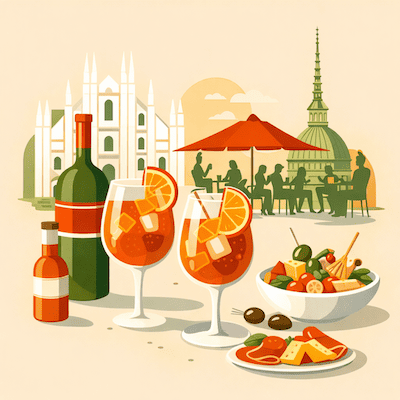
Oggi, quando si parla di aperitivo, si pensa subito allo spritz. Le sue origini risalgono all'Ottocento, quando il Veneto faceva parte dell'Impero austriaco e i soldati trovavano i vini locali troppo forti.
Today, when people talk about the aperitivo, the spritz is the first thing that comes to mind. Its origins go back to the nineteenth century, when the Veneto was part of the Austrian Empire and the soldiers found the local wines too strong.
Per renderli più leggeri, li allungavano con un po' d'acqua frizzante: in tedesco 'spritzen' vuol dire 'spruzzare'. Solo nel Novecento si aggiunsero i bitter, come l'Aperol, nato a Padova nel 1919, o il Campari, e il drink prese il suo colore arancione o rosso.
To make them lighter, they topped them up with a splash of sparkling water: in German 'spritzen' means 'to spray'. Only in the twentieth century were bitters added, such as Aperol, created in Padua in 1919, or Campari, giving the drink its orange or red colour.
Venezia e i cicchetti
Venice and cicchetti
L'aperitivo più tradizionale si trova a Venezia. Qui si fa il 'giro dei bacari', le piccole osterie della città, dove si beve un'ombra, cioè un bicchiere di vino, in piedi al banco.
The most traditional aperitivo is found in Venice. Here people do the 'giro dei bacari', a round of the city's small taverns, where they drink an 'ombra', a glass of wine, standing at the counter.
Con il vino o con lo spritz arrivano i cicchetti, piccoli assaggi come i crostini con il baccalà mantecato, le polpette o le sarde in saor, cioè sarde con cipolla in agrodolce. Si mangia bene senza mai sedersi a tavola.
With the wine or the spritz come cicchetti, little bites such as crostini with creamed salt cod, meatballs or sarde in saor, sardines with sweet-and-sour onions. You eat well without ever sitting down at a table.
Lo stuzzichino: il compagno ideale
Stuzzichini: the perfect companion
L'aperitivo non è mai solo da bere. Con il drink arriva sempre qualcosa da piluccare: nei bar più semplici olive, patatine e noccioline.
The aperitivo is never just about drinking. A drink always comes with something to nibble: in simpler bars, olives, crisps and peanuts.
Nei locali più curati, invece, si trovano pezzetti di focaccia calda, piccoli tranci di pizza, formaggi del territorio e salumi tagliati al momento.
In more stylish places, on the other hand, you'll find pieces of warm focaccia, small slices of pizza, local cheeses and cured meats sliced to order.
Regole di comportamento
Rules of behaviour
Anche se è un momento informale, ci sono alcune regole di buona educazione. Se si è pagato un solo drink, per esempio, non si dovrebbe riempire il piatto al buffet come se fosse una cena.
Although it's an informal moment, there are a few rules of good manners. If you've paid for only one drink, for example, you shouldn't fill your plate at the buffet as if it were dinner.
Inoltre l'aperitivo ha un suo orario: di solito comincia verso le sei e mezza di sera e finisce intorno alle otto e mezza. Più tardi si entra nel territorio della cena.
The aperitivo also has its own time slot: it usually starts around half past six in the evening and ends around half past eight. Any later and you're in dinner territory.
I grandi classici: oltre lo spritz
The great classics: beyond the spritz
Per chi vuole provare qualcosa di diverso, l'Italia ha molti cocktail classici, ognuno con la sua storia.
For anyone who wants to try something different, Italy has plenty of classic cocktails, each with its own story.
Negroni: nato a Firenze verso il 1919, quando il conte Camillo Negroni chiese di rinforzare il suo Americano con il gin al posto della soda.
Negroni: born in Florence around 1919, when Count Camillo Negroni asked for his Americano to be strengthened with gin instead of soda.
Negroni sbagliato: nato al Bar Basso di Milano, dove un barista usò per errore lo spumante al posto del gin.
Negroni sbagliato: born at Bar Basso in Milan, where a bartender used sparkling wine instead of gin by mistake.
Americano: vermut rosso, Campari e soda; è l'antenato del Negroni.
Americano: red vermouth, Campari and soda; it is the ancestor of the Negroni.
Bellini: prosecco e polpa di pesca bianca, inventato nel 1948 da Giuseppe Cipriani all'Harry's Bar di Venezia.
Bellini: prosecco and white peach purée, invented in 1948 by Giuseppe Cipriani at Harry's Bar in Venice.
Crodino: l'aperitivo analcolico più famoso, amaro e frizzante, prende il nome da Crodo, un paese del Piemonte.
Crodino: the best-known alcohol-free aperitif, bitter and fizzy, named after Crodo, a village in Piedmont.
L'aperitivo analcolico
The alcohol-free aperitivo
Negli ultimi anni molte persone scelgono aperitivi senza alcol, per la salute o perché devono guidare. In Italia questo non significa rinunciare al rito.
In recent years many people have been choosing alcohol-free aperitivi, for their health or because they have to drive. In Italy this doesn't mean giving up the ritual.
Molti barman preparano cocktail analcolici elaborati, con succhi di agrumi freschi, sciroppi alle erbe e acqua tonica artigianale. Il bicchiere è bello come quello degli altri, e la compagnia è la stessa.
Many bartenders make elaborate alcohol-free cocktails with fresh citrus juice, herbal syrups and craft tonic water. The glass looks just as good as everyone else's, and the company is the same.
Un momento per staccare
A moment to switch off
Nell'aperitivo conta meno il drink e più la possibilità di 'staccare la spina'. Si parla di calcio, di politica, delle vacanze, o semplicemente si ride con gli amici.
With the aperitivo, the drink matters less than the chance to 'unplug'. People talk about football, politics or holidays, or simply laugh with friends.
Si guarda meno il telefono e si chiacchiera di più. Per molti italiani è l'ora più piacevole della giornata.
People look at their phones less and chat more. For many Italians it's the nicest hour of the day.
Prima di cena
Before dinner
Se andate in Italia, prendetevi il tempo per un aperitivo. Ordinate uno spritz, un Crodino o un bicchiere di vino, e lasciate che la serata cominci con calma.
If you go to Italy, take the time for an aperitivo. Order a spritz, a Crodino or a glass of wine, and let the evening begin slowly.
E se il barista vi chiede 'Lo vuole con l'Aperol o con il Campari?', ora sapete che cosa rispondere.
And if the bartender asks you 'Lo vuole con l'Aperol o con il Campari?', 'Aperol or Campari?', now you know what to answer.
In the free app you can listen to this text read aloud and tap any word to see what it means.