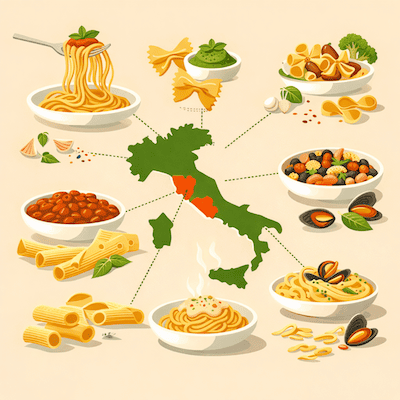
Formati di pasta
Pasta Shapes: Form follows function
 Learn ItalianFree app with audio, quizzes and real books
Key words
- casualeaccidental / random
- scanalaturagroove / ridge / flute
- condimentosauce / seasoning / dressing
- trattenereto hold / to retain / to keep back
- avvolgentienveloping / cozy / wrapping
- abbinamentopairing / matching / combination
- peccato mortalemortal sin
- vongoleclams
- setosasilky
- porosaporous
- ruvidarough / coarse
- aggrappareto grab / to cling / to grip
All 25 words
- intrappolatraps / ensnares
- concavaconcave
- cavohollow
- schizzanothey splash / they squirt
- impareggiabileunparalleled / matchless
- semolasemolina
- ripienofilling / stuffed
- scrignichests / caskets / caskets of treasure
- trafilaturaextrusion / drawing
- amidostarch
- scaffaleshelf / rack
- ingegneristicoengineering (adj.)
- immersioneimmersion
Chi viene da fuori resta spesso a bocca aperta davanti agli scaffali di un supermercato italiano: i formati di pasta sono più di trecento. Sembra un'esagerazione, ma per un italiano la scelta tra spaghetti e penne non è mai casuale.
Visitors are often left open-mouthed in front of the shelves of an Italian supermarket: there are more than three hundred pasta shapes. It looks like overkill, but for an Italian the choice between spaghetti and penne is never random.
In cucina vale una regola semplice: la forma segue la funzione. Ogni curva, buco o scanalatura serve a trattenere un certo tipo di condimento, così che in ogni boccone ci sia la giusta quantità di pasta e di sugo.
In the kitchen a simple rule applies: form follows function. Every curve, hole or groove is there to hold a certain kind of sauce, so that every mouthful has the right amount of pasta and sauce.
La scienza del sugo
The Science of Sauce
La superficie della pasta decide quanto sugo riuscirà a "catturare". La pasta rigata, per esempio, trattiene bene i sughi più liquidi, mentre quella liscia si abbina meglio a condimenti cremosi, che la avvolgono.
The surface of the pasta decides how much sauce it will "catch". Ridged pasta, for example, holds runnier sauces well, while smooth pasta goes better with creamy sauces that coat it.
Con l'abbinamento sbagliato si rischia di finire il piatto con la pasta da una parte e tutto il sugo sul fondo. Per molti italiani è quasi un peccato.
Get the pairing wrong and you risk finishing the dish with the pasta on one side and all the sauce at the bottom. To many Italians, that is almost a sin.
Pasta lunga: eleganza e semplicità
Long Pasta: Elegance and Simplicity
Gli spaghetti sono il formato più famoso del mondo. Lisci e sottili, stanno benissimo con condimenti semplici a base di olio, aglio o pomodoro fresco.
Spaghetti is the most famous pasta shape in the world. Smooth and thin, it goes beautifully with simple sauces based on oil, garlic or fresh tomato.
Due grandi classici sono la carbonara, con guanciale, uova, pecorino e pepe, e gli spaghetti alle vongole. In tutti e due i casi il condimento deve formare una crema leggera che avvolge ogni filo senza appesantirlo.
Two great classics are carbonara, with guanciale, eggs, pecorino and pepper, and spaghetti with clams. In both cases the sauce has to form a light cream that coats every strand without weighing it down.
Le tagliatelle e la forza dell'uovo
Tagliatelle and the Power of Egg
In Emilia-Romagna la pasta tradizionale è quella all'uovo, tirata a mano con il mattarello. Le tagliatelle hanno una superficie più porosa e ruvida degli spaghetti, e nel 1972 la loro larghezza ideale fu perfino depositata alla Camera di commercio di Bologna: otto millimetri, una volta cotte.
In Emilia-Romagna the traditional pasta is egg pasta, rolled out by hand with a rolling pin. Tagliatelle have a more porous, rougher surface than spaghetti, and in 1972 their ideal width was even officially deposited at the Bologna Chamber of Commerce: eight millimetres, once cooked.
Proprio questa porosità permette al ragù di "aggrapparsi" alla pasta. Un sugo così ricco di carne scivolerebbe via da uno spaghetto liscio, mentre sulle tagliatelle resta attaccato fino all'ultimo boccone.
It is precisely this porousness that lets ragù "cling" to the pasta. Such a meaty sauce would slide off smooth spaghetti, but on tagliatelle it stays put down to the last mouthful.
Pasta corta: le regine del sugo
Short Pasta: Queens of Sauce
Penne rigate e fusilli sono perfetti per i sughi con pezzetti di verdura o di carne. La spirale del fusillo funziona come una vite e trattiene il condimento tra le sue curve.
Penne rigate and fusilli are perfect for sauces with small pieces of vegetables or meat. The fusillo's spiral works like a screw and traps the sauce in its curves.
Le penne, con il buco al centro e le righe all'esterno, si riempiono di sugo dentro e fuori. Non a caso sono il formato classico dell'arrabbiata, il sugo romano di pomodoro, aglio e peperoncino.
Penne, with their hole in the middle and ridges on the outside, fill up with sauce inside and out. No wonder they are the classic shape for arrabbiata, the Roman sauce of tomato, garlic and chilli.
Orecchiette: piccole orecchie pugliesi
Orecchiette: Little Ears from Puglia
In Puglia la pasta più famosa sono le orecchiette. Nei vicoli di Bari Vecchia molte donne le fanno ancora a mano davanti alla porta di casa, trascinando un pezzetto di impasto con la punta di un coltello.
In Puglia the most famous pasta is orecchiette. In the alleys of Bari Vecchia many women still make them by hand outside their front doors, dragging a small piece of dough with the tip of a knife.
La forma concava e la superficie ruvida sono perfette per le cime di rapa: la piccola conca funziona come un cucchiaio e raccoglie la verdura, l'olio, l'aglio e il peperoncino.
The concave shape and rough surface are perfect for turnip tops: the little hollow works like a spoon and scoops up the greens, oil, garlic and chilli.
I formati "bucati" e la cucina romana
Pasta with Holes and Roman Cooking
A Roma uno dei formati più amati è il bucatino: sembra uno spaghetto grosso, ma all'interno ha un piccolo buco. È la pasta classica dell'amatriciana, con guanciale, pomodoro e pecorino.
In Rome one of the best-loved shapes is the bucatino: it looks like a thick spaghetti, but has a tiny hole running through it. It is the classic pasta for amatriciana, made with guanciale, tomato and pecorino.
Curiosamente, ad Amatrice, il paese del Lazio da cui il piatto prende il nome, si usano gli spaghetti. I bucatini sono elastici e schizzano facilmente: mangiarli senza macchiarsi la camicia è quasi un'arte.
Curiously, in Amatrice, the town in Lazio that gives the dish its name, they use spaghetti. Bucatini are springy and splash easily: eating them without staining your shirt is almost an art.
Il rigatone: il formato dei grandi classici
Rigatoni: The Shape of the Great Classics
Il rigatone, grande e rigato, regge bene i sughi di carne più pesanti e i pezzi di verdura. Si usa spesso per la pasta alla Norma, un piatto di Catania con melanzane fritte, pomodoro e ricotta salata, che prende il nome dall'opera di Vincenzo Bellini.
Rigatoni, large and ridged, stand up well to the heaviest meat sauces and to chunks of vegetables. They are often used for pasta alla Norma, a dish from Catania with fried aubergine, tomato and ricotta salata, named after Vincenzo Bellini's opera.
Le righe esterne danno anche una piacevole resistenza sotto i denti. Per legge, dal 1967, la pasta secca italiana deve essere fatta con semola di grano duro, che tiene bene la cottura.
The ridges on the outside also give a pleasant firmness to the bite. By law, since 1967, Italian dried pasta has had to be made from durum wheat semolina, which holds up well during cooking.
Pasta ripiena: piccoli scrigni
Filled Pasta: Little Treasure Chests
Tortellini, ravioli e agnolotti seguono un'altra logica. Qui la pasta serve a chiudere e proteggere un ripieno già saporito di carne, formaggio o verdura.
Tortellini, ravioli and agnolotti follow a different logic. Here the pasta's job is to enclose and protect a filling of meat, cheese or vegetables that is already full of flavour.
Per questo il condimento deve essere leggero: un po' di burro e salvia, oppure un buon brodo. A Bologna i tortellini si mangiano tradizionalmente in brodo, soprattutto a Natale.
That is why the sauce has to be light: a little butter and sage, or a good broth. In Bologna tortellini are traditionally eaten in broth, especially at Christmas.
La trafilatura al bronzo
Bronze Drawing
Oltre alla forma conta il modo in cui la pasta viene prodotta. La pasta "trafilata al bronzo" passa attraverso stampi di bronzo che la rendono chiara, opaca e ruvida; la pasta industriale più economica, fatta con stampi di teflon, è invece liscia e lucida.
Besides the shape, the way pasta is made matters too. "Bronze-drawn" pasta is pushed through bronze dies that make it pale, matt and rough; the cheapest industrial pasta, made with Teflon dies, is smooth and shiny instead.
È questa ruvidità a far sì che la pasta si unisca bene al sugo quando viene saltata in padella. La Pasta di Gragnano, vicino a Napoli, che dal 2013 ha il marchio IGP, deve essere trafilata al bronzo.
It is this roughness that lets the pasta blend well with the sauce when it is tossed in the pan. Pasta di Gragnano, from near Naples, which has had PGI status since 2013, must be bronze-drawn.
L'importanza dell'acqua di cottura
The Importance of Cooking Water
Un segreto di ogni cuoco italiano è l'acqua di cottura. La si sala bene prima di buttare la pasta, e durante la cottura si arricchisce dell'amido che la pasta rilascia.
One secret of every Italian cook is the pasta water. It is salted well before the pasta goes in, and during cooking it fills up with the starch the pasta releases.
Basta un mestolo di quest'acqua per allungare il sugo e renderlo cremoso: l'amido aiuta il grasso e l'acqua a legarsi, e così il condimento resta sulla pasta invece di finire liquido sul fondo del piatto.
A ladleful of this water is enough to loosen the sauce and make it creamy: the starch helps fat and water bind together, so the sauce stays on the pasta instead of ending up as liquid at the bottom of the plate.
Curiosità sui formati
Fun Facts about Pasta Shapes
Il 25 ottobre si celebra in tutto il mondo il World Pasta Day, la giornata mondiale della pasta.
World Pasta Day is celebrated around the world on 25 October.
A Bologna il ragù si mangia con le tagliatelle: gli "spaghetti alla bolognese" sono nati all'estero.
In Bologna ragù is eaten with tagliatelle: "spaghetti bolognese" was born abroad.
Il nome dei paccheri napoletani viene da "pacchero", che in dialetto significa "schiaffo".
The name of Neapolitan paccheri comes from "pacchero", which means "slap" in dialect.
La pasta al dente fa salire la glicemia più lentamente della pasta scotta.
Pasta cooked al dente raises blood sugar more slowly than overcooked pasta.
Le stelline e gli altri formati piccolissimi si usano soprattutto nei brodi, spesso per i bambini.
Stelline and other tiny shapes are used mainly in broths, often for children.
Conclusione
Conclusion
Ogni italiano mangia in media circa 23 chili di pasta all'anno, più di qualsiasi altro popolo al mondo. Non stupisce che quasi tutti sappiano quale formato scegliere per ogni sugo.
Italians eat on average about 23 kilos of pasta per person a year, more than any other people in the world. No wonder almost everyone knows which shape to choose for each sauce.
Per chi impara l'italiano, i nomi dei formati sono anche una piccola lezione di lingua: penne, farfalle, orecchiette, stelline e vermicelli sono parole di tutti i giorni diventate qualcosa da mangiare.
For anyone learning Italian, the names of the shapes are also a little language lesson: penne (quills), farfalle (butterflies), orecchiette (little ears), stelline (little stars) and vermicelli (little worms) are everyday words that have become something to eat.
In the free app you can listen to this text read aloud and tap any word to see what it means.