Il Rinascimento
The Renaissance: When Italy changed the world
 Learn ItalianFree app with audio, quizzes and real books
Key words
- straordinariextraordinary
- sudditosubject
- intellettointellect
- cullacradle
- ricchezzawealth / richness
- bottegheworkshops / shops
- capolavorimasterpieces
- cupoladome
- idealeideal
- scritturawriting
- medagliamedal / coin
- potenzapower / strength
All 25 words
- pietrastone
- tormentatotormented
- divinodivine
- dottilearned / scholars
- volgarevernacular / common
- profonditàdepth
- diffusionespread / diffusion
- sapereknowledge
- gentiluomogentleman
- manieremanners / ways
- mecenatepatron
- indelebileindelible
- pilastropillar
Tra il Trecento e il Cinquecento l'Italia visse una stagione straordinaria. Nelle sue città nacquero opere d'arte, idee e scoperte che segnarono la fine del Medioevo e cambiarono la cultura di tutta l'Europa.
Between the fourteenth and sixteenth centuries Italy went through an extraordinary period. Its cities produced works of art, ideas and discoveries that marked the end of the Middle Ages and changed the culture of all Europe.
Gli umanisti tornarono a leggere gli autori greci e latini e misero l'uomo al centro dei loro interessi. L'individuo non era più soltanto un suddito o un fedele: con il talento e lo studio poteva lasciare un segno nel mondo.
The humanists went back to reading Greek and Latin authors and put human beings at the centre of their interests. The individual was no longer just a subject or a believer: with talent and learning, a person could leave a mark on the world.
Firenze: la culla del genio
Florence: the cradle of genius
Tutto cominciò a Firenze. La città si era arricchita con il commercio della lana e con le banche, e la famiglia Medici, prima con Cosimo il Vecchio e poi con Lorenzo il Magnifico, spendeva somme enormi per artisti e studiosi.
It all began in Florence. The city had grown rich on the wool trade and banking, and the Medici family, first under Cosimo the Elder and then under Lorenzo the Magnificent, spent huge sums on artists and scholars.
Nelle botteghe lavoravano pittori, scultori e orafi che si osservavano e si sfidavano a vicenda. Ancora oggi milioni di visitatori entrano agli Uffizi o salgono sulla cupola del Duomo, che Filippo Brunelleschi costruì tra il 1420 e il 1436 senza le grandi armature di legno che si usavano di solito.
In the workshops, painters, sculptors and goldsmiths watched each other and competed. Millions of visitors still walk into the Uffizi or climb the cathedral dome, which Filippo Brunelleschi built between 1420 and 1436 without the large wooden frameworks normally used.
Leonardo da Vinci: l'uomo universale
Leonardo da Vinci: the universal man
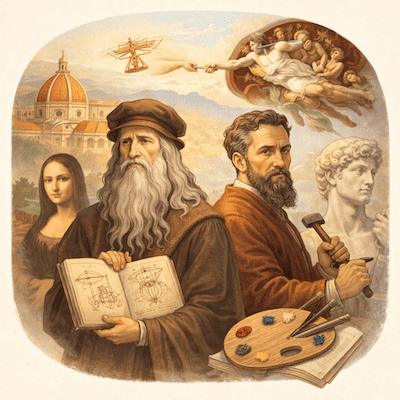
Leonardo da Vinci (1452-1519) è il modello dell'uomo universale del Rinascimento. Non era soltanto il pittore della Gioconda e dell'Ultima Cena: studiava anatomia, progettava macchine e canali, suonava e organizzava le feste di corte.
Leonardo da Vinci (1452-1519) is the model of the Renaissance universal man. He was not only the painter of the Mona Lisa and the Last Supper: he studied anatomy, designed machines and canals, played music and staged court festivities.
Nei suoi quaderni, scritti da destra a sinistra con una grafia a specchio, ci sono migliaia di pagine di disegni e appunti sul volo degli uccelli, sul corpo umano e sul movimento dell'acqua. Per lui arte e scienza erano due modi diversi di studiare la natura.
His notebooks, written from right to left in mirror script, contain thousands of pages of drawings and notes on the flight of birds, the human body and the movement of water. For him, art and science were two different ways of studying nature.
Michelangelo: la forza della pietra
Michelangelo: the power of stone
Se Leonardo era l'armonia, Michelangelo Buonarroti era la forza. Secondo lui la statua esiste già dentro il blocco di marmo, e lo scultore deve solo togliere la pietra in più per liberarla.
If Leonardo stood for harmony, Michelangelo Buonarroti stood for strength. In his view the statue already exists inside the block of marble, and the sculptor only has to remove the extra stone to set it free.
Scolpì il David tra il 1501 e il 1504, da un unico blocco di marmo che altri scultori avevano abbandonato. Poi, tra il 1508 e il 1512, dipinse quasi da solo la volta della Cappella Sistina, lavorando per anni in piedi sulle impalcature, con la testa piegata all'indietro.
He carved the David between 1501 and 1504 from a single block of marble that other sculptors had given up on. Then, between 1508 and 1512, he painted the ceiling of the Sistine Chapel almost single-handed, working for years standing on the scaffolding with his head bent back.
La questione della lingua
The language question
Nel Cinquecento gli scrittori discutevano su quale lingua usare quando non scrivevano in latino. Nel 1525 Pietro Bembo, nelle Prose della volgar lingua, propose come modello il fiorentino del Trecento: Petrarca per la poesia e Boccaccio per la prosa.
In the sixteenth century writers argued about which language to use when they were not writing in Latin. In 1525 Pietro Bembo, in his Prose della volgar lingua, proposed fourteenth-century Florentine as the model: Petrarch for poetry and Boccaccio for prose.
La sua proposta vinse e diventò la base dell'italiano scritto. In Europa i dotti continuavano a usare il latino, ma nelle corti si leggevano e si imitavano sempre di più i poeti e gli scrittori italiani.
His proposal won and became the basis of written Italian. Scholars across Europe went on using Latin, but at the courts Italian poets and writers were read and imitated more and more.
L'invenzione della prospettiva
The invention of perspective
Una delle grandi novità del periodo fu la prospettiva lineare. All'inizio del Quattrocento Brunelleschi mostrò con un esperimento come rappresentare la profondità su una superficie piatta, e nel 1435 Leon Battista Alberti spiegò il metodo nel trattato De pictura.
One of the great innovations of the period was linear perspective. In the early fifteenth century Brunelleschi showed through an experiment how to represent depth on a flat surface, and in 1435 Leon Battista Alberti explained the method in his treatise De pictura.
Masaccio lo usò nell'affresco della Trinità, nella chiesa di Santa Maria Novella. Alberti scriveva che un quadro deve essere come una finestra aperta da cui guardare la scena, e da allora i pittori ragionarono proprio così.
Masaccio used it in his fresco of the Trinity in the church of Santa Maria Novella. Alberti wrote that a painting should be like an open window through which you look at the scene, and from then on painters thought in exactly those terms.
La stampa e la diffusione del sapere
Printing and the spread of knowledge
La stampa a caratteri mobili, inventata in Germania da Gutenberg verso la metà del Quattrocento, arrivò presto in Italia. Alla fine del secolo Venezia aveva più tipografie di qualsiasi altra città d'Europa.
Printing with movable type, invented in Germany by Gutenberg around the middle of the fifteenth century, soon reached Italy. By the end of the century Venice had more printing presses than any other city in Europe.
Qui lavorava Aldo Manuzio, che pubblicò i classici greci e latini in piccoli volumi facili da portare con sé. Per questi libri fece incidere a Francesco Griffo un nuovo carattere inclinato, il corsivo, che in inglese si chiama ancora oggi italics.
This is where Aldus Manutius worked. He published the Greek and Latin classics in small volumes that were easy to carry around. For these books he had Francesco Griffo cut a new slanted typeface, the one still called italics in English.
Il cortigiano: l'arte di vivere
The courtier: the art of living
Il Rinascimento non fu solo un'epoca di quadri e statue, ma anche di nuove regole sociali. Nel 1528 Baldassarre Castiglione pubblicò Il Cortegiano, dove spiegava come doveva parlare, vestirsi e comportarsi il perfetto uomo di corte.
The Renaissance was not just an age of paintings and statues but also of new social rules. In 1528 Baldassare Castiglione published The Book of the Courtier, which explained how the perfect courtier should speak, dress and behave.
Trent'anni dopo, nel 1558, uscì il Galateo di Giovanni Della Casa, un piccolo manuale di buone maniere. Il titolo viene dal nome latino di un amico dell'autore, Galeazzo Florimonte, e da allora in italiano 'galateo' indica l'insieme delle regole per comportarsi bene.
Thirty years later, in 1558, Giovanni Della Casa's Galateo appeared, a short handbook of good manners. The title comes from the Latin name of a friend of the author, Galeazzo Florimonte, and ever since then 'galateo' has meant the rules of good behaviour in Italian.
Le parole del Rinascimento
Words of the Renaissance
Molte parole legate a quest'epoca si usano ancora oggi, nell'arte e nella vita di tutti i giorni:
Many words linked to this period are still used today, in art and in everyday life:
Mecenate: una persona ricca che protegge e finanzia gli artisti. Il nome viene da Mecenate, amico dell'imperatore Augusto.
Mecenate (patron): a wealthy person who protects and funds artists. The word comes from Maecenas, a friend of the Emperor Augustus.
Bottega: il laboratorio dove l'artista lavorava e insegnava il mestiere ai giovani apprendisti.
Bottega (workshop): the place where an artist worked and taught the trade to young apprentices.
Sfumato: la tecnica pittorica, portata alla perfezione da Leonardo, che rende morbidi i contorni.
Sfumato: the painting technique, brought to perfection by Leonardo, that softens outlines.
Umanesimo: il movimento culturale che mette al centro l'uomo e lo studio dei classici.
Umanesimo (humanism): the cultural movement that puts human beings and the study of the classics at the centre.
Prospettiva: il metodo per rappresentare gli oggetti su una superficie dando il senso della distanza.
Prospettiva (perspective): the method of depicting objects on a surface so as to give a sense of distance.
Le donne nel Rinascimento
Women in the Renaissance
Era un mondo dominato dagli uomini, ma alcune donne riuscirono a farsi spazio. Isabella d'Este, marchesa di Mantova, raccolse una celebre collezione d'arte e, quando nel 1509 il marito fu fatto prigioniero dai veneziani, governò lo Stato al suo posto.
It was a world dominated by men, but some women managed to make their mark. Isabella d'Este, Marchioness of Mantua, built up a famous art collection, and when her husband was taken prisoner by the Venetians in 1509 she ruled the state in his place.
Più tardi, all'inizio del Seicento, la pittrice Artemisia Gentileschi lottò per essere riconosciuta come professionista. Nel 1616 fu la prima donna ammessa all'Accademia delle Arti del Disegno di Firenze.
Later, in the early seventeenth century, the painter Artemisia Gentileschi fought to be recognised as a professional. In 1616 she became the first woman admitted to the Academy of the Arts of Drawing in Florence.
Raffaello e l'armonia perfetta
Raphael and perfect harmony
Il terzo grande nome è Raffaello Sanzio, nato a Urbino nel 1483. Nei suoi quadri tutto è equilibrio: figure, colori e spazio sembrano stare insieme senza nessuno sforzo.
The third great name is Raphael, born Raffaello Sanzio in Urbino in 1483. In his paintings everything is balance: figures, colours and space seem to fit together effortlessly.
A Roma papa Giulio II gli affidò la decorazione di alcune sale del Vaticano, oggi chiamate Stanze di Raffaello. Qui si trova la Scuola di Atene, dove Platone e Aristotele discutono circondati da altri filosofi. Raffaello morì nel 1520, a soli 37 anni.
In Rome, Pope Julius II commissioned him to decorate several rooms in the Vatican, now known as the Raphael Rooms. Here you find The School of Athens, where Plato and Aristotle are deep in discussion surrounded by other philosophers. Raphael died in 1520, aged only 37.
Che cosa resta
What remains
Il Rinascimento finì nel corso del Cinquecento, tra guerre, invasioni straniere e il Sacco di Roma del 1527. Le sue opere però sono ancora sotto i nostri occhi, nelle chiese, nelle piazze e nei musei di tutta Italia.
The Renaissance came to an end during the sixteenth century, amid wars, foreign invasions and the Sack of Rome in 1527. Yet its works are still before our eyes, in the churches, squares and museums all over Italy.
E molte idee nate allora oggi ci sembrano normali: che un artista abbia un nome e uno stile tutto suo, che la natura si possa studiare con curiosità, che un libro possa stare in tasca.
And many ideas born back then now seem perfectly normal to us: that an artist has a name and a style of their own, that nature can be studied with curiosity, that a book can fit in your pocket.
In the free app you can listen to this text read aloud and tap any word to see what it means.