Il rito del caffè
The Ritual of Coffee
 Learn ItalianFree app with audio, quizzes and real books
Key words
- penisolapeninsula
- coreografiachoreography
- banconecounter / bar top
- al voloon the fly / quickly
- imperdonabileunforgivable
- digestionedigestion
- macchiatostained / spotted (with milk)
- ristrettorestricted / short (coffee)
- correttocorrected / spiked (with alcohol)
- riscaldantiwarming / heating
- sospesosuspended / on hold
- solidarietàsolidarity
All 25 words
- caritàcharity
- puristipurists
- tostaturaroasting
- bustinasachet / small packet
- palatopalate
- sfumaturanuance / shade / tint
- gorgogliogurgling / bubbling sound
- inconfondibileunmistakable
- ospitalitàhospitality
- cucchiainoteaspoon
- regolamentatoregulated
- freneticafrenetic / hectic
- padroneggiareto master / to command
Per un italiano il caffè non è soltanto una dose di caffeina per svegliarsi. È una pausa, un gesto di amicizia, un piccolo rito che si ripete più volte al giorno, da Bolzano a Palermo.
For an Italian, coffee is not just a dose of caffeine to wake up. It is a break, a gesture of friendship, a small ritual repeated several times a day, from Bolzano to Palermo.
Basta entrare in un bar la mattina per capirlo: il rumore delle tazzine, il sibilo della macchina dell'espresso, il barista che lavora velocissimo e i clienti che scambiano due parole anche se non si conoscono.
Just walk into a bar in the morning and you'll see why: the clatter of cups, the hiss of the espresso machine, the barista working at lightning speed and customers exchanging a few words even though they don't know each other.
Il rito al bancone
The ritual at the counter
In Italia il caffè si beve spesso in piedi, al bancone. Si ordina, si paga (in molti bar si paga prima alla cassa e si porta lo scontrino al barista) e dopo due o tre minuti si è già fuori.
In Italy coffee is often drunk standing up, at the counter. You order, you pay (in many bars you pay first at the till and hand the receipt to the barista), and two or three minutes later you're already out the door.
Al banco si chiacchiera con il barista o con chi sta accanto. 'Ci prendiamo un caffè?' è il modo più comune per invitare qualcuno a parlare, a fare pace o a discutere di lavoro. Chi si siede al tavolino, invece, spesso paga di più per il servizio.
At the counter you chat with the barista or whoever is standing next to you. 'Shall we get a coffee?' is the most common way to invite someone for a talk, to make up after a quarrel or to discuss business. If you sit down at a table, on the other hand, you often pay more for the service.
La regola d'oro: niente cappuccino dopo le 11
The golden rule: no cappuccino after 11
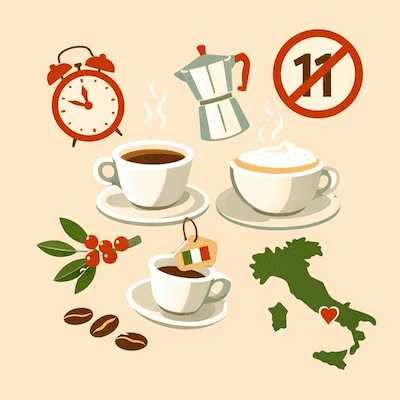
Una delle regole non scritte più famose riguarda il latte. Per gli italiani il cappuccino è una bevanda da colazione, da prendere con un cornetto. Il nome viene dai frati cappuccini, perché il suo colore ricorda quello del loro saio.
One of the most famous unwritten rules is about milk. For Italians, cappuccino is a breakfast drink, to be had with a cornetto. The name comes from the Capuchin friars, because its colour is like that of their habits.
Ordinare un cappuccino dopo pranzo, o peggio insieme a un piatto di pasta, fa sorridere il barista. Molti italiani pensano che il latte dopo un pasto abbondante appesantisca la digestione. Nessuno però vi negherà un cappuccino alle cinque del pomeriggio.
Ordering a cappuccino after lunch, or worse, with a plate of pasta, will make the barista smile. Many Italians believe that milk after a big meal makes digestion heavy. Still, nobody will refuse you a cappuccino at five in the afternoon.
L'espresso: ristretto, lungo o macchiato?
Espresso: ristretto, lungo or macchiato?
Quando un italiano ordina 'un caffè', riceve automaticamente un espresso: pochi sorsi di caffè forte con una crema color nocciola in superficie. Attenzione: se chiedete 'un latte', vi porteranno un bicchiere di latte.
When an Italian orders 'un caffè', they automatically get an espresso: a few sips of strong coffee with a hazel-coloured crema on top. Be careful: if you ask for 'un latte', you'll be brought a glass of milk.
Poi ci sono le varianti: il caffè ristretto, ancora più corto e intenso, il caffè lungo, con un po' più d'acqua, e il caffè macchiato, cioè 'macchiato' con una goccia di latte caldo o freddo. Il latte macchiato, invece, è un bicchiere di latte caldo con un po' di caffè.
Then there are the variations: caffè ristretto, even shorter and more intense; caffè lungo, with a little more water; and caffè macchiato, 'stained' with a drop of hot or cold milk. A latte macchiato, on the other hand, is a glass of hot milk with a little coffee in it.
Il caffè corretto: un goccio di liquore
Caffè corretto: a drop of liqueur
Dopo pranzo o dopo cena c'è chi ordina un 'caffè corretto', cioè un espresso 'corretto' con un po' di liquore.
After lunch or dinner, some people order a 'caffè corretto', an espresso 'corrected' with a little liqueur.
Di solito si usano la grappa, la sambuca o il brandy. L'abitudine è diffusa soprattutto al Nord e in montagna, dove d'inverno qualcosa che scalda è sempre ben accetto.
Grappa, sambuca or brandy are the usual choices. The habit is especially common in the North and in the mountains, where in winter anything that warms you up is always welcome.
Il caffè sospeso: la generosità napoletana
Caffè sospeso: Neapolitan generosity
A Napoli è nata una delle tradizioni più belle legate al caffè: il 'caffè sospeso'. Chi ha avuto una buona giornata paga due caffè, ma ne beve uno solo.
One of the loveliest coffee traditions was born in Naples: the 'caffè sospeso', or suspended coffee. Someone who has had a good day pays for two coffees but drinks only one.
Il secondo resta 'sospeso', già pagato per qualcuno che entrerà più tardi e non può permetterselo. Lo scrittore napoletano Luciano De Crescenzo ha dedicato a questa usanza un libro, intitolato proprio Il caffè sospeso.
The second one stays 'suspended', already paid for someone who will come in later and can't afford it. The Neapolitan writer Luciano De Crescenzo devoted a book to this custom, titled simply Il caffè sospeso.
Zucchero o amaro?
Sugar or bitter?
Sullo zucchero si discute da sempre. I puristi bevono il caffè amaro, perché secondo loro solo così si sentono davvero l'aroma e la tostatura.
Sugar has always been a matter of debate. Purists drink their coffee bitter, because in their view that is the only way to really taste the aroma and the roast.
Molti italiani però aggiungono una bustina di zucchero. A casa, con la moka, c'è chi prepara la 'cremina': si sbattono con forza le prime gocce di caffè insieme allo zucchero, finché si ottiene una crema chiara e densa.
Many Italians, though, add a sachet of sugar. At home, with the moka pot, some people make 'cremina': they vigorously whisk the first drops of coffee with sugar until they get a pale, thick cream.
L'importanza dell'acqua
The importance of water
In molti bar, soprattutto al Sud, insieme al caffè arriva un bicchierino d'acqua, naturale o frizzante.
In many bars, especially in the South, your coffee comes with a small glass of still or sparkling water.
L'acqua si beve prima del caffè, per pulire la bocca e sentire meglio il gusto. Secondo alcuni berla dopo vuol dire voler mandare via il sapore del caffè, come se non fosse stato buono.
The water is drunk before the coffee, to clean your palate and taste it better. Some say that drinking it afterwards means you want to wash away the taste, as if the coffee hadn't been good.
La moka: il caffè fatto in casa
The moka pot: coffee made at home
Se il bar è il luogo dove si sta insieme, in casa regna la moka. La lanciò Alfonso Bialetti nel 1933, e oggi in quasi tutte le cucine italiane ce n'è almeno una. Sulla scatola c'è ancora l'omino con i baffi, disegnato negli anni Cinquanta.
If the bar is where people get together, at home the moka pot reigns. Alfonso Bialetti launched it in 1933, and today almost every Italian kitchen has at least one. The box still shows the little man with a moustache, drawn in the 1950s.
Il borbottio della moka sul fuoco e il profumo che si sparge per la casa sono, per molti italiani, il segnale che la giornata è cominciata.
For many Italians, the gurgling of the moka on the stove and the smell drifting through the house are the sign that the day has begun.
Il caffè come identità regionale
Coffee as regional identity
Ogni città ha le sue abitudini. A Trieste, storico porto del caffè, il vocabolario è tutto diverso: l'espresso si chiama 'nero', il caffè macchiato 'capo' e il macchiato servito in un bicchierino 'capo in b'.
Every city has its own habits. In Trieste, a historic coffee port, the vocabulary is completely different: an espresso is called a 'nero', a caffè macchiato a 'capo', and a macchiato served in a small glass a 'capo in b'.
In Sicilia d'estate si fa colazione con la granita al caffè, con la panna e una brioche. A Lecce, invece, si beve il caffè in ghiaccio con il latte di mandorla.
In Sicily, in summer, people have coffee granita for breakfast, with whipped cream and a brioche. In Lecce, on the other hand, they drink iced coffee with almond milk.
Il galateo del caffè
Coffee etiquette
Ci sono piccoli gesti che mostrano quanto gli italiani rispettino il caffè. Il cucchiaino serve solo a mescolare lo zucchero e poi si appoggia sul piattino: non si mette in bocca.
Small gestures show how much Italians respect their coffee. The spoon is only for stirring in the sugar and then goes back on the saucer: you don't put it in your mouth.
E quando arriva un ospite, la prima cosa che gli si offre è un caffè, a qualsiasi ora. Si può dire di no, ma il padrone di casa probabilmente insisterà.
And when a guest arrives, the first thing they are offered is a coffee, at any time of day. You can say no, but your host will probably insist.
Curiosità sulla tazzina
Curiosities about the little cup
L'Italia non produce caffè, perché il clima non lo permette, ma è tra i maggiori importatori del mondo.
Italy doesn't grow coffee, because the climate doesn't allow it, but it is one of the biggest importers in the world.
La parola 'espresso' indica un caffè preparato al momento, apposta per chi lo ordina.
The word 'espresso' refers to coffee made on the spot, especially for the person who ordered it.
Lo zucchero si gira con delicatezza: il cucchiaino non dovrebbe sbattere rumorosamente contro la tazzina.
Stir your sugar gently: the spoon shouldn't clatter against the cup.
Chi vuole evitare la caffeina può ordinare un caffè d'orzo o un decaffeinato, che molti chiamano semplicemente 'deca'.
If you want to avoid caffeine you can order a barley coffee or a decaf, which many people simply call a 'deca'.
Al banco un espresso costa di solito poco più di un euro; al tavolo, nei posti turistici, il prezzo può essere molto più alto.
At the counter an espresso usually costs just over one euro; at a table in tourist spots the price can be much higher.
Un caffè, per favore
A coffee, please
In Italia il caffè è soprattutto una scusa per fermarsi qualche minuto, scambiare due parole e poi tornare alle proprie cose.
In Italy coffee is above all an excuse to stop for a few minutes, exchange a few words and then get back to your day.
Per chi impara l'italiano, entrare in un bar e dire senza esitare 'un caffè, per favore' è un primo piccolo passo per sentirsi a casa.
For anyone learning Italian, walking into a bar and saying 'un caffè, per favore' without hesitating is a first small step towards feeling at home.
In the free app you can listen to this text read aloud and tap any word to see what it means.