Anglicismi vs Purismo
Anglicisms vs. Purism
 Learn ItalianFree app with audio, quizzes and real books
Key words
- inarrestabileunstoppable
- precisioneprecision / accuracy
- sovranosovereign / supreme
- ambitofield / area / scope
- monitorareto monitor / to track
- sensibilizzareto raise awareness
- equivalenteequivalent
- scadenzadeadline / expiry date
- artificialeartificial
- necessitànecessity / need
- istruiteeducated
- trasparentetransparent / clear
All 25 words
- quotidianodaily
- coniugaticonjugated
- ibridahybrid
- confusioneconfusion
- esportatriceexporting
- stabilmentepermanently / stably
- confrontocomparison / confrontation
- raccomandaterecommended
- flessibilitàflexibility
- assorbireto absorb
- immobilestill / stationary / motionless
- arrendeyields / surrenders
- poverapoor
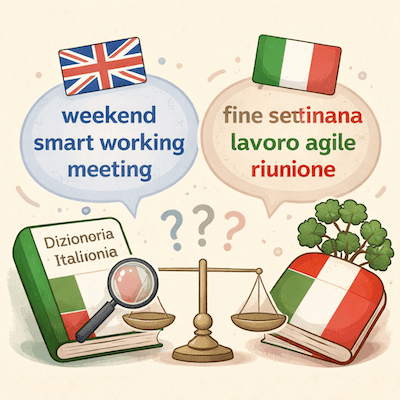
L'italiano è una lingua viva e, come ogni lingua viva, cambia di continuo. Negli ultimi decenni, però, molti si chiedono se non stia cambiando troppo in fretta: parole inglesi come 'meeting', 'weekend' o 'smart working' compaiono ovunque, dai giornali agli uffici pubblici.
Italian is a living language and, like every living language, it is always changing. In recent decades, though, many people have started to wonder whether it is changing too fast: English words such as 'meeting', 'weekend' and 'smart working' turn up everywhere, from newspapers to government offices.
C'è chi le considera un segno di modernità e di praticità, e chi teme che l'italiano finisca per diventare una lingua mista, che qualcuno chiama scherzosamente 'itanglese' o 'Italish'.
Some see them as a sign of modernity and practicality; others fear that Italian will end up as a hybrid, jokingly called 'itanglese' or 'Italish'.
Dalla scrivania allo smart working
From the Desk to Smart Working
Il mondo del lavoro è il campo in cui l'inglese avanza di più. La legge italiana del 2017 parla di 'lavoro agile', ma durante la pandemia quasi tutti, giornalisti e ministri compresi, hanno detto 'smart working'.
The workplace is where English has made the biggest inroads. Italian law has used the term 'lavoro agile' since 2017, but during the pandemic almost everyone, journalists and ministers included, said 'smart working'.
Curiosamente, in Gran Bretagna e negli Stati Uniti si dice piuttosto 'remote working' o 'working from home'. In Italia la versione inglese piace perché sembra più breve, più professionale o semplicemente più alla moda.
Oddly enough, in Britain and the United States people usually say 'remote working' or 'working from home'. In Italy the English version is popular because it sounds shorter, more professional or simply more fashionable.
L'Accademia della Crusca, custode della lingua
The Accademia della Crusca, Guardian of the Language
L'Accademia della Crusca nacque a Firenze nel 1583 ed è una delle più antiche accademie linguistiche del mondo. Il nome viene dalla crusca, la parte del grano che si separa dalla farina: i fondatori volevano separare la lingua buona da quella cattiva. Nel 1612 l'Accademia pubblicò il primo grande vocabolario dell'italiano.
The Accademia della Crusca was founded in Florence in 1583 and is one of the oldest language academies in the world. Its name comes from 'crusca', the bran that is sifted out from flour: the founders wanted to sift good language from bad. In 1612 the Academy published the first major dictionary of Italian.
Oggi i linguisti della Crusca non fanno i 'poliziotti' della lingua: studiano come cambia l'italiano e rispondono alle domande dei cittadini. Quando una parola inglese non serve, però, propongono un'alternativa italiana e spiegano perché è preferibile.
Today the Crusca's linguists don't act as 'language police': they study how Italian is changing and answer questions from the public. When an English word isn't needed, though, they suggest an Italian alternative and explain why it is better.
Gli anglicismi 'di lusso'
'Luxury' Anglicisms
I linguisti chiamano 'anglicismi di lusso' le parole inglesi che hanno già un buon equivalente italiano e che vengono usate lo stesso.
Linguists use the term 'luxury anglicisms' for English words that already have a good Italian equivalent but get used anyway.
Dire 'deadline' invece di 'scadenza', 'meeting' invece di 'riunione' o 'feedback' invece di 'parere' non rende il discorso più preciso. Serve soprattutto a sembrare competenti e internazionali, e a volte il risultato suona un po' artificiale.
Saying 'deadline' instead of 'scadenza', 'meeting' instead of 'riunione' or 'feedback' instead of 'parere' doesn't make anything more precise. It mainly helps the speaker sound competent and international, and the result can sound a bit forced.
Anglicismi necessari: computer e web
Necessary Anglicisms: Computers and the Web
Esistono però anche gli anglicismi 'di necessità': parole nate insieme a un'invenzione o a un'idea del mondo anglosassone, come 'computer', 'software', 'mouse' o 'social network'.
There are also 'necessary' anglicisms, though: words that arrived together with an invention or idea from the English-speaking world, such as 'computer', 'software', 'mouse' and 'social network'.
Qui l'italiano si è comportato in modo diverso da altre lingue. In Francia il computer si chiama 'ordinateur' e il software 'logiciel', in Spagna si dice 'ordenador', mentre gli italiani hanno preso le parole inglesi così come sono.
Here Italian behaved differently from other languages. In France a computer is an 'ordinateur' and software is 'logiciel', in Spain people say 'ordenador', while Italians simply took the English words as they were.
La politica e la difesa della lingua
Politics and the Defence of the Language
Il dibattito è arrivato anche in Parlamento. Nel 2023 una proposta di legge prevedeva multe fino a 100.000 euro per gli enti che usavano parole straniere nelle comunicazioni ufficiali senza un vero motivo, e ha fatto molto discutere.
The debate has even reached Parliament. In 2023 a bill proposed fines of up to 100,000 euros for bodies that used foreign words in official communications without good reason, and it caused quite a stir.
Chi difende regole di questo tipo sostiene che l'abuso dell'inglese esclude gli anziani e chi ha studiato meno: se lo Stato parla in modo poco chiaro, i cittadini fanno fatica a capire i propri diritti.
Supporters of rules like these argue that overusing English shuts out older people and those with less education: if the state doesn't speak clearly, citizens struggle to understand their own rights.
Lo slang dei giovani: i nuovi prestiti
Youth Slang: The New Borrowings
Tra i più giovani l'inglese è ovunque, anche grazie ai social e ai videogiochi. Verbi come 'shippare', 'triggerare' o 'ghostare' sono ormai normali nelle chat dei ragazzi.
Among young people English is everywhere, partly thanks to social media and video games. Verbs like 'shippare', 'triggerare' and 'ghostare' are now perfectly normal in teenagers' chats.
Non sono semplici parole straniere: hanno preso una forma italiana. Si coniugano come i verbi regolari in -are, quindi si dice 'mi ha ghostato' o 'li shippo da sempre'.
These aren't just foreign words: they have taken on an Italian form. They are conjugated like regular -are verbs, so people say 'mi ha ghostato' (he ghosted me) or 'li shippo da sempre' (I've always shipped them).
Itanglese: un rischio reale?
Itanglese: A Real Risk?
I puristi temono la nascita di una lingua mista, né italiano né inglese. Spesso, poi, le parole inglesi in Italia cambiano significato o addirittura non esistono in inglese.
Purists fear the birth of a mixed language that is neither Italian nor English. What's more, English words often change meaning in Italy, or don't even exist in English.
Un italiano che fa 'footing' sta correndo, ma un inglese direbbe 'jogging'. Allo stesso modo lo 'smoking' è l'abito elegante da sera, che in inglese si chiama 'tuxedo' o 'dinner jacket'. Questi falsi anglicismi creano confusione e non aiutano a farsi capire nel mondo.
An Italian who goes 'footing' is out running, but an English speaker would say 'jogging'. In the same way, a 'smoking' is a formal evening suit, which in English is called a 'tuxedo' or 'dinner jacket'. These false anglicisms cause confusion and don't help anyone make themselves understood abroad.
L'italiano, una lingua che esporta parole
Italian, a Language that Exports Words
Anche l'italiano, però, ha prestato molte parole alle altre lingue. 'Piano', 'allegro', 'soprano' e 'opera' si usano nella musica di tutto il mondo; nell'arte si parla di 'fresco' e di 'chiaroscuro'; e dalle banche del Medioevo vengono l'inglese 'bank' e 'bankrupt', da 'banca' e 'banca rotta'.
Italian, however, has also lent plenty of words to other languages. 'Piano', 'allegro', 'soprano' and 'opera' are used in music all over the world; in art people talk about 'fresco' and 'chiaroscuro'; and the banks of the Middle Ages gave English 'bank' and 'bankrupt', from 'banca' and 'banca rotta' (broken bench).
Oggi è soprattutto la cucina a esportare parole: 'pizza', 'espresso', 'cappuccino' e 'tiramisù' si capiscono in quasi ogni angolo del pianeta.
Today it is mainly food that exports words: 'pizza', 'espresso', 'cappuccino' and 'tiramisù' are understood in almost every corner of the planet.
Inglese o italiano? Qualche esempio
English or Italian? A Few Examples
Ecco alcune parole inglesi molto usate in Italia, con le alternative italiane che propongono i puristi:
Here are some English words that are widely used in Italy, with the Italian alternatives purists recommend:
Location → luogo, sede, ambientazione
Location → luogo, sede, ambientazione (place, venue, setting)
Weekend → fine settimana
Weekend → fine settimana (weekend)
Manager → dirigente, responsabile
Manager → dirigente, responsabile (executive, person in charge)
Fashion → moda
Fashion → moda (fashion)
Trend → tendenza
Trend → tendenza (trend)
La flessibilità dell'italiano
The Flexibility of Italian
Per fortuna l'italiano è una lingua molto flessibile. Molti anglicismi arrivano con una moda e, se non servono davvero, spariscono con lei dopo pochi anni.
Fortunately, Italian is a very flexible language. Many anglicisms arrive with a fashion and, if they aren't really useful, disappear with it a few years later.
Nel corso dei secoli l'italiano ha già accolto parole arabe, francesi e spagnole, come 'zucchero', 'giardino' e 'baule', senza perdere la propria struttura. Con ogni probabilità farà lo stesso con l'inglese.
Over the centuries Italian has already taken in words from Arabic, French and Spanish, such as 'zucchero' (sugar), 'giardino' (garden) and 'baule' (trunk), without losing its own structure. In all likelihood it will do the same with English.
Conclusione
Conclusion
Il confronto tra anglicismi e purismo probabilmente non avrà mai un vincitore. Una lingua che non cambia è una lingua morta, ma una lingua che prende tutto da un'altra si impoverisce.
The contest between anglicisms and purism will probably never have a winner. A language that doesn't change is a dead language, but a language that takes everything from another one becomes poorer.
Per chi studia l'italiano vale una regola pratica: se esiste una parola italiana chiara, come 'scadenza' o 'riunione', conviene usarla. La capiranno tutti, nonni compresi.
For learners of Italian there is a practical rule: if there's a clear Italian word, such as 'scadenza' or 'riunione', it's better to use it. Everyone will understand it, grandparents included.
In the free app you can listen to this text read aloud and tap any word to see what it means.