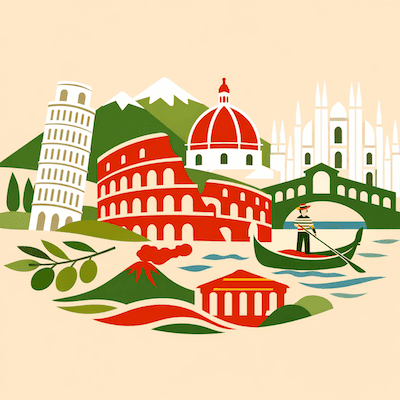
Il Bel Paese
Il Bel Paese: Why so many UNESCO sites?
 Learn ItalianFree app with audio, quizzes and real books
Key words
- soprannomenickname
- oggettivoobjective / factual
- custodiscepreserves / guards / keeps
- risiedelies / resides
- improntaimprint / mark / footprint
- indelebileindelible / permanent
- stratificazionestratification / layering
- valorizzareto enhance / to add value / to promote
- conservatipreserved / kept
- tramontosunset
- occidentaleWestern
- convivecoexists / lives together
All 25 words
- geniogenius
- obbligatoriamandatory / compulsory / obligatory
- lagunalagoon
- fluttuareto float / to fluctuate
- tramandatopassed down / handed down
- paesaggisticalandscape (adj.) / scenic
- armonioseharmonious
- indissolubileunbreakable / indissoluble
- sapientewise / skillful / expert
- cristallizzatecrystallized
- manutenzionemaintenance
- tassellopiece / dowel / tile
- acquisireto acquire / to gain
L'Italia viene spesso chiamata 'il Bel Paese'. L'espressione è antichissima: la usa Dante nella 'Divina Commedia' e la riprende Petrarca, che descrive il 'bel paese ch'Appennin parte, e 'l mar circonda et l'Alpe'. Più tardi diede il nome a un libro di geografia del 1876 e perfino a un formaggio.
Italy is often called 'il Bel Paese', the beautiful country. The phrase is very old: Dante uses it in the 'Divine Comedy', and Petrarch picks it up, describing the 'beautiful country divided by the Apennines and surrounded by the sea and the Alps'. Later it gave its name to an 1876 geography book and even to a cheese.
Oltre alla bellezza, c'è anche un dato concreto: con una sessantina di siti, l'Italia è tra i paesi con più luoghi nella lista del Patrimonio mondiale dell'UNESCO, e da anni si contende il primo posto con la Cina.
Beyond its beauty, there is also a hard fact: with around sixty sites, Italy is one of the countries with the most places on UNESCO's World Heritage List, and for years it has been vying with China for first place.
Perché proprio l'Italia?
Why Italy?
Una spiegazione sta nella posizione dell'Italia, al centro del Mediterraneo. Per tremila anni questa terra è stata un punto d'incontro: qui sono passati Etruschi, Greci, Romani, Bizantini, Arabi, Normanni e Spagnoli.
One explanation lies in Italy's position at the centre of the Mediterranean. For three thousand years this land has been a meeting point: Etruscans, Greeks, Romans, Byzantines, Arabs, Normans and Spaniards all passed through.
Ogni popolo ha lasciato qualcosa: un tempio, una chiesa, un modo di costruire. Il risultato è una stratificazione di storia così fitta che in molte città, scavando per una nuova metropolitana, si trovano ancora resti antichi.
Each people left something behind: a temple, a church, a way of building. The result is such dense layers of history that in many cities, digging a new metro line still turns up ancient remains.
La Magna Grecia in Sicilia
Magna Graecia in Sicily
Cominciamo dal sud. Ad Agrigento, in Sicilia, la Valle dei Templi conserva i resti di una delle città più ricche della Magna Grecia. Il Tempio della Concordia, costruito nel V secolo a.C., è uno dei templi dorici meglio conservati al mondo.
Let's start in the south. In Agrigento, Sicily, the Valley of the Temples holds the remains of one of the richest cities of Magna Graecia. The Temple of Concordia, built in the fifth century BC, is one of the best-preserved Doric temples in the world.
Passeggiare tra le colonne al tramonto, con il mare sullo sfondo, fa capire quanto fosse importante la Sicilia per i Greci più di 2.400 anni fa.
Walking among the columns at sunset, with the sea in the background, you understand how important Sicily was to the Greeks more than 2,400 years ago.
Roma, il cuore dell'Impero
Rome, Heart of the Empire
Salendo verso nord si arriva a Roma, il cui intero centro storico è patrimonio UNESCO dal 1980. Il Colosseo fu inaugurato nell'80 d.C.; il Pantheon, con la sua cupola di cemento, ha quasi 1.900 anni ed è ancora usato come chiesa.
Heading north, we reach Rome, whose entire historic centre has been a UNESCO site since 1980. The Colosseum opened in AD 80; the Pantheon, with its concrete dome, is almost 1,900 years old and is still used as a church.
A Roma l'UNESCO non protegge solo i monumenti, ma una città intera in cui l'antico e il moderno convivono ogni giorno: il traffico passa accanto ai Fori, e si prende il caffè guardando una fontana barocca.
In Rome UNESCO protects not just monuments but a whole city where old and new live side by side every day: traffic runs past the Forums, and people drink their coffee looking at a Baroque fountain.
Firenze e il Rinascimento
Florence and the Renaissance
In Toscana, il centro storico di Firenze è nella lista dal 1982. In pochi chilometri quadrati si trovano la cupola del Brunelleschi, completata nel 1436, Piazza della Signoria, gli Uffizi e Ponte Vecchio.
In Tuscany, the historic centre of Florence has been on the list since 1982. Within a few square kilometres you find Brunelleschi's dome, completed in 1436, Piazza della Signoria, the Uffizi and the Ponte Vecchio.
Nel Quattrocento e nel Cinquecento qui lavorarono artisti come Botticelli, Leonardo da Vinci e Michelangelo, e la città divenne il centro del Rinascimento. Ancora oggi ogni anno milioni di visitatori fanno la fila per vedere il David.
In the fifteenth and sixteenth centuries artists such as Botticelli, Leonardo da Vinci and Michelangelo worked here, and the city became the centre of the Renaissance. Even today millions of visitors queue every year to see the David.
Venezia, un miracolo sull'acqua
Venice, a Miracle on the Water
Venezia è costruita su 118 piccole isole collegate da più di 400 ponti. Sotto i palazzi ci sono milioni di pali di legno piantati nel fango della laguna, alcuni da più di mille anni.
Venice is built on 118 small islands linked by more than 400 bridges. Beneath its palaces are millions of wooden piles driven into the mud of the lagoon, some of them more than a thousand years ago.
La città e la sua laguna sono patrimonio UNESCO dal 1987. Ma è un paesaggio fragile: l'acqua alta, l'erosione e il moto ondoso delle barche la minacciano, e dal 2020 le barriere mobili del MOSE la proteggono dalle maree più forti.
The city and its lagoon have been a UNESCO site since 1987. But it is a fragile landscape: high water, erosion and the wash from boats all threaten it, and since 2020 the MOSE mobile barriers have protected it from the highest tides.
Le Dolomiti, bellezza naturale
The Dolomites: Natural Beauty
L'UNESCO non riguarda solo le città. Nel 2009 sono entrate nella lista anche le Dolomiti, nel nord-est del Paese, per il loro paesaggio e per il loro valore geologico: queste rocce si sono formate da antiche barriere coralline di un mare tropicale.
UNESCO isn't only about cities. In 2009 the Dolomites, in the north-east of the country, were added to the list for their scenery and their geological value: these rocks formed from ancient coral reefs in a tropical sea.
Sono chiamate 'Monti Pallidi' per il colore chiaro della roccia. Al tramonto le cime diventano rosa e poi rosso fuoco: in ladino questo fenomeno si chiama 'enrosadira'.
They are called the 'Pale Mountains' because of the light colour of the rock. At sunset the peaks turn pink and then fiery red: in Ladin this is called 'enrosadira'.
Siti meno noti ma affascinanti
Lesser-Known but Fascinating Sites
Oltre alle grandi città d'arte, ci sono siti meno noti ma altrettanto straordinari, come i trulli di Alberobello, in Puglia, o i Sassi di Matera, in Basilicata, case e chiese scavate nella roccia e abitate fin dalla preistoria.
Beyond the great art cities there are less famous but equally extraordinary sites, such as the trulli of Alberobello, in Apulia, or the Sassi of Matera, in Basilicata: houses and churches carved into the rock and lived in since prehistoric times.
Negli anni Cinquanta i Sassi erano considerati una 'vergogna nazionale' per la povertà dei loro abitanti, che furono trasferiti in case nuove. Oggi sono restaurati, ospitano alberghi e ristoranti, e nel 2019 Matera è stata Capitale europea della cultura.
In the 1950s the Sassi were called a 'national disgrace' because of the poverty of the people living there, who were moved to new housing. Today they have been restored, they are home to hotels and restaurants, and in 2019 Matera was European Capital of Culture.
Non solo pietre: vino e pizza
Not Just Stones: Wine and Pizza
L'UNESCO non protegge solo muri e monumenti. Nel 2014 sono entrati nella lista i paesaggi vitivinicoli di Langhe, Roero e Monferrato, in Piemonte, e nel 2019 le colline del Prosecco, in Veneto: campagne disegnate in secoli di lavoro dai viticoltori.
UNESCO doesn't only protect walls and monuments. In 2014 the vineyard landscapes of the Langhe, Roero and Monferrato, in Piedmont, joined the list, followed in 2019 by the Prosecco hills in the Veneto: countryside shaped by centuries of work by winegrowers.
Nel 2017 è stata riconosciuta perfino un'arte: quella del pizzaiuolo napoletano, inserita nel Patrimonio culturale immateriale. A essere protetto non è un piatto, ma il sapere e i gesti che passano da un pizzaiolo all'altro.
In 2017 even a craft was recognised: the art of the Neapolitan pizzaiuolo, added to the list of Intangible Cultural Heritage. What is protected is not a dish but the know-how and techniques passed down from one pizza maker to the next.
Alcuni siti da non perdere
Some Sites Not to Miss
Ecco una piccola lista di tesori che rendono l'Italia unica:
Here is a short list of treasures that make Italy unique:
Pompei ed Ercolano: città romane sepolte dall'eruzione del Vesuvio nel 79 d.C. e rimaste come fotografate in quel giorno.
Pompeii and Herculaneum: Roman towns buried by the eruption of Vesuvius in AD 79 and preserved as if photographed on that day.
Villa d'Este a Tivoli: un capolavoro del giardino all'italiana, con decine di fontane e centinaia di getti d'acqua.
Villa d'Este in Tivoli: a masterpiece of the Italian garden, with dozens of fountains and hundreds of water jets.
Le Cinque Terre: villaggi colorati sospesi tra le rocce e il mare della Liguria.
The Cinque Terre: colourful villages perched between the rocks and the Ligurian Sea.
La Reggia di Caserta: progettata da Luigi Vanvitelli e spesso paragonata a Versailles per la sua grandezza.
The Royal Palace of Caserta: designed by Luigi Vanvitelli and often compared to Versailles for its size.
I mosaici di Ravenna: tra i più belli dell'arte bizantina, con i loro fondi d'oro del V e VI secolo.
The mosaics of Ravenna: among the finest in Byzantine art, with their gold backgrounds from the fifth and sixth centuries.
La responsabilità della conservazione
The Responsibility of Conservation
Avere così tanti siti è un onore, ma anche un peso. Restaurare un affresco o mettere in sicurezza un muro romano costa molto e richiede anni di lavoro.
Having so many sites is an honour, but also a burden. Restoring a fresco or making a Roman wall safe costs a great deal and takes years of work.
Il problema più nuovo è il turismo di massa. Venezia, che ha meno di 50.000 abitanti nel centro storico, riceve milioni di visitatori l'anno, e dal 2024 in alcuni giorni chi viene solo per una giornata deve pagare un contributo d'accesso.
The newest problem is mass tourism. Venice, with fewer than 50,000 residents in its historic centre, receives millions of visitors a year, and since 2024 day-trippers have had to pay an entry fee on certain days.
Conclusione
Conclusion
Dalla Valle dei Templi alle colline del Prosecco, i siti UNESCO italiani raccontano tremila anni di storia in uno spazio relativamente piccolo.
From the Valley of the Temples to the Prosecco hills, Italy's UNESCO sites tell three thousand years of history in a relatively small space.
Per chi studia l'italiano, sono anche un ottimo motivo per leggere: i cartelli, le guide e i racconti dei custodi sono pieni di parole che nessun manuale insegna.
For learners of Italian, they are also a great reason to read: the signs, guidebooks and stories told by the custodians are full of words no textbook teaches.
In the free app you can listen to this text read aloud and tap any word to see what it means.