I borghi più belli d'Italia
Italy's Most Beautiful Borghi
 Learn ItalianFree app with audio, quizzes and real books
Key words
- nascostahidden
- patrimonioheritage / assets
- vicoloalley / narrow street
- fortificatofortified
- acciottolatecobbled / cobblestone
- mozzafiatobreathtaking
- arroccataperched / clinging
- pedonalepedestrian
- mestieritrades / crafts
- bottegheworkshops / small shops
- tramandatipassed down / handed down
- buongustaifoodies / gourmets
All 25 words
- abbracciareto embrace / to hug
- sfornatofreshly baked / taken out of the oven
- sagrafolk festival / food festival
- patronopatron saint
- rigorosestrict / rigorous
- spopolamentodepopulation
- simbolicisymbolic
- gioiellijewels / gems
- fiabescafairy-tale / magical
- intattaintact / untouched
- diffusawidespread / scattered
- alterareto alter / to change
- panchinabench
Roma, Firenze e Venezia attirano ogni anno milioni di turisti, ma esiste un'altra Italia, più silenziosa: quella dei borghi. Sono piccoli paesi, spesso di origine medievale, dove le strade sono troppo strette per le auto e il tempo sembra scorrere più lentamente.
Rome, Florence and Venice draw millions of tourists every year, but there is another, quieter Italy: the Italy of the borghi. These are small villages, often medieval in origin, where the streets are too narrow for cars and time seems to pass more slowly.
Dal 2001 l'associazione 'I Borghi più belli d'Italia' sceglie e promuove questi luoghi. Oggi ne conta più di 300, dalle Alpi alla Sicilia, e per entrare nella lista un paese deve avere un centro storico ben conservato.
Since 2001 the association 'I Borghi più belli d'Italia' (The Most Beautiful Villages of Italy) has been selecting and promoting these places. Today it lists more than 300, from the Alps to Sicily, and to join the list a village must have a well-preserved historic centre.
Che cos'è un borgo?
What Is a Borgo?
La parola 'borgo' viene dal latino tardo 'burgus', che indicava una piccola fortificazione. Nel Medioevo il borgo era il centro abitato nato ai piedi di un castello o lungo una strada importante, spesso protetto da mura.
The word 'borgo' comes from the Late Latin 'burgus', meaning a small fort. In the Middle Ages a borgo was a settlement that grew up at the foot of a castle or along an important road, often protected by walls.
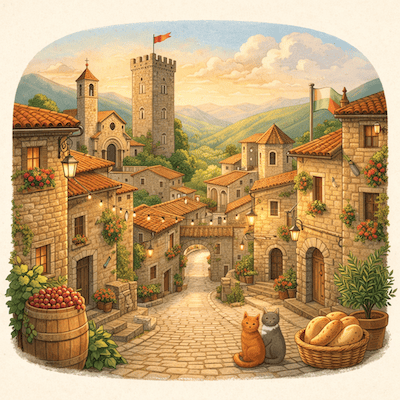
Oggi si chiama borgo un piccolo paese con un centro storico antico: strade di ciottoli, case di pietra, una piazza con la chiesa e, quasi sempre, una bella vista sulla campagna intorno.
Today a borgo is a small village with an old historic centre: cobbled streets, stone houses, a square with a church and, almost always, a fine view over the surrounding countryside.
Civita di Bagnoregio, 'la città che muore'
Civita di Bagnoregio, 'the Dying Town'
Nel nord del Lazio, in provincia di Viterbo, Civita di Bagnoregio sta in cima a una collina di tufo, una roccia morbida che la pioggia e il vento consumano piano piano. Per questo lo scrittore Bonaventura Tecchi, nato a Bagnoregio, la chiamò 'la città che muore'.
In northern Lazio, in the province of Viterbo, Civita di Bagnoregio sits on top of a hill of tuff, a soft rock that rain and wind are slowly wearing away. That is why the writer Bonaventura Tecchi, who was born in Bagnoregio, called it 'the dying town'.
Ci si arriva solo a piedi, attraverso un lungo ponte pedonale. In paese vive ormai una manciata di persone, mentre ogni anno arrivano centinaia di migliaia di visitatori, che dal 2013 pagano un biglietto d'ingresso.
The only way in is on foot, across a long pedestrian bridge. Just a handful of people still live there, while hundreds of thousands of visitors arrive every year; since 2013 they have had to buy an entrance ticket.
L'artigianato: mani che creano
Craftsmanship: Hands at Work
In molti borghi sopravvivono mestieri antichi. Entrando in una bottega si possono vedere artigiani che lavorano con gli stessi gesti dei loro nonni.
Old trades survive in many borghi. Step into a workshop and you can watch craftspeople working with the same movements as their grandparents.
A Deruta, in Umbria, la ceramica si dipinge a mano dal Medioevo; a Volterra, in Toscana, si lavora l'alabastro, una pietra chiara e morbida che usavano già gli Etruschi. Spesso queste tecniche passano di generazione in generazione nella stessa famiglia.
In Deruta, in Umbria, pottery has been painted by hand since the Middle Ages; in Volterra, in Tuscany, people carve alabaster, a pale, soft stone the Etruscans were already using. These skills are often handed down from generation to generation within the same family.
Borghi di mare: i colori della Liguria
Seaside Borghi: The Colours of Liguria
Non tutti i borghi sono in collina o in montagna. Sulla costa ligure, i cinque paesi delle Cinque Terre e borghi come Portofino hanno case dai colori vivaci, costruite una sopra l'altra a pochi metri dal mare.
Not all borghi are in the hills or mountains. On the Ligurian coast, the five villages of the Cinque Terre and places like Portofino have brightly coloured houses built one above the other just a few metres from the sea.
Erano paesi di pescatori, e la cucina lo racconta ancora: a Monterosso si conservano le acciughe sotto sale, mentre in tutta la regione si prepara il pesto con il basilico ligure. Molti visitatori vengono anche solo per questi sapori.
They were fishing villages, and the food still shows it: in Monterosso anchovies are preserved in salt, while all over the region people make pesto with Ligurian basil. Many visitors come just for these flavours.
Il turismo lento
Slow Tourism
Visitare un borgo significa praticare il cosiddetto 'turismo lento'. Non si corre da un monumento all'altro: ci si siede in piazza, si beve un bicchiere di vino locale e si guarda la vita del paese.
Visiting a borgo means practising what is known as 'slow tourism'. You don't rush from one monument to the next: you sit in the square, drink a glass of local wine and watch village life go by.
Contano i piccoli dettagli: il profumo del pane appena sfornato, le campane a mezzogiorno, due chiacchiere senza fretta con chi abita lì.
It's the small details that count: the smell of freshly baked bread, the church bells at noon, an unhurried chat with the people who live there.
Sagre e tradizioni
Sagre and Traditions
Quasi ogni borgo ha la sua sagra, una festa popolare dedicata a un prodotto tipico, come le castagne, il tartufo o il vino nuovo. Per qualche giorno la piazza si riempie di lunghi tavoli e tutto il paese mangia all'aperto.
Almost every borgo has its sagra, a village festival devoted to a local product such as chestnuts, truffles or new wine. For a few days the square fills up with long tables and the whole village eats outdoors.
In cucina ci sono spesso i volontari del posto, e le ricette sono quelle delle nonne del paese, che difficilmente si trovano nei ristoranti delle grandi città.
The cooking is often done by local volunteers, and the recipes are those of the village grandmothers, the kind you'll rarely find in big-city restaurants.
Il problema dello spopolamento
The Problem of Depopulation
Nonostante la loro bellezza, molti borghi si stanno svuotando. I giovani si trasferiscono in città per studiare o lavorare, e in paese restano soprattutto gli anziani.
For all their beauty, many borghi are emptying out. Young people move to the cities to study or work, and those left behind are mostly elderly.
Per invertire la tendenza, alcuni comuni vendono vecchie case abbandonate a un euro, a patto che chi le compra le ristrutturi entro pochi anni. Il primo è stato Salemi, in Sicilia, nel 2008; poi l'idea è stata ripresa da decine di altri paesi, come Sambuca di Sicilia e Mussomeli.
To reverse the trend, some towns sell old abandoned houses for one euro, on condition that the buyer renovates them within a few years. The first was Salemi, in Sicily, in 2008; since then dozens of other villages have taken up the idea, including Sambuca di Sicilia and Mussomeli.
Alcuni borghi da non perdere
Some Borghi Not to Miss
Ecco alcuni esempi che mostrano quanto sono diversi i borghi italiani:
Here are a few examples that show how varied Italy's borghi are:
Spello (Umbria): famosa per le Infiorate, quando nella notte prima del Corpus Domini le strade si coprono di tappeti di petali.
Spello (Umbria): famous for its Infiorate, when on the night before Corpus Domini the streets are covered with carpets of petals.
Alberobello (Puglia): famoso per i trulli, case bianche di pietra calcarea con il tetto a cono.
Alberobello (Apulia): famous for its trulli, white limestone houses with cone-shaped roofs.
Erice (Sicilia): borgo medievale a circa 750 metri d'altezza, spesso avvolto dalle nuvole, con vista sul mare di Trapani.
Erice (Sicily): a medieval village about 750 metres up, often wrapped in cloud, looking out over the sea at Trapani.
Castelmezzano (Basilicata): nel cuore delle Dolomiti Lucane, sembra incastrato nella roccia.
Castelmezzano (Basilicata): in the heart of the Lucanian Dolomites, it looks wedged into the rock.
Vipiteno (Alto Adige): borgo alpino dove si parlano italiano e tedesco, con una torre medievale in mezzo alla via principale.
Vipiteno (South Tyrol): an Alpine village where both Italian and German are spoken, with a medieval tower in the middle of the main street.
I borghi e il cinema
Borghi on the Big Screen
Molti registi hanno scelto i borghi come set. Le facciate antiche e la luce particolare di questi luoghi offrono una scenografia già pronta, senza bisogno di costruire nulla.
Many directors have chosen borghi as film sets. The old facades and the special light of these places provide a ready-made backdrop, with nothing to build.
'Il postino', con Massimo Troisi, fu girato in parte a Procida, alla Corricella, il vecchio quartiere dei pescatori. In 'The American', del 2010, George Clooney si muove invece tra Castel del Monte e Calascio, due paesi di montagna in Abruzzo.
'Il Postino', starring Massimo Troisi, was partly shot on Procida, in Corricella, the old fishermen's quarter. In 'The American' (2010), George Clooney moves between Castel del Monte and Calascio, two mountain villages in Abruzzo.
L'albergo diffuso
The 'Scattered Hotel'
Per salvare i borghi è nata anche l'idea dell''albergo diffuso'. Invece di costruire un nuovo hotel, si sistemano le case vuote sparse nel centro storico e le si trasforma in camere, con una sola reception per tutte.
Another idea for saving the borghi is the 'albergo diffuso', or scattered hotel. Instead of building a new hotel, empty houses dotted around the historic centre are restored and turned into guest rooms, with a single reception for all of them.
Uno degli esempi più noti è Santo Stefano di Sessanio, in Abruzzo. Chi dorme lì non è solo un turista: per qualche giorno vive come un abitante del paese e aiuta l'economia locale senza cambiare l'aspetto delle case.
One of the best-known examples is Santo Stefano di Sessanio, in Abruzzo. Guests there are more than tourists: for a few days they live like villagers and help the local economy without changing the look of the houses.
Conclusione
Conclusion
L'Italia dei borghi è fragile: basta poco perché un paese si svuoti o venga invaso dai turisti. Per questo va visitata con rispetto, magari fuori stagione e fermandosi almeno una notte.
The Italy of the borghi is fragile: it takes little for a village to empty out or be overrun by tourists. That's why it should be visited with respect, ideally out of season and staying at least one night.
Per chi studia l'italiano, un borgo è anche un'ottima palestra: per comprare il pane o chiedere una strada bisogna parlare con le persone, e spesso la conversazione dura molto più del previsto.
For learners of Italian, a borgo is also excellent practice: to buy bread or ask the way you have to talk to people, and the conversation often goes on much longer than expected.
In the free app you can listen to this text read aloud and tap any word to see what it means.