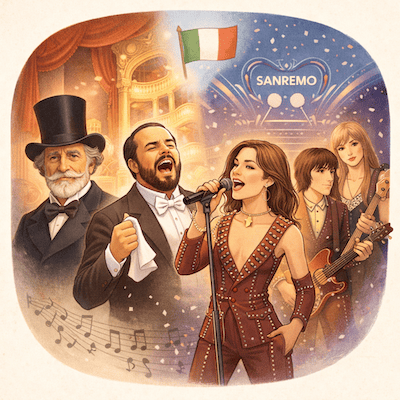
Dall'Opera al Pop
From Opera to Pop
 Learn ItalianFree app with audio, quizzes and real books
Key words
- battitobeat / heartbeat
- solennisolemn
- massamass / crowd
- gridocry / shout
- caloreheat / warmth
- barrierebarriers
- innnianthems / hymns
- nostalgianostalgia / homesickness
- ritoritual / rite
- palcostage
- cantautoresinger-songwriter
- vettepeaks / summits
All 25 words
- graffiantebiting / scratching / edgy
- classifichecharts / rankings
- provocatoriaprovocative
- apprendimentolearning
- orecchiabilecatchy
- tormentonesummer hit / obsession
- palcoscenicostage / spotlight
- prestigiosiprestigious
- custodiguardians / custodians
- acusticaacoustics
- battaglierofeisty / combative / fighting
- vibrareto vibrate / to thrill
- branopiece / passage / song
Per secoli l'Italia è stata uno dei centri della musica europea. Lo dimostrano le parole che ha regalato al mondo: 'piano', 'forte', 'allegro', 'soprano' e 'opera' si usano ancora oggi nei conservatori di ogni paese.
For centuries Italy was one of the centres of European music. You can tell from the words it gave the world: 'piano', 'forte', 'allegro', 'soprano' and 'opera' are still used in music schools in every country.
Dalle arie dei teatri dell'Ottocento alle canzoni del Festival di Sanremo, la storia della musica italiana segue quella della società: da un'arte per pochi a una passione di massa.
From the arias of nineteenth-century opera houses to the songs of the Sanremo Festival, the history of Italian music follows that of Italian society: from an art for the few to a mass passion.
L'età d'oro del melodramma
The Golden Age of Opera
Tra Ottocento e primo Novecento l'opera era la musica pop del tempo. Giuseppe Verdi e, più tardi, Giacomo Puccini erano vere star: le loro arie si fischiettavano per strada e le suonavano gli organetti nelle piazze.
In the nineteenth and early twentieth centuries opera was the pop music of its day. Giuseppe Verdi and, later, Giacomo Puccini were real stars: people whistled their arias in the street and barrel organs played them in the squares.
Verdi divenne anche un simbolo del Risorgimento. Sui muri si scriveva 'Viva VERDI', che si leggeva 'Viva Vittorio Emanuele Re d'Italia'. Quando morì, nel 1901, a Milano una folla immensa cantò in suo onore il coro 'Va, pensiero' dal 'Nabucco'.
Verdi also became a symbol of the Risorgimento. People wrote 'Viva VERDI' on walls, which could be read as 'Long live Vittorio Emanuele, King of Italy'. When he died in 1901, a huge crowd in Milan sang the chorus 'Va, pensiero' from 'Nabucco' in his honour.
Il tenore, la voce dell'Italia
The Tenor, Italy's Voice
Pochi suoni ricordano l'Italia come la voce di un tenore. Enrico Caruso, nato a Napoli nel 1873, fu uno dei primi cantanti a diventare famoso in tutto il mondo grazie ai dischi. Quasi un secolo dopo, Luciano Pavarotti cantò 'Nessun dorma' ai Mondiali di calcio del 1990 e l'aria di Puccini diventò un successo anche tra chi non era mai stato all'opera.
Few sounds say 'Italy' like a tenor's voice. Enrico Caruso, born in Naples in 1873, was one of the first singers to become world-famous through records. Almost a century later Luciano Pavarotti sang 'Nessun dorma' at the 1990 World Cup, and Puccini's aria became a hit even with people who had never been to the opera.
Con i concerti 'Pavarotti & Friends', organizzati a Modena per beneficenza, Pavarotti cantò accanto a star del rock e del pop come Sting e Bono, dimostrando che tra generi diversi non ci sono muri.
With the 'Pavarotti & Friends' charity concerts in Modena, Pavarotti sang alongside rock and pop stars such as Sting and Bono, showing that there are no walls between different genres.
La canzone napoletana
Neapolitan Song
A cavallo tra Ottocento e Novecento Napoli era la capitale della canzone. 'Funiculì funiculà' fu scritta nel 1880 per la nuova funicolare del Vesuvio; ''O sole mio' è del 1898 e 'Torna a Surriento' del 1902.
Around the turn of the twentieth century Naples was the capital of song. 'Funiculì funiculà' was written in 1880 for the new funicular railway up Vesuvius; ''O sole mio' dates from 1898 and 'Torna a Surriento' from 1902.
Queste canzoni parlano d'amore, di mare e di nostalgia. Gli emigranti le portarono in America, e per decenni hanno dato all'estero l'immagine romantica dell'Italia.
These songs are about love, the sea and longing. Emigrants took them to America, and for decades they shaped the romantic image of Italy abroad.
Il Festival di Sanremo, un rito collettivo
The Sanremo Festival, a National Ritual
Il Festival di Sanremo è nato nel 1951 ed è molto più di una gara di canzoni. Per cinque sere, di solito a febbraio, milioni di italiani lo guardano in TV e il giorno dopo ne parlano in ufficio, al bar e sui social.
The Sanremo Festival began in 1951 and is much more than a song contest. For five evenings, usually in February, millions of Italians watch it on TV and talk about it the next day at work, in the bar and on social media.
Su questo palco, nel 1958, Domenico Modugno cantò 'Nel blu dipinto di blu', che tutti ricordano come 'Volare'. La canzone arrivò in testa alla classifica americana e vinse due Grammy: per la musica italiana fu l'inizio di uno stile più moderno e libero.
It was on this stage, in 1958, that Domenico Modugno sang 'Nel blu dipinto di blu', which everyone remembers as 'Volare'. The song went to number one in the American charts and won two Grammys: for Italian music it marked the start of a freer, more modern style.
I cantautori: la musica che pensa
The Cantautori: Music That Makes You Think
Negli anni Sessanta e Settanta si affermò la figura del cantautore, che scrive da sé testi e musica. Fabrizio De André, Lucio Dalla, Francesco De Gregori e Francesco Guccini raccontavano nelle loro canzoni emarginati, operai, guerre e amori difficili.
In the 1960s and 70s the figure of the cantautore emerged: the singer-songwriter who writes both words and music. Fabrizio De André, Lucio Dalla, Francesco De Gregori and Francesco Guccini sang about outcasts, factory workers, wars and difficult loves.
Molti dei loro testi oggi si trovano nelle antologie scolastiche accanto alle poesie, perché hanno dimostrato che anche una canzone leggera può essere letteratura.
Many of their lyrics now appear in school anthologies next to poems, because they showed that even a popular song can be literature.
Il rock e il pop di oggi
Rock and Pop Today
L'Italia ha anche un'anima rock. Gianna Nannini e Vasco Rossi riempiono gli stadi da decenni con testi diretti e graffianti. Nel 2017 il concerto di Vasco al Modena Park ebbe più di 220.000 spettatori paganti, un record mondiale.
Italy has a rock soul too. Gianna Nannini and Vasco Rossi have been filling stadiums for decades with blunt, biting lyrics. In 2017 Vasco's concert at Modena Park drew more than 220,000 paying fans, a world record.
Laura Pausini, che vinse Sanremo nel 1993 con 'La solitudine', ed Eros Ramazzotti sono star internazionali, amatissime soprattutto in Spagna e in America Latina, dove spesso incidono le loro canzoni anche in spagnolo.
Laura Pausini, who won Sanremo in 1993 with 'La solitudine', and Eros Ramazzotti are international stars, hugely popular above all in Spain and Latin America, where they often record their songs in Spanish as well.
L'effetto Måneskin
The Måneskin Effect
Nel 2021 la band romana dei Måneskin vinse prima Sanremo e poi l'Eurovision con 'Zitti e buoni'. Per l'Italia era la prima vittoria all'Eurovision dal 1990, e poco dopo la loro versione di 'Beggin'' entrò anche nella classifica americana.
In 2021 the Roman band Måneskin won first Sanremo and then Eurovision with 'Zitti e buoni'. It was Italy's first Eurovision win since 1990, and shortly afterwards their version of 'Beggin'' also made the American charts.
Il loro successo ha dimostrato che la musica italiana non vive solo di melodia e di passato: può essere anche giovane, provocatoria e cantata da tutto il mondo.
Their success showed that Italian music isn't just about melody and the past: it can also be young, provocative and sung all over the world.
Imparare l'italiano con le canzoni
Learning Italian with Songs
Per chi studia l'italiano, le canzoni sono un ottimo aiuto. Un ritornello ripetuto dieci volte resta in testa e, con lui, la pronuncia, le rime e i modi di dire.
For learners of Italian, songs are a great help. A chorus heard ten times sticks in your head, and so do its pronunciation, rhymes and idioms.
Ascoltare un brano leggendo il testo è un buon esercizio di comprensione. Si scoprono anche parole e sentimenti che nei libri di grammatica non ci sono.
Listening to a song while reading the lyrics is good comprehension practice. You also come across words and feelings that grammar books leave out.
Piccolo vocabolario musicale
A Short Music Glossary
Brano: un pezzo musicale, una canzone.
Brano: a piece of music, a song.
Ritornello: la parte della canzone che si ripete più volte.
Ritornello: the part of a song that is repeated several times (the chorus).
Orecchiabile: una melodia facile da ricordare e da cantare.
Orecchiabile: a tune that is easy to remember and sing (catchy).
Tormentone: una canzone che per un'estate si sente dappertutto.
Tormentone: a song you hear everywhere for a whole summer.
Palcoscenico: la parte del teatro dove si esibiscono gli artisti.
Palcoscenico: the part of the theatre where the performers appear (the stage).
I templi della musica
Temples of Music
In Italia si trovano alcuni dei teatri d'opera più famosi del mondo. Il San Carlo di Napoli, aperto nel 1737, è il più antico teatro d'opera d'Europa ancora in attività; la Scala di Milano è del 1778; la Fenice di Venezia, inaugurata nel 1792, è bruciata più volte e ogni volta è stata ricostruita.
Italy is home to some of the most famous opera houses in the world. The San Carlo in Naples, opened in 1737, is the oldest opera house in Europe still in use; La Scala in Milan dates from 1778; and La Fenice in Venice, opened in 1792, has burned down more than once and been rebuilt every time.
Vedere un'opera in uno di questi teatri, tra palchi dorati e velluto rosso, è un'esperienza che unisce musica, storia e architettura.
Seeing an opera in one of these theatres, surrounded by gilded boxes and red velvet, is an experience that brings together music, history and architecture.
Curiosità: l'inno d'Italia
Did You Know? Italy's National Anthem
L'inno nazionale si chiama 'Il Canto degli Italiani', ma tutti lo conoscono come 'Inno di Mameli'. Il testo fu scritto nel 1847 dal genovese Goffredo Mameli, che morì due anni dopo, a soli 21 anni, combattendo per la Repubblica Romana; la musica è di Michele Novaro.
The national anthem is called 'Il Canto degli Italiani' (The Song of the Italians), but everyone knows it as the 'Inno di Mameli'. The words were written in 1847 by Goffredo Mameli from Genoa, who died two years later, aged just 21, fighting for the Roman Republic; the music is by Michele Novaro.
Ha un ritmo di marcia molto energico e gli italiani lo cantano a pieni polmoni soprattutto prima delle partite della Nazionale. Curiosamente, è diventato inno ufficiale per legge solo nel 2017: fino ad allora lo era 'provvisoriamente', dal 1946.
It has a very energetic marching rhythm, and Italians sing it at the top of their voices, especially before national team matches. Oddly enough, it only became the official anthem by law in 2017: until then it had been the anthem 'provisionally', since 1946.
Conclusione
Conclusion
Dall'opera al pop, la musica italiana ha cambiato più volte pubblico e linguaggio, ma una cosa è rimasta: l'importanza della melodia e della voce.
From opera to pop, Italian music has changed its audience and its language several times, but one thing has stayed the same: the importance of melody and of the voice.
Un buon modo per cominciare è ascoltare un'aria di Puccini, una canzone di De André e l'ultimo vincitore di Sanremo, uno dopo l'altro, e notare quanto cambia la lingua da un brano all'altro.
A good way to start is to listen to a Puccini aria, a De André song and the latest Sanremo winner one after the other, and notice how much the language changes from one to the next.
In the free app you can listen to this text read aloud and tap any word to see what it means.