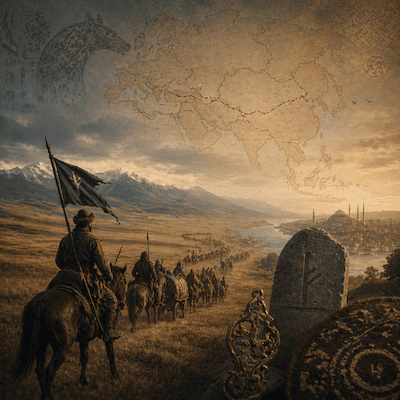
Orta Asya'dan Anadolu'ya
From Central Asia to Anatolia
 Learn TurkishFree app with audio, quizzes and real books
Key words
- bozkırsteppe
- göçmigration
- göçebenomadic
- kültürculture
- medeniyetcivilization
- kağanlıkkhaganate
- yazıtinscription
- mirasheritage / legacy
- boytribe / clan
- fetihconquest
- ittifakalliance
- dönüm noktasıturning point
All 26 words
- zafervictory
- yerleşmekto settle
- kimlikidentity
- uygarlıkcivilization
- destanepic
- yiğitlikbravery / heroism
- onurhonor
- halıcarpet / rug
- mimariarchitecture
- folklorfolklore
- kervansaraycaravanserai
- ticarettrade / commerce
- anadilnative language
- mirasçıheir / inheritor
Türklerin tarihi, Moğolistan bozkırlarından Akdeniz kıyılarına uzanan uzun bir yolculuğun hikâyesidir. Bu yolculuk tek bir göçle tamamlanmadı, yüzyıllar boyunca dalga dalga sürdü. Türk boyları yol boyunca pek çok halkla ve kültürle karşılaştı.
The history of the Turks is the story of a long journey that stretches from the steppes of Mongolia to the shores of the Mediterranean. It was not completed in a single migration but went on in wave after wave over centuries. Along the way the Turkic tribes met many peoples and cultures.
Göç eden boylar, yeni yurtlarına yalnızca atlarını ve çadırlarını getirmedi. Dillerini, inançlarını, destanlarını ve devlet kurma geleneklerini de beraberlerinde taşıdı. Bugün Türkiye'de konuşulan Türkçe, bu uzun yolculuğun en canlı izidir.
The migrating tribes brought more than their horses and tents to their new homelands. They also carried their languages, beliefs, epics and traditions of statecraft with them. The Turkish spoken in Turkey today is the most vivid trace of that long journey.
Bozkırda Başlayan Hikâye
A Story That Began on the Steppe
Türklerin ataları, bugünkü Moğolistan, Güney Sibirya ve Kazakistan bozkırlarında göçebe olarak yaşıyordu. Hayatları at sırtında geçerdi. Sürülerini otlatmak için mevsimden mevsime yer değiştirir, keçe çadırlarda kalır, kımız içerlerdi. Usta binici ve okçu oldukları için savaşta da güçlüydüler.
The ancestors of the Turks lived as nomads on the steppes of present-day Mongolia, southern Siberia and Kazakhstan. Their lives were spent on horseback. They moved from season to season to graze their herds, lived in felt tents and drank kumis. As skilled riders and archers, they were also formidable in war.
"Türk" adı yazılı kaynaklarda ilk kez 6. yüzyılda, Çin kayıtlarında geçer. Bu adı devletlerinin adı olarak ilk kullananlar Göktürklerdir. Onlardan kalan Orhun Yazıtları, Türkçe yazılmış en eski uzun metinlerin başında gelir.
The name "Türk" first appears in written sources in the 6th century, in Chinese records. The Göktürks were the first to use it as the name of their state. The Orkhon inscriptions they left behind are among the oldest long texts written in Turkic.
Göktürkler ve Taşa Yazılan Tarih
The Göktürks and History Carved in Stone
Göktürk Kağanlığı 552'de kuruldu. Bumin Kağan, Türklerin o zamana kadar boyun eğdiği Juan-juanları yenerek kendini kağan ilan etti. Devletin toprakları kısa sürede genişledi ve doğuda Mançurya'dan batıda Karadeniz'in kuzeyindeki bozkırlara kadar uzandı.
The Göktürk Khaganate was founded in 552. Bumin Qaghan defeated the Rouran, to whom the Turks had until then been subject, and proclaimed himself khagan. The state quickly expanded, reaching from Manchuria in the east to the steppes north of the Black Sea in the west.
Göktürklerin en ünlü mirası, Orhun Vadisi'ndeki yazıtlardır. Kül Tigin ve ağabeyi Bilge Kağan için 732 ve 735 yıllarında dikilen bu taşlarda hükümdar doğrudan halkına seslenir. Kül Tigin Yazıtı şu sözlerle başlar: "Üstte mavi gök, altta yağız yer yaratıldığında ikisinin arasında insanoğlu yaratılmış."
The most famous legacy of the Göktürks is the inscriptions in the Orkhon Valley. On these stones, raised in 732 and 735 for Kül Tigin and his elder brother Bilge Qaghan, the ruler speaks directly to his people. The Kül Tigin inscription opens with these words: "When the blue sky above and the brown earth below were created, between the two were created the sons of men."
Batıya Doğru Göç Dalgaları
Waves of Migration to the West
8. ve 9. yüzyıllarda bozkırdaki dengeler değişti. Göktürklerin yerini Uygurlar aldı. 840'ta Kırgızlar Uygur Kağanlığı'nı yıkınca pek çok boy yeni bir yurt aramaya başladı. Kuraklık, otlak sıkıntısı ve boylar arasındaki savaşlar da göçleri hızlandırdı. Bazı topluluklar Çin sınırında kaldı, Oğuzlar ise Aral Gölü ile Seyhun Irmağı çevresine yerleşti.
In the 8th and 9th centuries the balance of power on the steppe shifted. The Uyghurs took the place of the Göktürks. When the Kyrgyz destroyed the Uyghur Khaganate in 840, many tribes set out in search of a new homeland. Drought, a shortage of pasture and wars between the tribes also sped up the migrations. Some groups stayed on the Chinese frontier, while the Oghuz settled around the Aral Sea and the Syr Darya.
Türkler bu dönemde İslam dünyasıyla da tanıştı. İlk temaslar 8. yüzyılda başladı, ancak boyların büyük bölümü 10. yüzyılda Müslüman oldu. Orta Asya'da İslam'ı kabul eden ilk büyük Türk devletlerinden biri Karahanlılardır. Yeni din, Türkleri Bağdat'tan Buhara'ya uzanan geniş bir ticaret ve kültür dünyasına bağladı.
In this period the Turks also came into contact with the Islamic world. The first contacts began in the 8th century, but most of the tribes became Muslim in the 10th. The Karakhanids were one of the first major Turkic states in Central Asia to adopt Islam. The new religion linked the Turks to a vast world of trade and culture that stretched from Baghdad to Bukhara.
Selçuklular ve Malazgirt
The Seljuks and Manzikert
Türklerin Anadolu'ya yerleşmesinde dönüm noktası, 26 Ağustos 1071'deki Malazgirt Savaşı'dır. Büyük Selçuklu Sultanı Alparslan, Bizans İmparatoru Romen Diyojen'in ordusunu yendi ve imparatoru esir aldı. Ancak onu öldürmedi, bir antlaşma imzaladıktan sonra serbest bıraktı.
The turning point in the Turkish settlement of Anatolia is the Battle of Manzikert on 26 August 1071. The Great Seljuk sultan Alp Arslan defeated the army of the Byzantine emperor Romanos IV Diogenes and took the emperor prisoner. He did not kill him, however, and set him free after signing a treaty.
Savaşın ardından Türkmen boyları Anadolu'nun içlerine kadar ilerledi. Kısa süre sonra Anadolu Selçuklu Devleti kuruldu. O sırada Anadolu'da Rumlar, Ermeniler, Süryaniler ve başka halklar yaşıyordu. Türkçe konuşan Müslümanlar ancak yüzyıllar içinde, yavaş yavaş çoğunluk hâline geldi. Yeni gelenler de bu süreçte yerli halkların kültüründen çok şey öğrendi.
After the battle, Turkmen tribes advanced deep into Anatolia. Soon afterwards the Seljuk Sultanate of Rum was founded. At the time Anatolia was home to Greeks, Armenians, Syriacs and other peoples. Turkish-speaking Muslims became the majority only gradually, over the course of centuries. In the process the newcomers also learned a great deal from the cultures of the local peoples.
Bozkırdan Getirilen Miras
A Legacy Brought from the Steppe
Türkler Anadolu'ya bozkır hayatından pek çok şey getirdi: at sevgisini, keçe ve çadır kültürünü, halı ve kilim dokumacılığını, ozanların kopuz eşliğinde söylediği şiirleri. Bilinen en eski Türk halılarından bazıları Konya'daki Alaeddin Camii'nde bulunmuştur. 13. yüzyıldan kalan bu halılar bugün müzelerde sergilenir.
The Turks brought much of steppe life with them to Anatolia: their love of horses, the tradition of felt and tents, the weaving of carpets and kilims, and the poems that bards sang to the kopuz. Some of the oldest known Turkish carpets were found in the Alaeddin Mosque in Konya. These 13th-century carpets are now displayed in museums.
Bu mirasın en güçlü taşıyıcısı ise dildir. Türkçe zamanla Arapça ve Farsçadan binlerce kelime aldı, ancak temel yapısını korudu. Orhun Yazıtları'nda geçen "at", "su", "yol", "gök" gibi kelimeler bugün de hemen hemen aynı biçimde kullanılır.
The strongest carrier of this heritage, however, is the language. Over time Turkish took thousands of words from Arabic and Persian, yet it kept its basic structure. Words found in the Orkhon inscriptions, such as "at" (horse), "su" (water), "yol" (road) and "gök" (sky), are still used in almost the same form today.
Kimliği Taşıyan Destanlar
Epics That Carry an Identity
Yazının pek kullanılmadığı bozkırda tarih, ozanların dilinde yaşadı. Dede Korkut Hikâyeleri, Oğuz Türklerinin destansı anlatılarıdır. Deli Dumrul'un ölüm meleği Azrail'e meydan okuması, Bamsı Beyrek'in maceraları ve tek gözlü dev Tepegöz'ün öyküsü bu anlatıların en bilinenleridir. On iki hikâyenin tamamı, Dresden'de saklanan bir el yazmasında yer alır.
On the steppe, where writing was little used, history lived on in the words of the bards. The Book of Dede Korkut is a collection of the epic tales of the Oghuz Turks. Deli Dumrul's challenge to Azrael, the angel of death, the adventures of Bamsı Beyrek and the tale of the one-eyed giant Tepegöz are the best known of them. All twelve stories survive in a manuscript kept in Dresden.
Kırgızların Manas Destanı ise dünyanın en uzun destanları arasındadır. Kahraman Manas'ı ve onun soyunu anlatan destanın bazı anlatımları yüz binlerce dizeyi bulur. Manas Destanı da Dede Korkut mirası da bugün UNESCO'nun Somut Olmayan Kültürel Miras listesinde yer alır.
The Kyrgyz Epic of Manas is among the longest epics in the world. Some versions of the epic, which tells of the hero Manas and his descendants, run to hundreds of thousands of lines. Today both the Manas epic and the heritage of Dede Korkut are on UNESCO's list of Intangible Cultural Heritage.
Türk Tarihinden İlginç Bilgiler
Curious Facts from Turkic History
Orhun Yazıtları 732 ve 735 yıllarında dikildi. Yazıtların bulunduğu Orhun Vadisi, UNESCO Dünya Mirası Listesi'nde yer alır.
The Orkhon inscriptions were erected in 732 and 735. The Orkhon Valley, where they stand, is a UNESCO World Heritage Site.
Her boyun kendine ait bir damgası vardı ve hayvanlar ile eşyalar bu işaretle tanınırdı. Bazı araştırmacılara göre Göktürk harflerinin bir kısmı bu damgalardan türemiştir.
Every tribe had its own tamga, a mark by which its animals and belongings were recognised. According to some researchers, some of the letters of the Göktürk script developed from these marks.
Selçuklular, ticaret yolları üzerinde aşağı yukarı bir günlük yol arayla kervansaraylar kurdu. Aksaray'daki Sultanhanı (1229), bunların en büyüklerinden biridir.
The Seljuks built caravanserais along the trade routes, roughly a day's journey apart. Sultanhanı (1229) in Aksaray is one of the largest of them.
Türkçeyi anadili olarak konuşanların sayısı 80 milyonu aşar. Bütün Türk dillerini konuşanların toplamı ise 170 milyonun üzerindedir.
More than 80 million people speak Turkish as their mother tongue. The total number of speakers of all Turkic languages is over 170 million.
Göktürk alfabesi sağdan sola yazılırdı ve 38 kadar harften oluşuyordu. Bu yazıyı 1893'te Danimarkalı dilbilimci Vilhelm Thomsen çözdü.
The Göktürk alphabet was written from right to left and had about 38 letters. The Danish linguist Vilhelm Thomsen deciphered it in 1893.
İznik 1097'de elden çıkınca Konya, Anadolu Selçuklularının başkenti oldu. Mevlânâ Celaleddin Rumi ömrünün büyük bölümünü bu şehirde geçirdi ve ünlü Mesnevi'sini burada Farsça yazdı.
After Nicaea (İznik) was lost in 1097, Konya became the capital of the Seljuks of Rum. Rumi spent most of his life in this city and wrote his famous Masnavi here, in Persian.
Anadolu: Yeni Yurt
Anatolia: A New Homeland
Türkler Anadolu'da yüzyıllar boyunca Rumlar, Ermeniler, Kürtler, Süryaniler ve başka topluluklarla yan yana yaşadı. Bu komşuluk mutfakta, müzikte ve dilde izler bıraktı. Örneğin "lahana", "fasulye" ve "midye" kelimeleri Türkçeye Rumcadan geçmiştir.
For centuries the Turks of Anatolia lived side by side with Greeks, Armenians, Kurds, Syriacs and other communities. This neighbourliness left its mark on cooking, music and language. The Turkish words "lahana" (cabbage), "fasulye" (beans) and "midye" (mussel), for example, came from Greek.
Türklerin yerleştiği topraklarda çok eski uygarlıkların izleri vardı. Hititlerin başkenti Hattuşa, bugünkü Çorum il sınırları içindedir. Kral Midas'ın başkenti Gordion'du, ilk madenî paraları basan Lidyalıların merkezi ise Sardes'ti. Efes gibi Yunan ve Roma şehirleri de bu mirasın bir parçasıdır.
The lands where the Turks settled bore traces of very ancient civilisations. Hattusa, the capital of the Hittites, lies within today's province of Çorum. King Midas's capital was Gordion, and the centre of the Lydians, who struck the first coins, was Sardis. Greek and Roman cities such as Ephesus are also part of this heritage.
Farklı Yollar, Farklı Kaderler
Different Paths, Different Destinies
Orta Asya'dan yola çıkan boyların hepsi Anadolu'ya gelmedi. Türk kökenli Bulgarlar, Asparuh Han'ın önderliğinde 681'de Tuna'nın güneyinde bir devlet kurdu ve zamanla Slavlaştı. Kumanlar 13. yüzyılda Macaristan'a sığındı. Hazarlar ise uzun süre Hazar Denizi'nin kuzeyindeki bozkırlara hâkim oldu.
Not all the tribes that set out from Central Asia reached Anatolia. The Bulgars, a people of Turkic origin, founded a state south of the Danube in 681 under Khan Asparukh and over time became Slavic. The Cumans took refuge in Hungary in the 13th century. The Khazars, for their part, long ruled the steppes north of the Caspian Sea.
Bugün Özbekler, Kazaklar, Azerbaycanlılar, Türkmenler, Kırgızlar, Uygurlar, Tatarlar ve Sibirya'daki Sahalar (Yakutlar) Türk dilleri konuşur. Bu halkların bir kısmının kendi devleti vardır. Bir kısmı ise başka ülkelerin sınırları içinde yaşar. Diller zamanla birbirinden uzaklaşmıştır, ancak "ata", "ay", "göz" gibi pek çok temel kelime hâlâ birbirine çok benzer.
Today Uzbeks, Kazakhs, Azerbaijanis, Turkmens, Kyrgyz, Uyghurs, Tatars and the Sakha (Yakuts) of Siberia speak Turkic languages. Some of these peoples have their own states. Others live within the borders of other countries. The languages have drifted apart over time, but many basic words such as "ata" (father), "ay" (moon) and "göz" (eye) are still very similar.
Yolculuğun Bıraktıkları
What the Journey Left Behind
Bozkırda sürüleriyle dolaşan boylar zamanla şehirler kurdu. Selçuklu Konya'sı, Osmanlı Bursa'sı ve İstanbul'u bu yolun durakları oldu. Göçebe hayatın bazı alışkanlıkları bugün de sürer: Anadolu'nun pek çok köyünde yazın hayvanlarla yaylaya çıkılır.
Over time the tribes that roamed the steppe with their herds founded cities. Seljuk Konya and Ottoman Bursa and Istanbul became stops along the way. Some habits of nomadic life continue to this day: in many villages in Anatolia, people take their animals up to the high pastures, the yayla, in summer.
Bu tarihin katmanları dilde de görülür. Orhun taşlarındaki eski kelimeler, Arapça ve Farsçadan gelenler ve Anadolu'daki komşulardan alınanlar Türkçede yan yana durur. Bunların her biri, Orta Asya'dan Anadolu'ya uzanan yolun başka bir durağından kalmıştır.
The layers of this history can also be seen in the language. Old words from the Orkhon stones, words from Arabic and Persian and words borrowed from neighbours in Anatolia stand side by side in Turkish. Each of them is left over from a different stop on the road from Central Asia to Anatolia.
In the free app you can listen to this text read aloud and tap any word to see what it means.