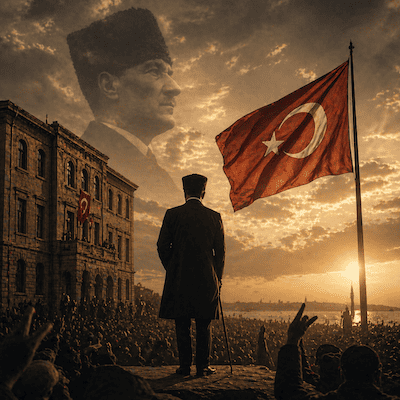
Bir Milletin Doğuşu
The Birth of a Nation
 Learn TurkishFree app with audio, quizzes and real books
Key words
- cumhuriyetrepublic
- egemenliksovereignty
- işgaloccupation
- bağımsızlıkindependence
- devrimrevolution / reform
- meclisassembly / parliament
- anayasaconstitution
- laikliksecularism
- mücadelestruggle
- zafervictory
- barışpeace
- milletnation
All 27 words
- vatandaşcitizen
- reformreform
- savaşwar
- orduarmy
- liderleader
- özgürlükfreedom
- başkentcapital city
- anlaşmaagreement / treaty
- halkpeople / public
- kanunlaw
- devletstate
- seçimelection
- modernleşmemodernization
- ulusnation
- gelecekfuture
1923 yılı, Türk tarihinin en önemli dönüm noktalarından biridir. Bu yıl, altı yüz yılı aşkın bir süre ayakta kalan Osmanlı İmparatorluğu'nun yerine Ankara'da Türkiye Cumhuriyeti kuruldu. Değişiklik yalnızca yönetim biçimiyle sınırlı kalmadı; eğitimden hukuka, alfabeden ulusal kimliğe kadar pek çok alan yeniden biçimlendi.
The year 1923 is one of the most important turning points in Turkish history. That year the Republic of Türkiye was founded in Ankara, in place of the Ottoman Empire, which had lasted for more than six hundred years. The change was not limited to the form of government: many areas, from education to law and from the alphabet to national identity, were reshaped.
Birinci Dünya Savaşı'nın ardından Osmanlı toprakları paylaşılmaya başlandı. İstanbul işgal edildi; Anadolu'nun büyük bölümüne de yabancı askerler yerleşti. Cumhuriyetin hikâyesi, umudun neredeyse tükendiği bu günlerde örgütlenen bir direnişle başlar.
After the First World War the Ottoman lands began to be carved up. Istanbul was occupied, and foreign troops settled in much of Anatolia. The story of the republic begins with a resistance organised in these days, when hope had almost run out.
Osmanlı'nın Çöküşü ve Kurtuluş Savaşı'nın Başlangıcı
The Fall of the Ottomans and the Start of the War of Independence
Osmanlı Devleti, 30 Ekim 1918'de Limni adasındaki Mondros limanında imzalanan ateşkesle Birinci Dünya Savaşı'ndan yenik çekildi. İki hafta sonra İtilaf Devletleri'nin savaş gemileri İstanbul önlerine demir attı. Ardından Anadolu'nun çeşitli bölgelerine İngiliz, Fransız ve İtalyan askerleri çıkarıldı. 15 Mayıs 1919'da ise Yunan ordusu İzmir'i işgal etti.
With an armistice signed on 30 October 1918 in the harbour of Mudros on the island of Lemnos, the Ottoman state withdrew from the First World War defeated. Two weeks later Allied warships dropped anchor off Istanbul. British, French and Italian troops were then landed in various parts of Anatolia, and on 15 May 1919 the Greek army occupied Izmir.
Dört gün sonra, 19 Mayıs 1919'da Mustafa Kemal Samsun'a çıktı. Dokuzuncu Ordu Müfettişi sıfatıyla bölgedeki asayişi sağlamakla görevlendirilmişti. Asıl amacı ise dağınık direniş gruplarını birleştirmek ve işgale karşı düzenli bir mücadele başlatmaktı. 19 Mayıs, bugün Atatürk'ü Anma, Gençlik ve Spor Bayramı olarak kutlanır.
Four days later, on 19 May 1919, Mustafa Kemal landed at Samsun. As Inspector of the Ninth Army, he had been given the task of keeping order in the region. His real aim, however, was to unite the scattered resistance groups and start an organised struggle against the occupation. Today 19 May is celebrated as the Commemoration of Atatürk, Youth and Sports Day.
Kongreler ve Millî İrade
The Congresses and the Will of the Nation
Mustafa Kemal, kısa sürede ülke çapında bir örgütlenme kurdu. Temmuz 1919'da Erzurum'da, Eylül 1919'da ise Sivas'ta kongreler toplandı. Bu kongrelerde vatanın bölünmez bir bütün olduğu ve milletin geleceğine yine milletin karar vereceği ilan edildi.
Mustafa Kemal quickly built a nationwide organisation. Congresses met in Erzurum in July 1919 and in Sivas in September 1919. They declared that the homeland was an indivisible whole and that the nation itself would decide its own future.
Sivas Kongresi, millî mücadelenin dönüm noktalarından biri oldu. Yurdun dört bir yanındaki direniş dernekleri burada "Anadolu ve Rumeli Müdafaa-i Hukuk Cemiyeti" adı altında birleşti; böylece yerel direnişler tek bir ulusal harekete dönüştü. Mustafa Kemal ve arkadaşları, Aralık 1919'da Ankara'ya geçti. İşgal bölgelerinden uzak olan ve demiryolu üzerinde bulunan bu küçük şehir, kısa sürede millî hareketin merkezi hâline geldi.
The Sivas Congress was one of the turning points of the national struggle. There, resistance societies from every corner of the country united under the name "Association for the Defence of the Rights of Anatolia and Rumelia", and the local resistance groups thus became a single national movement. In December 1919 Mustafa Kemal and his companions moved to Ankara. This small town, far from the occupied areas and on the railway, soon became the centre of the national movement.
Türkiye Büyük Millet Meclisi'nin Açılışı
The Opening of the Grand National Assembly of Türkiye
Türkiye Büyük Millet Meclisi, 23 Nisan 1920'de Ankara'da açıldı. İstanbul'daki padişah hükümeti, işgal kuvvetlerinin denetimi altındaydı. Bu nedenle Meclis, yasa yapmanın yanı sıra hükümeti de kendi içinden kurdu. 23 Nisan, bugün Ulusal Egemenlik ve Çocuk Bayramı olarak kutlanır.
The Grand National Assembly of Türkiye opened in Ankara on 23 April 1920. The sultan's government in Istanbul was under the control of the occupying forces. For this reason the Assembly not only made laws but also formed a government from among its own members. Today 23 April is celebrated as National Sovereignty and Children's Day.
Mustafa Kemal, Meclis Başkanı seçildi. Meclisin açılmasıyla yeni bir ilke hayata geçti: Yönetme yetkisi artık padişahtan değil, milletten geliyordu. 1 Kasım 1922'de saltanatın kaldırılmasıyla bu ilke, kurulacak cumhuriyetin temel taşı oldu.
Mustafa Kemal was elected Speaker of the Assembly. With the opening of the Assembly a new principle came into being: the right to govern no longer came from the sultan but from the nation. When the sultanate was abolished on 1 November 1922, this principle became the cornerstone of the republic that was to come.
Zaferden Barışa: Lozan Antlaşması
From Victory to Peace: The Treaty of Lausanne
Kurtuluş Savaşı 1919'dan 1922'ye kadar sürdü ve birkaç cephede birden yürütüldü. Doğuda 1920'de Ermenistan'a karşı savaşıldı. Güneyde Antep, Maraş ve Urfa çevresinde Fransız kuvvetleriyle çatışmalar yaşandı. En uzun ve en kanlı mücadele ise batıda Yunan ordusuna karşı verildi; 1921'deki Sakarya Meydan Muharebesi tam 22 gün sürdü.
The War of Independence lasted from 1919 to 1922 and was fought on several fronts at once. In the east there was fighting against Armenia in 1920. In the south there were clashes with French forces around Antep, Maraş and Urfa. The longest and bloodiest struggle, though, was in the west against the Greek army; the Battle of Sakarya in 1921 lasted a full 22 days.
26 Ağustos 1922'de başlayan Büyük Taarruz, savaşın sonucunu belirledi ve Türk ordusu 9 Eylül'de İzmir'e girdi. 24 Temmuz 1923'te imzalanan Lozan Antlaşması ile yeni Türkiye'nin sınırları uluslararası alanda tanındı. Böylece 1920'de imzalanan ama hiçbir zaman uygulanmayan Sevr Antlaşması'nın ağır şartları da tarihe karıştı.
The Great Offensive, launched on 26 August 1922, decided the outcome of the war, and the Turkish army entered Izmir on 9 September. The Treaty of Lausanne, signed on 24 July 1923, gave international recognition to the borders of the new Türkiye. The harsh terms of the Treaty of Sèvres, signed in 1920 but never put into effect, were thus consigned to history.
29 Ekim 1923: Cumhuriyetin İlanı
29 October 1923: The Proclamation of the Republic
Lozan'dan sonra sıra yeni devletin yönetim biçimini belirlemeye geldi. 13 Ekim 1923'te Ankara başkent ilan edildi. 29 Ekim 1923 akşamı Meclis cumhuriyeti ilan etti ve Mustafa Kemal'i oybirliğiyle cumhurbaşkanı seçti. Başbakanlığa ise sonradan İnönü soyadını alacak olan İsmet Paşa getirildi.
After Lausanne it was time to decide the form of government of the new state. On 13 October 1923 Ankara was declared the capital. On the evening of 29 October 1923 the Assembly proclaimed the republic and unanimously elected Mustafa Kemal president. İsmet Pasha, who later took the surname İnönü, became prime minister.
Cumhuriyetin ilanı, yalnızca yönetim biçimini değiştirmekle kalmadı. Hanedana ve dinî meşruiyete dayanan Osmanlı düzeninin yerini, millî egemenliğe ve hukuka dayanan, zamanla laikliği de benimseyen yeni bir devlet anlayışı aldı. Meclis'in genel kurul salonunda bugün de "Egemenlik kayıtsız şartsız milletindir" sözü yazılıdır.
The proclamation of the republic did more than change the form of government. The Ottoman order, based on a dynasty and on religious legitimacy, gave way to a new idea of the state based on national sovereignty and the rule of law, which in time also embraced secularism. The words "Sovereignty belongs unconditionally to the nation" are still written today in the main chamber of the Assembly.
İmparatorluktan Cumhuriyete: Temel Farklar
From Empire to Republic: The Key Differences
Osmanlı'da egemenlik padişaha ve hanedanına aitti. Cumhuriyet ise egemenliğin kayıtsız şartsız millete ait olduğunu ilan etti.
In the Ottoman Empire sovereignty belonged to the sultan and his dynasty. The republic, by contrast, declared that sovereignty belonged unconditionally to the nation.
Osmanlı padişahları aynı zamanda halife unvanını taşıyordu; din ve devlet işleri iç içeydi. Cumhuriyet ise bu ikisini birbirinden ayırarak laikliği benimsedi.
The Ottoman sultans also held the title of caliph, and religion and the affairs of state were intertwined. The republic separated the two and adopted secularism.
Osmanlı'da halk padişahın tebaası sayılır, insanların hukuki durumu da büyük ölçüde dinlerine göre belirlenirdi. Cumhuriyet ise herkese eşit vatandaşlık tanıdı.
In the Ottoman Empire the people were regarded as the sultan's subjects, and a person's legal status depended largely on their religion. The republic granted equal citizenship to everyone.
İmparatorluğun resmî yazı dili, Arap harfleriyle yazılan Osmanlı Türkçesiydi. 1928'deki Harf Devrimi ile Latin harflerine dayanan yeni Türk alfabesi kabul edildi.
The official written language of the empire was Ottoman Turkish, written in Arabic script. With the Alphabet Reform of 1928 a new Turkish alphabet based on Latin letters was adopted.
Osmanlı İmparatorluğu çok uluslu bir devletti. Cumhuriyet ise ortak bir Türk ulusal kimliği üzerine kuruldu; bu değişim, büyük reformların yanında ciddi gerilimleri de beraberinde getirdi.
The Ottoman Empire was a multinational state. The republic, on the other hand, was built on a shared Turkish national identity; alongside major reforms, this change also brought serious tensions.
İmparatorluğun merkezi yüzyıllar boyunca İstanbul'du. Cumhuriyetin başkenti ise Anadolu'nun ortasındaki Ankara oldu.
For centuries the centre of the empire was Istanbul. The capital of the republic, by contrast, became Ankara, in the middle of Anatolia.
Atatürk'ün Reformları: İlk Adımlar
Atatürk's Reforms: The First Steps
Cumhuriyetin ilanından sonra reformlar art arda geldi. 3 Mart 1924'te halifelik kaldırıldı ve Osmanlı hanedanının üyeleri yurt dışına çıkarıldı. Aynı yılın nisan ayında ise yeni bir anayasa kabul edildi.
After the proclamation of the republic, reforms followed one after another. On 3 March 1924 the caliphate was abolished and the members of the Ottoman dynasty were sent abroad. In April of the same year a new constitution was adopted.
1925'te tekke ve zaviyeler kapatıldı. 1926'da İsviçre Medeni Kanunu örnek alınarak hazırlanan Türk Medeni Kanunu yürürlüğe girdi. Bu kanunla çok eşlilik yasaklandı, kadınlar da boşanma davası açma hakkını elde etti. 1928'de "Devletin dini İslam'dır" ifadesi anayasadan çıkarıldı. Bütün bu değişiklikler, beş yıldan kısa bir sürede gerçekleştirildi.
In 1925 the dervish lodges and shrines were closed. In 1926 the Turkish Civil Code, modelled on the Swiss Civil Code, came into force. Under this code polygamy was banned, and women gained the right to file for divorce. In 1928 the phrase "The religion of the state is Islam" was removed from the constitution. All these changes were carried out in less than five years.
Nüfus Mübadelesi: Yurdunu Değiştiren İnsanlar
The Population Exchange: People Who Lost Their Homeland
Ocak 1923'te Lozan'da imzalanan bir sözleşmeyle Türkiye ile Yunanistan arasında zorunlu nüfus mübadelesi kararlaştırıldı. Yaklaşık 1,2 milyon Ortodoks Hristiyan Türkiye'den Yunanistan'a, 400.000 kadar Müslüman da Yunanistan'dan Türkiye'ye göç etmek zorunda kaldı. Mübadelede dil ya da köken değil, din esas alındı. İstanbul Rumları ile Batı Trakya Müslümanları ise mübadelenin dışında tutuldu.
Under a convention signed in Lausanne in January 1923, a compulsory exchange of populations was agreed between Türkiye and Greece. About 1.2 million Orthodox Christians had to leave Türkiye for Greece, and some 400,000 Muslims had to leave Greece for Türkiye. The exchange was based not on language or origin but on religion. The Greeks of Istanbul and the Muslims of Western Thrace were exempted from it.
Mübadele, kuşaklar boyunca aynı topraklarda yaşamış insanları yurtlarından kopardı. Kapadokya'nın Türkçe konuşan Ortodoks Karamanlıları Yunanistan'a, Rumca konuşan Girit Müslümanları ise Türkiye'ye gönderildi. Pek çok aile evini, tarlasını ve yakınlarının mezarlarını geride bıraktı. Mübadillerin anıları, bugün hem Türkiye'de hem de Yunanistan'da kitaplara, şarkılara ve filmlere konu olur.
The exchange uprooted people who had lived on the same land for generations. The Turkish-speaking Orthodox Karamanlides of Cappadocia were sent to Greece, and the Greek-speaking Muslims of Crete to Türkiye. Many families left behind their homes, their fields and the graves of their loved ones. Today the memories of the exchanged populations are the subject of books, songs and films in both Türkiye and Greece.
Cumhuriyetin Kuruluşuna Dair İlginç Bilgiler
Interesting Facts About the Founding of the Republic
Cumhuriyet ilan edildiğinde Mustafa Kemal 42 yaşındaydı. Kurtuluş Savaşı'nı başkomutan olarak yönetmiş, ardından yeni devletin kurucusu olmuştu.
When the republic was proclaimed, Mustafa Kemal was 42. He had led the War of Independence as commander-in-chief and then became the founder of the new state.
Türk kadınları 1930'da belediye seçimlerinde, 1934'te ise milletvekili seçimlerinde oy kullanma hakkını kazandı. Fransız kadınlar bu hakka 1944'te, İtalyan kadınlar ise 1945'te kavuştu.
Turkish women won the right to vote in local elections in 1930 and in parliamentary elections in 1934. French women gained this right in 1944, and Italian women in 1945.
Ona "Atatürk" soyadını, 1934'te çıkarılan Soyadı Kanunu'nun ardından Türkiye Büyük Millet Meclisi verdi. "Ata" ve "Türk" kelimelerinden oluşan bu ad, "Türklerin atası" anlamına gelir.
He was given the surname "Atatürk" by the Grand National Assembly of Türkiye after the Surname Law was passed in 1934. Made up of the words "ata" and "Türk", the name means "father of the Turks".
Ankara, 1923'te başkent olduğunda küçük bir Anadolu şehriydi. Ancak işgal bölgelerinden uzaktı, ülkenin ortasındaydı ve demiryolu hattı üzerindeydi. Kurtuluş Savaşı da buradan yönetilmişti.
When Ankara became the capital in 1923, it was a small Anatolian town. But it was far from the occupied areas, in the middle of the country and on the railway line. The War of Independence had also been directed from there.
1927 nüfus sayımına göre halkın yaklaşık dörtte üçü köylerde yaşıyor ve tarımla geçiniyordu. Sanayileşme ve kentleşme, sonraki on yılların temel hedefleri oldu.
According to the 1927 census, about three quarters of the population lived in villages and made their living from farming. Industrialisation and urbanisation became the main goals of the following decades.
Atatürk, yeni harfleri tanıtmak için yurdu dolaştı ve kara tahtanın başında bizzat ders verdi; bu yüzden "Başöğretmen" olarak anıldı. Yetişkinlere okuma yazma öğretmek amacıyla 1929'da Millet Mektepleri açıldı.
Atatürk toured the country to introduce the new letters and taught lessons at the blackboard himself, which is why he became known as the "Head Teacher". In 1929 the Nation's Schools were opened to teach adults to read and write.
1923'ün Mirası
The Legacy of 1923
Cumhuriyetin kuruluşu, tarihçilerin bugün de tartıştığı bir miras bırakmıştır. Bir yanda hızlı modernleşme reformları, uluslararası alanda tanınan bağımsız bir devlet ve kadın hakları alanında erken atılmış adımlar bulunur. Öte yanda ise zorunlu nüfus hareketleri, farklı etnik ve dinî topluluklara yönelik politikalar ve uzun süren tek parti yönetimi sıkça eleştirilir.
The founding of the republic left a legacy that historians still debate today. On the one hand there are rapid modernising reforms, an independent state recognised internationally and early steps in women's rights. On the other hand, the forced population movements, the policies towards various ethnic and religious communities and the long years of one-party rule are often criticised.
Laiklik, millî egemenlik ve Batı'ya yönelme, on yıllar boyunca Türk siyasetinin ana eksenini oluşturdu. Türkiye 1946'da çok partili hayata geçti, 1952'de NATO'ya katıldı ve 1987'de Avrupa Topluluğu'na üyelik başvurusunda bulundu. 1923'te savaştan yeni çıkmış yoksul bir tarım ülkesi olan Türkiye, sonraki on yıllarda sanayisi ve şehirleri hızla büyüyen bir ülkeye dönüştü.
For decades secularism, national sovereignty and an orientation towards the West formed the main axis of Turkish politics. Türkiye moved to a multi-party system in 1946, joined NATO in 1952 and applied for membership of the European Community in 1987. In 1923 Türkiye was a poor farming country that had just come out of a war; over the following decades it became a country with fast-growing industry and cities.
Sonuç
Conclusion
1923'te yalnızca yeni bir devlet değil, yeni bir düşünce biçimi de doğdu. Osmanlı'nın çöküşünün ardından yeni Türkiye, gelenekle modernlik arasındaki gerilimin içinde şekillendi. Bu süreç ne yalnızca bir zafer ne de yalnızca bir yıkım hikâyesiydi; içinde hem büyük bir değişim isteği hem de derin acılar vardı.
In 1923 not only a new state but also a new way of thinking was born. After the collapse of the Ottoman Empire, the new Türkiye took shape amid the tension between tradition and modernity. This process was neither simply a story of victory nor simply one of destruction; it held both a strong desire for change and deep suffering.
Türkiye Cumhuriyeti'nin kuruluşu, bir imparatorluğun dağılıp yerine bir ulus devletin kurulmasının en iyi bilinen örneklerinden biridir. 1923'te başlayan değişim, birkaç yıl içinde ülkenin yazısından takvimine kadar pek çok şeyi yeniden biçimlendirdi.
The founding of the Republic of Türkiye is one of the best-known examples of an empire breaking up and a nation state being founded in its place. The change that began in 1923 reshaped a great deal within a few years, from the country's script to its calendar.
In the free app you can listen to this text read aloud and tap any word to see what it means.