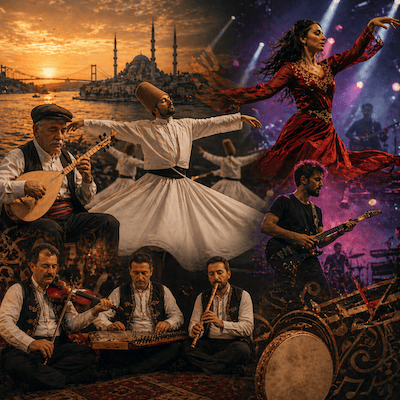
Türk Müziği ve Dansı
Turkish Music and Dance
 Learn TurkishFree app with audio, quizzes and real books
Key words
- müzikmusic
- dansdance
- türküfolk song
- ozanbard / minstrel
- sazsaz / bağlama
- bağlamabaglama
- neyreed flute
- davuldrum
- zurnashawm
- makammusical mode
- mehterOttoman military band
- ritimrhythm
All 26 words
- horonBlack Sea folk dance
- zeybekzeybek dance
- halaytraditional line dance
- tasavvufSufism
- semawhirling ceremony
- semazenwhirling dervish
- arabeskarabesk music
- hasretlonging
- kaderfate
- bestecomposition
- ezgimelody
- şarkısong
- gelenektradition
- kültürculture
Türk müziğinin geçmişi çok eskilere uzanır. Orta Asya'da kopuz çalan ozanlar, Osmanlı sarayında makamlarla eser besteleyenler, Anadolu köylerinde bağlamayla türkü söyleyen âşıklar ve bugünün pop yıldızları aynı uzun hikâyenin parçalarıdır.
Turkish music has a very long history. The bards who played the kopuz in Central Asia, the composers who wrote works in the makams at the Ottoman court, the âşıks who sang folk songs to the bağlama in Anatolian villages and today's pop stars are all part of the same long story.
Türkiye'de müzik hiçbir zaman yalnızca bir eğlence aracı olmamıştır. Düğünlerde davul zurna çalınır, askere giden gençler türkülerle uğurlanır, bayramlarda halay çekilir, ölenlerin ardından ağıt yakılır. Bir türkü, çoğu zaman bir yörenin acısını, sevincini ve özlemini anlatır.
In Türkiye, music has never been just entertainment. The davul and zurna (drum and shawm) play at weddings, young men leaving for military service are sent off with folk songs, people dance the halay on holidays, and laments are sung for the dead. A türkü, or folk song, often tells of a region's pain, joy and longing.
Orta Asya'dan Gelen Sesler: Âşıklık Geleneği
Voices from Central Asia: The Âşık Tradition
Türk müziğinin köklerinden biri, Orta Asya'daki ozan geleneğidir. Dede Korkut hikâyelerinde boyların toplantılarında ve düğünlerinde kopuz çalıp hikâye anlatan bilge ozan, Dede Korkut'un kendisidir. Bu gelenek Anadolu'da "âşık" denen gezgin şair-müzisyenlerle sürdü. Âşıklar köy köy dolaşır, sazlarını çalarak destanlar, aşk şiirleri ve haksızlığa karşı dizeler söylerdi. Âşık, hem müzisyen hem şair hem de hikâye anlatıcısıydı.
One of the roots of Turkish music is the bardic (ozan) tradition of Central Asia. In the Book of Dede Korkut, the wise bard who plays the kopuz and tells stories at the gatherings and weddings of the tribes is Dede Korkut himself. In Anatolia the tradition lived on with the wandering poet-musicians known as âşıks. They went from village to village, playing the saz and singing epics, love poems and verses against injustice. An âşık was musician, poet and storyteller all at once.
Bu geleneğin en büyük adlarından biri, 16. yüzyılda yaşamış olan Pir Sultan Abdal'dır. Haksızlığa karşı çıkan ve insan sevgisini anlatan deyişleri bugün de söylenir. 20. yüzyılda ise Âşık Veysel, ülkenin dört bir yanında tanınan bir halk ozanı oldu. Yedi yaşında çiçek hastalığı yüzünden gözlerini kaybeden Veysel, sazı ve "Uzun İnce Bir Yoldayım" gibi türküleriyle Anadolu'nun sesi hâline geldi.
One of the greatest names of this tradition is Pir Sultan Abdal, who lived in the 16th century. His songs, which stand up against injustice and speak of love for humanity, are still sung today. In the 20th century Âşık Veysel became a folk poet known all over the country. Veysel lost his sight to smallpox at the age of seven, yet with his saz and songs such as "Uzun İnce Bir Yoldayım" ("I Am on a Long, Narrow Road") he became the voice of Anatolia.
Geleneksel Çalgılar
Traditional Instruments
Türk halk müziğinin en tanınan çalgısı, halk arasında saz da denen bağlamadır. Uzun saplı ve telli bir çalgı olan bağlama, her yörede biraz farklı boyda yapılır ve farklı biçimde akort edilir. Genellikle mızrapla çalınır. Tellere parmaklarla vurularak çalınan tekniğe ise "şelpe" adı verilir.
The best-known instrument of Turkish folk music is the bağlama, which people also call the saz. A long-necked string instrument, it is made in slightly different sizes and tuned differently from region to region. It is usually played with a plectrum. The technique of striking the strings with the fingers is called şelpe.
Ney, kamıştan yapılan üflemeli bir çalgıdır. Tasavvuf müziğinde neyin ayrı bir yeri vardır; Mevlânâ'nın Mesnevi'si de neyin ayrılıktan yakınmasıyla başlar. Düğün ve bayramlarda açık havada çalınan davul ile zurna ise birbirinden ayrılmayan bir ikilidir. Ud, kanun, kemençe ve tanbur, klasik Türk müziğinin temel çalgıları arasındadır. Karadeniz'de ise kemençe denince küçük, üç telli Karadeniz kemençesi akla gelir.
The ney is a wind instrument made of reed. It holds a special place in Sufi music; Rumi's Masnavi itself opens with the ney lamenting its separation. The davul and zurna, played outdoors at weddings and festivals, are an inseparable pair. The oud, kanun, kemençe and tanbur are among the main instruments of classical Turkish music. On the Black Sea coast, though, the word kemençe brings to mind the small three-stringed Black Sea kemençe.
Osmanlı Saray Müziği ve Mehter
Ottoman Court Music and the Mehter
Osmanlı sarayında gelişen müziğe bugün "klasik Türk müziği" ya da "Türk sanat müziği" denir. Bu müzik, makamlara dayanır. Makam, Batı müziğindeki gamdan daha kapsamlıdır; hangi seslerin kullanılacağını, ezginin nereden başlayıp nasıl ilerleyeceğini ve nerede duracağını da belirler. Rast, hicaz, uşşak ve saba, en bilinen makamlardandır. Her makamın kendine özgü bir havası vardır.
The music that developed at the Ottoman court is now called "classical Turkish music" or "Turkish art music". It is based on makams. A makam is more than a scale in Western music: it also sets which notes are used, where the melody starts, how it moves and where it comes to rest. Rast, hicaz, uşşak and saba are among the best-known makams. Each makam has a mood of its own.
Mehter, Osmanlı ordusunun askerî bandosudur. Dünyanın en eski askerî bandolarından biri olarak kabul edilir. Mehter takımında davul, zurna, boru, zil, kös ve nakkare bulunurdu. Seferlerde, törenlerde ve zafer kutlamalarında çalan mehterin sesi Avrupa'yı da etkiledi. Mozart'ın ünlü "Türk Marşı" ile Beethoven'ın 9. Senfoni'sinin son bölümünde büyük davul, zil ve üçgenle çalınan marş, bu "Türk tarzı"nın bilinen örnekleridir.
The mehter was the military band of the Ottoman army. It is regarded as one of the oldest military bands in the world. A mehter band included the davul, zurna, trumpet, cymbals, kös (large kettledrums) and nakkare (small kettledrums). Its sound, heard on campaigns, at ceremonies and at victory celebrations, also influenced Europe. Mozart's famous "Turkish March" and the march played with bass drum, cymbals and triangle in the last movement of Beethoven's Ninth Symphony are well-known examples of this "Turkish style".
Halk Dansları: Her Yörenin Kendi Oyunu
Folk Dances: Every Region Has Its Own
Anadolu'da halk danslarına genellikle "oyun" denir. Her yörenin kendine özgü oyunları, ritimleri ve kıyafetleri vardır. Düğünlerde, bayramlarda ve hasat sonunda oynanan bu oyunlar, yüzyıllardır kuşaktan kuşağa aktarılır.
In Anatolia, folk dances are usually called oyun (literally "play"). Every region has its own dances, rhythms and costumes. Danced at weddings, on holidays and after the harvest, these dances have been passed down from generation to generation for centuries.
Karadeniz'in horonu, hızlı temposu ve titreyen omuzlarıyla hemen tanınır. Oyuncular omuz omuza ya da kol kola dizilir; kemençenin sesiyle hep birlikte titrer, sıçrar, öne ve arkaya gider. Ege'nin zeybeği ise ağır ve görkemli figürleriyle efelerin cesaretini ve gururunu yansıtır. Doğu ve Güneydoğu Anadolu'da halay, Trakya'da karşılama, Silifke'de ise tahta kaşıklarla oynanan kaşık oyunları sevilir.
The horon of the Black Sea is instantly recognisable by its fast tempo and quivering shoulders. The dancers line up shoulder to shoulder or arm in arm and, to the sound of the kemençe, quiver, jump and move forwards and back together. The zeybek of the Aegean, with its slow, stately figures, expresses the courage and pride of the efes, the region's legendary folk heroes. In eastern and southeastern Anatolia people love the halay, in Thrace the karşılama, and in Silifke the spoon dances performed with wooden spoons.
Tasavvuf Müziği ve Sema
Sufi Music and the Sema
Türk müziğinin en derin kollarından biri tasavvuf müziğidir. Mevlevîlerin sema töreninde müzik, hareket ve ibadet bir araya gelir. Beyaz tennurelerini giyen semazenler ney, kudüm ve tanburun eşliğinde dönmeye başlar. Sağ ellerinin avucu göğe, sol ellerininki yere bakar; bu duruş, Tanrı'dan alınan rahmetin insanlara aktarılmasını simgeler.
One of the deepest branches of Turkish music is Sufi music. In the sema ceremony of the Mevlevi order, music, movement and worship come together. Wearing their white tennures (long skirts), the semazens begin to whirl to the ney, the kudüm (small kettledrums) and the tanbur. The palm of the right hand faces the sky and the palm of the left faces the earth; this posture symbolises God's mercy being received and passed on to people.
Mevlevî sema töreni, 2008'de UNESCO'nun İnsanlığın Somut Olmayan Kültürel Mirası listesine alındı. Konya'da her yıl 10 ile 17 Aralık arasında Mevlânâ'yı anma törenleri düzenlenir; bu törenlere dünyanın dört bir yanından ziyaretçi gelir. Mevlânâ'nın öldüğü 17 Aralık gecesi, "düğün gecesi" anlamına gelen "Şeb-i Arûs" adıyla anılır. İlahiler ve Mevlevî ayinleri bugün de konserlerde ve törenlerde seslendirilir.
In 2008 the Mevlevi sema ceremony was added to UNESCO's list of the Intangible Cultural Heritage of Humanity. Every year from 10 to 17 December, commemorations of Mevlana (Rumi) are held in Konya, drawing visitors from all over the world. The night of 17 December, when Mevlana died, is known as Şeb-i Arus, meaning "wedding night". Hymns (ilahi) and Mevlevi ceremonial works are still performed today at concerts and ceremonies.
Arabesk: Göçün Şarkıları
Arabesk: Songs of Migration
1950'lerden itibaren Türkiye'de köyden kente büyük bir göç başladı. İstanbul, Ankara ve İzmir'in kenar mahallelerine yerleşen milyonlarca insan ne tam anlamıyla şehirli olabildi ne de köydeki eski hayatına dönebildi. Bu arada kalmışlığın acısı en çok arabesk müzikte dile geldi.
From the 1950s onwards, a great migration from the countryside to the cities began in Türkiye. The millions who settled on the outskirts of Istanbul, Ankara and İzmir could neither fully become city people nor return to their old village life. The pain of being caught in between found its strongest voice in arabesk music.
Arabesk, Mısır filmlerinin ve müziğinin etkisiyle doğdu; zamanla kendine özgü bir Türk türü hâline geldi. Bu şarkılarda kader, hasret, yoksulluk ve karşılıksız aşk anlatılır. Orhan Gencebay, Müslüm Gürses, Ferdi Tayfur ve İbrahim Tatlıses, türün en büyük adlarıdır. Arabesk, uzun yıllar devlet radyosu TRT'de pek yer bulamadı; ancak dolmuşlarda, kasetçalarlarda ve gazinolarda milyonlara ulaştı. Bugün Türkiye'de popüler müziğin vazgeçilmez bir parçasıdır.
Arabesk was born under the influence of Egyptian films and music, but over time it became a distinctly Turkish genre. Its songs tell of fate, longing, poverty and unrequited love. Orhan Gencebay, Müslüm Gürses, Ferdi Tayfur and İbrahim Tatlıses are the greatest names of the genre. For many years arabesk was given little airtime on the state broadcaster TRT, yet it reached millions in shared minibuses (dolmuş), on cassette players and in music halls (gazino). Today it is an essential part of popular music in Türkiye.
Türk Pop ve Rock: Doğu ile Batı Arasında
Turkish Pop and Rock: Between East and West
1960'larda Batı'daki rock müzikten etkilenen gençler, "Anadolu rock" adı verilen akımı başlattı. Bu müzisyenler elektro gitarı ve davulu, türkülerin ezgileriyle ve bağlamanın sesiyle buluşturdu. Cem Karaca, Barış Manço, Erkin Koray ve Moğollar, bu akımın öncüleri arasındadır.
In the 1960s, young people inspired by Western rock music started the movement known as "Anatolian rock". These musicians brought the electric guitar and drum kit together with the melodies of folk songs and the sound of the bağlama. Cem Karaca, Barış Manço, Erkin Koray and Moğollar are among the pioneers of the movement.
Barış Manço, uzun saçları, bıyığı ve parmaklarındaki iri yüzükleriyle hemen tanınırdı. Türküleri rock düzenlemeleriyle seslendirdi; daha sonra "7'den 77'ye" adlı televizyon programıyla çocukların ve büyüklerin sevgilisi oldu. 1990'lardan itibaren Türk pop müziği büyük bir sektöre dönüştü. Sezen Aksu, Ajda Pekkan, Tarkan ve Mustafa Sandal bu dönemin yıldızlarıdır. Tarkan'ın 1997'de çıkan "Şımarık" şarkısı Avrupa'nın birçok ülkesinde listelere girdi. Şarkının sözlerini ve müziğini Sezen Aksu yazmıştı.
Barış Manço was instantly recognisable by his long hair, his moustache and the big rings on his fingers. He performed folk songs in rock arrangements and later, with his TV programme "7'den 77'ye" ("From 7 to 77"), became a favourite of children and adults alike. From the 1990s Turkish pop grew into a big industry. Sezen Aksu, Ajda Pekkan, Tarkan and Mustafa Sandal are the stars of this period. Tarkan's 1997 song "Şımarık" ("Spoiled") entered the charts in many European countries. Its lyrics and music had been written by Sezen Aksu.
Türk Müziği Hakkında İlginç Bilgiler
Interesting Facts About Turkish Music
Türk halk müziğinde 5/8, 7/8 ve 9/8 gibi "aksak" ritimler çok yaygındır. Batı pop müziğinde ise bu ölçülere pek az rastlanır.
"Aksak" ("limping") rhythms such as 5/8, 7/8 and 9/8 are very common in Turkish folk music. In Western pop music, by contrast, these metres are rare.
Sezen Aksu, yalnızca kendi şarkılarıyla değil, Tarkan, Sertab Erener ve daha birçok şarkıcıya yazdığı şarkılarla da Türk popuna yön vermiştir.
Sezen Aksu has shaped Turkish pop not only through her own songs but also through the songs she wrote for Tarkan, Sertab Erener and many other singers.
Türkiye, Eurovision Şarkı Yarışması'nı 2003'te Sertab Erener'in "Everyway That I Can" şarkısıyla kazandı. Bu, Türkiye'nin yarışmadaki tek birinciliğidir.
Türkiye won the Eurovision Song Contest in 2003 with Sertab Erener's "Everyway That I Can". It is Türkiye's only win in the contest.
Klasik Türk müziğinde bir tam ses dokuz komaya bölünür. Bu yüzden bazı makamları piyano gibi Batı çalgılarıyla tam doğru çalmak mümkün değildir.
In classical Turkish music a whole tone is divided into nine commas. That is why some makams cannot be played exactly in tune on Western instruments such as the piano.
Orta Asya'dan gelen kopuz, bugünkü bağlamanın atası sayılır.
The kopuz, which came from Central Asia, is considered the ancestor of today's bağlama.
Zeybek oyuncusunun iki yana açtığı kollar, çoğu zaman kartal kanatlarına benzetilir.
The arms a zeybek dancer stretches out to either side are often likened to an eagle's wings.
Bugünün Türk Müziği: Gelenekten Geleceğe
Turkish Music Today: From Tradition to the Future
21. yüzyılda Türk müziğinde eski ile yeni sık sık buluşur. Bazı genç prodüktörler türküleri elektronik müzikle harmanlar, bazı sanatçılar ise Divan şiirini yeni düzenlemelerle seslendirir. Yurt dışında da Anadolu rock'a ilgi artmıştır. Amsterdam'da kurulan Altın Gün grubu, eski Türk şarkılarını yeniden yorumlayarak geniş bir dinleyici kitlesine ulaştı.
In 21st-century Turkish music, old and new often meet. Some young producers blend folk songs with electronic music, while some artists perform classical Ottoman (Divan) poetry in new arrangements. Interest in Anatolian rock has also grown abroad. The band Altın Gün, founded in Amsterdam, has reached a wide audience by reinterpreting old Turkish songs.
Müzik platformları sayesinde Türk şarkıcılar bugün dünyanın her yerindeki dinleyicilere ulaşabilir. Orta Doğu'dan Latin Amerika'ya kadar izlenen Türk dizileri de dizi müziklerini tanıttı. Bugün Türkiye'de alternatif rock'tan hip-hop'a, elektronik müzikten caza kadar pek çok tür yan yana yaşar; müzisyenler de bu türleri kendi gelenekleriyle harmanlar.
Thanks to streaming platforms, Turkish singers can now reach listeners all over the world. Turkish TV series, watched from the Middle East to Latin America, have also made their soundtracks known. Today many genres live side by side in Türkiye, from alternative rock to hip-hop and from electronic music to jazz, and musicians blend them with their own traditions.
Son Söz: Müzikte Bir Halkın Hikâyesi
A Final Word: A People's Story in Music
Türk müziği ve dansları, bu toprakların tarihini ve insanlarını en iyi anlatan sanatlar arasındadır. Bir türküde Anadolu köylerinin hasreti, sema töreninde dervişlerin duası, horonda Karadeniz'in coşkusu, zeybekte ise efelerin gururu yaşar.
Turkish music and dance are among the arts that best tell the history of this land and its people. The longing of Anatolian villages lives on in a folk song, the prayer of the dervishes in the sema, the exuberance of the Black Sea in the horon, and the pride of the efes in the zeybek.
Müzik, Türkçe öğrenenler için de çok iyi bir yardımcıdır. Şarkılar, kelimeleri ve kalıpları tekrar tekrar kulağa getirir; sözleri anlamaya çalışmak da dinlediğini anlama becerisini geliştirir. Pek çok öğrenci, sevdiği bir türkünün sözlerini anladığı gün o şarkıyı sanki ilk kez dinliyormuş gibi hisseder.
Music is also a great help for people learning Turkish. Songs bring words and patterns back to the ear again and again, and trying to understand the lyrics improves listening comprehension. Many learners feel, on the day they finally understand the words of a folk song they love, as if they were hearing it for the first time.
In the free app you can listen to this text read aloud and tap any word to see what it means.